
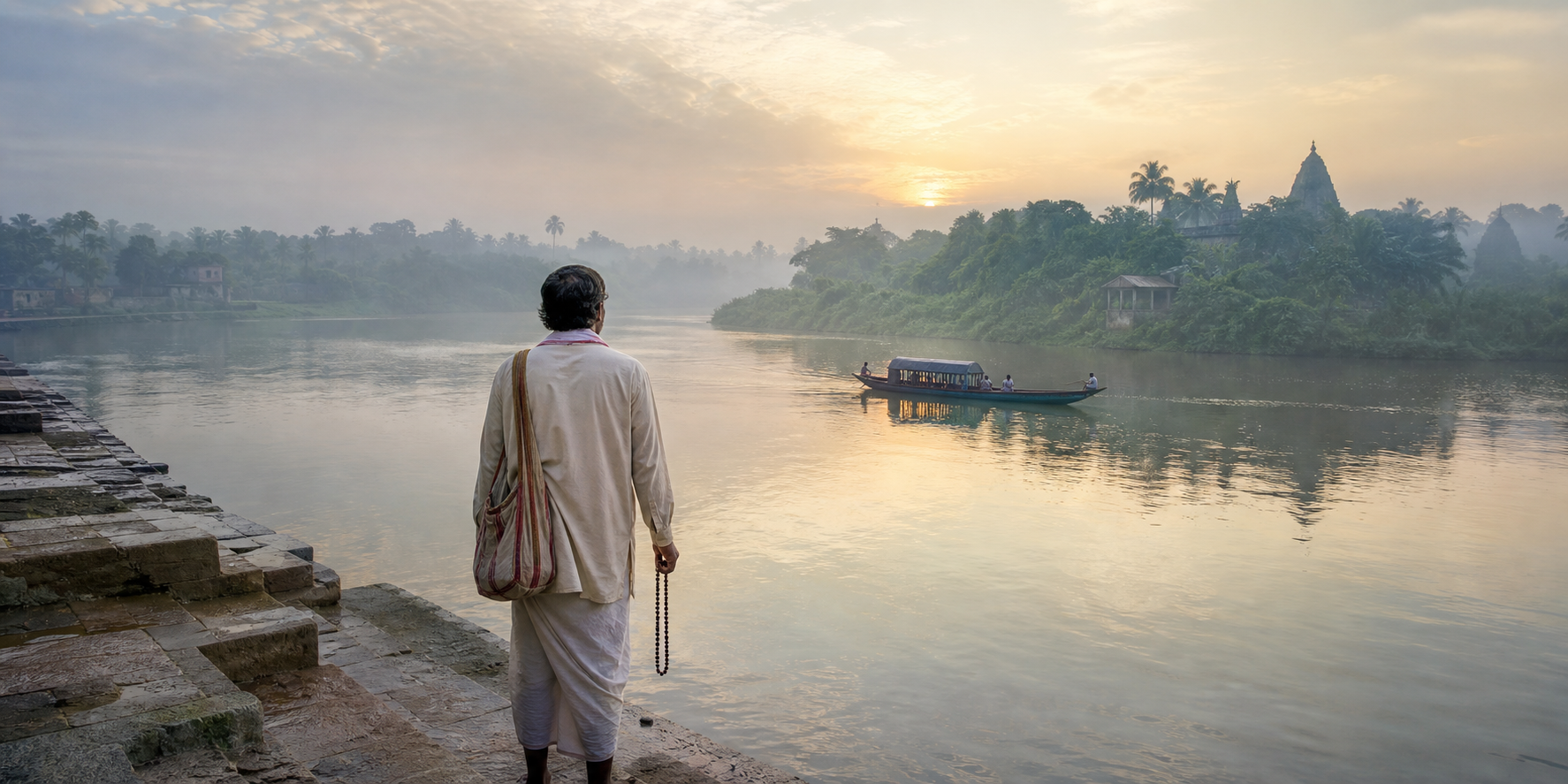
You can arrive in Bengal with a full list of temples and still miss the pilgrimage. The problem is rarely lack of information. It is moving so quickly between sanctums, ghats, roads, and rituals that no place has time to change how you listen, speak, serve, or remember.
A more fruitful journey begins with one practical decision: choose the discipline you want the landscape to teach you. Mayapur and Navadvipa can train attention through hearing, chanting, remembrance, and service. Attahasa can turn speech itself into a form of sadhana. Once you travel with that purpose, Bengal’s sacred geography stops being a collection of coordinates and becomes a way of living.
Begin with a practice, not a checklist
A sacred place remains alive through repeated acts. Mantra is recited before dawn. Lamps are offered. Stories are heard again. Pilgrims walk inherited routes. Residents maintain shrines, feed visitors, care for animals, and protect the land that makes worship possible. Geography becomes sacred not because human activity has stopped there, but because generations have directed human activity toward remembrance.
This distinction matters in Bengal because the terrain itself refuses to behave like a museum. The Bhagirathi-Ganga and Jalangi shape a deltaic landscape of changing channels, alluvial deposits, and seasonal inundation. Riverbanks move, yet devotional memory continues to identify islands, ghats, paths, and places of lila through oral teaching and parikrama. The sacred map is therefore neither a modern survey nor a fantasy floating above the land. It is a practiced relationship between physical terrain, inherited memory, and present conduct.
Attahasa expresses the same principle in a different theological language. Near Labhpur in Birbhum, Phullara Devi is worshipped in a natural stone form associated by local tradition with Sati’s fallen lip. The earth is not merely the platform beneath a manufactured icon. Its own texture participates in the shrine’s aniconic form of reverence.
Before arranging the route, write down one intention in direct language: hear without interrupting, chant with attention, repair careless speech, perform an unnoticed service, or reduce the waste you leave behind. Keep it specific enough to test. A wish to feel spiritual can dissolve as soon as travel becomes tiring; a decision to complete one period of attentive japa or avoid one habitual form of harmful speech can survive the journey home.
Do not flatten Mayapur and Attahasa into interchangeable examples of a generic spirituality. One is deeply formed by Gaudiya Vaishnava bhakti and Sri Caitanya’s sankirtana movement; the other belongs to Bengal’s Shakta and Shakti Peetha landscape. Their forms, liturgies, and theological emphases deserve to remain distinct. Their meeting point is practical: both ask you to discipline the body, voice, attention, and relationship to place.
Let Navadvipa’s nine islands teach nine modes of bhakti
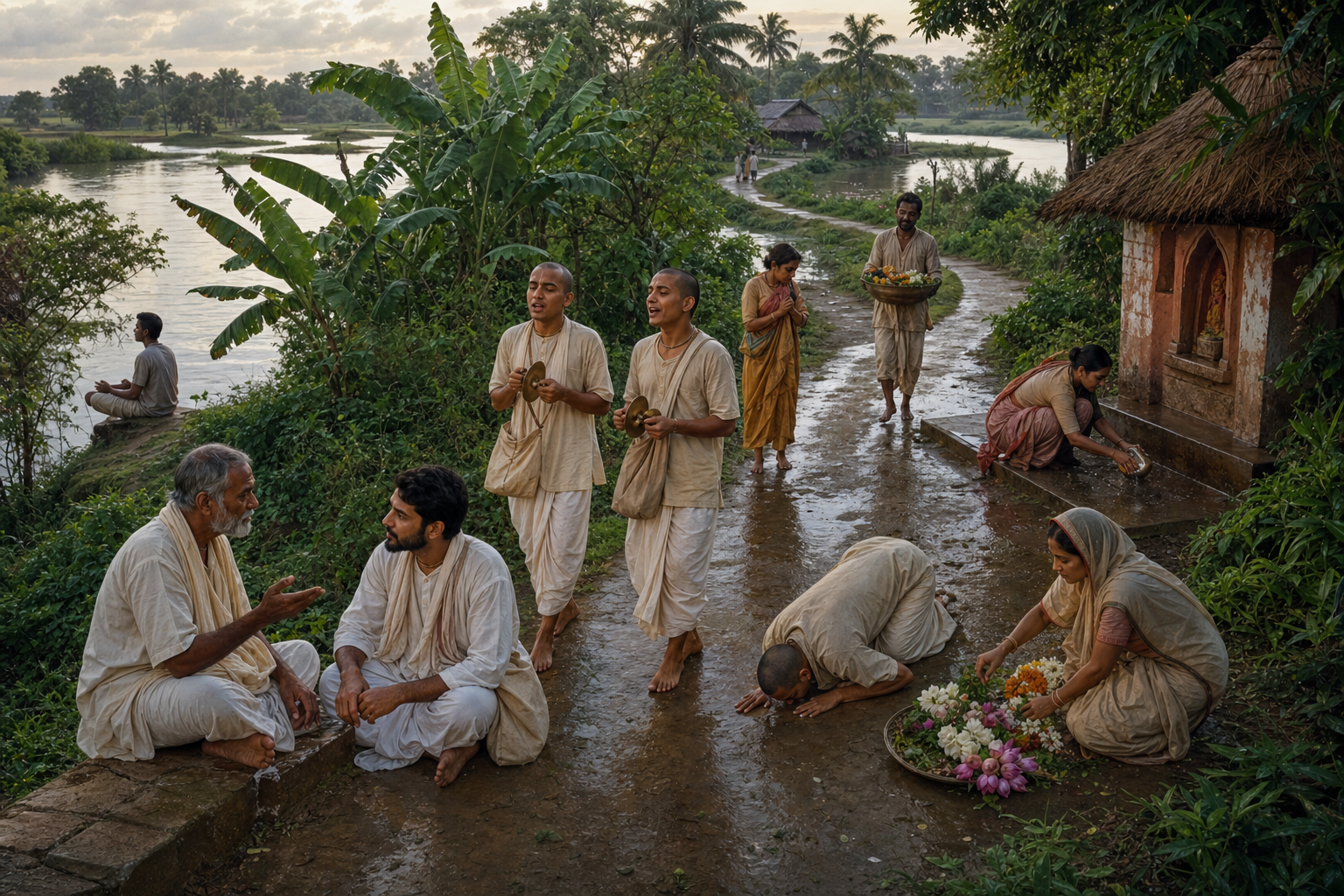
Mayapur lies in Nadia district across from historic Nabadwip and is identified in Gaudiya tradition with Antardvipa, the place associated with the appearance of Sri Caitanya Mahaprabhu, who lived from 1486 to 1533. The wider Navadvipa region is contemplated as nine islands, each aligned with one limb of navadha-bhakti, or ninefold devotion. Local enumerations can vary, so these associations should guide practice without turning every difference in a route or boundary into an argument.
Use the ninefold map as a set of prompts. The final column below is not a substitute for local instruction; it is a simple way to stop each name from becoming another item on a sightseeing list.
| Island | Limb of bhakti | Practice prompt |
|---|---|---|
| Antardvipa | Atma-nivedanam, complete self-offering | Name one attachment, fear, or demand you are willing to place before the Divine. |
| Simantadvipa | Sravanam, hearing | Give a teaching, recitation, or local narration your full attention before forming a response. |
| Godrumadvipa | Kirtanam, devotional chanting | Join the sacred sound before reaching for a camera or evaluating the performance. |
| Madhyadvipa | Smaranam, remembrance | Pause long enough to recollect the divine name instead of immediately moving onward. |
| Koladvipa | Pada-sevanam, reverential service | Ask what useful service is appropriate rather than assuming what a shrine or community needs. |
| Rtudvipa | Arcana, deity worship | Observe the order and care of worship, including instructions that apply to visitors. |
| Jahnudvipa | Vandana, offering obeisance | Make each pranam deliberate rather than repeating it mechanically. |
| Modadrumadvipa | Sakhya, friendship with the Divine | Bring honesty and trust into prayer instead of presenting a polished religious persona. |
| Rudradvipa | Dasya, servitorship | Accept a simple task whose value does not depend on being noticed. |
The sequence turns movement into instruction. At Simantadvipa, the question is not simply whether you arrived but whether you heard. At Godrumadvipa, it is whether you allowed the divine name to occupy your voice. At Koladvipa and Rudradvipa, it is whether service displaced self-importance. The landscape becomes a teacher because each place demands a different use of the same mind and body.
Navadvipa also carries an intellectual inheritance that a purely emotional pilgrimage can overlook. Historic Nabadwip was an eminent centre of Navya-Nyaya and produced scholars including Raghunatha Siromani. Hearing, study, reason, song, and surrender therefore need not be treated as rivals. Set aside time for a serious teaching or scriptural reading instead of assuming that only a crowded kirtan counts as devotional participation.
For Gaudiya Vaishnavas, Sri Caitanya’s congregational chanting is the yuga-dharma of the present age. The theological claim becomes concrete in the region’s soundscape: voice, mridanga, karatala, melody, rhythm, and mantra work together as sadhana. Listen for diction and tempo as well as emotional force. A kirtan can train sustained attention when you participate as a practitioner rather than consume it as entertainment.
Keep Mayapur’s daily rhythm before chasing its landmarks
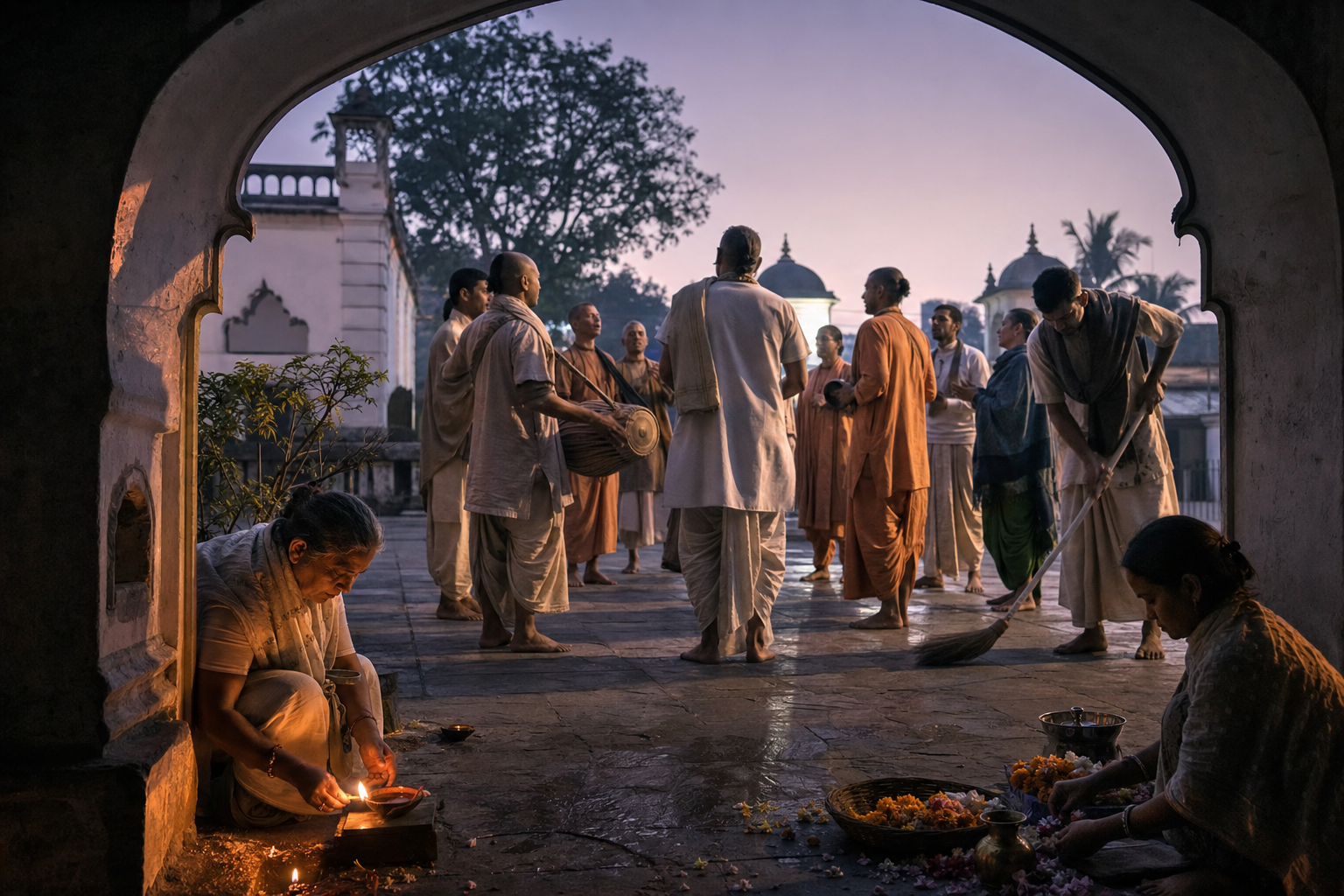
Mayapur is easiest to understand through the structure of a devotional day. The recurring pattern moves from pre-dawn worship and individual mantra to communal song, study, service, prasada, and evening remembrance. You do not need to imitate a renunciate’s entire discipline, but you do need enough stillness to experience the order in which attention is gathered and then offered through action.
- Arrive before the day becomes noisy. Join mangala-arati where visitor participation is permitted. Enter quietly, learn the local protocol, and let the lamps, bells, conches, and mantra establish the pace.
- Protect a period for japa. The Hare Krishna maha-mantra is not background sound for checking messages or arranging the next stop. Keep the phone away and return attention to the name whenever it wanders.
- Hear before interpreting. Attend a class, reading, or sacred narration. If a teaching is unfamiliar, note the question and ask it respectfully after listening to the full explanation.
- Place seva in the middle of the day. Ask an established temple or community representative what service is suitable. Service is not improved by ignoring safety, ritual boundaries, or the work residents are already doing.
- Receive prasada without turning the meal into consumption alone. Take what you can finish, avoid waste, and make room for the people serving and eating around you.
- Return to congregational sound in the evening. Notice whether the morning’s japa changed the way you enter kirtan. The point is continuity, not the accumulation of separate religious experiences.
Worship at Mayapur’s principal shrines centres on the Pancha-tattva: Sri Caitanya, Nityananda, Advaita, Gadadhara, and Srivasa. Gaudiya practice joins precise arcana with hearing, chanting, remembering, and service. This corrects two common mistakes. Ritual precision without inward attention becomes mechanical, while emotion that disregards temple discipline burdens the very community sustaining the worship.
The scale of contemporary Mayapur can create another distraction. Its campus supports kirtan, bhakti-sastra education, prasada distribution, community life, goshalas, and service activity. Large sacred architecture can also teach through symbol and scriptural cosmology. Do not measure the dham only by the size of a dome, the number of photographs you take, or how many buildings you enter. Ask what the architecture directed your attention toward after its visual impact passed.
The devotional calendar changes the experience substantially. Gaura Purnima draws tens of thousands for Navadvipa parikrama, when villages, ghats, paths, and the ninefold map become part of a large communal act of remembrance. Kartik intensifies lamp offerings and kirtan. Choose such a period if you want concentrated collective practice. If your priority is quiet hearing and an unhurried routine, do not assume a major festival will feel like an ordinary day in the dham. Confirm current ritual and access timings locally rather than building a plan around an old schedule.
At Attahasa, make speech the pilgrimage
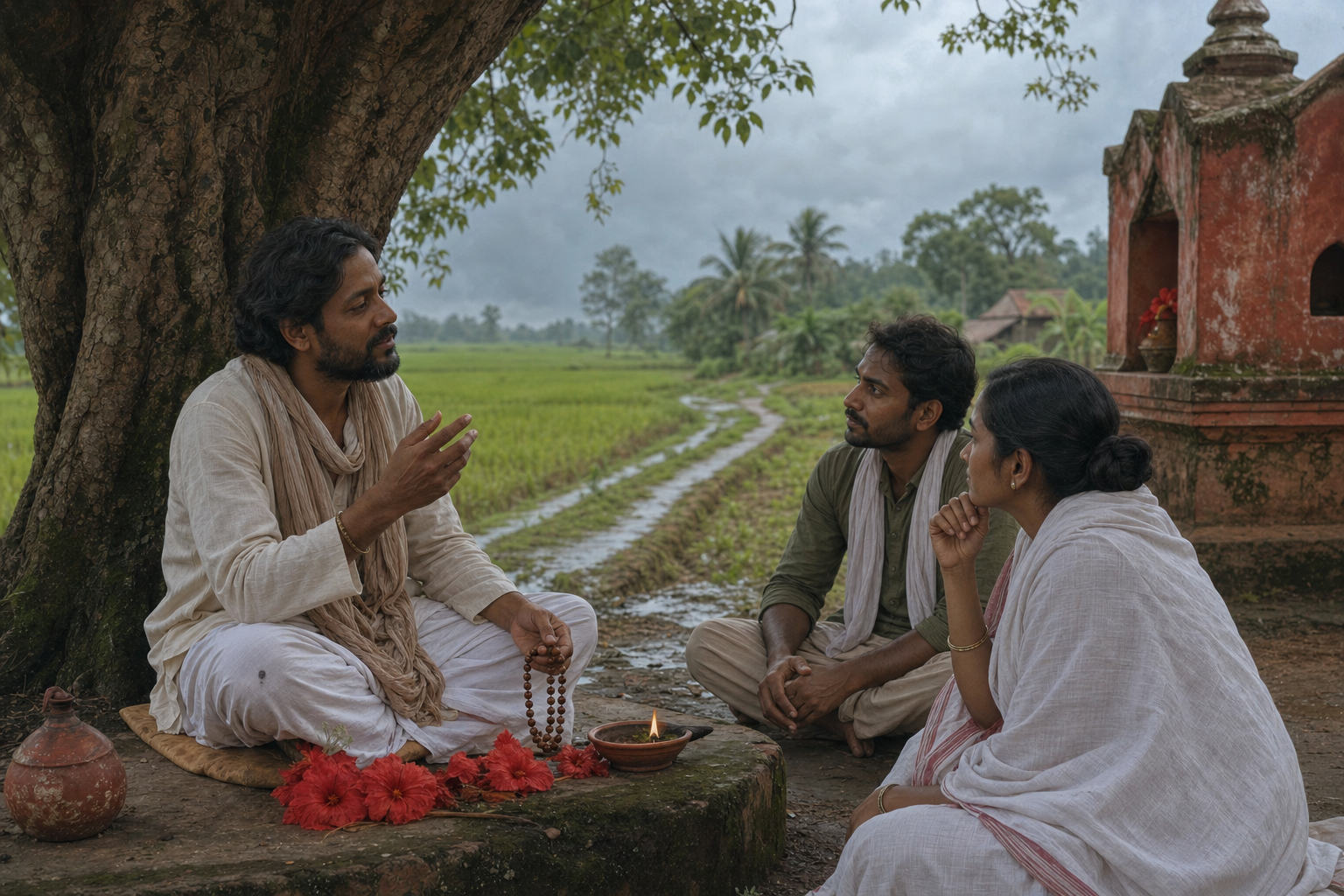
Attahasa gives you a different discipline. The Shakti Peetha tradition remembers fifty-one sacred seats arising from the dispersal of Sati’s body, and local tradition associates Attahasa with her lip. The name evokes resounding laughter, while Phullara, the Blooming Goddess, carries the sense of flowering and renewal. These motifs bring vak, the creative and ethical power of speech, to the centre of the visit.
Most recensions identify the shrine’s Bhairava as Vishvesh, expressing the inseparability of Shiva and Shakti, consciousness and dynamic power. Daily worship follows Shakta forms ranging from pancopacara to sodasopacara. Full-moon observances, Navaratri recitation of the Devi Mahatmya, and seasonal fairs establish a communal rhythm. As a visitor, your first responsibility is not to reproduce rites you have not learned. It is to follow the temple’s order and let the shrine’s central teaching become visible in your own conduct.
That teaching can be tested immediately. Before entering, identify one way your speech has become misaligned: exaggeration, needless harshness, gossip, evasiveness, constant interruption, or religious argument pursued for victory rather than truth. During darshan and japa, do not rehearse a defence of the habit. Ask what truthful speech would sound like if it were also governed by dharma and softened by karuna.
Then choose one action for after the visit. It may be a correction of something false you said, an apology without self-justification, a necessary truth expressed without humiliation, or a period in which you listen before answering. This is how the symbolism of the sacred lip avoids becoming decorative mythology. Vak flowers when speech starts restoring clarity and relationship.
Attahasa belongs to a wider Birbhum constellation that includes Tarapith, Kankalitala, and Nandikeshwari. Tarapith is especially associated with maternal grace; Kankalitala remembers Sati’s bones; Nandikeshwari is linked with her neck. If you include several shrines, resist compressing them into a rapid circuit of nearly identical photographs. Give each place a distinct contemplative question, and leave enough time to observe how local worship differs.
The practical base is straightforward but should not be overplanned from assumptions. Attahasa is reachable from Bolpur-Shantiniketan, Sainthia, and nearby Birbhum towns by local road and rail connections, with modest facilities in surrounding towns. Winter through early spring is generally the more comfortable period identified for a visit. Verify present transport, accommodation, temple access, and festival arrangements locally before departure, especially if your schedule depends on a particular observance.
The shrine also offers a useful way to understand kinship across Dharmic paths without erasing difference. Shakta reverence for divine energy can resonate with Buddhist devotion to Tara, while disciplined compassion, Jain ahimsa and aparigraha, and Sikh seva and nam-simran can meet Hindu bhakti in shared ethical seriousness. Resonance does not make the doctrines identical. It gives you a basis for respect: truthful speech, restraint, care for beings, remembrance, and service can be recognised across traditions without forcing them into one theology.
Plan for conduct, conservation, and what continues at home
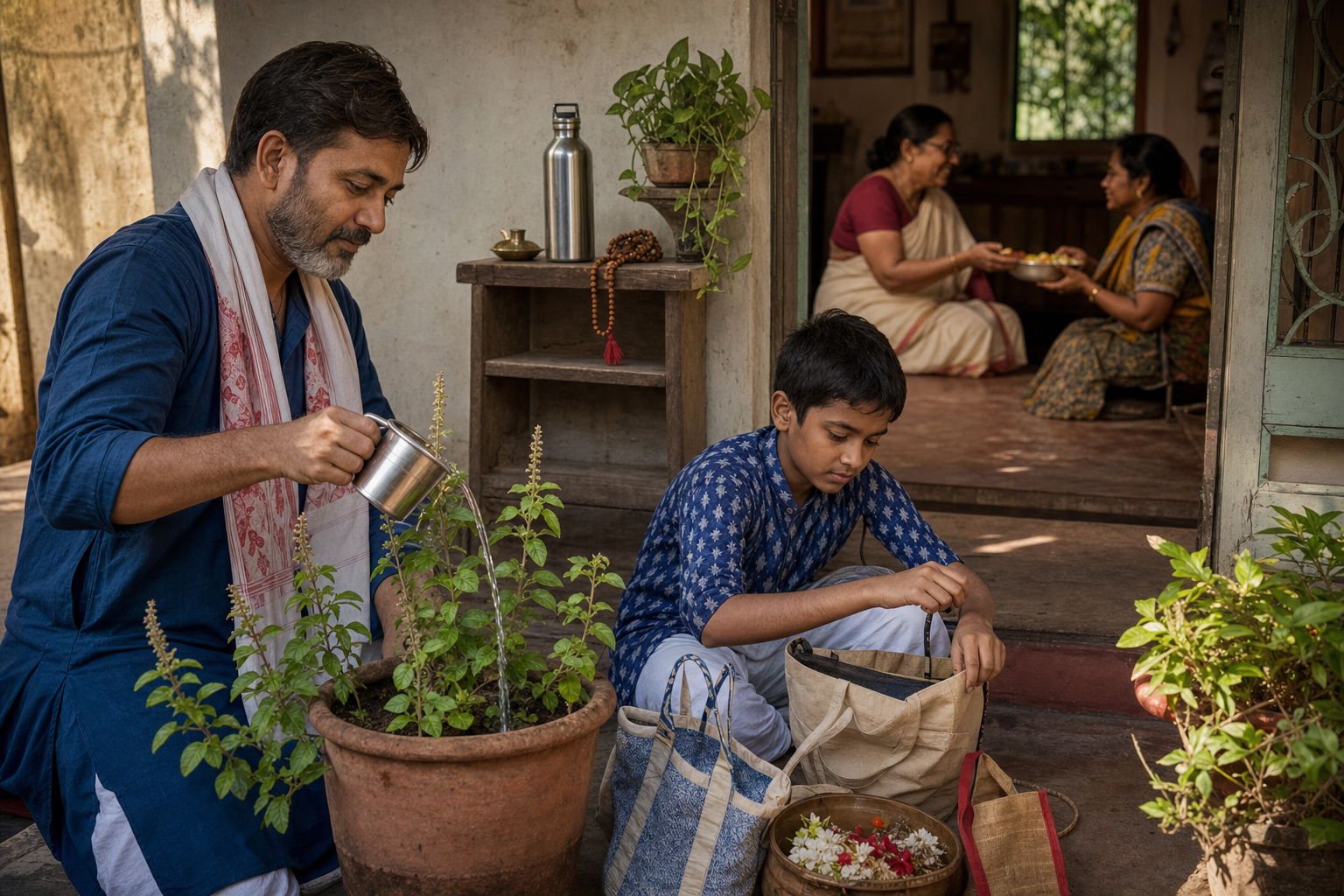
If you visit both regions, treat Mayapur-Navadvipa and Attahasa-Birbhum as two devotional centres rather than two entries in a single race. Build the order around your actual question. Begin in Mayapur if you need a disciplined rhythm of mantra, hearing, and seva. Begin at Attahasa if your immediate work concerns renewal or the use of speech. The order matters less than allowing each discipline enough time to become more than an idea.
Your behaviour around the land is part of the pilgrimage. At Mayapur, riverbank erosion, siltation, and monsoon variability affect the same communities, routes, and ghats that pilgrims use. Keep pollutants out of the river, respect bathing queues, carry water without creating avoidable waste, and leave ghats clear for ritual activity. At Attahasa and other Birbhum shrines, avoid single-use plastic where possible and do not abandon offerings in ways that burden trees, animals, water, or temple workers.
Wear modest clothing, ask before taking photographs, and remain attentive during arati and kirtan. These are not cosmetic rules imposed on an otherwise private experience. A sacred space depends on collective concentration. One visitor filming intrusively, blocking a passage, speaking through worship, or leaving rubbish behind changes the place for everyone else.
Expect to walk in the Navadvipa region and set a contemplative pace. If a local route, island sequence, or oral identification differs from the version you learned elsewhere, ask how the community practises it before declaring one map correct and another false. In a river-made landscape, continuity can reside in ritual memory and inherited association even where channels and banks have changed.
Key takeaways
- Choose one discipline before choosing every destination: hearing, chanting, remembrance, service, truthful speech, or ecological care.
- Use Navadvipa’s nine islands as a map of nine devotional actions, not merely nine locations to record.
- Organise a Mayapur day around the movement from pre-dawn worship and japa to study, seva, prasada, and evening kirtan.
- At Attahasa, translate the symbolism of Sati’s lip and Phullara’s blooming power into one concrete change in how you speak.
- Follow local temple protocols, verify current arrangements, minimise waste, and treat rivers, trees, animals, residents, and fellow pilgrims as participants in the sacred landscape.
Before you book the journey, complete this sentence: “I am going to Bengal to practise ____.” After you return, keep the same practice for a defined part of each day. A pilgrimage has entered your life when the place is no longer under your feet but active in your conduct.
References
- Dandavats – Mayapur as a Living Dham: A Sadhu’s Lens on Navadvipa, Bhakti, and Sacred Geography
- DharmaRenaissance Blog – Phullara Devi at Attahasa Shakti Peetha: Bengal’s Blooming Goddess of Renewal and Vak
