
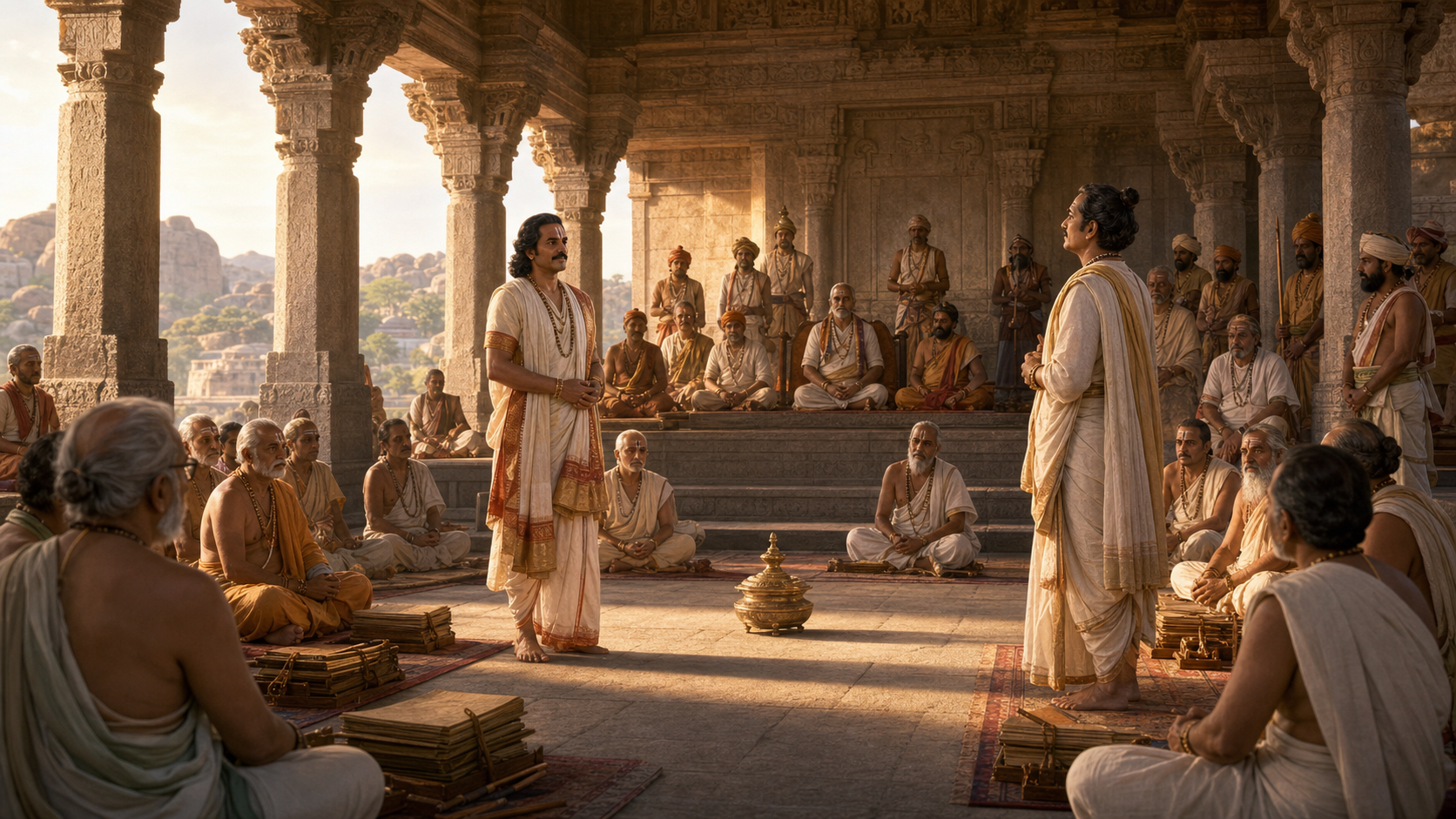
If you have heard that Srinatha marched into Vijayanagara, outwitted its leading scholar, and proclaimed himself Kavi Sarvabhauma, you probably want to know what the episode actually tells us. Was it a duel between two proud poets, a reliable piece of history, or a legend about intellectual brilliance?
The most useful answer has three layers. There is a recognisable fifteenth-century world of courts, patrons, scholarly offices, endowed settlements, and public disputation. There is a carefully constructed literary contest between Srinatha and Arunagirinatha. And there is an enduring lesson about how intellectual authority should be tested. Keep those layers distinct, and you can appreciate Srinatha’s achievement without turning historical fiction into documentary evidence.
What you can responsibly say about the challenge
Nori Narasimha Sastry’s Kavisarvabhaumuḍu is a compact historical novel set during the reign of Devaraya II. Its action runs for roughly nine months, from Pushya to Ashwayuja. That precise calendar belongs to the architecture of the plot; it does not by itself prove that a historical confrontation unfolded on the same schedule.
The central distinction concerns Manasollasa, the Sanskrit khanda-kavya that Srinatha composes as the instrument of his challenge. Independent evidence that Srinatha wrote this particular work is absent. Its composition is historically plausible within the setting, but plausibility is not attestation. When you retell the episode, call Manasollasa part of Nori’s reconstruction rather than presenting it as a surviving, independently verified composition.
| Layer | What it contains | How to read it |
|---|---|---|
| Historical milieu | Devaraya II’s Vijayanagara, Andhra courts, learned patronage, Sanskrit disciplines, and sacred Pampa Virupaksha | Use it to understand the political and institutional setting of courtly learning. |
| Institutional texture | The Vidyadhikari, scholarly entourages, agraharas, public emblems, royal audiences, and intellectual reputation | Notice that scholarship depended on offices, resources, networks, and ceremonial recognition. |
| Challenge narrative | Manasollasa, the apaśabdābhāsa device, exchanged letters, a deadline, and Srinatha’s procession | Read the sequence as a tightly designed demonstration of method, pride, and accountability. |
| Explicit evidence limit | No independent evidence for Srinatha’s authorship of this Manasollasa | Do not convert a plausible literary premise into an unqualified historical claim. |
This distinction does not diminish the story. It makes the story more useful. You can ask what its details reveal about the ideals of scholarship without pretending that every letter, deadline, and procession survives in an archival record. Historical fiction often works best when you know exactly where interpretation begins.
Vijayanagara made scholarship a form of political prestige
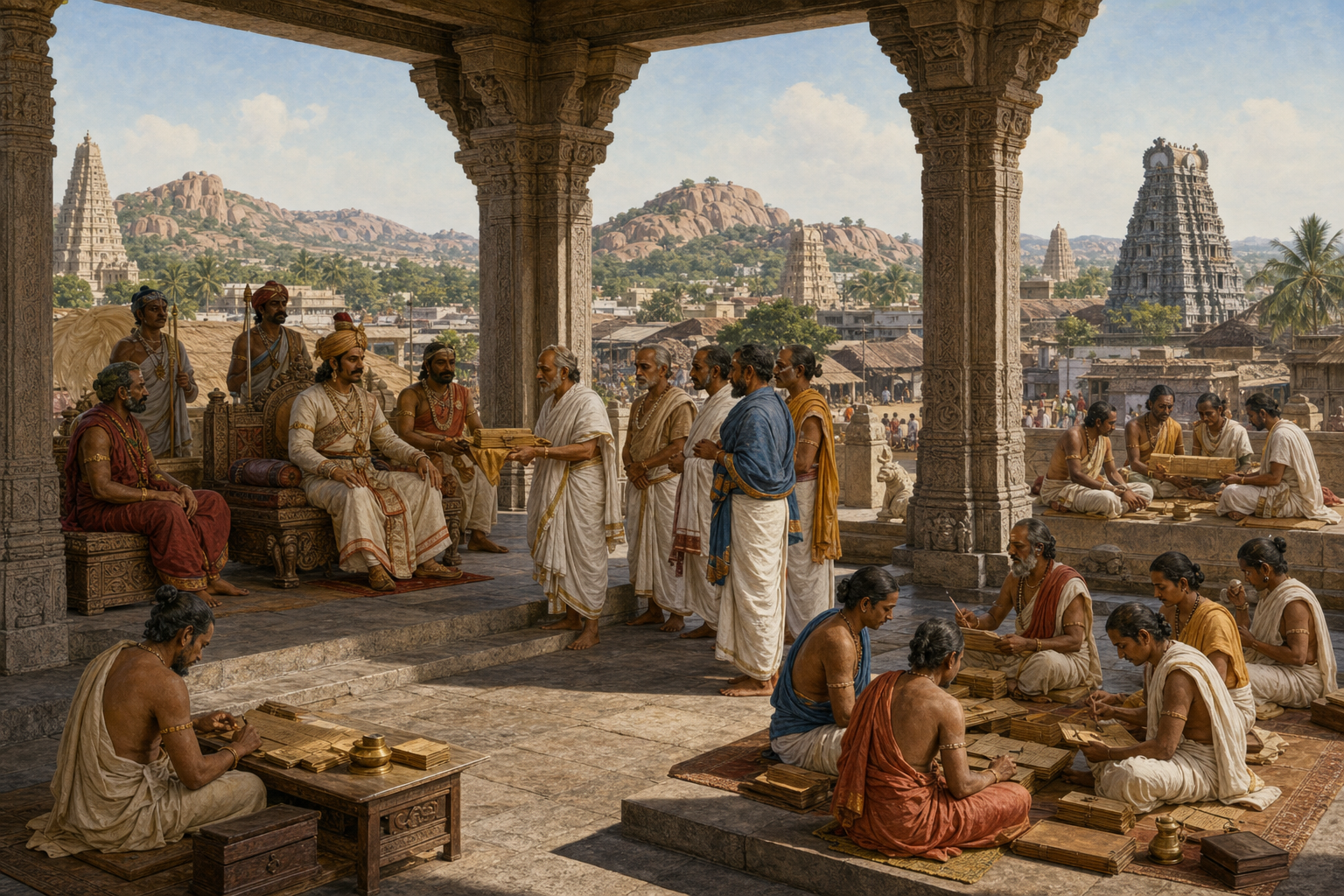
Devaraya II presided over what is remembered as a high point of Vijayanagara power. His court’s scholarly standing had deeper foundations associated with Vidyaranya Swami and Sayanacharya. Learned people arrived from different regions of the subcontinent, including Vanga or Gauda Desha. Sonadrinatha belonged to this wider movement of scholars into the imperial centre.
That geography matters. Vijayanagara’s court was not simply a local circle sharing one regional idiom. It functioned as a meeting ground in which scholars from different lineages could argue through disciplines whose claims travelled across regions. Sanskrit grammar and poetics supplied a common intellectual arena even when the participants came from different political and cultural settings.
The Andhra world surrounding Srinatha had its own centres of power. Kondaveedu and Rachakonda were rival hill capitals in the broader Krishna River region. Their ruling houses faced political fragmentation, yet they continued to compete by supporting poets, sculptors, and other artists. Cultural patronage allowed a smaller court to claim distinction even when it could not match an empire’s territorial strength.
Srinatha served at Kondaveedu under Vema Reddi and received generous patronage despite the principality’s limited resources. Within the challenge narrative, Vema Reddi understands that Vijayanagara cannot be surpassed through direct political confrontation. A literary victory offers another route to honour. Srinatha therefore travels not as an isolated adventurer but as the intellectual representative of a patron and a court.
This changes how you should interpret the contest. Srinatha’s motive is not reduced to personal vanity. Gratitude to his patron, regional prestige, and scholarly reputation move together. The court poet’s learning has public consequences because his success reflects upon everyone who sustains him.
Trace the chain of relationships and the structure becomes clear: a regional ruler commissions the endeavour; a poet gathers an entourage; a grammarian carries the test; an imperial Vidyadhikari judges it; courtiers and the king receive the dispute; and the capital becomes its audience. Courtly scholarship was a networked institution, not a private exchange between two writers.
Srinatha’s strategy tests the judge before it defeats the rival
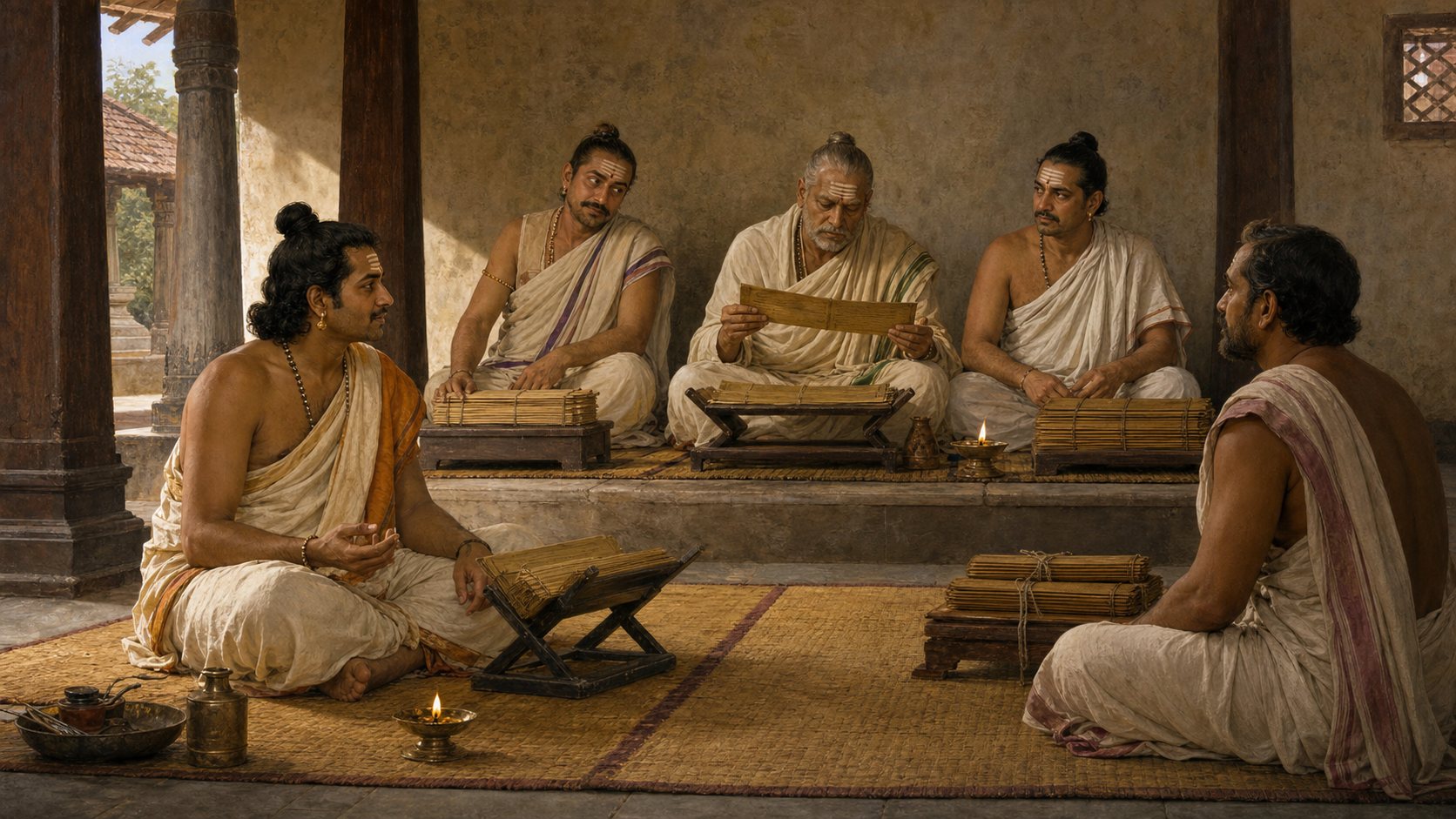
Srinatha does not begin with an insult. He first creates a legitimate object of criticism. That is the strategic core of the encounter. A public dispute without a definite scholarly question could look like theatre generated for its own sake. A composed work, formally submitted for examination, places the Vidyadhikari under the obligations of his office.
- Srinatha composes Manasollasa as a Sanskrit khanda-kavya celebrating Vijayanagara’s urban life and the sanctity of Pampa Virupaksha.
- He sends it through Nrsimha Bhatta, a grammarian in his entourage, and requests an assessment appropriate to the imperial Vidyadhikari.
- The verses contain apaśabdābhāsa: an appearance of incorrect language that dissolves when the construction is examined with sufficient grammatical care.
- Arunagirinatha reads too quickly, declares the composition defective, and thereby exposes his own failure to verify the apparent errors.
- Srinatha demands an apology and the surrender of the hereditary bronze bheri associated with Arunagirinatha’s scholarly authority.
- After Arunagirinatha refuses, Srinatha sets the full moon of Vaishakha as a deadline and announces that he will parade with bronze, silver, and gold drums while proclaiming himself Kavi Sarvabhauma.
The apaśabdābhāsa is more than a clever trap. It tests whether a critic can distinguish appearance from structure. A hurried reader sees a faulty expression and stops. A disciplined grammarian suspends judgement, parses the construction, checks the governing rules, and asks whether an apparently irregular form is actually defensible.
That is why the presence of Nrsimha Bhatta matters. Srinatha is not merely saying that his poem is good. He is pointing out that Arunagirinatha condemned it in a setting where exact grammatical scrutiny was both possible and expected. The charge is procedural: a holder of scholarly office issued a damaging verdict without completing the examination his position required.
Rajanatha, Arunagirinatha’s elder son, reveals the error when he returns from collecting grain from agraharas assigned to the family. He had already warned his father against meeting a formidable challenger with haste and ego. On reading the poem, he recognises the apaśabdābhāsa immediately. His intervention supplies the judgement that his father should have delayed long enough to reach.
You can apply this principle far beyond medieval poetics. Before declaring a text, translation, ritual explanation, or historical claim wrong, identify the exact rule that has allegedly been broken. Then reconstruct the strongest possible reading. If the objection disappears under careful parsing, the first impression was never adequate evidence.
Grammar and poetics required different kinds of proof
Once the grammatical mistake becomes public, Arunagirinatha changes ground. He turns from vyakarana to Alankara Shastra. This is not a minor technical adjustment. It is a move from a field with comparatively hard constraints to one that allows more room for aesthetic judgement.
Within the intellectual framework of the episode, Panini, Vararuchi, and Patanjali provide grammar with recognised authorities and demanding standards. A disputed construction can be tested against rules, derivations, and accepted usage. The parties may still argue about application, but they cannot treat every reaction as equally decisive.
Poetics operates differently. Alankara Shastra asks how language produces beauty, suggestion, relish, and connoisseurial satisfaction. Its reasoning is not lawless, but aesthetic response and interpretive inference permit multiple routes. The asymmetry between grammatical proof and poetic judgement gives Arunagirinatha room to continue defending himself after the grammatical verdict has failed.
Do not flatten this into the claim that grammar is objective while poetics is merely subjective. The sharper lesson is that different disciplines recognise different burdens of proof. A formal error, an interpretive weakness, and a failure of aesthetic effect are not interchangeable accusations.
- When someone alleges a grammatical fault, ask for the rule and the complete parsing.
- When someone alleges a poetic fault, ask which aesthetic criterion is being applied and whether another competent reading remains available.
- When a critic changes criteria after losing the first argument, mark the shift openly before continuing the discussion.
- When taste is presented as technical error, separate preference from demonstrable violation.
Srinatha’s advantage lies in understanding both the text and the forum. He anticipates the kind of error his rival is likely to make, selects a device that can expose it, and preserves a clear route from private examination to public accountability. His strategy is therefore intellectual, procedural, and political at once.
The bronze bheri shows that learning had institutions
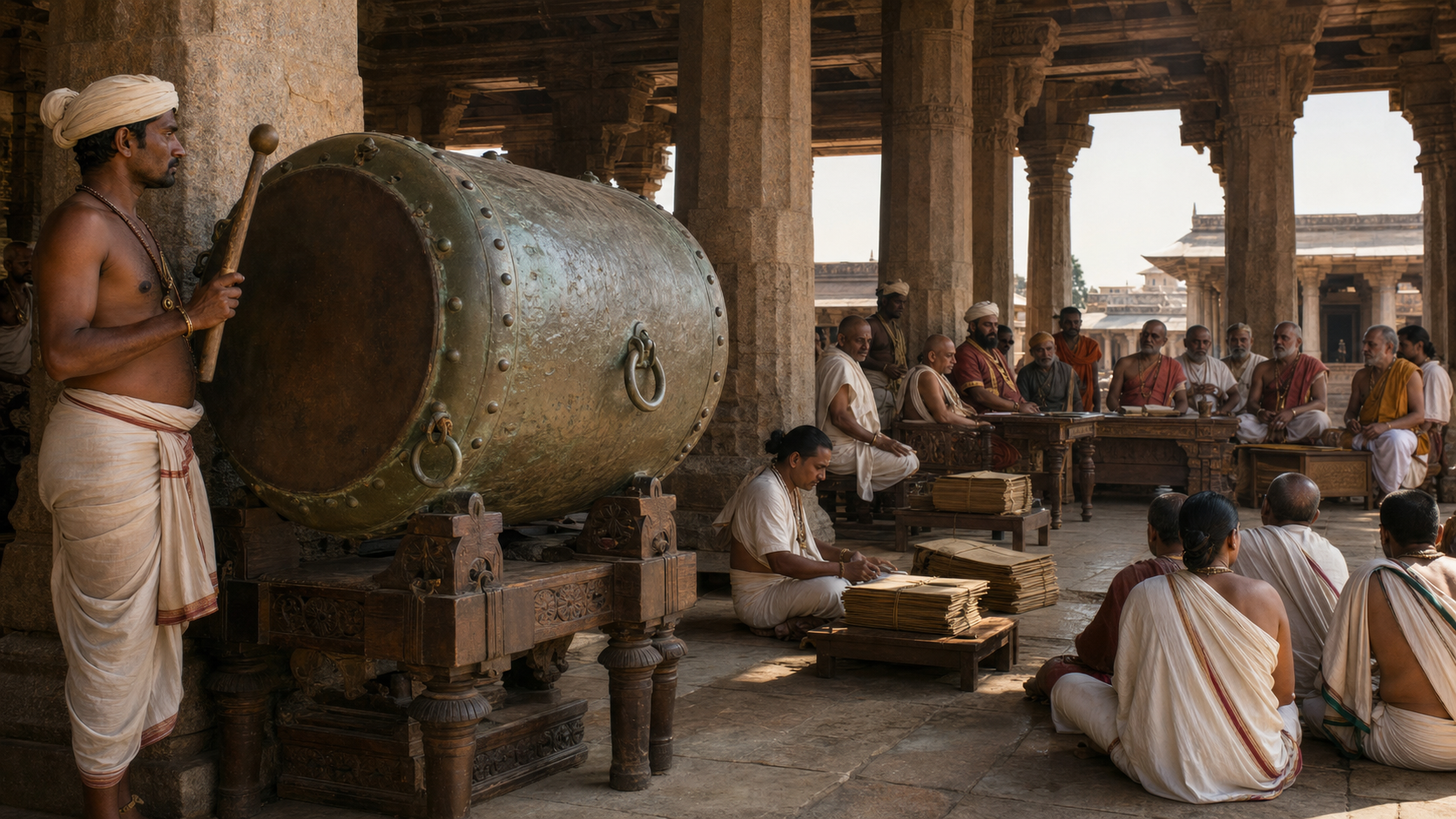
Arunagirinatha Dindima Bhatta is not simply another poet. He serves as Vidyadhikari, an office that gives his judgement institutional weight. He also carries and sounds a bronze bheri reputedly given by Bukkaraya and preserved as a hereditary emblem of scholarly pre-eminence. The sound announces status before an argument even begins.
That emblem helps explain why Srinatha demands its surrender. He is not asking for a decorative possession. He is challenging the visible sign that links lineage, office, reputation, and public authority. When Arunagirinatha refuses, Srinatha answers with a rival ceremonial language: new drums, a proclamation, and a procession through Vijayanagara.
The dispute also rests on less spectacular forms of support. Rajanatha’s journey to collect grain from agraharas points to the economic foundation beneath learned life. Agraharas were endowed Brahmin settlements sustained through land revenue. They allowed scholarly lineages to teach, study, perform ritual duties, and remain connected to political patrons. The grain behind the scholar and the bronze emblem before him belong to the same institutional world.
Pampa Virupaksha supplies another part of that world. By praising the sacred centre associated with Vijayanagara, Manasollasa locates the contest within the city’s religious as well as political identity. Srinatha’s challenge is directed at an officeholder, but it is staged within a civilizational setting where sacred geography, royal power, literary excellence, and public reputation overlap.
When you study another premodern scholar, look for five things: the office that authorised judgement, the patron who financed learning, the endowment that sustained the lineage, the emblem that made rank visible, and the audience that could recognise or reject the claim. A list of poems and titles alone will not show you how scholarship functioned.
This is also where the episode speaks to a wider Dharmic readership. You do not need to pretend that Hindu, Buddhist, Jain, and Sikh traditions used identical institutions or methods. The stronger common principle is ethical: knowledge deserves reverence, but a claimant to authority must still submit to disciplined examination. Debate serves dharma only when method restrains ego.
Key takeaways for reading Srinatha well
- Separate history from reconstruction. The courtly setting is historically grounded, while Srinatha’s composition of Manasollasa lacks independent evidence and should be identified as a plausible literary device.
- Read the contest institutionally. Srinatha represents Kondaveedu and its patronage system; Arunagirinatha represents an imperial office, a scholarly lineage, and a public emblem of authority.
- Understand the technical hinge. Apaśabdābhāsa works by making a correct construction appear defective to an incautious reader. The test is not memory alone but patient grammatical analysis.
- Keep disciplines distinct. Vyakarana and Alankara Shastra do not settle claims in the same way. Always identify the standard of proof before accepting a verdict.
- Treat prestige as accountable. The higher the office and the louder the emblem, the greater the duty to read carefully, explain the ruling, and correct a public error.
- Preserve the Dharmic lesson without flattening traditions. Intellectual plurality remains fruitful when argument is joined to restraint, method, and responsibility.
The next time you share Srinatha’s challenge, label its layers in a single sentence: a historically plausible courtly world, a literary reconstruction with a known evidentiary limit, and a precise lesson in scholarly accountability. That small act of care honours Srinatha better than an exaggerated claim would. It keeps the story alive while preserving the discipline the story itself demands from you.
References
