
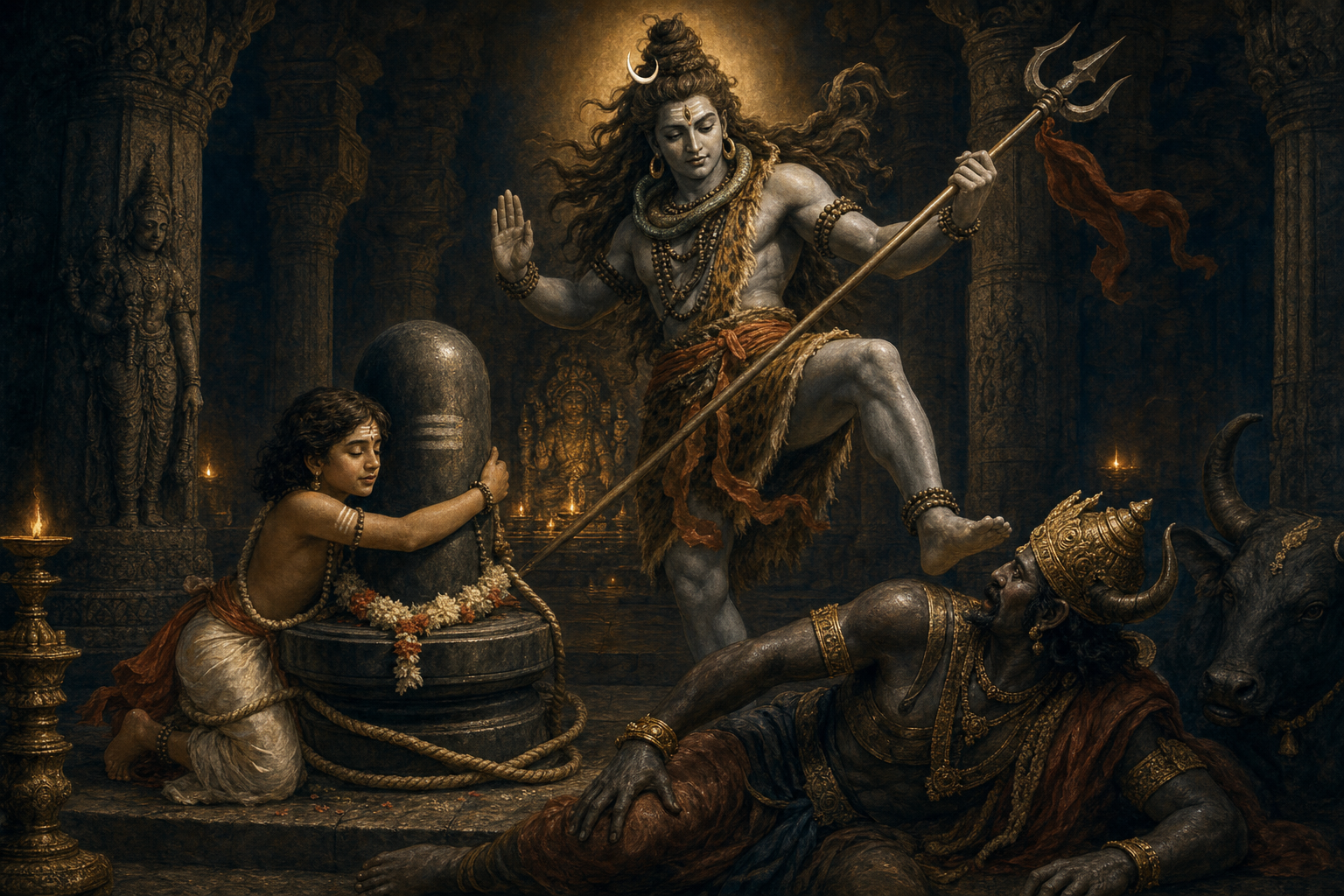
If you are standing before a fierce image of Shiva and wondering whether it is Kalantaka, do not begin by counting arms or identifying every weapon. Look first for a relationship: a young devotee at a linga, Yama brought low, and Shiva intervening between refuge and death.
Once you see that relationship, the image becomes more than a dramatic battle scene. You can read it as a precise Shaiva teaching about time, mortality, devotion and the kind of grace that restores order without pretending death does not exist.
Identify Kalantaka by the narrative cluster
The name gives you the first clue. Kāla means time and can also designate Yama, the deity who governs death. Antaka means an ender or terminator. Kalantaka is therefore Shiva as the one who brings Kāla under a higher authority. The name does not mean that chronological time disappears or that no one dies. It announces that neither time nor death is ultimate.
The decisive identifier is the Markandeya narrative. Markandeya is destined to die at sixteen. When Yama comes to claim him, the young devotee embraces a Shivalinga. Yama casts his noose, which encircles the linga as well as Markandeya. Shiva then manifests from the linga, subdues Yama and protects the devotee. Versions of this episode occur across the Shiva Purana, Linga Purana, Skanda Purana and related traditions.
Use the following sequence when identifying a complete sculpture, bronze or temple relief:
- Find the linga. It is the narrative axis, not a background accessory. Shiva’s intervention proceeds from the place where Markandeya has taken refuge.
- Find the young devotee. Markandeya may clasp the linga, kneel beside it or appear in a posture of gratitude.
- Look for Yama. He may be fallen, reeling, restrained or placed beneath Shiva’s foot.
- Check for the buffalo. Yama’s vehicle strengthens the identification, especially when the human figures are damaged or compressed.
- Only then examine Shiva’s attributes. Trident, drum, flame, noose, antelope and protective gestures can confirm a Shaiva identity, but they do not identify Kalantaka by themselves.
This order matters because many formidable forms of Shiva share flying matted hair, serpents, fire, a trident or a commanding stance. Kalantaka is defined by an event. A fierce Shiva without Markandeya, the linga, Yama or another clear narrative clue should be labelled cautiously rather than identified from one weapon alone.
Regional style can change almost everything except that underlying event. South Indian bronzes often give the body a controlled, flame-like movement. Stone reliefs in Karnataka may make the episode read as a compact narrative register, while Odishan treatments can appear denser. Stucco and wooden panels introduce still other accents. If a fragment has lost one or two figures, use its original location, neighbouring panels and surviving relationships before settling on a name.
Read the composition from refuge outward
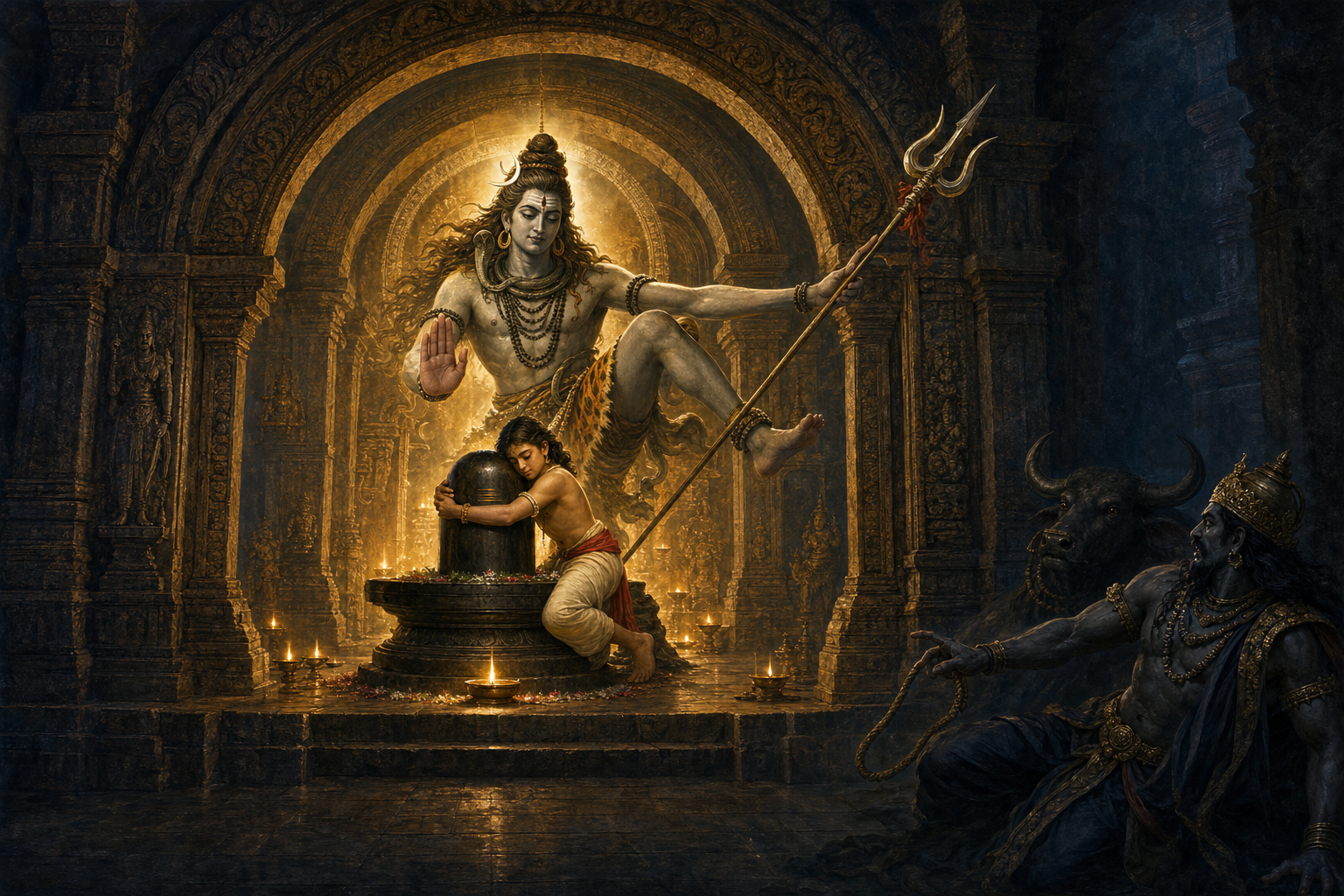
The easiest way to misread Kalantaka is to let the largest figure dominate your attention. Shiva is visually commanding, but the meaning begins lower in the composition, at the linga and the devotee who holds it. Read from that centre outward.
The linga marks refuge and manifestation. It is where Markandeya’s devotion becomes visible and where Shiva’s presence breaks into the scene. In compositional terms, it joins the human appeal below with divine action above. If you treat it as a generic pedestal, you miss the mechanism of the story.
Markandeya embodies concentrated dependence on Shiva. His youth and smaller scale heighten his vulnerability, but his defining act is neither escape nor counterattack. He remains attached to the linga. The contrast directs you toward a practical question: when control is no longer available, what does your mind actually hold?
Yama represents a necessary power brought back within bounds. He is not a demon whose existence must be erased. Death remains part of the cosmic order, and Yama’s office is not permanently abolished. His lowered position shows subordination, not the destruction of moral causality. The icon would lose much of its depth if it merely portrayed Shiva as stronger than an enemy.
The buffalo gives mortality material weight. Its presence locates Yama in the ordinary world where embodied life ends. It also helps you distinguish the figure beneath Shiva when facial details, weapons or inscriptions are missing.
Shiva’s moving body is the interruption. Flying locks, taut limbs and a forceful gaze make divine response visible. The third eye, crescent moon and Ganga may appear in the mass of matted hair. A flaming prabhavali, when present, can make the whole form seem to master the enclosing rhythm of time. That circular energy may recall Nataraja, but the two forms should not be collapsed. Nataraja presents the cosmic fivefold activity of creation, preservation, dissolution, concealment and grace; Kalantaka addresses the particular crisis of Markandeya and Yama.
The ornaments hold apparent opposites together. Serpents and tiger skin evoke Shiva’s ascetic and cremation-ground associations, while jewellery and a radiant crown-like arrangement give him sovereign presence. The result is neither a wild ascetic alone nor a distant king. It is a liminal protector who can enter the domain of death without belonging to it.
The attributes explain what Shiva masters
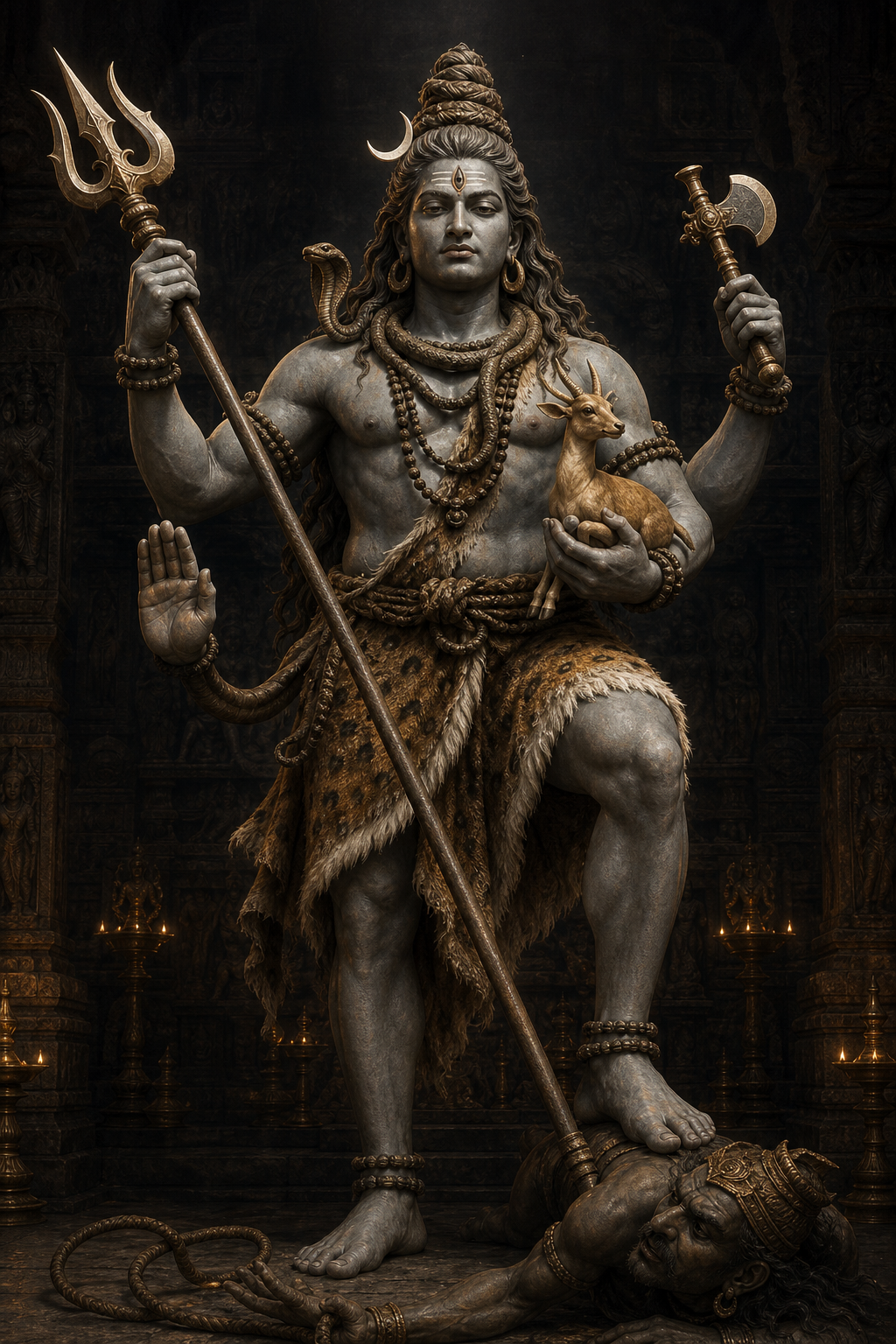
Weapons in sacred iconography are not merely instruments of physical force. In Kalantaka, each attribute helps translate an invisible claim into something the eye can follow. Because the number of arms and combination of objects vary by region and period, read the attributes as a vocabulary rather than a rigid inventory.
- Trishula: The trident signifies mastery over triads. It can be read through past, present and future, or through the three gunas of sattva, rajas and tamas. In this scene, time is not denied; its threefold reach is held within Shiva’s sovereignty.
- Damaru: The hourglass drum carries the pulse of creation and the beat by which time becomes perceptible. Beside the defeated power of death, it indicates that reality has a generative rhythm as well as a terminal boundary.
- Agni: Fire signifies purification and transformation. A Tantric reading directs this fire inward: what must be burned is not only an external threat but the residue of fear that governs conduct before death arrives.
- Pāśa: At the narrative level, the noose is Yama’s instrument for claiming Markandeya. In Tantric interpretation, it also evokes the bonds of ignorance, accumulated conditioning and habitual attachment. Do not merge these levels carelessly; the physical noose tells the story, while the symbolic noose opens the story into practice.
- Abhaya and varada: Gestures of fearlessness and boon-bestowal reveal the purpose behind the formidable action. The same form that subdues Yama can turn toward the devotee with protection and generosity.
- Antelope: When present, it belongs to Shiva’s wider iconographic vocabulary. It can support the identification of Shiva, but it is less decisive for Kalantaka than the linga, Markandeya and Yama.
Notice the grammar formed by these elements. The noose binds; the trident integrates; fire transforms; the drum re-establishes rhythm; the open hand removes fear. The sequence moves from constriction to restored freedom. That is why the image’s violence should not be isolated from its protective gestures or its vulnerable devotee.
This also explains why a museum label that says only “Shiva trampling Yama” gives you too little. It names the visible action but not its direction. Shiva is not displaying arbitrary fury. His force serves refuge, reorders a threatened boundary and returns death to its proper place.
The image promises fearlessness, not immunity from death
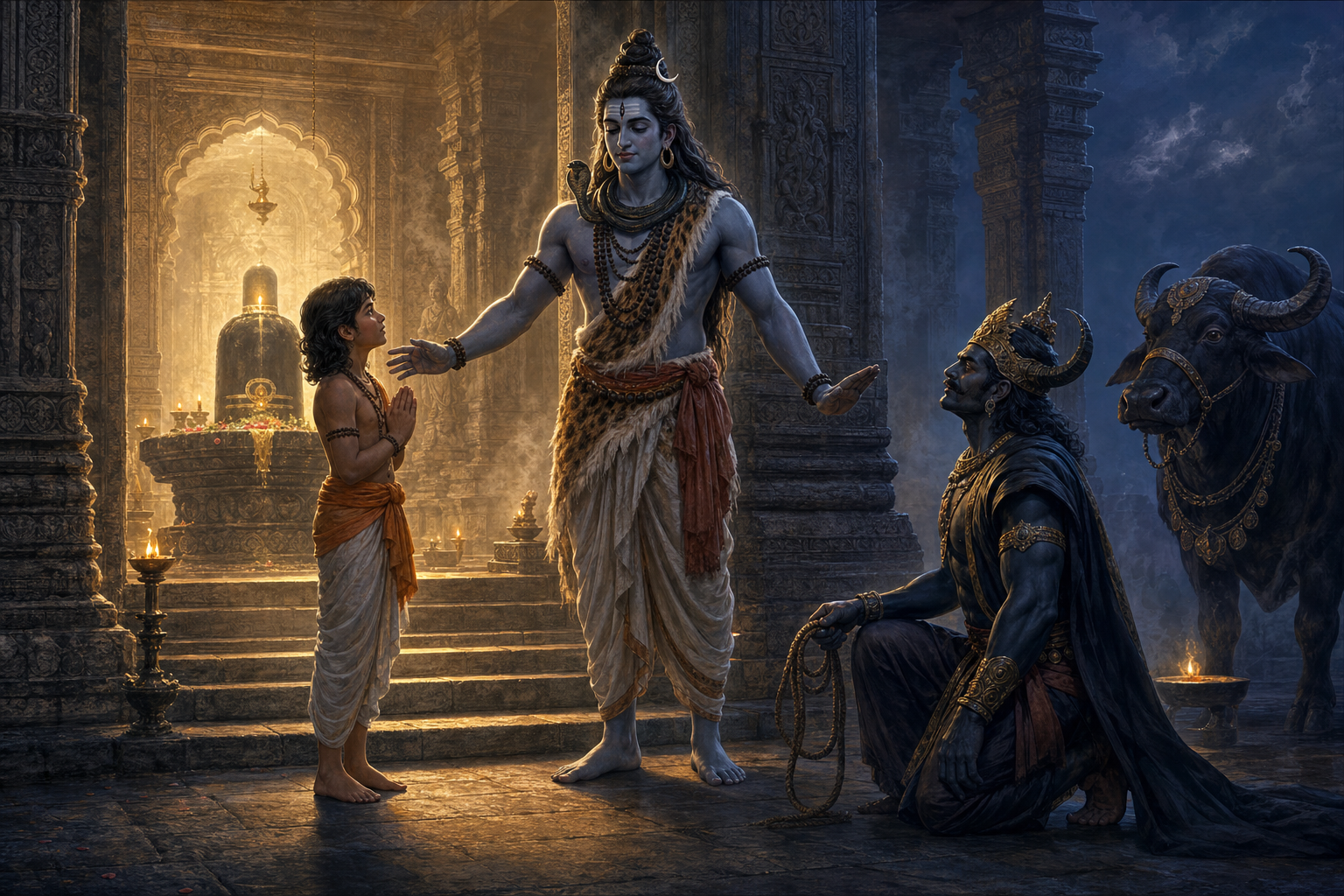
Kalantaka is sometimes understood too literally, as though devotion should exempt a person from biological death. The icon makes a more demanding claim. Mortality remains real, Yama retains a legitimate cosmic function, and embodied existence stays subject to change. What is denied is death’s status as the final measure of the Self.
Within a Shaiva philosophical reading, the body and mind belong to conditioned existence, while luminous consciousness is not manufactured by time and cannot be reduced to time’s products. Kalantaka places that teaching before the eyes. Shiva stands over Kāla because consciousness is not exhausted by chronology.
The Markandeya episode also prevents this from becoming detached metaphysics. Devotion, knowledge and grace meet in one crisis. Markandeya does not conquer Yama through personal force. Shiva does not erase the order Yama represents. Grace intervenes so that law is not confused with blind mechanism. Mercy reveals the deeper purpose of dharma rather than cancelling it.
For someone facing illness, ageing or bereavement, this distinction is essential. Kalantaka does not ask you to deny loss or manufacture certainty about how long anyone will live. The image asks you to separate two fears that are often fused: the end of a particular embodied life and the belief that reality itself becomes meaningless at that end. Shaiva practice addresses the second without trivialising the first.
The civilizational resonance extends beyond Shaivism, but the traditions should not be treated as interchangeable. Buddhist accounts of subduing Māra turn fear and craving into occasions for awakening. Jain understandings of immense time-cycles place individual mortality within a moral cosmos directed toward kevala jnana. Sikh remembrance of Akal Purakh brings the seeker before the Timeless. These are meaningful convergences around freedom from domination by time and fear; they are not alternate names for the specifically Shaiva icon of Kalantaka.
Approach Kalantaka through observation and disciplined worship
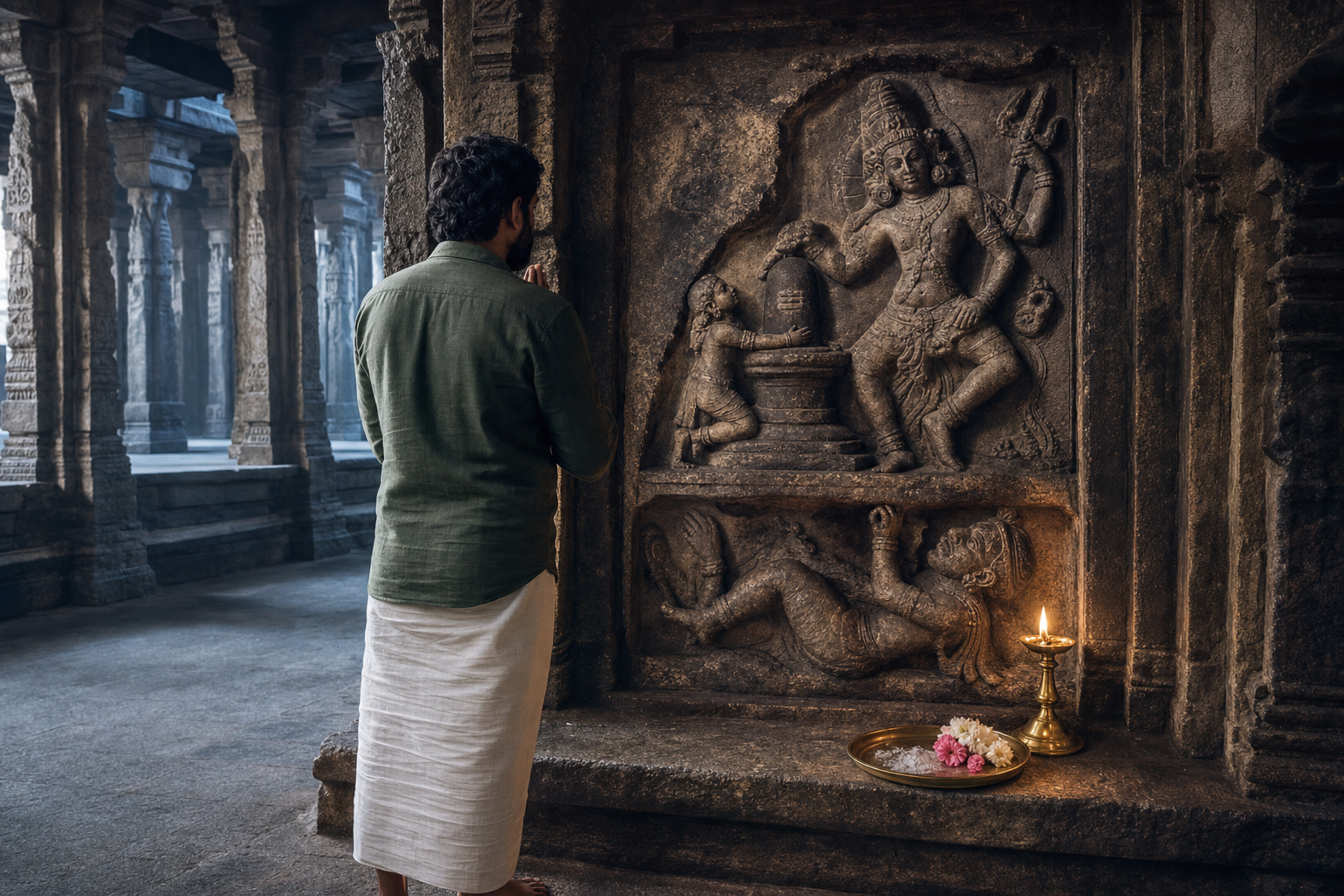
You can use a short viewing practice in a temple or museum without pretending to perform a ritual outside its proper setting. Give the image one uninterrupted minute. Begin with the linga, locate Markandeya, trace the implied path of Yama’s noose, find Yama and the buffalo, and only then let your gaze rise through Shiva’s posture, hands, face and aureole. After that first reading, consult the label or temple explanation and check which details you missed.
If the work is a Chola-period lost-wax bronze, pay particular attention to how movement is made stable. The finest examples do not look chaotic even when hair, limbs and ornaments surge through space. Their kinetic balance belongs to the same South Indian artistic world associated with the great temples at Thanjavur and Gangaikondacholeesvarar. The craft turns a moment of divine eruption into a form capable of sustained darshana.
At the Amritaghateshwarar-Abirami Temple in Thirukadaiyur, Tamil Nadu, the Markandeya memory remains connected with ceremonies of longevity and renewed purpose. Shashtiabdapoorthi marks the completion of sixty years, while Sathabhishekam is associated with the eighty-first year. Their meaning is strongest when longevity is understood as additional time for dharmic responsibility, not as a transaction that guarantees a particular lifespan.
Kalantaka also meets devotional life through Shiva as Mrityunjaya, the victor over death. The Mahamrityunjaya mantra is recited in prayers for healing, longevity and passage through danger:
Tryambakaṁ yajāmahe sugandhiṁ puṣṭivardhanam, urvārukamiva bandhanān mṛtyor mukṣīya mā’mṛtāt.
Its liturgical setting turns the Kalantaka insight into repeated practice: remember the deathless while living responsibly within mortal conditions. Abhishekam may employ water, milk, curds and honey, with bilva leaves and recitation. Panchopachara and Shodashopachara patterns place the worshipper’s limited daily time within a larger sacred rhythm.
If you wish to participate, follow the protocol of the temple, family tradition or qualified teacher rather than improvising around a formidable murti. Recitation, pilgrimage and abhishekam can offer spiritual discipline and consolation, but they do not guarantee a longer biological life and should never replace medical diagnosis or treatment.
A simple personal contemplation can remain faithful to the image without making supernatural promises. Name the fear that is tightening around you. Ask whether it concerns a practical danger that requires action, an unavoidable limit that requires acceptance, or an imagined future that has begun to govern the present. Then return mentally to the composition: refuge at the linga, the noose arrested, fearsome power placed in the service of grace.
Key takeaways
- Identify Kalantaka through the complete narrative cluster: Shiva, Yama, Markandeya, the Shivalinga and, where preserved, Yama’s buffalo.
- Do not rely on the trident, flame, drum or flying hair alone; those belong to a wider Shaiva vocabulary.
- Read from the linga outward. Refuge and devotion explain why Shiva’s formidable action occurs.
- Yama is subordinated, not permanently abolished. The image restores the order of death rather than denying mortality.
- The noose, trident, fire, drum and protective gestures move the meaning from bondage and fear toward integration, purification and grace.
- Approach longevity rites and the Mahamrityunjaya tradition as disciplines of fearless, dharmic living, not as guarantees of immunity from illness or death.
The next time you encounter Kalantaka, resist the urge to see only a victorious deity and a defeated figure. Locate the devotee first. Follow the noose. Then look at the power that interrupts it. That viewing order allows the icon to do its real work: teaching you to respect mortality without surrendering consciousness, conduct or devotion to the fear of it.
References
