
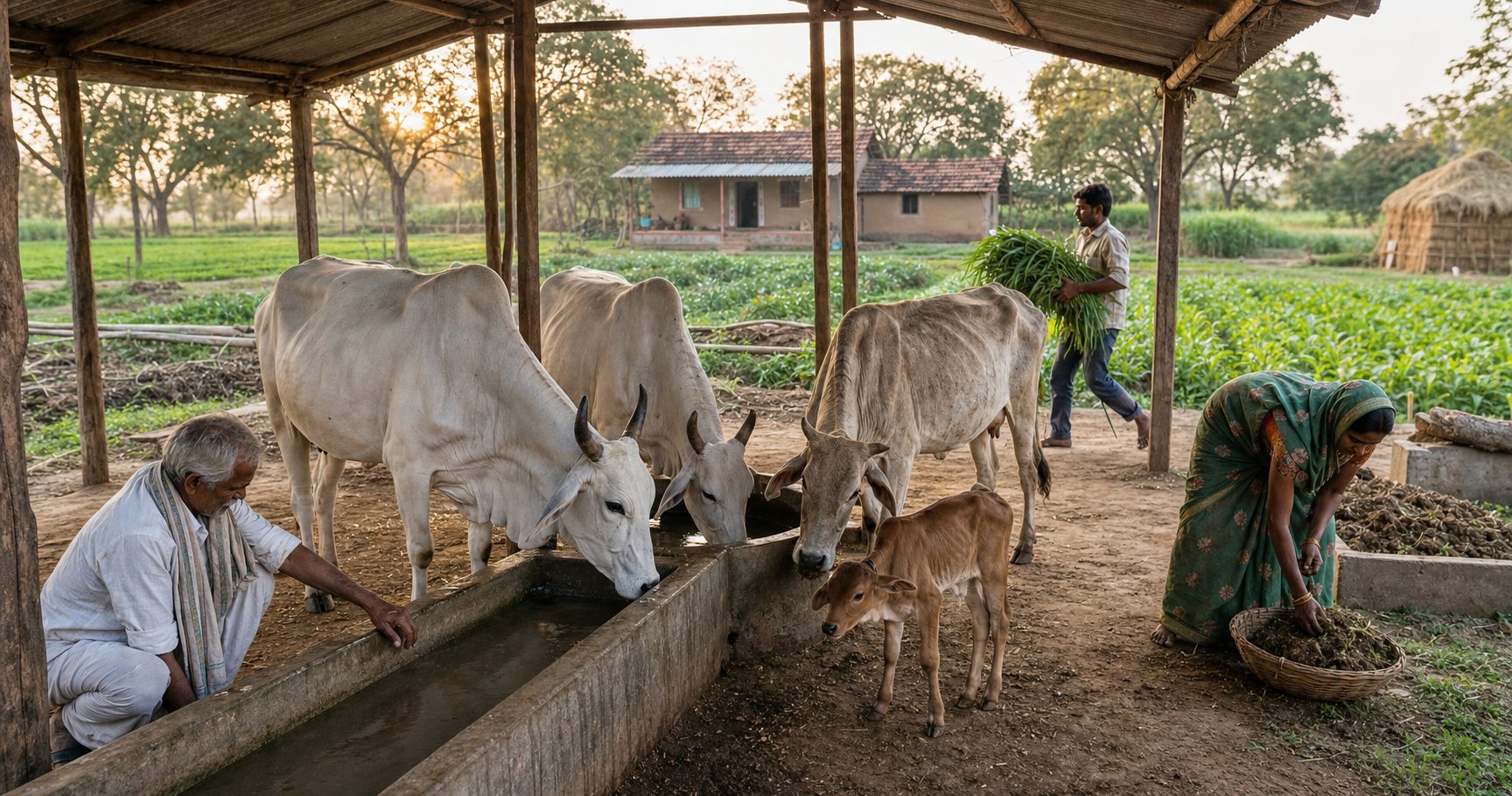
If you are considering rural life because you want cows, clean food, and a household ordered around dharma, do not begin with acreage, equipment, or an attractive herd. Begin with the obligations. A living cow sets a daily timetable, continues to need care when milk production falls, and exposes every weakness in your water, fodder, labor, and finances.
A cow-centered farm is therefore not a dairy business decorated with devotional language. It is a whole household system in which protection lasts for the cow’s life, dung has a useful destination, land supports animals and people, and income does not depend on discarding whichever creature has become unprofitable. That standard is demanding, but it gives you a practical way to distinguish goseva from rural nostalgia.
Key takeaways before you bring cows home
- Define cow protection across the animal’s entire life, including dry periods, illness, disability, old age, bulls, and calves that will not produce milk.
- Map fodder, water, shelter, manure, household food, energy, and sales as one connected system. An isolated cow project will continually import necessities and export problems.
- Budget labor by the morning and evening duty cycle, not by a vague estimate of how many people live on the farm.
- Treat equipment as a transfer of work. A machine may reduce physical effort while adding washing, maintenance, setup, fuel, and repair.
- Build several compatible forms of household support. Milk alone is too narrow a foundation for lifelong cow care.
- Expand only after the present system has passed through its difficult season without neglected animals, exhausted caregivers, accumulated manure, or emergency sales.
Put the whole life of the cow at the center
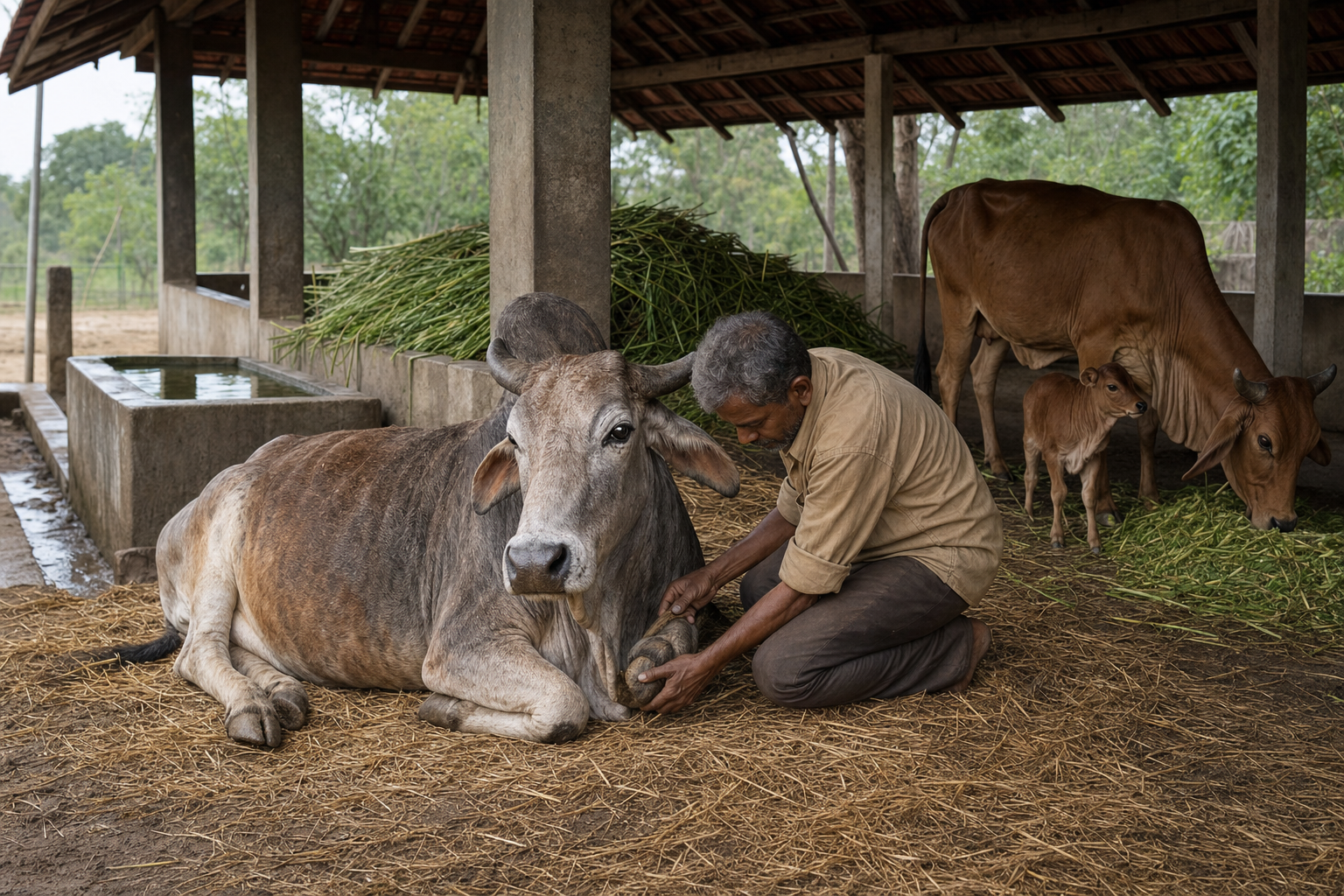
The decisive question is not how much milk a cow gives. It is what happens when she gives none. A farm may look cow-centered while productive animals are paying their way, yet reveal a very different ethic when an old cow becomes a continuing expense.
That contradiction appeared even within an otherwise resourceful family farm: old dairy cows were eventually sold into markets that turned them into leather goods. The lesson is not to condemn a past family from a distance. It is to notice the financial pressure before reproducing it. If your plan protects only lactating cows, it is a dairy-production plan, not lifelong goseva.
Write a care policy before acquiring an animal. It should answer questions that enthusiasm tends to postpone:
- Where will the cows graze when the season permits, and what will replace grazing during the hardest season?
- Who is responsible for water, fodder, shelter, cleaning, observation, and obtaining veterinary help?
- Who takes over when the primary caregiver is ill, travelling, or injured?
- What place will breeding bulls, male calves, dry cows, disabled animals, and elderly cows have?
- Which household income will continue to fund care when an animal produces no saleable milk?
- What humane and locally lawful arrangements will govern illness, death, and the handling of remains?
Turn that policy into an individual cow ledger. Record each animal’s identity, condition, care needs, feed arrangement, responsible caregivers, productive status, and retirement provision. The ledger is not bureaucracy for its own sake. It stops an elderly cow from becoming an unforeseen liability several years after the emotional decision to bring her home.
This is where ahimsa becomes an operating constraint rather than a slogan. It changes breeding decisions, herd size, cash reserves, land use, and the kind of buyer or institution with which you are willing to work. If any part of the budget assumes that an unwanted animal can simply leave the farm, revise the budget.
Design a circular farm, not a collection of projects
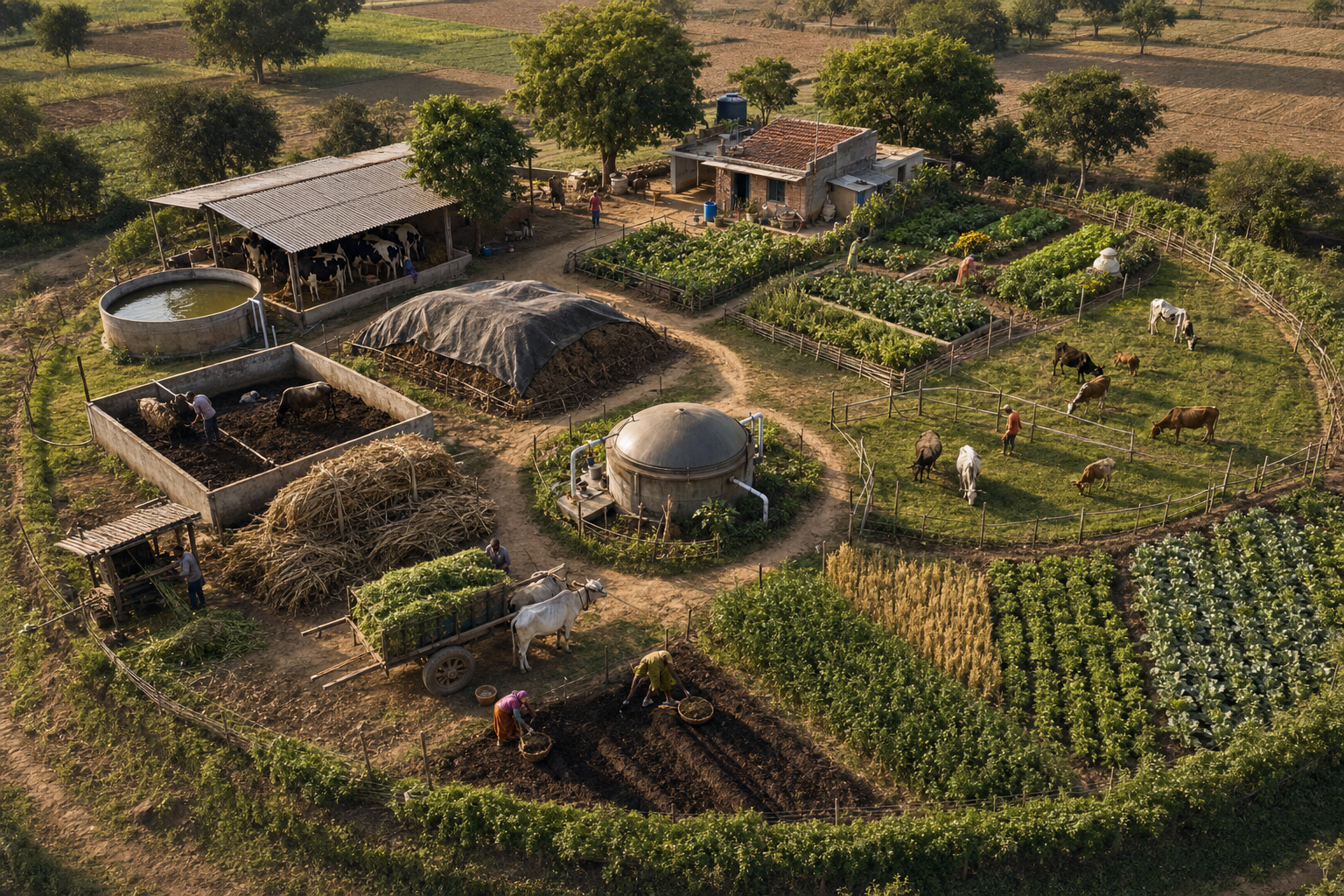
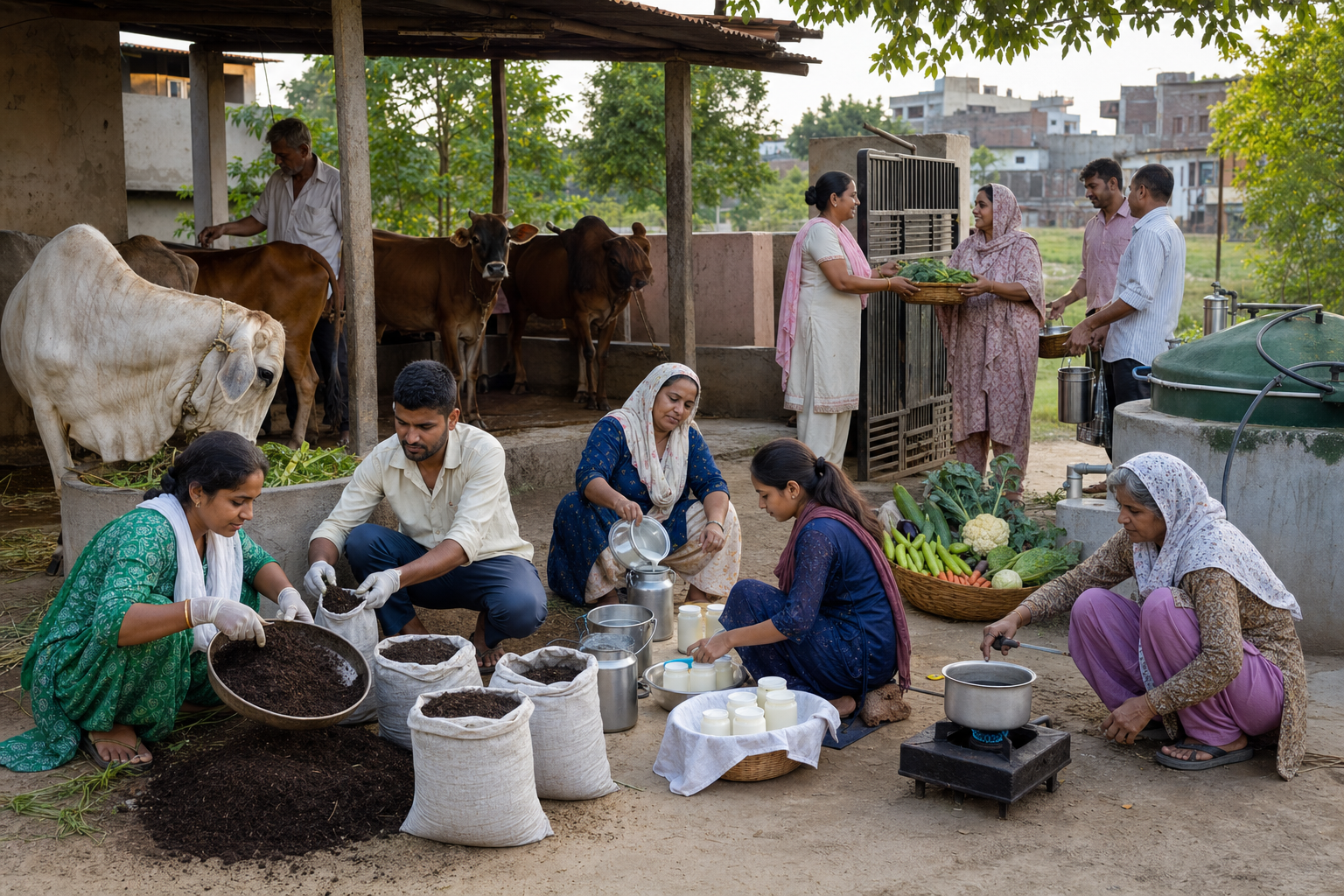
Cows become an agricultural center when their needs and outputs are joined to the rest of the farm. A historical operation of 180 acres and 85 dairy cows illustrates the pattern, although those figures must not be treated as a stocking recommendation. Climate, soil, water, pasture quality, animal size, and purchased feed all affect what a particular property can support.
On that farm, manure was combined with plant matter from a 20-acre vegetable garden, a small soybean field, and roadside cuttings. The resulting compost returned to the vegetable, soybean, and cash-crop fields. Cows grazed while seasonal weather allowed, wells supplied the property, and garden produce served both the household and roadside customers. Each activity answered a need created by another.
Cow dung also entered the energy system. By 1955, a relatively simple manure-to-methane installation was powering house and barn lights, outdoor lighting, and battery charging. It later helped supply electricity for milking equipment. This does not mean every small farm should buy a digester. It shows that dung can be treated as a designed resource instead of an inconvenient pile.
Methane is combustible, and a working digester involves gas containment, pressure, ventilation, electrical interfaces, and local rules. Do not improvise such a system from a nostalgic description. Use competent technical design and inspection. First determine whether the amount and consistency of available manure, the intended energy load, maintenance capacity, and the destination of all by-products make the installation sensible.
Before buying machinery or increasing the herd, draw a material-flow map on one sheet of paper. Follow each input and output:
- Fodder enters the farm: identify whether it is grown, purchased, stored, or seasonally unavailable.
- Water reaches each animal: identify the source, pumping method, trough or vessel, cleaning duty, and backup during failure.
- Dung leaves the shelter or pasture: identify who gathers it, where it waits, how it becomes compost or energy, and where the finished material goes.
- Crop residues leave the garden and fields: identify what can safely enter compost and what requires separate handling.
- Milk and produce leave daily routines: identify household use, processing work, cold storage, transport, and a lawful buyer.
- Equipment breaks: identify who can repair it, which task must continue without it, and what manual fallback remains available.
Circle every output with no destination and every essential input with no backup. Those circles are your real expansion limits. More land or more cows will magnify them; neither will solve them.
Do the labor arithmetic before the financial arithmetic
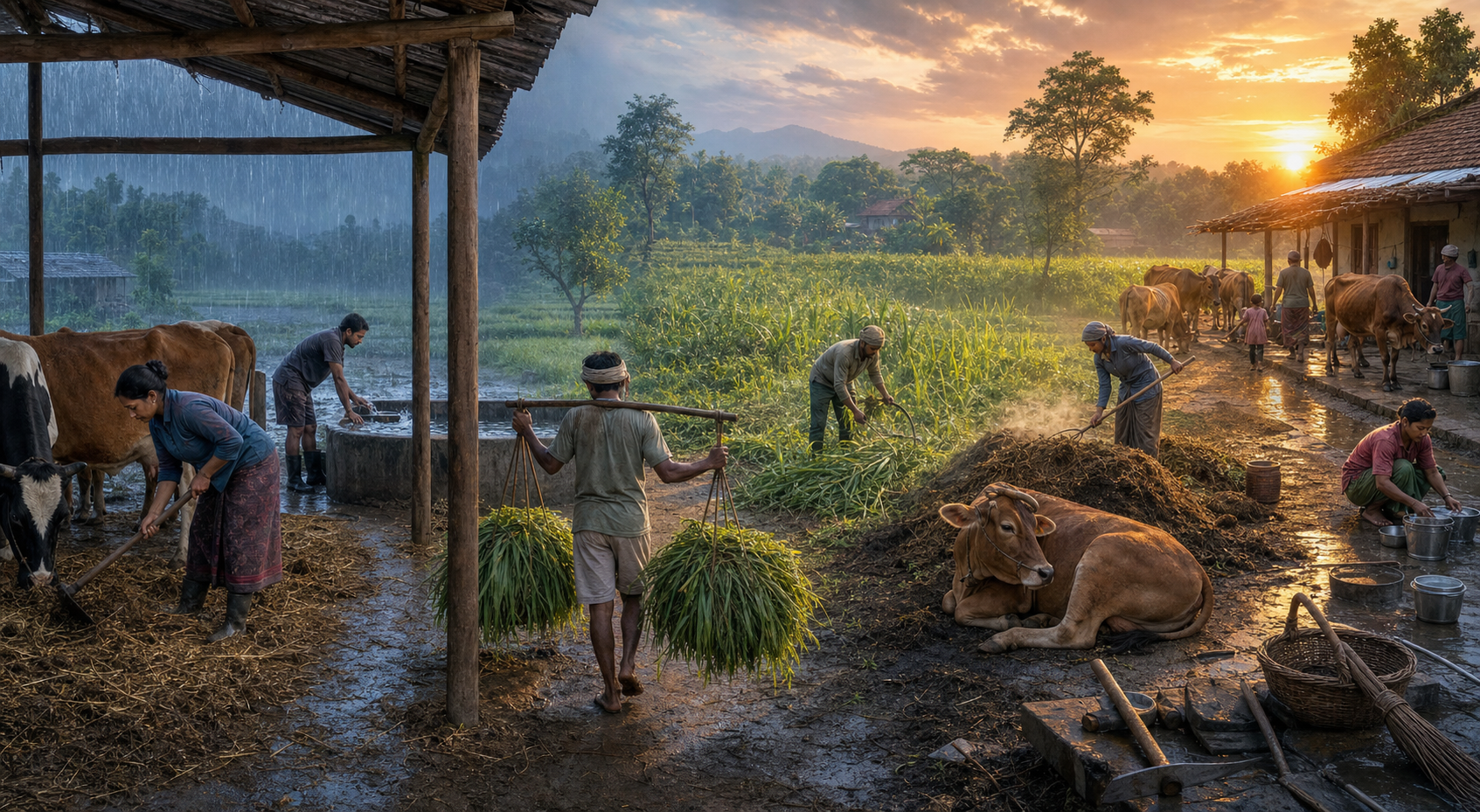
Rural self-sufficiency is labor-intensive even when the material system is elegant. The farm above operated largely with three people and occasional additional help at harvest. Working days began around five in the morning and ran into early evening. The household also repaired equipment, improved the property, cultivated crops, marketed food, and cared for several kinds of animals.
The 85 cows were milked by hand each morning and evening until mechanical equipment arrived. Yet the machines did not simply erase the work. Attaching them, removing them, and cleaning them could consume more time than expected. The equipment was adopted partly because the dairy buyer required it, not because it made every part of the day easier.
That distinction matters when you evaluate a milking machine, tractor, pump, separator, digester, or other device. Automation relocates labor. It may replace lifting or repetitive motion with sanitation, setup, maintenance, bookkeeping, fuel management, or dependence on spare parts. Ask which exact bottleneck the equipment removes and which new duties it creates.
Make a duty board based on actual tasks. For each task, record its timing, trained caregiver, backup person, equipment dependency, and consequence if delayed. Include animal observation, fodder preparation, watering, milking, utensil cleaning, manure handling, pasture work, crop work, repairs, food processing, customer service, and records.
The backup column is the one most likely to expose a fragile plan. If only one person can milk, operate the pump, handle a bull, recognise a sick animal, or contact a buyer, that person is not merely busy; the whole system depends on that person’s uninterrupted availability. Train another capable adult before adding animals.
Peak work also overlaps. Vegetables do not wait patiently because an animal needs attention, and a broken pump does not respect market day. Compare the animal-care calendar with planting, harvest, food preservation, sales, maintenance, and family obligations. If the same caregiver appears in several critical places at once, reduce the scale or change the enterprise mix while the conflict is still on paper.
Build an economy that can keep its promises
Self-sufficiency does not mean isolation from trade. The historical household consumed part of what it produced, but it also sold milk and cream to a local dairy supplier, made simple hard cheese, marketed vegetables and fruit from a roadside stand, and sold soybeans and a commercial crop. Customers at the stand often filled their own bags and left payment in a cigar box. Trust, proximity, and several modest outlets were part of the economy.
A tobacco crop kept that particular farm afloat for roughly half a century. Tobacco is not a model for a dharmic farm. The transferable lesson is that milk was not expected to carry the whole household. A durable cow-centered economy must distinguish the sacred commitment to protection from the commercial question of which lawful and ethical activity supplies cash.
Build your household map around separate functions:
- Household provisioning: milk, vegetables, fruit, preserved food, compost, and other outputs that replace genuine household purchases.
- Recurring cash: products or services with dependable buyers and a workload compatible with animal care.
- Seasonal cash: crops or processed goods that bring income at particular points but require heavy labor at those same points.
- Cow-care reserve: money protected for fodder shortages, veterinary attention, shelter repair, and the needs of non-productive animals.
- Capital and maintenance: funds for pumps, fencing, utensils, transport, power systems, and equipment that will eventually fail.
Do not count a product as income merely because you know how to make it. Confirm that a buyer exists, calculate the processing and delivery work, and check the rules that apply where you live. Raw milk, cheese, roadside food sales, animal transport, manure handling, and energy equipment can all be regulated differently by jurisdiction. Obtain the relevant local agricultural, food-safety, veterinary, and legal guidance before investing around an assumed market.
Then set gates for expansion. The existing herd should have reliable fodder and water through the difficult season. Manure should move through its intended process without an accumulating backlog. The routine should survive the primary caregiver’s absence. Sales should cover recurring obligations without depending on the removal of old or unproductive animals. Repairs and animal care should have reserves rather than competing for the last available money.
A compact farm that meets those tests is more faithful to goseva than a large herd supported by overworked people and unresolved promises. The first practical step is therefore not a land purchase. Prepare the whole-life cow ledger, material-flow map, duty board, and household economy map. Where they contradict one another, revise the plan on paper. When they align, rural farm life stops being an escape fantasy and becomes what it ought to be: disciplined, daily service.
References
