
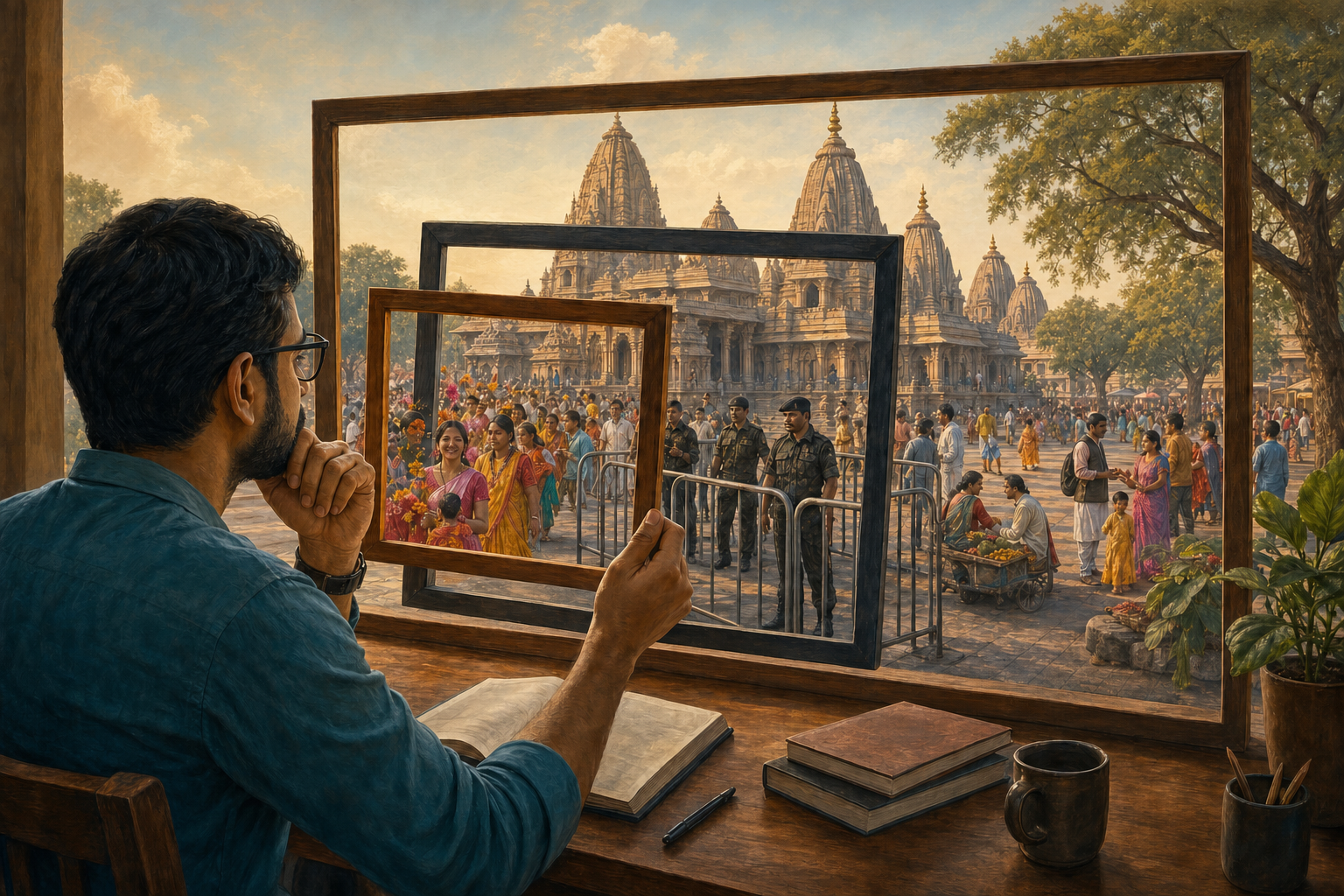
You open a report about a Hindu temple, pilgrimage or devotional expression. Its individual statements may sound defensible, yet the finished account leaves you with a civilization made legible only through spectacle, grievance or threat. The distortion may lie less in an invented fact than in the frame that decides what the facts are allowed to mean.
If you want to evaluate such coverage fairly, don’t begin by guessing a journalist’s motives. Examine the language, the distribution of context and the standard applied to Hindu subjects. That gives you a disciplined way to identify bias without dismissing legitimate criticism.
Framing happens before a claim becomes false
A frame is the interpretive boundary placed around a set of facts. It tells you which details are central, which are incidental and which are invisible. A report can therefore be literally accurate in places while remaining deeply inadequate as an account of Hindu life.
Suppose a camera records the clothing, bodies and movements of pilgrims but never asks what they believe they are doing. The visible details may be real. The implied meaning can still be false because the participants appear only as objects of observation. Their vows, discipline, memory and sacred purpose have disappeared from the account.
Use three separate tests rather than the vague question, "Is this biased?"
- Accuracy: Is the literal claim supported, or does the wording smuggle an allegation into what looks like description?
- Adequacy: Has the reader been given enough cultural and historical context to understand the event as its participants understand it?
- Symmetry: Would the outlet use the same degree of compression, suspicion and ridicule when describing a familiar Western religious community?
These tests stop two common mistakes. The first is accepting a distorted account because every sentence contains some defensible detail. The second is rejecting unwelcome reporting merely because it criticizes Hindus or Bharat. Criticism is not automatically anti-Hindu; a consistently unequal descriptive standard is the stronger evidence.
Three phrases reveal three different framing mechanisms
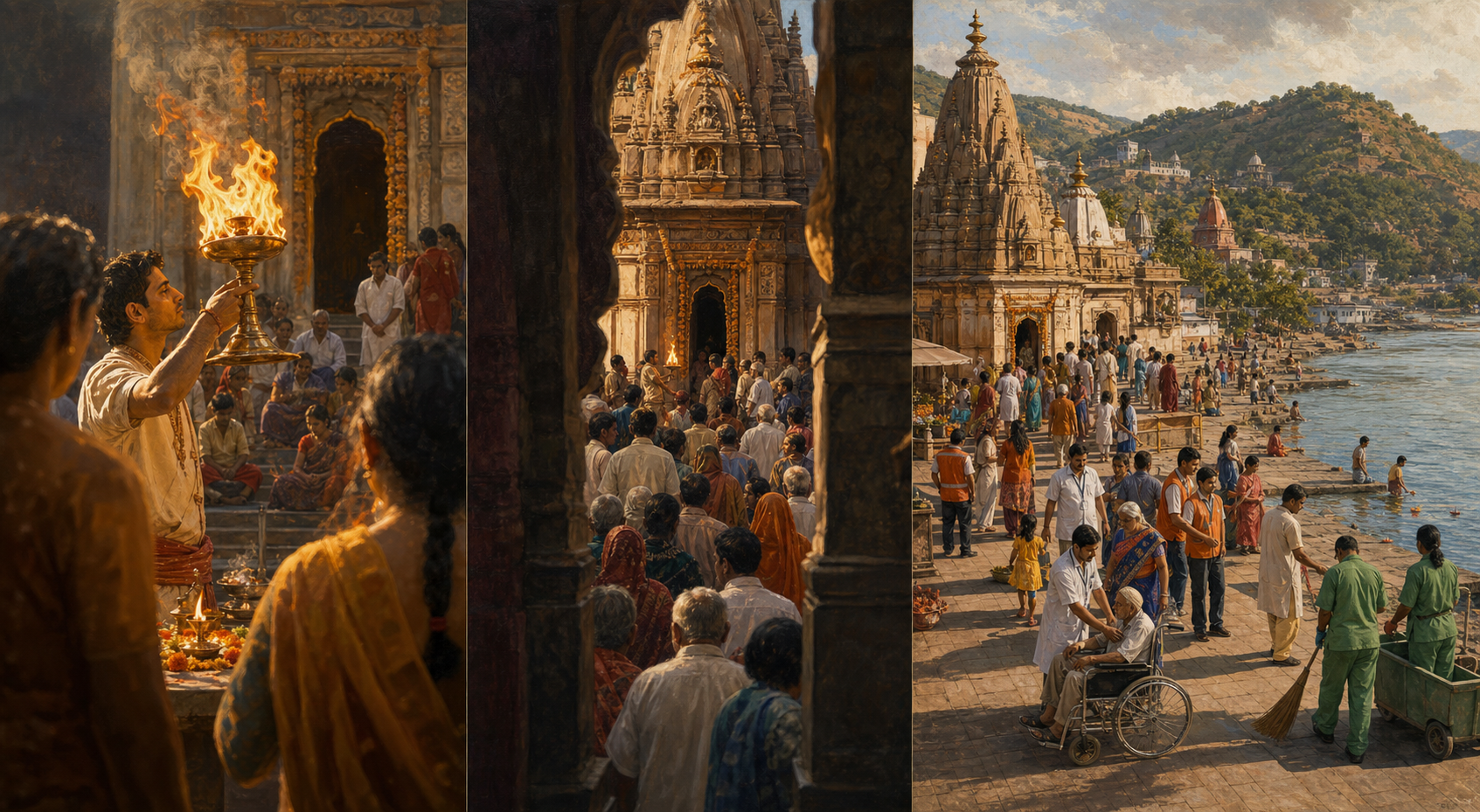
The clearest way to understand framing is to watch what a loaded label does to a real subject. The issue isn’t that Western media must praise every Hindu institution. It is whether Hindu meaning remains present after the editing is finished.
Mahakumbh becomes a visual curiosity
BBC editor Geeta Pandey described Naga Sadhus as "naked ash-smeared ascetics" and Mahakumbh as a "bathing spectacle". Neither formula needs to invent what a camera can see. The framing works by allowing appearance to consume meaning.
"Spectacle" places the observer outside the event. It invites fascination with scale, bodies and strangeness, while the pilgrims’ sacred purposes become optional background. The result resembles travel entertainment more than religious reporting. Hindu practice is something to look at, not something people have reasons to undertake.
Scale makes that omission harder to defend. Mahakumbh drew 65 crore visitors over 45 days. Attendance alone does not explain the pilgrimage’s sacred meaning, but it establishes that this was not a marginal curiosity. It was simultaneously a religious, cultural and administrative event of immense scale.
When you encounter this kind of coverage, ask one exact question: What would a participant say is happening here, and has the report allowed that answer to appear? An account need not endorse a believer’s claims. It does need to represent the believer as a thinking human being rather than scenery.
Ram Mandir becomes a demolition caption
Describing Ram Mandir chiefly through the label "razed mosque" performs a different operation. It makes the temple intelligible primarily as the aftermath of Muslim loss. Hindu sacred memory and the temple’s present religious meaning are pushed outside the governing frame.
The remedy is not to erase conflict or prevent scrutiny of historical claims. Painful history belongs in serious reporting. The question is grammatical as much as political: does contested history appear as relevant background, or is one selected episode made into the permanent definition of the Hindu institution?
Look closely at headlines and opening paragraphs. The first noun phrase often controls everything that follows. If a temple is introduced only as the product of demolition, every act of worship inside it is made to inherit that accusation. A fairer account can report the dispute while also explaining why the site is sacred to Hindus. One fact does not have to annihilate the other.
Jai Shri Ram becomes the identity of its worst use
Calling Jai Shri Ram a "murder cry" makes a third move: it transfers the moral character of a violent act to a devotional invocation. The possibility that someone used sacred words during wrongdoing does not turn wrongdoing into the inherent meaning of those words.
Grammar again exposes the difference. "Attackers shouted X during an assault" attributes conduct to actors in a particular event. "X is a murder cry" defines the expression itself by the event. The first construction can be tested against evidence. The second converts association into essence.
When a report links a religious expression to violence, check whether it identifies the people, conduct and context with precision. If the actors disappear while the Hindu words remain in the foreground, responsibility has been shifted from human agents to a tradition.
Use this six-question test before accepting or sharing a report
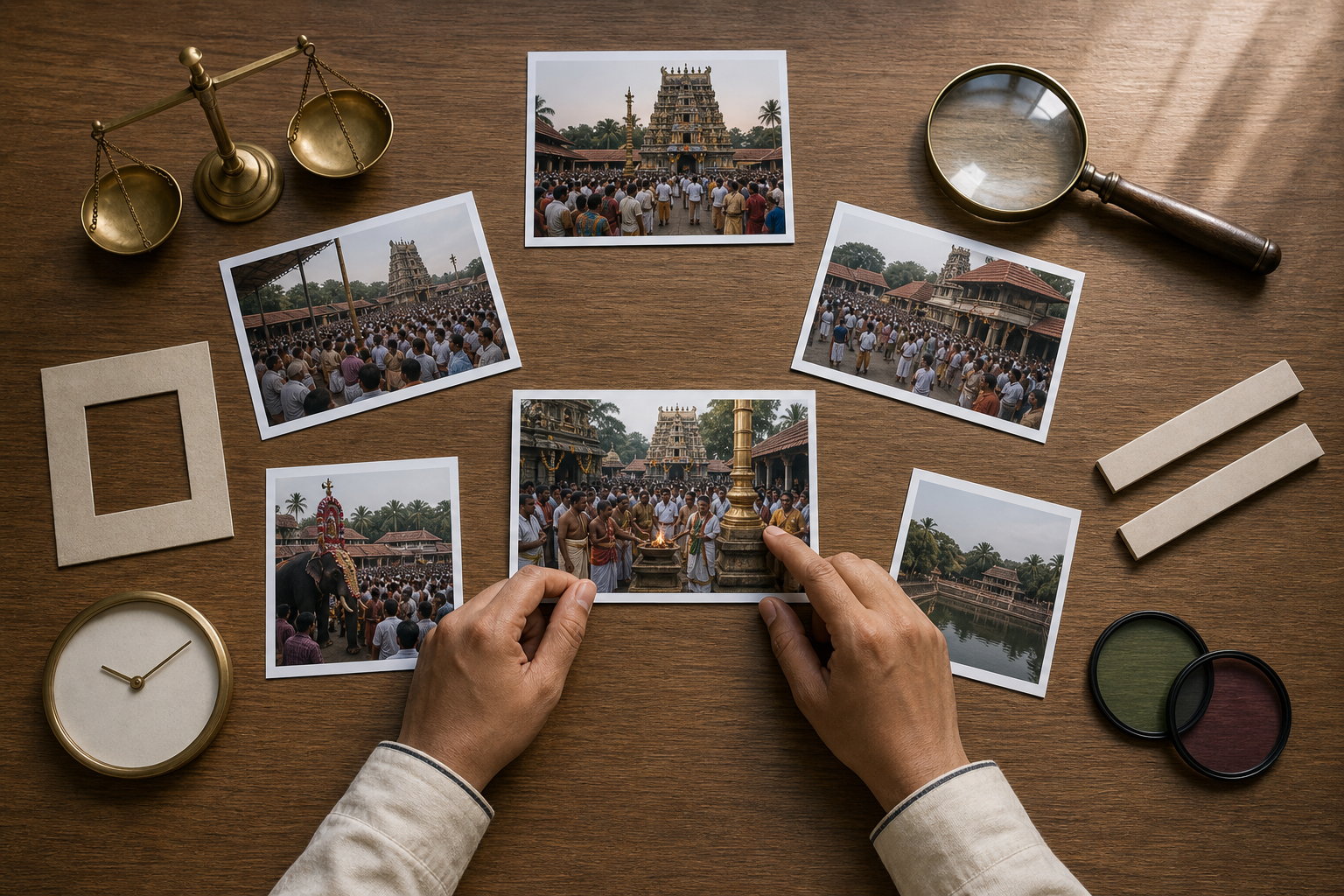
You do not need specialist media training to audit a story. Copy its headline and first two paragraphs into a note, then work through these questions. This takes a few minutes and usually reveals whether your objection concerns facts, context or framing.
- What is the literal claim, and what is the evaluative packaging? Underline the nouns and adjectives separately from the verifiable actions. "Pilgrims bathed" describes conduct; "bathing spectacle" tells you how to regard it. If removing an adjective changes the moral verdict but not the event, that adjective is doing the framing work.
- Who receives interiority? Notice who is allowed motives, memories and explanations. If officials and foreign observers speak while Hindu participants merely chant, bathe or gather, the story has distributed personhood unevenly. Look for at least one serious account of what the practice means to those performing it.
- Does one incident define an entire symbol or community? Move from the specific sentence to the headline. A report may document an individual’s wrongdoing and then use a religious slogan, temple or identity as the larger explanation. Demand evidence for that leap rather than treating proximity as causation.
- Which context is present, and which context is missing? Missing context is not proved merely because a story is short. Ask whether the omitted fact would materially change how a reasonable reader interprets the central claim. Participant meaning, the scale of an event and competing historical claims often meet that standard.
- Would the label survive a substitution test? Replace the Hindu subject with a religious tradition familiar to the outlet’s home audience. Would its pilgrims be reduced to bodies, its sacred building defined only by an opponent’s grievance, or its prayer defined by a criminal’s use of it? The comparison is diagnostic, not conclusive, but a stark difference warrants scrutiny.
- Does the criticism remain valid after neutral rewriting? Rewrite the loaded sentence in precise language. If a serious concern survives, engage with it. If the accusation disappears when the theatrical adjective is removed, the frame may have been carrying more weight than the evidence.
This method also disciplines pro-Hindu criticism. A single newsroom example cannot establish the motives of every Western journalist, and one objectionable phrase cannot prove that every negative fact is fabricated. The strongest case identifies a repeatable textual mechanism and shows exactly how it changes the reader’s understanding.
Answer distorted coverage without weakening your case

An angry denunciation may satisfy people who already agree with you, but it rarely persuades a careful reader. A useful response should be narrower than the distortion it challenges. Preserve what is true, identify what is missing and propose language that reports the same event more accurately.
- Capture the exact wording. Record the headline, relevant sentence, publication, date and link. Do not argue against a paraphrase when the original language is available.
- Name the type of failure. Distinguish a factual error from an omitted context, an unsupported inference or an unequal descriptive standard. Mixing all four into the word "bias" makes correction easier to evade.
- Restore only material context. Add the participant meaning, scale or historical dimension that changes interpretation. A pile of unrelated facts will look like deflection.
- Offer replacement wording. Show that accurate reporting remains possible. For example, "sacred pilgrimage and mass gathering that includes ritual bathing" preserves the visible act without reducing the whole event to visual entertainment.
- Concede any legitimate concern. If a violent act occurred, say it should be investigated and reported. If a historical dispute matters, say it belongs in the account. Your objection is stronger when readers can see that you are correcting a frame rather than demanding immunity from scrutiny.
A compact rebuttal can follow this structure: The report labels X as Y. That wording is inadequate because it omits Z or transfers the conduct of particular actors to a wider Hindu symbol. A more precise description would be A. The underlying issue B can still be examined on its own evidence.
Avoid answering civilizational reduction with another reduction. Calling all Western media anti-Hindu on the strength of one example repeats the very error you are contesting: turning a diverse field into the identity of its worst instance. Track patterns across wording, placement and repetition before making a systemic claim.
Key takeaways
- A statement can be literally defensible yet misleading when visual detail replaces religious meaning.
- Test coverage for accuracy, adequacy and symmetry instead of relying on a general impression of bias.
- Watch the governing noun phrase: "spectacle," "razed mosque" and "murder cry" each instruct the reader how to interpret the subject before the evidence is weighed.
- Keep the actions of particular people separate from the inherent meaning of a Hindu invocation, temple or tradition.
- The most persuasive response quotes the exact language, restores material context, offers a precise alternative and preserves any valid criticism.
The next time a report about Hindu India feels wrong, pause before sharing either the report or an outraged reaction. Mark the label, recover the missing point of view and rewrite the central claim in neutral language. You will then know whether you are facing an error, a legitimate criticism or a frame designed to do the arguing in advance.
References
