
If you have been told that archaeology disproves the Purāṇic ages—or that one ancient structure proves an epic chronology—you are being pushed toward a conclusion that the evidence cannot carry. The real question is not which side you must choose. It is what each kind of evidence can establish.
You need a method that respects dharmic testimony without converting reverence into an archaeological date. You also need to read scientific chronologies without mistaking a provisional model for the whole truth about the past. Once those tasks are separated, Purāṇic time and archaeology can challenge, constrain, and enrich one another.
Two clocks are measuring different dimensions of the past
Modern archaeological chronology normally arranges events in a non-repeating sequence. One occupation layer lies below another. A ceramic form appears, changes, and disappears. A settlement expands, contracts, or moves. The aim is to determine what happened first, what followed, and how much time separated the two.
Purāṇic time works at more than one level. It places dynasties and human events within an immense recurring order, while also describing changes in dharma, knowledge, social capacity, and moral condition. Satya, Tretā, Dvāpara, and Kali are therefore not merely four labels on a very long calendar. They mark qualitatively different phases within a repeating civilizational and cosmic pattern.
The conventional scale is mathematically explicit. A mahāyuga contains 4,320,000 years, distributed across four yugas:
| Purāṇic unit | Conventional duration | Place in the cycle |
|---|---|---|
| Satya Yuga | 1,728,000 years | The first of the four yugas |
| Tretā Yuga | 1,296,000 years | The second yuga |
| Dvāpara Yuga | 864,000 years | The third yuga |
| Kali Yuga | 432,000 years | The fourth yuga |
| Mahāyuga | 4,320,000 years | One complete four-yuga cycle |
Seventy-one mahāyugas form a manvantara, and fourteen manvantaras belong to a kalpa, conventionally described as a daytime of Brahmā lasting about 4.32 billion years. A night of equal length follows. Three hundred and sixty day-night cycles form a year of Brahmā, while one hundred such years span approximately 311 trillion years. Many reckonings also distinguish transitional intervals called sandhyā and sandhyāṁśa.
Those numbers establish the internal scale of the cosmology. They do not, by themselves, date a potsherd, settlement wall, river channel, or human burial. Conversely, a laboratory date assigned to a material sample cannot by itself disprove a cosmological cycle or measure the moral condition associated with a yuga. Confusion begins when one clock is made to answer the other clock’s question.
Before evaluating a chronological claim, classify it:
- A cosmological claim concerns the scale, formation, dissolution, or recurrence of worlds.
- An ethical claim concerns the waxing and waning of dharma, knowledge, conduct, or human capacity.
- A historical claim concerns a particular ruler, settlement, migration, flood, technology, landscape, or material event.
Archaeology can test the third kind most directly. It may place constraints on the historical setting in which the first two were transmitted, but it cannot reduce their full meaning to excavated material.
Cyclical thinking is also broader than one Hindu textual lineage. Buddhist kalpas, Jain ascending and descending time arcs, and Sikh references to the yugas express distinct teachings rather than one interchangeable system, yet all resist the assumption that history is simply a one-way climb from primitive life to permanent progress. That shared intuition matters when you interpret civilizational decline, recovery, and recurrence.
An archaeological date is a result with a context, not a verdict
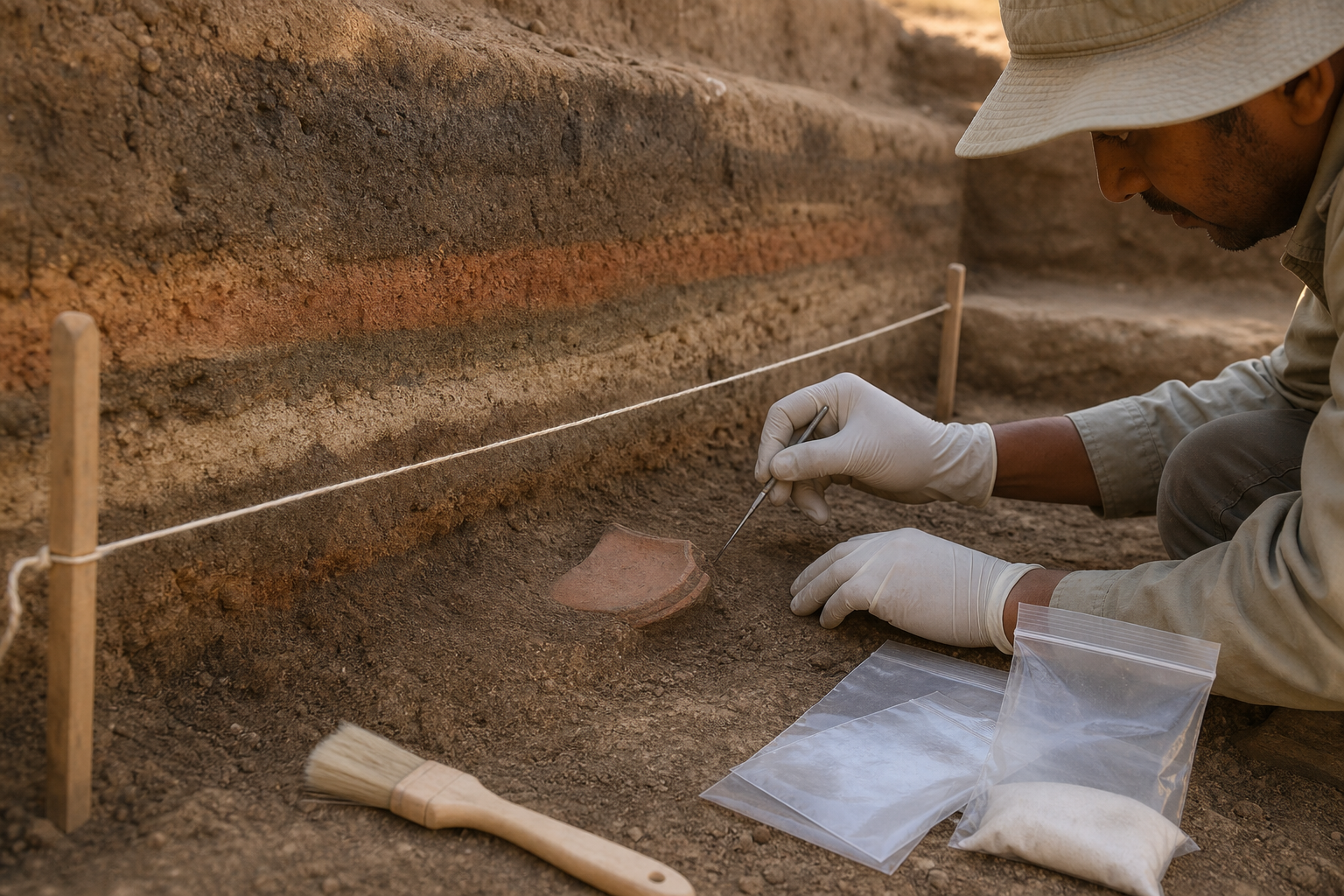
A date looks authoritative when it is reduced to a single number. In practice, the number belongs to a sample, the sample belongs to a layer or feature, and the interpretation belongs to an argument. If any link in that chain is weak, the historical conclusion must remain limited.
Stratigraphy establishes relative order when a site has retained its layers: lower deposits generally preceded upper deposits. Absolute dating methods then estimate when particular physical processes occurred. Different methods answer different questions:
- Radiocarbon dating estimates the age of suitable organic material. Calibration is necessary, and reservoir effects or the use of old timber can make the sample older than the event being investigated.
- Thermoluminescence can be applied to heated materials, including ceramics, but the result depends on the material’s radiation history and the event whose clock was reset by heating.
- Optically stimulated luminescence estimates when suitable sediment grains were last exposed to light. Incomplete bleaching before burial can distort the inferred age.
- Uranium-series dating can constrain the formation of suitable mineral deposits, but that mineral event must still be related carefully to the human activity under discussion.
- Archaeomagnetism uses a material record of Earth’s magnetic field, commonly preserved in appropriately heated or fired features. Its value depends on context and an adequate regional reference sequence.
Even a technically sound measurement may date something adjacent to the event you care about. Charcoal in a floor can predate the building. Sediment around an object can have been redeposited. A later pit can cut through an older layer. Roots, animals, erosion, flooding, and subsequent construction can move material across contexts. Perishable evidence may vanish completely, leaving an apparently empty interval that never was culturally empty.
This is why calibration, stratigraphic integrity, sample selection, taphonomic loss, and explicit error ranges matter more than the headline date. Bayesian chronological models can combine measurements with known stratigraphic relationships, but their output still depends on the quality of the samples and the assumptions entered as priors. Statistics can make assumptions visible and consistently applied; they cannot rescue contaminated material or circular reasoning.
When you encounter a claim that an excavation has proved or disproved a traditional chronology, ask for four pieces of information:
- What physical material was measured?
- What event does the chosen method actually date?
- Was the sample recovered from a secure and documented context?
- Do independent samples, methods, or laboratories converge within their stated uncertainties?
If those answers are missing, you do not yet have a chronological conclusion. You have an interesting claim that still needs its evidentiary chain.
Turn sacred memory into a question that evidence can test
Respect for śabda does not require making an artifact carry more meaning than its context permits. A textual memory can guide investigation while the material record decides whether a specific historical prediction survives. That is a stronger position than either dismissing the memory as fantasy or announcing confirmation after a superficial resemblance.
Use the following sequence when a Purāṇic, epic, or regional tradition appears to correspond with an archaeological discovery:
- Write the claim in one precise sentence. “An ancient city existed here” is different from “this structure belonged to a named city at a specified time.”
- Separate the claim into parts. Location, occupation, destruction, submergence, cultural identity, personal identity, and absolute date are separate propositions. Evidence for one is not automatic evidence for the others.
- State the expected material signature before examining the preferred result. A proposed river-supported settlement pattern should generate geographical, sedimentary, chronological, and archaeological expectations. A proposed coastal submergence should generate different ones.
- Build independent chronological lines. Date the occupation, environmental change, destruction layer, and later disturbance separately where suitable material exists. Do not use one convenient sample as the date of every event.
- Compare competing explanations against the same evidence. Gradual environmental change, abrupt disruption, local relocation, trade reorientation, and wider cyclical reorganization may leave overlapping traces. The favored interpretation must explain more than its rivals.
- State what would weaken the claim. If no possible finding could count against an interpretation, it is not functioning as a testable historical model.
A cyclical model earns archaeological value when it predicts a pattern that can be distinguished from generic change. “Civilizations rise and fall” is too broad because almost any sequence can be fitted to it after the fact. A useful model must specify the relevant region, interval, indicators, and recurrence: settlement contraction, reoccupation, changes in water systems, shifts in craft production, or some other observable combination.
The same discipline must be applied to a linear-progressive model. Increasing material complexity in one domain does not establish uninterrupted improvement in ethics, ecological stability, knowledge, or social order. A larger city may coexist with greater vulnerability. A lost craft may leave little trace. Archaeology records material survival, not a complete ranking of civilizations.
The best research design therefore declares its rival models and sampling strategy in advance, uses more than one suitable dating method where possible, seeks independent laboratory checks, publishes raw results and uncertainty, and permits replication. This does not privilege doubt over tradition. It prevents the desired conclusion from choosing the samples, assumptions, and comparisons that appear to support it.
Four fields show where disciplined cross-reading matters

Sarasvati: keep the river, settlement, and textual identity questions separate
The Sarasvati question is often compressed into a single yes-or-no dispute. It actually contains several investigations. Did major channels carry water? When and with what intensity? When did settlements occupy their banks? How did changing water conditions affect settlement? When did the name and memory represented in Vedic or later traditions become associated with that landscape?
Remote sensing can map buried channels. Sedimentology can reconstruct depositional environments. Geochronology can constrain phases of channel activity. Settlement survey and excavation can establish where communities lived and how their material culture changed. In the Ghaggar-Hakra system, palaeochannels, changing phases of Holocene flow, and dense settlement associated with the Indus-Sarasvati cultural horizon make integrated investigation worthwhile.
None of those observations alone establishes every part of the identification. A buried channel proves neither continuous flow nor a textual name. A settlement concentration does not automatically reveal why people chose the location. A textual description can motivate the geographical hypothesis, but sediment dates and occupation dates must be obtained independently. Keep the separate timelines visible, then examine where they overlap.
Dwarka: establish the context before naming the remains
Coastal and underwater finds are especially vulnerable to premature identification because dramatic settings encourage dramatic conclusions. Surveys around Dwarka and Bet Dwarka have recorded anchors, structural remains, and ceramics associated with late Holocene phases. Those finds justify careful investigation. They do not all have to belong to one construction episode, one inundation, or one named city.
Underwater context can be altered by currents, storms, sediment movement, reuse, and later maritime activity. The useful sequence is to document the object’s exact position, determine its relationship to nearby deposits and structures, establish material typology, apply suitable dating methods, and reconstruct the coastal geomorphology. Only then should the results be compared with textual memories of submergence, relocation, or rebuilding.
The distinction to preserve is simple: a tradition can lead you to the right place without every object at that place proving the entire tradition. Treating memory as a research lead protects its value; turning the first suggestive find into final proof makes the historical case easier to challenge.
Archaeoastronomy: date the observation before dating the text
Nakshatra positions, solstitial references, and precessional markers can sometimes define an astronomical window. The calculation may be exact while the historical inference remains uncertain. A verse may preserve an observation older than the surviving compilation, may have been redacted, may describe a ritual convention, or may be metaphorical rather than observational.
Use independent astronomical calculations, conservative error bounds, and corroboration from archaeology, palaeoclimate evidence, or inscriptions. Do not choose the desired historical date first and then search a large textual corpus for a sky configuration that can be made to fit it. The astronomical window, textual history, and material context must be constructed independently before they are compared.
Genetics and linguistics: use boundaries, not borrowed timestamps
Ancient DNA and population genetics can identify patterns of ancestry, interaction, and demographic change. Historical linguistics can model relationships, divergence, borrowing, and contact among languages. Neither discipline can independently assign an absolute date to a Purāṇic passage, identify a named individual, or prove that a material assemblage spoke one particular language.
Their proper role is to establish boundary conditions. A historical model must be compatible with the population interactions, language contacts, inscriptions, and material distributions relevant to its claim. Convergence strengthens the model. Conflict reveals where its route, scale, identity, or date needs revision. Do not transfer a date from genes to a text, from language to pottery, or from pottery to a named community without an independent bridge between them.
Key takeaways: five questions to ask before accepting a claim
- What is actually being claimed: a cosmological truth, an ethical pattern, or a datable material event?
- What object or physical process was dated, and is it demonstrably connected to the event being discussed?
- Is the archaeological context secure against intrusion, redeposition, erosion, and later disturbance?
- Do stratigraphy, laboratory dating, environmental evidence, texts, and other independent lines converge without borrowing assumptions from one another?
- What finding would make the proposed identification weaker or require its revision?
This method leaves room for a distinctly dharmic reading of history. Cyclical time warns you that material growth is not identical to moral progress, that knowledge can be lost, and that civilizational decline need not be permanent. Buddhist attention to impermanence and Jain accounts of ascending and descending conditions deepen that resistance to triumphal history. Archaeology, meanwhile, keeps historical claims answerable to surviving matter.
You do not honor Bharat’s past by demanding certainty where the context permits only a possibility. Nor do you defend scientific rigor by treating civilizational memory as irrelevant before testing what it preserves. The next time a sensational chronology appears, slow the argument down: identify the kind of claim, inspect the chain from sample to conclusion, and ask what independent evidence would have to agree. That is how a promising correspondence becomes a serious inquiry.
References
