
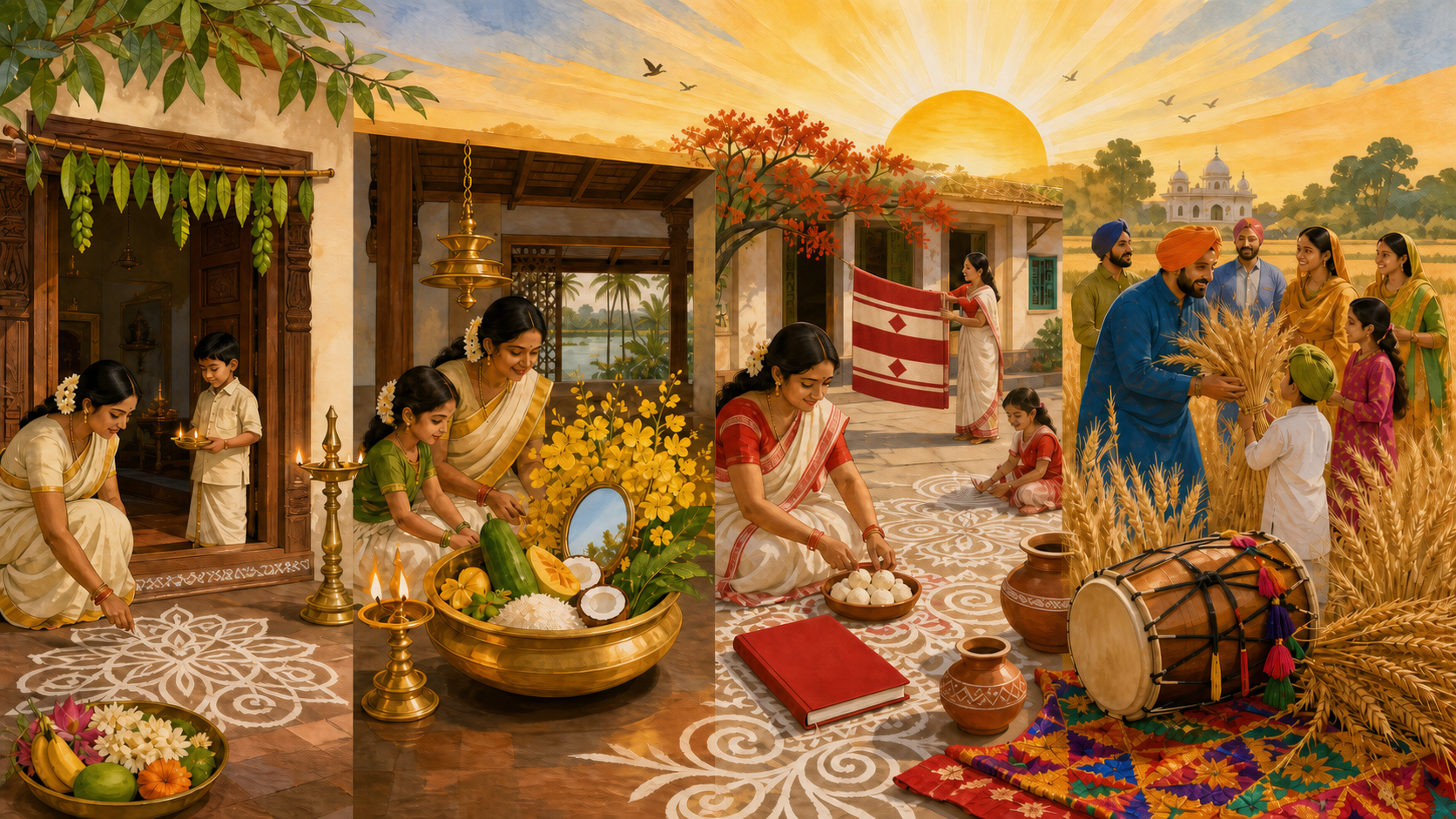
You open three family chats in April and find three different New Year greetings. One relative says Puthandu, another says Vishu, a Bengali friend is preparing for Poila Baisakh, and Vaisakhi appears in the same week. Then two calendars disagree by a day.
You don’t have to choose which tradition is the “real” one. You do need to know what each calendar is measuring, which locality it serves, and whether you are planning a ritual, a family meal, or a community event. Those three checks resolve most of the confusion.
The common threshold is solar, but the calendars are not identical

The mid-April cluster begins with an astronomical marker: Mesha Sankranti, the Sun’s entry into sidereal Aries. In technical language, this is nirayana Mesha, whose starting point is zero degrees in the sidereal zodiac. It is distinct from the tropical, or sayana, zodiac commonly encountered in Western astronomy. That difference is why the relevant solar ingress arrives around mid-April rather than at the March equinox.
In a sidereal solar calendar, an ingress can open a new month. For Tamils, Mesha Sankranti opens Chithirai, and Chithirai 1 is celebrated as Puthandu or Varusha Pirappu. In the traditional West Bengal reckoning, the concluding month Choitro corresponds to the Sun’s passage through sidereal Meena, or Pisces; its completion makes way for the new Bangabda year.
This shared solar structure does not turn the observances into interchangeable names for one festival. Tamil, Malayali, Bengali, Punjabi, Sikh, Sinhalese Buddhist, and Sri Lankan Tamil communities have developed their own ritual languages around the season. The astronomical neighborhood may be shared, but memory, theology, food, and social purpose remain local.
Nor is every spring New Year solar. Ugadi in Andhra Pradesh and Telangana and Yugadi in Karnataka belong to a lunisolar Chaitra framework and are generally observed earlier. Gudi Padwa follows that broader lunisolar rhythm as well. A lunar tithi and a solar ingress are different kinds of calendar marker, even when both festivals express renewal. Several South Indian almanacs also share a 60-year Jovian cycle and its year names, but a common cyclic name does not mean that every region starts the year on the same day.
What each regional observance asks you to notice
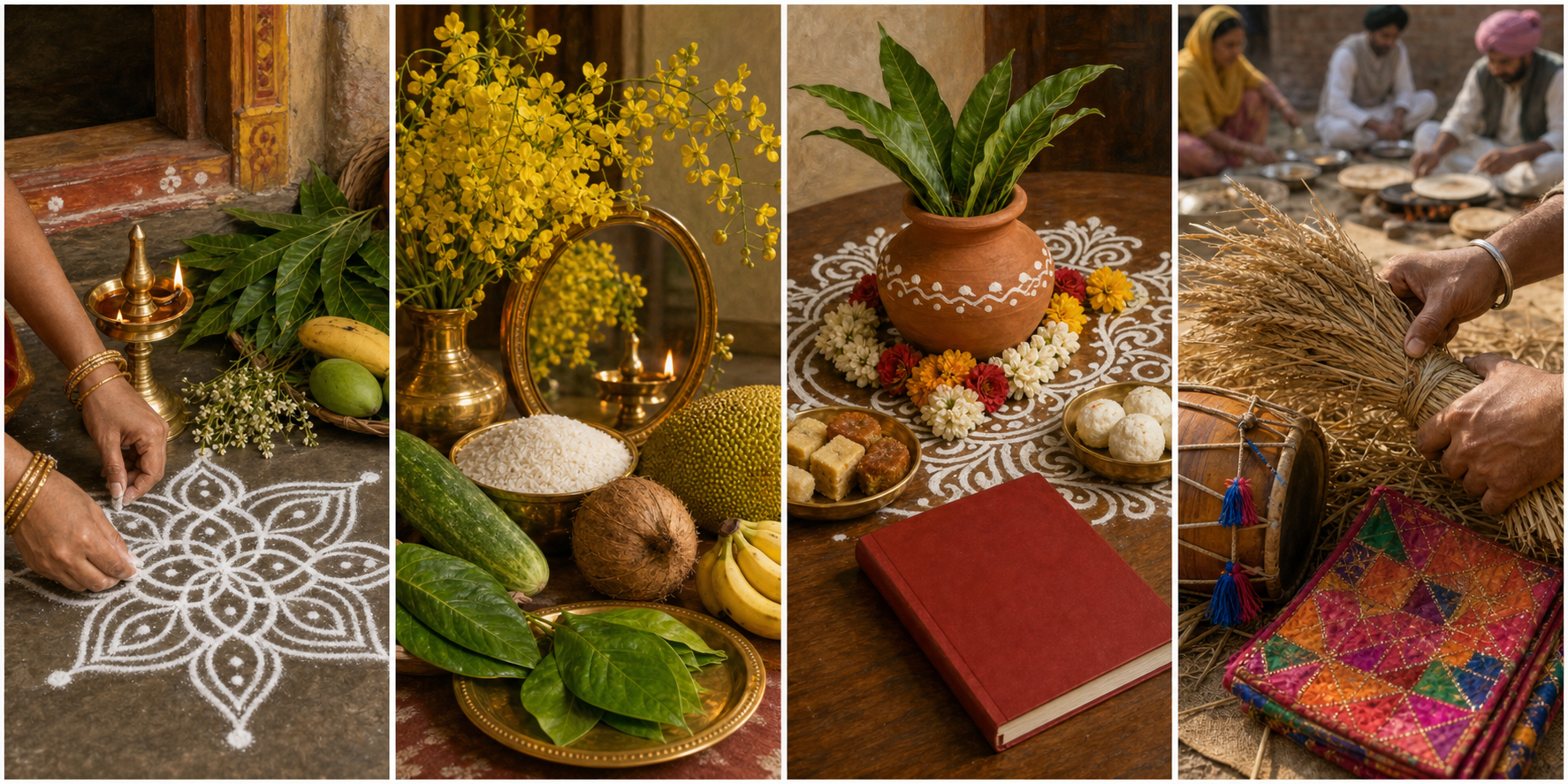
The clearest way to understand these traditions is to look at both the calendar anchor and the work the observance performs within its community.
| Tradition and region | Calendar relationship | Distinctive emphasis | What not to flatten |
|---|---|---|---|
| Puthandu or Varusha Pirappu in Tamil communities | Chithirai 1, associated with Mesha Sankranti | Dawn purification, kolam, lamp lighting, mango-leaf toranam, family blessings, worship, panchangam reading, and a festive meal | Maanga pachadi and Tamil household customs belong to a particular cultural grammar; they are not a generic menu for every April New Year |
| Vishu in Kerala | Associated with the same mid-April Mesha transition | The auspicious first sight, or kani, directs attention toward how the year is first received | Its resemblance to Tamil first-sight customs does not make Vishu another name for Puthandu |
| Poila Baisakh in Bengal | Begins the Bengali year after Choitro; West Bengal retains a sidereal solar panjika convention | Closing old accounts, preparing or opening the Halkhata, household renewal, and movement from Choitro austerity into celebration | Bangladesh primarily uses a revised civil calendar that fixes Pohela Boishakh to April 14, so “Bengali calendar” does not always identify one calculation |
| Vaisakhi in Punjab and Sikh life | Occupies the same mid-April season and coincides with Mesha Sankranti | Harvest, collective gathering, and a pivotal spiritual commemoration | It should not be reduced to a Punjabi translation of a southern solar New Year; its Sikh and agrarian meanings deserve to be named |
| New-year season in Sri Lanka | Shared mid-April seasonal window among Sinhalese Buddhists and Tamil Hindus | Merit, generosity, reconciliation, family participation, and community renewal | A shared season does not erase the distinct religious identities and inherited practices of the participating communities |
Puthandu’s maanga pachadi offers a particularly clear example of how a local practice carries philosophy. Its sweet, sour, bitter, salty, pungent, and astringent elements teach that the coming year will not have one emotional flavor. You receive the whole mixture and cultivate steadiness within it. You can appreciate that lesson without claiming that every regional New Year uses the same dish or symbolism.
Bengal places equal weight on the outgoing year. Choitro culminates in observances such as Gajan and Charak Puja, with vows, restraint, processions, dana, and prayers for collective and agricultural well-being. The movement into Poila Baisakh therefore begins before New Year’s morning: closure, restitution, and purification prepare the ground for auspicious recommencement.
Why two trustworthy calendars can show different dates

A one-day disagreement is not automatically an error. It usually means that the calendars are answering slightly different questions. Work through these checks before announcing that one of them is wrong.
- Identify the community and place. A West Bengal panjika and Bangladesh’s revised civil calendar do not apply the same rule to the Bengali year. A calendar prepared for Chennai should not be copied blindly for a family in Toronto or Singapore.
- Identify the kind of event. Puthandu and Vishu are tied to a solar ingress. Chaitra Navratri, Rama Navami, and other lunar observances depend on tithi and may use sunrise-based rules. The English word “Chaitra” can therefore appear in discussions of two systems without making their dates equivalent.
- Identify the computational convention. Traditional siddhanta-based reckonings, drik calculations using modern astronomical parameters, and regional panjika conventions can place a boundary slightly differently. Bengali almanacs may also differ in whether they follow a Bisuddha Siddhanta or drik approach. Treat the method as part of the date, not as invisible fine print.
- Identify what precision you actually need. A public greeting needs the date adopted by the relevant community. A sankalpa or exact Sankranti puja needs a location-specific time from a trusted local panchangam or temple calendar.
Solar and lunar dates also cross civil midnights differently. A solar observance is often assigned to the local civil date containing the relevant ingress, while a lunar festival may depend on which tithi prevails at sunrise. Time zone, latitude, longitude, and the rule used to assign the observance can therefore affect what appears on your phone.
For diaspora households, use a simple hierarchy. Follow your inherited family convention when the family is observing together. Use your local temple’s calendar for temple worship. Consult a location-specific panchangam when an exact muhurta matters. If a community celebration is moved to a convenient weekend, record the ritual date and the gathering date separately instead of making one replace the other.
This distinction is especially important in Bengal. West Bengal’s sidereal solar reckoning and Bangladesh’s fixed civil date can produce different planning instructions while both remain meaningful within their own settings. Asking “Which Bengali calendar?” is more useful than searching for a majority vote online.
Build your observance from the tradition’s own grammar
If you are preparing a household celebration, begin with the practices your family or regional community actually recognizes. You do not need an elaborate collection of objects. You need a clear sequence that joins completion, worship, relationship, and service.
- Close what can be closed. Clean the worship area and threshold, review routine household or business accounts where that belongs to your tradition, return what is owed when practical, and settle small unresolved duties. The point is to avoid carrying preventable disorder into a ceremonial beginning.
- Prepare local symbols. A Tamil household might draw a kolam, hang a fresh mango-leaf toranam, polish reusable lamps, and gather ingredients for maanga pachadi. A family observing Vishu may give special care to the kani. A Bengali business household may prepare the Halkhata. Choose the symbols that carry inherited meaning rather than assembling a pan-Indian festival collage.
- Begin at the appropriate time. At dawn, bathe or wash, light a deepam, offer a simple prayer, make a sankalpa, and seek the blessings of elders. If your family worships an Ishta Devata, use the prayers or namavali you already know. Precision in a complicated ritual is less important than sincerity unless you have deliberately undertaken a rite with formal requirements.
- Receive the calendar reflectively. A temple or household panchanga sravanam can help you consider the year ahead. Annual jyotisha indicators such as Aaya Vyaya, honor, expenditure, or challenge are better used as prompts for discipline and discernment than as deterministic scripts. Let the reading sharpen svadharma; do not let it excuse fear or passivity.
- Serve the regional meal without universalizing it. Explain to children why a dish matters, who taught it to the family, and what season made its ingredients available. If you borrow a custom respectfully, name where it comes from. Cultural unity becomes more credible when difference is remembered accurately.
- Extend the beginning beyond the household. Call an elder, include someone who would otherwise eat alone, contribute dana, volunteer at a temple or community kitchen, or support a local welfare effort. In Bengal’s year-end rites and Sri Lanka’s new-year season alike, collective welfare is not decoration around the festival; it is part of the renewal.
Ecological restraint fits naturally into this plan. Use biodegradable leaves and flowers where available, reusable lamps and vessels, and locally sourced seasonal food. Avoid treating abundance as disposable display. A household that begins the year by creating unnecessary waste has missed an opportunity to connect celebration with stewardship.
If you are greeting someone outside your own community, use the observance’s proper name. “Happy Puthandu,” “Happy Vishu,” “Shubho Nobo Borsho,” or a Vaisakhi greeting recognizes a living tradition more carefully than calling everything “Indian New Year.” We can speak of a shared dharmic and civilizational rhythm without pretending that every community tells the same story.
Key takeaways
- The mid-April cluster is largely shaped by the Sun’s entry into sidereal Aries, but a common astronomical season does not create one uniform festival.
- Check three things before using a date: the community, the locality, and whether the event is solar, lunar, or fixed by a civil calendar.
- A one-day difference may come from time zone, day-assignment rules, or the almanac’s computational convention. Use a local panchangam when a precise ritual time matters.
- Puthandu, Vishu, Poila Baisakh, Vaisakhi, and Sri Lanka’s new-year season should be understood through their own foods, memories, religious meanings, and social duties.
- A workable household observance joins closure, a simple sacred beginning, family transmission, a regional meal, and an act of generosity.
Before the next mid-April season, make one calendar entry with three fields: the tradition’s proper name, the local date and time, and the panjika or temple calendar your family follows. That small note will prevent the annual date dispute and leave you free to attend to what the day is actually for.
References
- DharmaRenaissance Blog — Varusha Pirappu 2026 (Parabhava): Date, Rituals, Auspicious Practices, and Cultural Significance
- DharmaRenaissance Blog — Choitro (Chaitra) 2026: Complete Guide to Dates, Gajan, Charak Puja, and Poila Baisakh
