
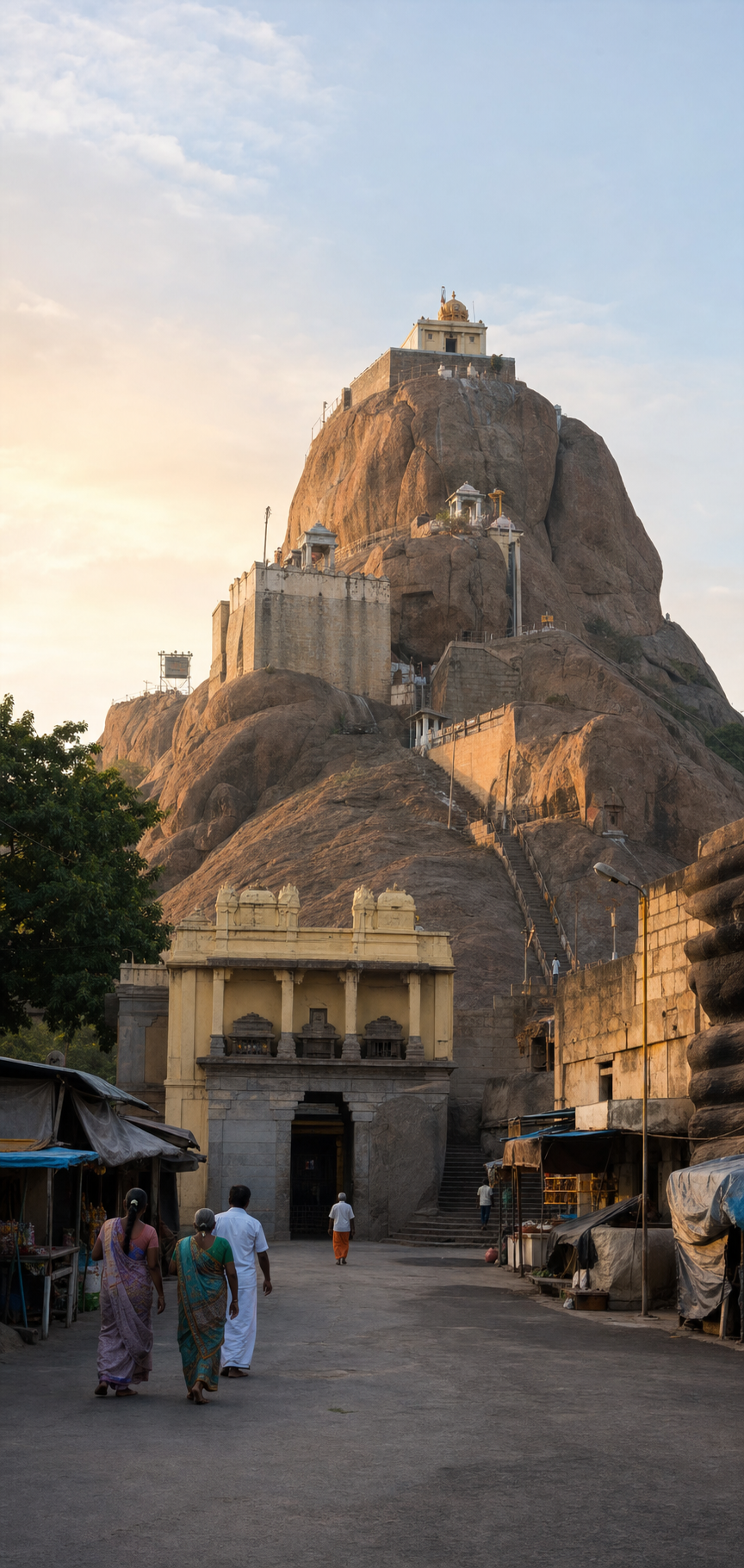
You may have only one morning in Tiruchirappalli and one clear hope: receive unhurried darshan, witness Abhishekam, and reach Ucchi Pillayar before the heat builds on the exposed stone. Whether that happens depends less on how quickly you climb than on when you arrive, which shrine you prioritize, and how much room you leave for temple time.
Rockfort is not merely a summit temple with a panoramic view. Its sacred order begins with Manikka Vinayakar at the foothill, continues through the Thayumanaswamy Temple of Shiva, and culminates at Ucchi Pillayar. When you approach all three as one pilgrimage, the climb becomes a movement through invocation, surrender, and renewed clarity rather than a race up approximately 417 steps.
Plan the ascent around the three shrines
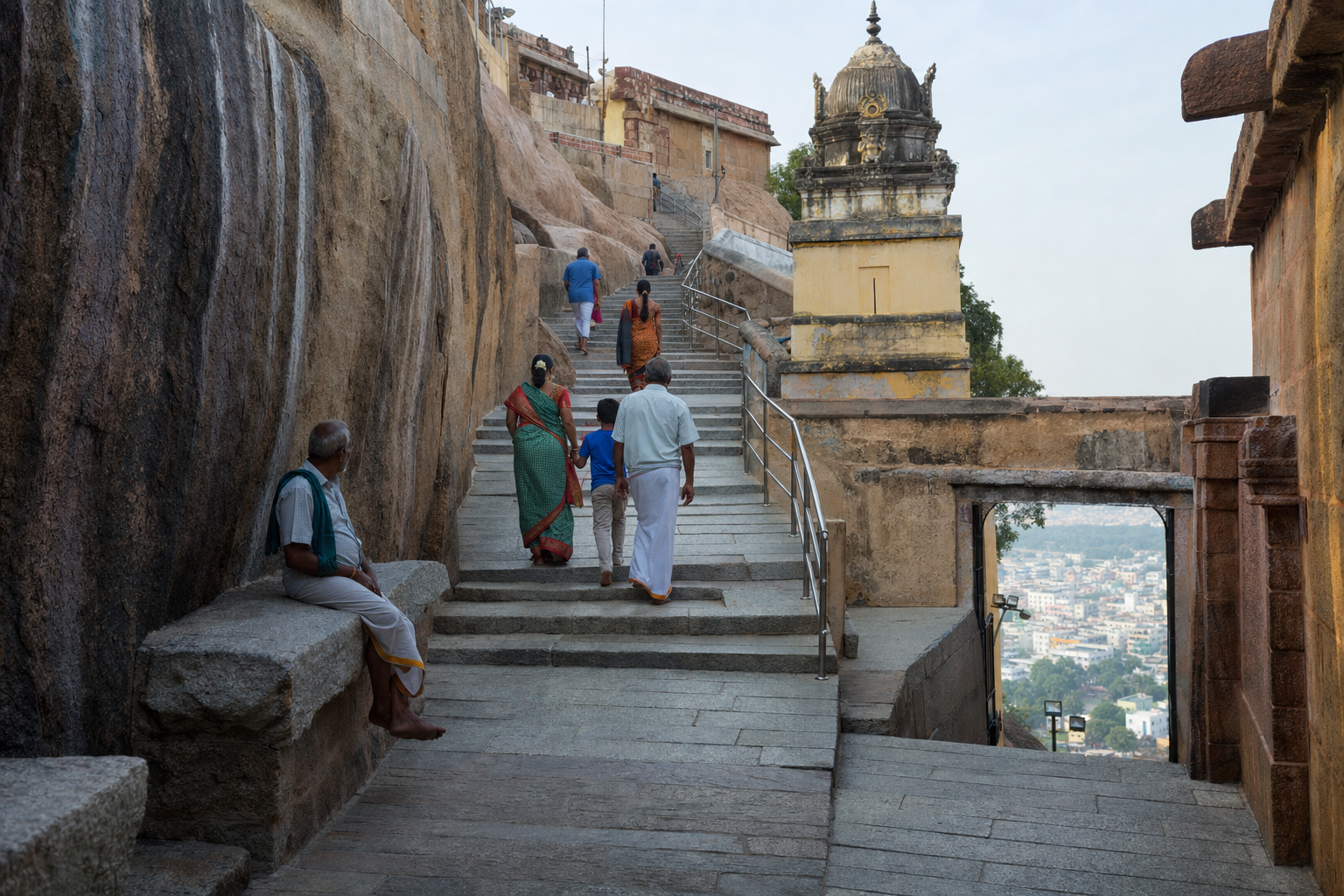
The most common planning mistake is to treat Ucchi Pillayar as the sole destination. That leaves the foothill shrine feeling like an entrance hall and the Thayumanaswamy sanctum like an interruption. Reverse that attitude. The order of the temples is part of what Rockfort teaches.
- Begin with Manikka Vinayakar. Pause before the climb instead of passing the shrine while mentally counting steps. Ganapati worship establishes the journey under the principle of obstacles recognized and removed.
- Give Thayumanaswamy the largest share of your time if Abhishekam is your main purpose. This Shiva temple stands roughly midway up the rock and has its own ritual gravity; it is not simply a rest stop on the way to the summit.
- Complete the ascent to Ucchi Pillayar. Receive darshan before turning toward the panorama. The view is memorable, but the summit remains a functioning shrine rather than an observation deck.
Thayumanaswamy means the Lord who became as a mother. Temple lore remembers Shiva coming to the aid of a devotee during childbirth, giving this form of the Divine an unusual tenderness within the physical severity of the rock. If you are carrying concern for a parent, child, pregnancy, family member, or anyone in need of care, you can hold that person in your sankalpa without converting prayer into a demand for a particular outcome.
The terraces and mandapas are useful places to recover your breath, but they can also prevent the pilgrimage from collapsing into physical exertion. At each substantial landing, stop long enough for your breathing to settle. Notice whether impatience, comparison, or the urge to hurry has taken over. Then begin again. That small discipline turns the ascent into tapas without making bodily strain an achievement in itself.
Arrive early and protect the morning Abhishekam window
For most pilgrims, sunrise is the practical anchor. The stone is cooler, the climb is less fatiguing, and morning worship is more likely to align with Abhishekam. Temple hours commonly extend from early morning toward midday and resume later in the afternoon, but you should not build a journey around a remembered timetable. Abhishekam schedules can change with lunar tithis, Pradosham, vratas, and festival observances, so verify the day’s opening and ritual times locally.
If you are arriving by train, use Tiruchirappalli Junction as the transport anchor and continue to the Rockfort foothill by local transport or rideshare. If you are approaching from Kalyanapuram through Kumbakonam, protect the first connection of the day: an early departure leaves room for railway delays and temple queues without forcing you to rush through worship.
Prepare for a steep sacred site, not a casual urban stop:
- Wear modest, light, breathable clothing that will remain comfortable on stairs and in humid conditions.
- Carry water for the approach and climb where permitted, but keep the bag small. Extra weight becomes noticeable well before the summit.
- Choose footwear with a stable, non-slip sole and which is easy to remove. Footwear must be left at the appropriate point before shoeless temple zones.
- Use the handrails on steeper stretches and rest in shaded alcoves when needed. A steady pace preserves attention better than alternating between rushing and long periods of exhaustion.
- If stairs regularly cause pain, breathlessness, dizziness, or instability, assess the climb conservatively and ask temple staff about current access conditions before committing to the summit. A handrail does not make every section suitable for every body.
- Keep photography for open terraces and other permitted areas. Do not assume that a visible murti, ritual, or interior doorway may be photographed; sanctum restrictions should be followed without argument.
Your preferred atmosphere should also determine the date. Maha Shivaratri intensifies worship at Thayumanaswamy, while Vinayaka Chaturthi draws greater attention to Ucchi Pillayar. Karthigai Deepam, Navaratri, and local Adi and Panguni observances can also bring larger crowds and expanded ritual activity. Choose these occasions if collective celebration is part of your purpose. Choose an ordinary early morning if silence and slower observation matter more.
Let Abhishekam become a discipline of attention
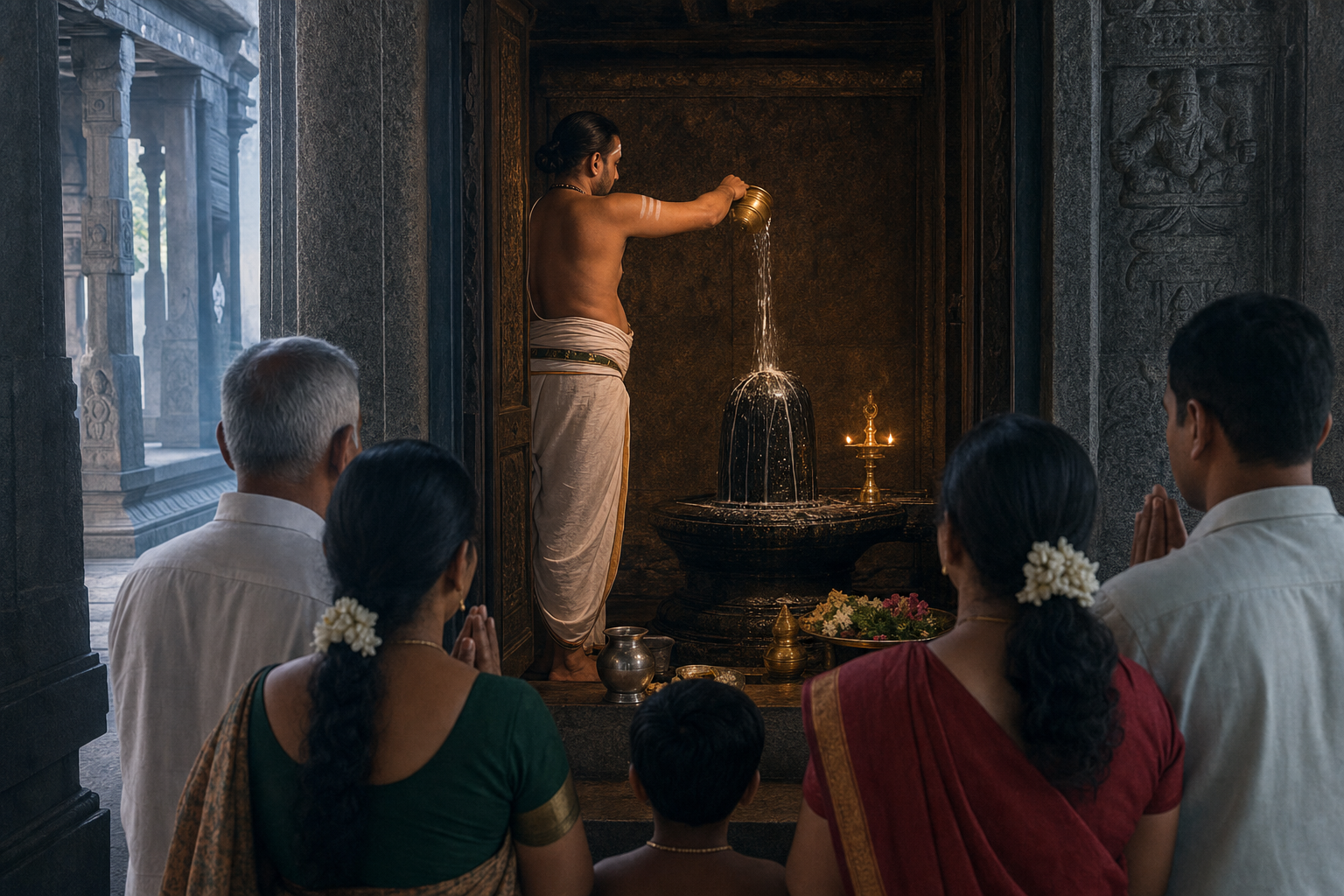
Abhishekam is often described too quickly as ritual bathing. Within the Agamic grammar of South Indian temple worship, it is a carefully ordered act in which selected substances touch the murti, are rinsed away, and give way to adornment and light. The Divine is not being cleaned in an ordinary sense. Purity, nourishment, auspiciousness, and gratitude are being enacted in a visible form.
If you witness the sequence of honey, milk, curd, and Panchamirtham, do not reduce it to a list of promised benefits. Attend to the quality each offering embodies:
- Honey carries the symbolism of sweetness and soothing. As it moves slowly across the icon, consider where harshness has entered your speech or conduct and what it would mean to answer without bitterness.
- Milk signifies purity, maternal nourishment, and sattvic calm. Let it direct attention toward what you consume through food, conversation, media, and company, not merely toward outward cleanliness.
- Curd represents fertility, prosperity, and grounded plenitude. Its density can remind you that dharmic life must become embodied in habits, work, family responsibilities, and service.
- Panchamirtham brings several offerings into balance. Its classical five nectars are milk, curd, ghee, honey, and sugar or jaggery, while regional forms may also include ripe banana. Its lesson is integration: sweetness alone is not balance, and purity alone is not a complete life.
The visible progression matters. Honey’s sheen gives way to milk’s whiteness, curd brings a heavier texture, and Panchamirtham completes the sequence with a fragrant richness. Rinsing is followed by sacred ash or sandal, floral alankara, and deepa-aradhana. What first appears to be a series of offerings resolves into form, fragrance, beauty, and illumination.
You can follow a simple contemplative discipline without interfering with temple procedure. Before entering the line, state one intention inwardly in a single sentence. During each offering, remain with its quality rather than asking for a growing catalogue of favors. When the lamp is shown, stop composing requests and simply look. The conch, bells, sandal fragrance, and feel of granite underfoot then become supports for dhyana rather than background sensations.
Arrive early enough to wait without resentment. Abhishekam is not a performance that must begin when your itinerary says it should. Line discipline, quiet near the sanctum, and attention to instructions are forms of seva because they preserve the ritual environment for everyone around you.
Read the rock as sacred geography and layered history
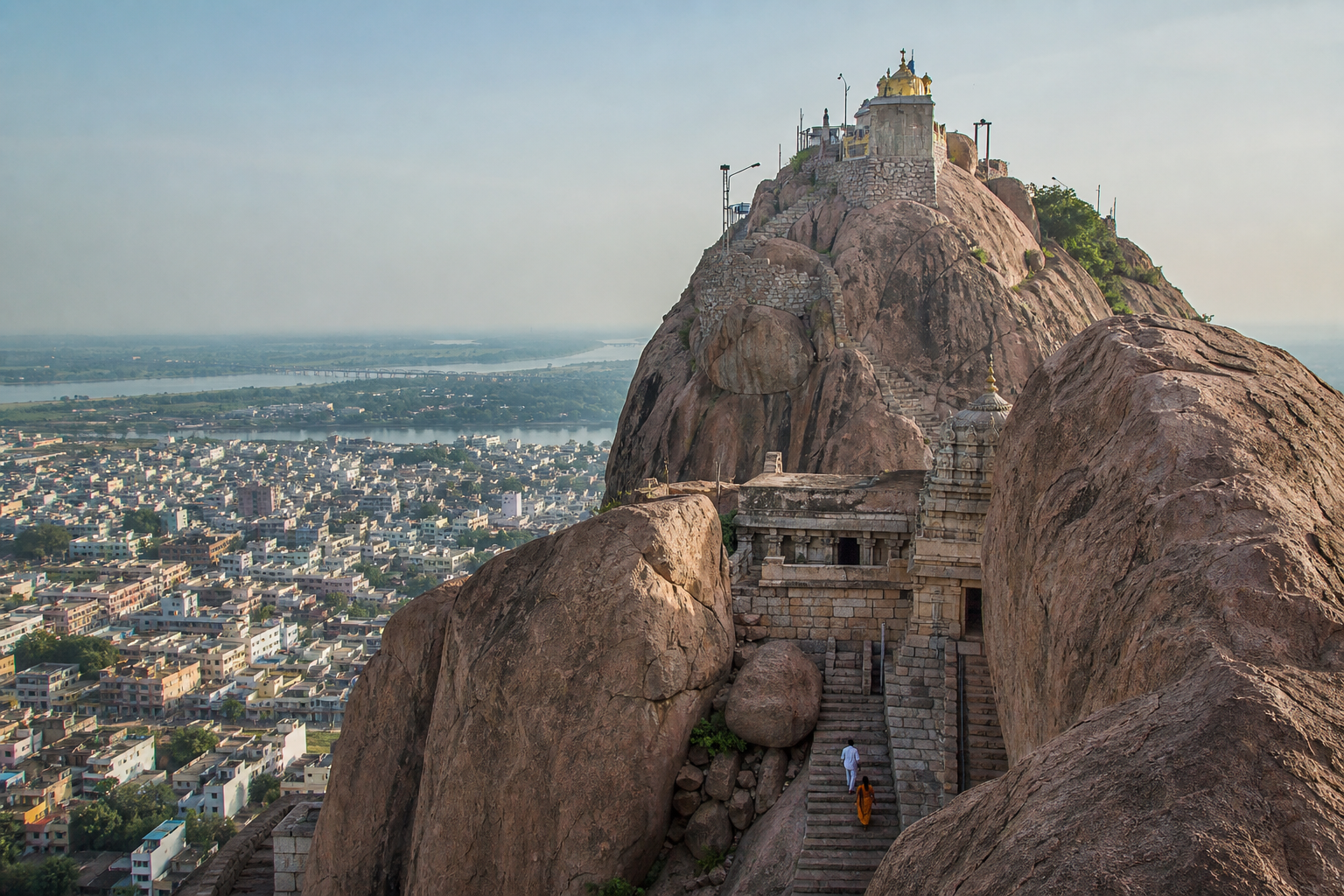
The hill is not a neutral platform beneath later monuments. It is the material presence that gives the pilgrimage its character. The outcrop consists largely of charnockite and related gneissic formations and is widely placed in the Archean eon. Estimates associated with the rock range from roughly 3.0 to 3.8 billion years, although such figures should be understood as a range rather than a single uncontested birthday. Even at the lower end, the stone carries a timescale far older than the Himalayas.
Pause with that scale for a moment. Hindu ritual regularly joins cyclical time, ancestral memory, and immediate action. At Rockfort, the physical setting makes that relationship difficult to ignore: a morning offering takes place on stone formed in the deepest reaches of Earth’s history. Your own urgency becomes smaller, but your conduct in the present does not become less important.
The built complex also preserves successive layers of Bharatiya and early modern history. Pallava cave-temple activity is associated with the sixth and seventh centuries CE. Chola-era additions followed. The Madurai Nayaks fortified the hill during the sixteenth and seventeenth centuries, creating the bastions and gateways behind the name Rockfort. Its height later made it strategically important during the eighteenth-century Carnatic Wars.
You can notice this history without turning darshan into an architectural checklist. Look for the transition from rock-cut space to constructed mandapas, the way gateways compress movement before terraces reopen the horizon, and how gopuram, prakara, shrine axis, and staircase adjust to the irregular hill. The architecture does not erase the rock. It negotiates with it.
Extend the pilgrimage into the Kaveri sacred landscape
From the upper terraces, the Kaveri floodplain and the gopurams of Srirangam place Rockfort within a larger sacred geography. Sri Ranganathaswamy Temple lies to the north, while Jambukeswarar Temple at Thiruvanaikaval lies to the east. Water, temple settlement, cultivation, and urban life are not separate themes here; they have shaped one another across the Kaveri basin.
If you have only a morning, complete Rockfort without compressing it and choose one additional temple rather than collecting hurried darshans. If you have a full day and the stamina for more walking and queues, Rockfort, Srirangam, and Thiruvanaikaval can form a coherent circuit. Begin at Rockfort early because the exposed ascent becomes harder as the day warms; leave the level-ground portions of the circuit for later.
At the summit, take in the Kaveri and Srirangam only from permitted open areas. Give way to moving queues, keep clear of ledges, and do not block access while taking photographs. The panorama is most useful when it helps you recognize the relationship between river and shrine, not when it becomes a contest for the widest camera angle.
Key takeaways for a focused Rockfort pilgrimage
- Arrive around sunrise if you want cooler stone, a steadier climb, and the best chance of aligning with morning Abhishekam.
- Confirm the day’s worship and opening times locally; lunar observances, Pradosham, vratas, and festivals can alter the usual rhythm.
- Treat Manikka Vinayakar, Thayumanaswamy, and Ucchi Pillayar as one ordered pilgrimage rather than rushing directly to the summit.
- Reserve enough time for Thayumanaswamy if Abhishekam is central to your visit. Waiting is part of temple time, so do not schedule the morning too tightly.
- Use the symbolic progression from honey to Panchamirtham as a framework for examining speech, purity, responsibility, and balance.
- Pace the approximately 417-step ascent according to your body. Use landings, shaded alcoves, and handrails, and do not turn strain into a measure of devotion.
- If you extend the day to Srirangam or Thiruvanaikaval, protect the quality of darshan by choosing fewer temples when time or stamina is limited.
Decide your primary intention before you leave: Abhishekam, quiet darshan, festival worship, historical study, or the wider Kaveri circuit. Then arrange transport, arrival time, and pace around that intention. Rockfort rewards a pilgrim who climbs attentively far more than one who reaches the summit quickly.