
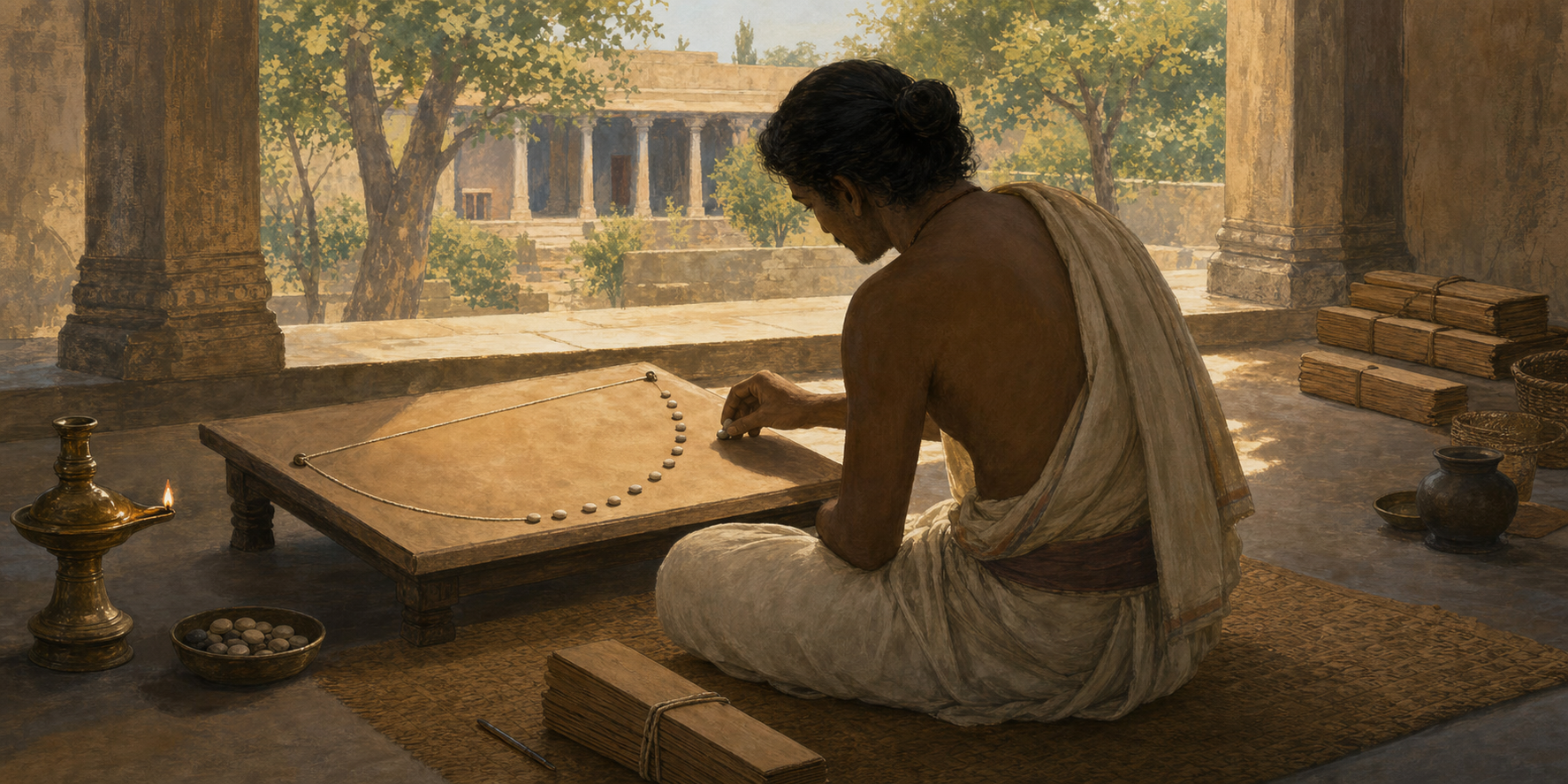
You searched for classical Indian mathematics because you want to understand what Bharat’s thinkers actually knew and how they worked. Yet the subject is often forced into a false choice: either Ganita was only an early version of a modern school subject, or every modern achievement was already present in ancient India.
You don’t have to accept either story. A better approach begins by preserving the tradition’s own vocabulary, reconstructing its procedures, and making only the historical claims that the evidence can carry. That approach is more demanding, but it gives you something far more valuable than a slogan: an intelligible encounter with an Indian knowledge tradition.
The first correction: translation is not identity

The English word mathematics is a useful entry point, but it should not become a cage. Ganita is not simply identical to the modern category called mathematics. The terms overlap, but an English approximation does not automatically reproduce the boundaries, classifications, methods, purposes, or standards of an Indian intellectual tradition.
This distinction matters because translation can quietly rewrite history. If you replace every occurrence of ganita with mathematics and then interpret the passage through a current curriculum, you may see only the parts that resemble what you already know. Features that do not fit the modern category can begin to look irrelevant, undeveloped, or merely cultural, even when they help explain how the knowledge was organized.
Use translation in layers. In your notes, retain the original term first, place a provisional English gloss beside it, and then record what the term is doing in that particular passage. Your entry might therefore begin with ganita, add mathematics as a temporary aid, and leave its precise function open until you have examined the surrounding problem and procedure.
Apply the same discipline to related vocabulary. If both Ganita and Ganitasastra appear, do not silently collapse them into one English word. Two distinct terms should remain distinct in your notes until context justifies treating them as equivalent. This simple habit prevents a convenient translation from erasing a potentially important conceptual boundary.
The practical rule is straightforward: translate so that you can begin reading, but keep the translation revisable. An English gloss is a bridge into the material, not a verdict on what the Indian term was allowed to mean.
Reconstruct the operation before making the comparison
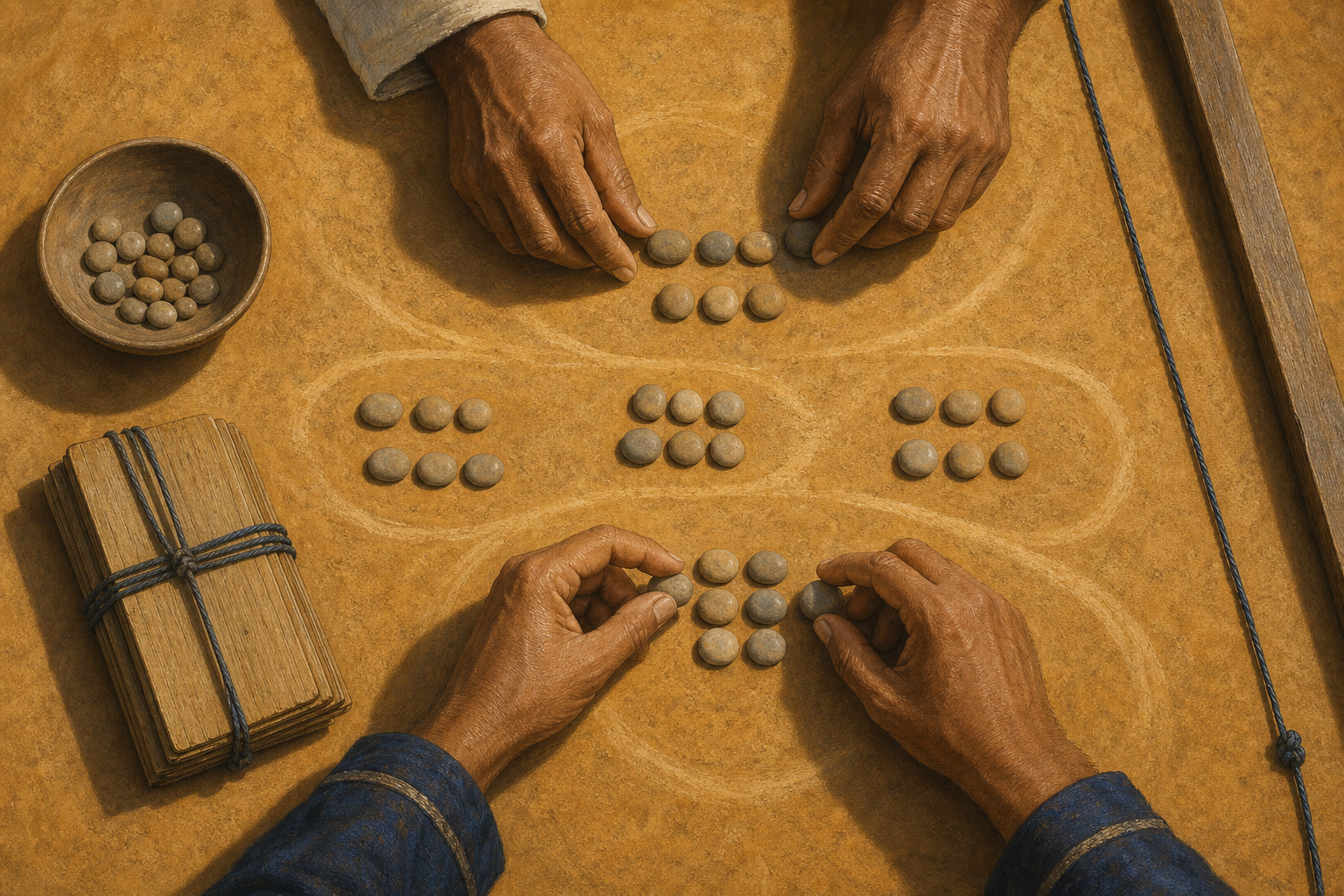
Recognizing a familiar answer is not the same as understanding a method. A modern formula may reproduce the result of a classical procedure while hiding the sequence of reasoning that made the procedure intelligible in its own setting. If you translate the passage immediately into current notation, that compact notation can make the old procedure appear more modern than it was, or more primitive than it was.
Read a Ganita passage as an act of knowledge, not merely as a container of conclusions. The relevant field includes terminology, classification, method, and validation. Each deserves its own question.
- Preserve the wording. Copy the technical terms before replacing them with English equivalents. Mark repeated words and changes in vocabulary.
- Identify the task. State exactly what is given, what must be found, and what counts as the completed result. Do not add a modern problem statement that the passage itself does not require.
- Trace the procedure. Write each operation in the order presented. Keep verbal instructions visible before compressing them into symbols.
- Separate rule from illustration. Determine which part offers a general procedure and which part merely demonstrates its use. An example can clarify a rule without defining its full scope.
- Execute the method. Work through the supplied operation and then try the procedure with another suitable case. This helps you notice omitted assumptions, limited conditions, or translation choices that a passive reading can conceal.
- Ask how the result is validated. Look for whatever makes the procedure or result acceptable within the passage. Do not assume that validation must take the form of a modern formal proof, but do not treat a correct-looking answer as sufficient evidence either.
- Compare only after reconstruction. Once you can explain the procedure without modern notation, translate it into a contemporary form and state both the similarity and the difference.
The final step is where useful comparison begins. You may find that a current symbol expresses the operation efficiently. You may also find that the symbol imports assumptions, classifications, or conceptual objects that were not stated in the classical formulation. Say both. A modern restatement can illuminate an older method, but it should not be mistaken for a transcript of the older thinker’s mind.
Keep uncertainty visible as you work. Use labels such as explicit, implied by the procedure, modern restatement, and unresolved. These labels make it much harder for an interpreter’s reconstruction to drift into the historical record as though it were the wording of the original material.
Civilizational confidence requires disciplined claims
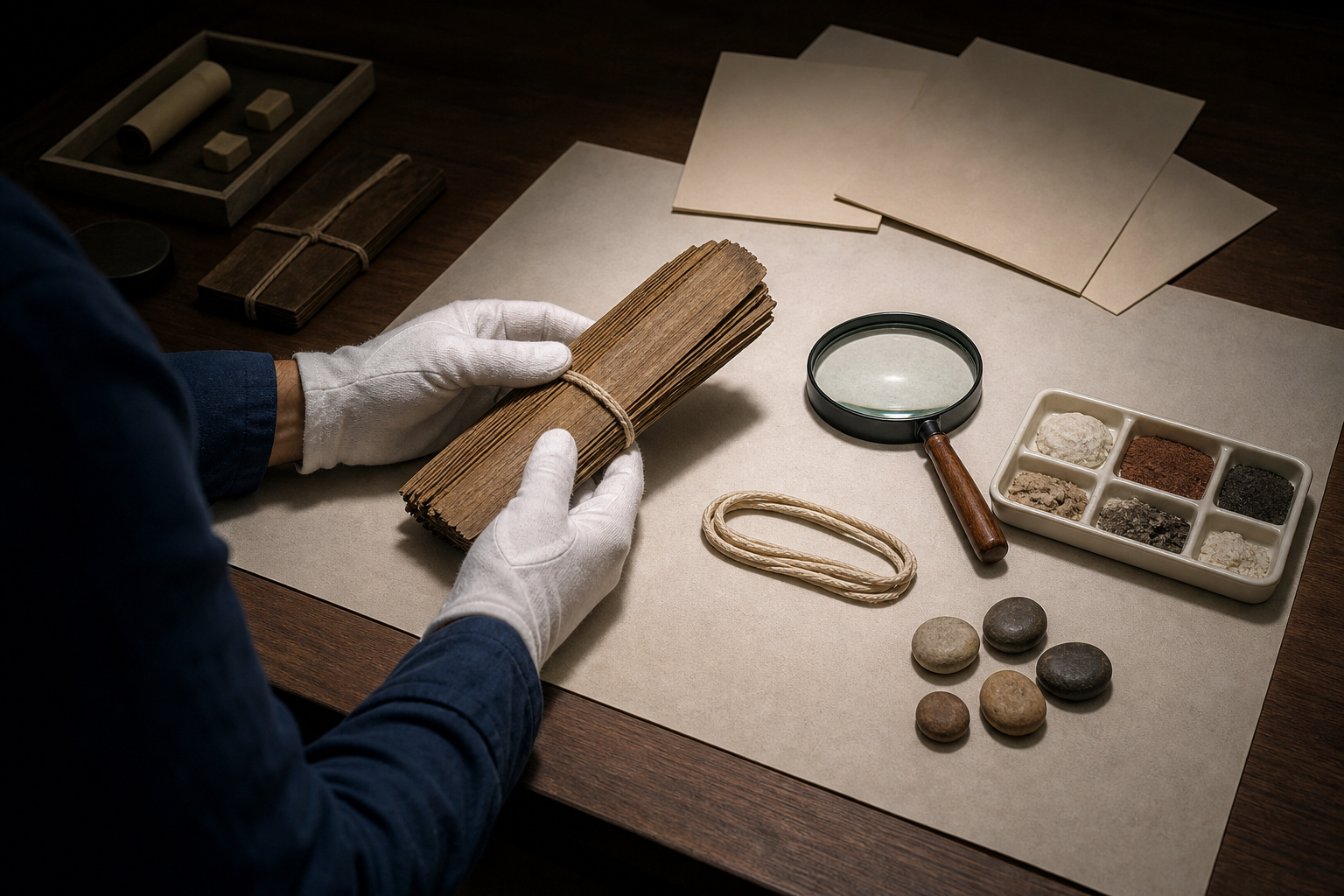
A pro-Bharat account does not become stronger by making the largest claim available. It becomes stronger when a reader can inspect the terminology, reproduce the operation, understand its validation, and see exactly where the conclusion ends. Precision is not a concession to hostile interpretations. It is how an intellectual inheritance is protected from both dismissal and exaggeration.
One common error treats a classical procedure as valuable only when it resembles present-day mathematics. That makes the modern discipline the sole judge of the past. It can acknowledge a familiar result while overlooking the Indian categories and practices that gave the procedure its own coherence.
The opposite error begins with a resemblance and leaps to identity, priority, or direct influence. Similar outcomes do not by themselves prove that two traditions used the same concepts. A modern notation capable of representing a classical operation does not prove that the classical author possessed everything now associated with that notation. Resemblance is a reason to investigate, not a complete historical argument.
Before accepting or repeating a claim about Ganita, put it through this filter:
- Textual anchor: Can the central claim be tied to identifiable wording, terminology, or a reconstructable procedure?
- Translation transparency: Are original terms preserved, and are approximate English equivalents clearly marked as approximations?
- Operational clarity: Can you perform the method as described, rather than merely recognize a modern result?
- Conceptual restraint: Does the interpretation distinguish what is explicit from what has been supplied by modern notation?
- Historical scope: Is the conclusion limited to the material actually examined, or has it been expanded into a claim about all of ancient India?
- Validation: Does the claim explain why the result or procedure was accepted, rather than treating agreement with a modern answer as the entire case?
- Comparison discipline: Are similarity, identity, influence, and priority treated as different claims requiring different evidence?
If a claim fails this filter, you do not need to reject Ganita. You need to narrow the claim. Replace an inflated assertion with the smallest statement that the terminology and procedure actually support. A bounded claim can later be enlarged when further evidence appears; a spectacular but unsupported claim gives critics an easy reason to ignore the underlying achievement.
Key takeaways for reading Ganita responsibly
- Keep Ganita visible instead of treating mathematics as a complete translation.
- Record the original term, a provisional English gloss, and the term’s observed function as separate things.
- Reconstruct the sequence of operations before rewriting it in modern symbols.
- Ask what validates a procedure within its own presentation; do not equate validation automatically with either modern proof or mere numerical success.
- Distinguish a modern restatement from a historically explicit concept.
- Treat resemblance, identity, influence, and priority as separate conclusions.
- Defend Bharat’s intellectual heritage with reproducible methods and carefully bounded claims.
Turn your next reading into a working Ganita notebook

You can put this approach into practice with the next short passage you encounter. Divide your notebook entry into the original vocabulary, the problem being addressed, the ordered procedure, the mode of validation, and a later modern comparison. Finish with two summaries: one that explains the passage using its retained terminology, and another that explains what a contemporary mathematical reader might recognize in it.
Then add a boundary statement: what does this passage not establish? It may not establish the meaning of the term in every setting, the practice of every school, a line of transmission, or a claim of priority. Writing that boundary is not an act of doubt. It shows that you know the difference between respecting evidence and recruiting the past for a conclusion chosen in advance.
Begin with one manageable procedure and make it fully intelligible. Preserve its vocabulary, perform its operations, identify its validation, and mark every modern addition. That patient reconstruction is how Ganita stops being a civilizational slogan and becomes a living object of study.