
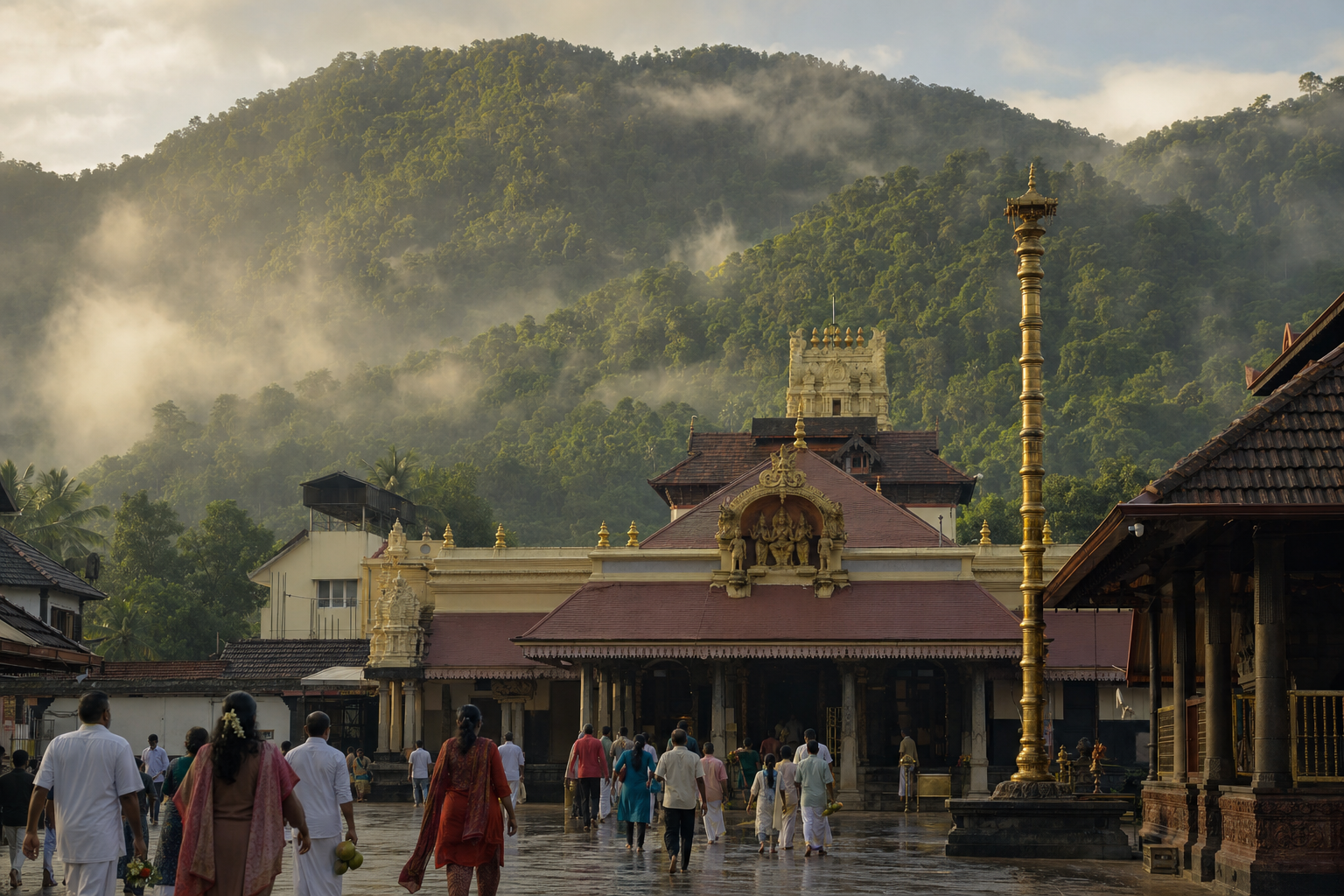
You may arrive at Kukke Subramanya with a family vow, a concern about sarpa-dosha, or a simple wish for darshan. In each case, the most useful preparation is the same: understand that you are entering a connected sacred landscape, not merely joining a queue for one sanctum.
The temple stands in Subrahmanya town, beside the Kumaradhara River and at the forested edge of the Western Ghats. Its main sanctum, Naga-related rites, ancillary shrines, river, Matha and monsoon-shaped buildings form one ritual geography. Reading that geography correctly will help you plan your visit, avoid common mistakes and notice what the architecture is teaching.
Begin with your purpose, not a ritual name
Decide first whether you are coming for ordinary darshan, fulfilling a known vow, or undertaking a rite already discussed with the temple. Do not book a major ceremony merely because a relative, driver or social-media account has attached the label sarpa-dosha to a difficult period in your life. A dharmic rite is a disciplined act of worship and atonement, not a speculative diagnosis or a guaranteed transaction.
Sarpa Samskara and Ashlesha Bali belong to Kukke’s established stream of Naga veneration. They are associated with atonement for transgressions symbolically connected with the Naga principle, including inadvertent injury to serpents or disturbance of their habitat. Both are priest-guided observances that commonly require advance arrangements. Their names should not be treated as interchangeable instructions. Ask the temple which rite applies, what must be booked, who must attend, when to report and which offerings are authorized.
If you have already booked a rite, its prescribed order takes precedence over a self-designed temple tour. Sarpa Samskara or Ashlesha Bali may include visits to Adi Subrahmanya and other sannidhis as part of a coherent sequence. Follow the officiating priest’s directions rather than breaking away to complete a personal checklist.
Kukke’s ritual life is not limited to Naga observances. At the KukkeLinga shrine, Shaiva abhishekas and lamp offerings sit naturally within the larger Subrahmanya kshetra. This is an important clue to the temple’s character: Kaumara worship remains central, while Shaiva and Vaishnava presences support rather than compete with that identity.
Key takeaways
- For ordinary darshan, use the temple’s natural sequence and do not invent ritual obligations for yourself.
- For Sarpa Samskara or Ashlesha Bali, verify the current booking, reporting and participation requirements directly with the temple.
- During a booked ceremony, follow the priestly sequence even when it differs from a general visitor’s route.
- Route every offering through authorized counters; never leave milk or food in an anthill, forest patch or other presumed serpent habitat.
- Wear modest, traditional clothing. Men should be prepared to remove shirts and vests before approaching the inner sanctum, and everyone should follow current photography and queue notices.
Follow the sacred circuit as a progression
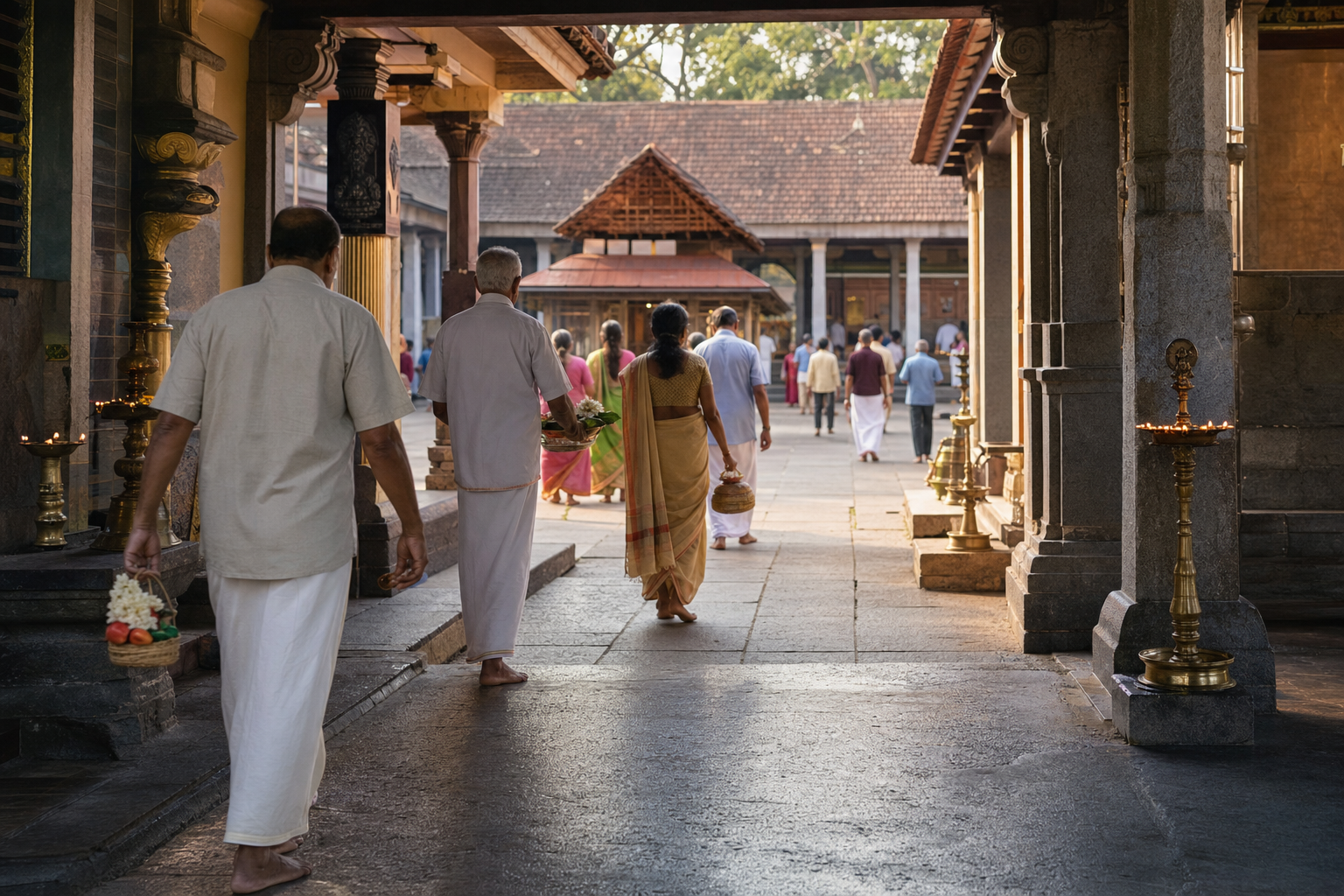
A sensible general visit begins at the Ganesha sannidhi near the entrance. The shrine is modest in scale, but its position is deliberate. Pause there instead of treating it as a minor stop: Ganapati worship marks the transition from travel, conversation and logistical distraction into an auspicious devotional frame.
From there, move toward the Garuda-stambha and the main sanctum. Within Kukke’s sacred symbolism, the stambha is more than a visual marker. It stands as a protective boundary connected with Subrahmanya’s guardianship of Vasuki. Use this threshold to settle yourself before darshan rather than pressing forward only to gain a few places in the queue.
After the principal darshan, many pilgrims continue to Adi Subrahmanya. Its Naga stones and sanctified valmika, or anthill, express the kshetra’s primordial association with Subrahmanya and Vasuki. Some ritual procedures may place this visit before or after the main sanctum, so priestly instructions should determine the order when you are performing a formal rite.
The KukkeLinga shrine then makes the Shaiva relationship visible. An Ishvara or Uma-Maheshwara presence in the wider precinct reinforces the same point: Subrahmanya worship here belongs within a connected Hindu sacred order. You do not need to rush through every ancillary sannidhi. Give each one enough attention to understand its ritual function, and leave space for devotees whose observance requires a particular station.
If time and access permit, include Sri Samputa Narasimha in the Sri Subrahmanya Matha. The compact, casket-associated form of Narasimha carries a protective meaning and is linked with the Dvaita lineage and the memory of Sri Madhvacharya. The Matha is administered independently, so do not assume that the main temple’s queue, timings or instructions automatically govern it. Treat it as a related but distinct node in the larger kshetra.
This circuit is not a collection exercise. Ganapati prepares the beginning; the Garuda-stambha marks protection and transition; the main sanctum gives the visit its centre; Adi Subrahmanya discloses the Naga relationship; and KukkeLinga and Samputa Narasimha reveal the wider Shaiva and Vaishnava harmony around the principal deity. Once you see that order, circumambulation becomes intelligible rather than hurried.
Let the architecture teach you how Kukke works
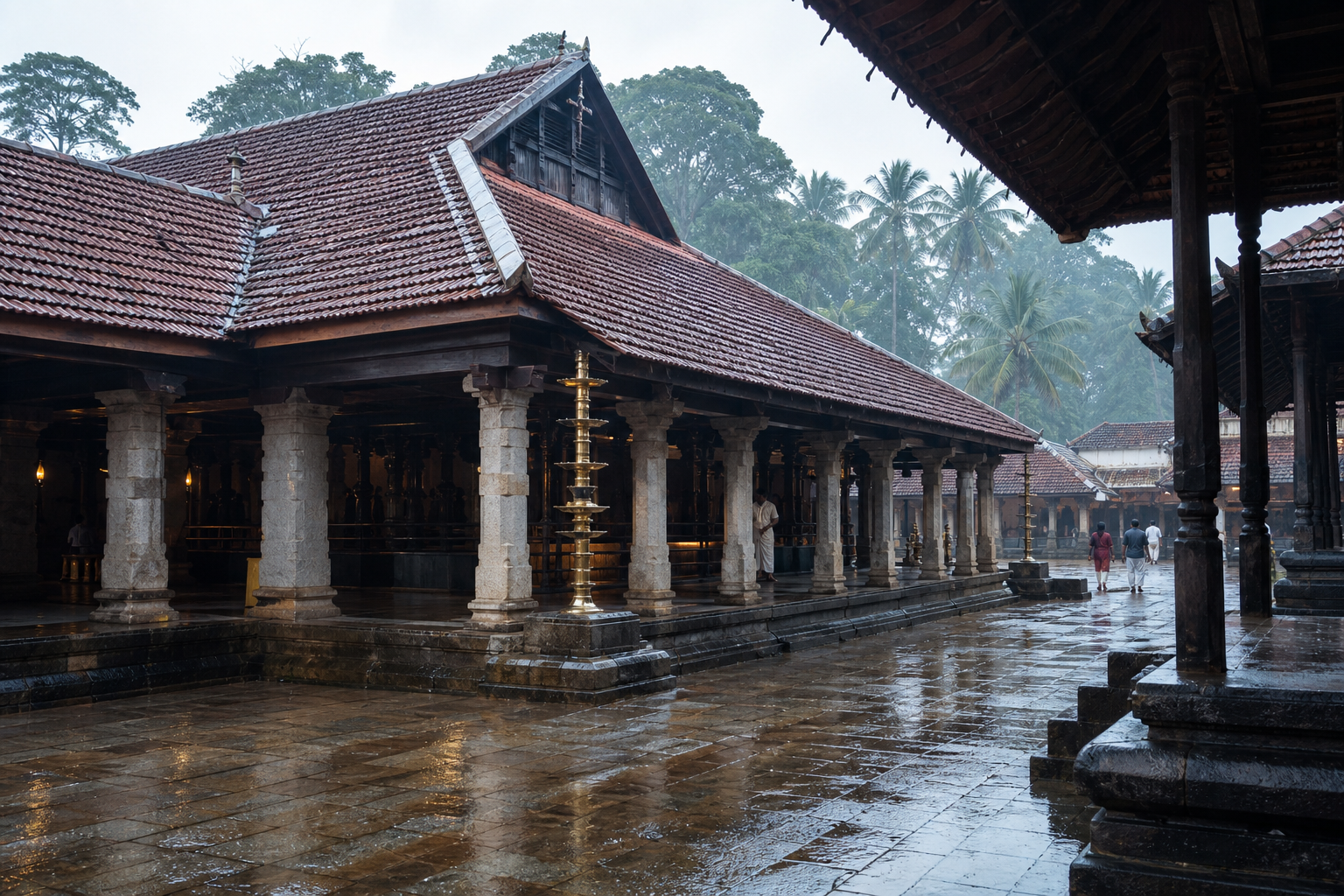
Do not judge Kukke by whether it resembles a temple dominated by a tall masonry tower. Its architecture belongs to the high-rainfall world of Tulunadu. Pitched tiled roofs, timber framing, wooden joinery and a relatively restrained exterior are practical responses to the monsoon. They also give the complex an inward-facing character: attention gathers progressively around the sanctum instead of being spent on a distant skyline.
As you enter, notice the broad ritual sequence of mahadwara, balipeetha, dhwajastambha, layered mandapas and square garbhagriha. These are not unrelated fixtures. They regulate movement from the public threshold toward increasing sacred concentration. Walk through them without blocking the flow, and observe how roof height, enclosure, light and proximity change as you approach the centre.
The square sanctum is especially significant. Within vastu and agamic temple grammar, the square provides a stable mandala on which sacred space can be ordered. At KukkeLinga, the square garbhagriha has no towering vimana. That absence is not an architectural deficiency. It reflects a regional method in which a timber-and-tile superstructure can shed rain, limit excessive load and preserve the sanctum’s gravity without a massive vertical crown.
This gives you a practical way to read the complex. Look first at how water would leave a roof, how deep eaves protect timber, how covered spaces manage movement and how the sanctum remains visually concentrated. Kukke’s craft becomes clearer when you ask how architecture serves climate and ritual together, rather than searching only for sculptural monumentality.
Festivals change the way this architecture functions. Subrahmanya Shashti, deepotsava and ratha-related observances activate the mandapas, processional routes and ancillary shrines with larger congregations, lamps, sound and movement. If you visit during a major observance, expect the sacred circuit to operate as communal liturgy rather than as a quiet architectural walk. Check current access instructions before assuming that every shrine will be approachable in the usual way.
Treat the river and forest as part of the kshetra
Kukke’s sthala-purana remembers Vasuki seeking refuge in the forest and receiving Subrahmanya’s protection. The name Kukke is associated in local sacred memory with a wicker basket and an act of concealment or safeguarding. Whether you approach this account devotionally or as sacred geography, its ethical direction is plain: protection, not exploitation, defines the Naga relationship.
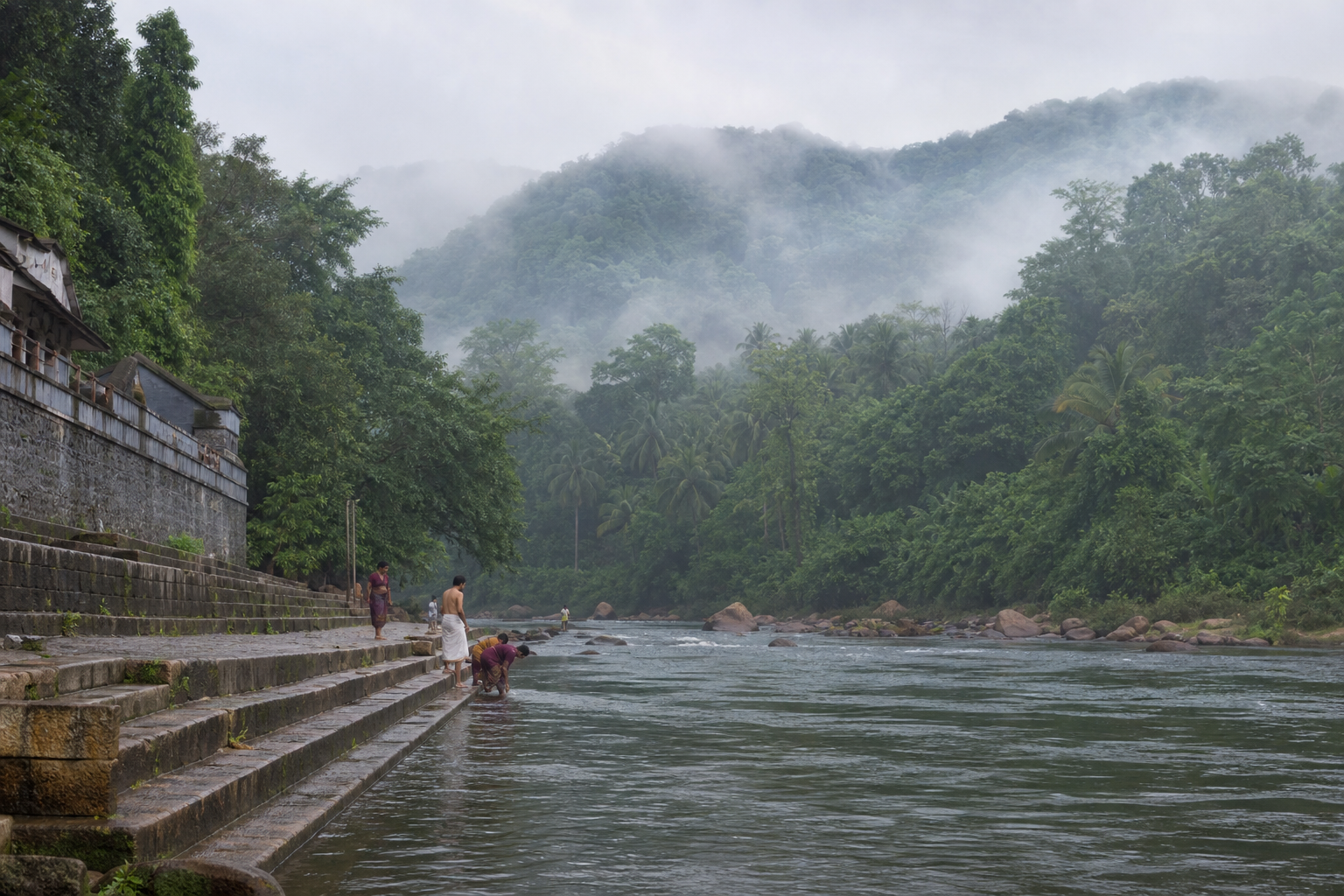
That principle matters at Adi Subrahmanya, Biladvara, the forest paths and the Kumaradhara River. These are not decorative surroundings. The cave, earth, water and canopy preserve the kshetra’s older Naga associations and extend worship beyond constructed walls.
Enter the Kumaradhara only when bathing is permitted and local conditions are safe. Western Ghats rain can change currents and travel conditions, so an inherited custom is not permission to ignore a present warning. If immersion is unsafe or restricted, you can retain the tirtha’s contemplative purpose through prayer, mantra-japa or quiet reflection from an appropriate place on the bank.
Never pour milk, discard food or place puja materials in a natural serpent habitat. Authorized temple counters should receive ritual offerings. This protects the habitat, keeps waste out of the landscape and preserves the integrity of the ceremony. Naga devotion that damages earth or water contradicts the protective meaning at the heart of Kukke.
Make a visit plan that can survive changing conditions
Subrahmanya Road railway station, on the Mangaluru-Bengaluru line, is approximately 12-15 kilometres from the temple, with onward road transport available. Mangaluru International Airport is the principal air gateway. The final approach passes through the Western Ghats foothills, and monsoon conditions can lengthen road journeys. Build flexibility into your arrival rather than scheduling a booked ritual against the narrowest possible connection.
Before leaving home, verify four things through current temple information: whether your ritual requires advance booking, the reporting instructions, the dress requirements and any access or photography restrictions. Arrangements can change, particularly around festivals and heavy seasonal crowds. An old itinerary or forwarded message should not overrule the temple’s present noticeboard or information counter.
For a general visit, begin with Ganapati, pause at the Garuda-stambha, take main darshan and then continue through Adi Subrahmanya and the ancillary shrines without racing. For a formal rite, arrive with your confirmation and let its prescribed sequence govern the day. In both cases, keep offerings within authorized channels and obey river advisories.
Make one clear note before you travel: why you are going, what has actually been booked and which details still require confirmation. Once you arrive, allow Kukke’s sequence of threshold, sanctum, subsidiary shrines, river and forest to order your attention. That is the simplest way to turn a crowded pilgrimage into a coherent act of dharma.