
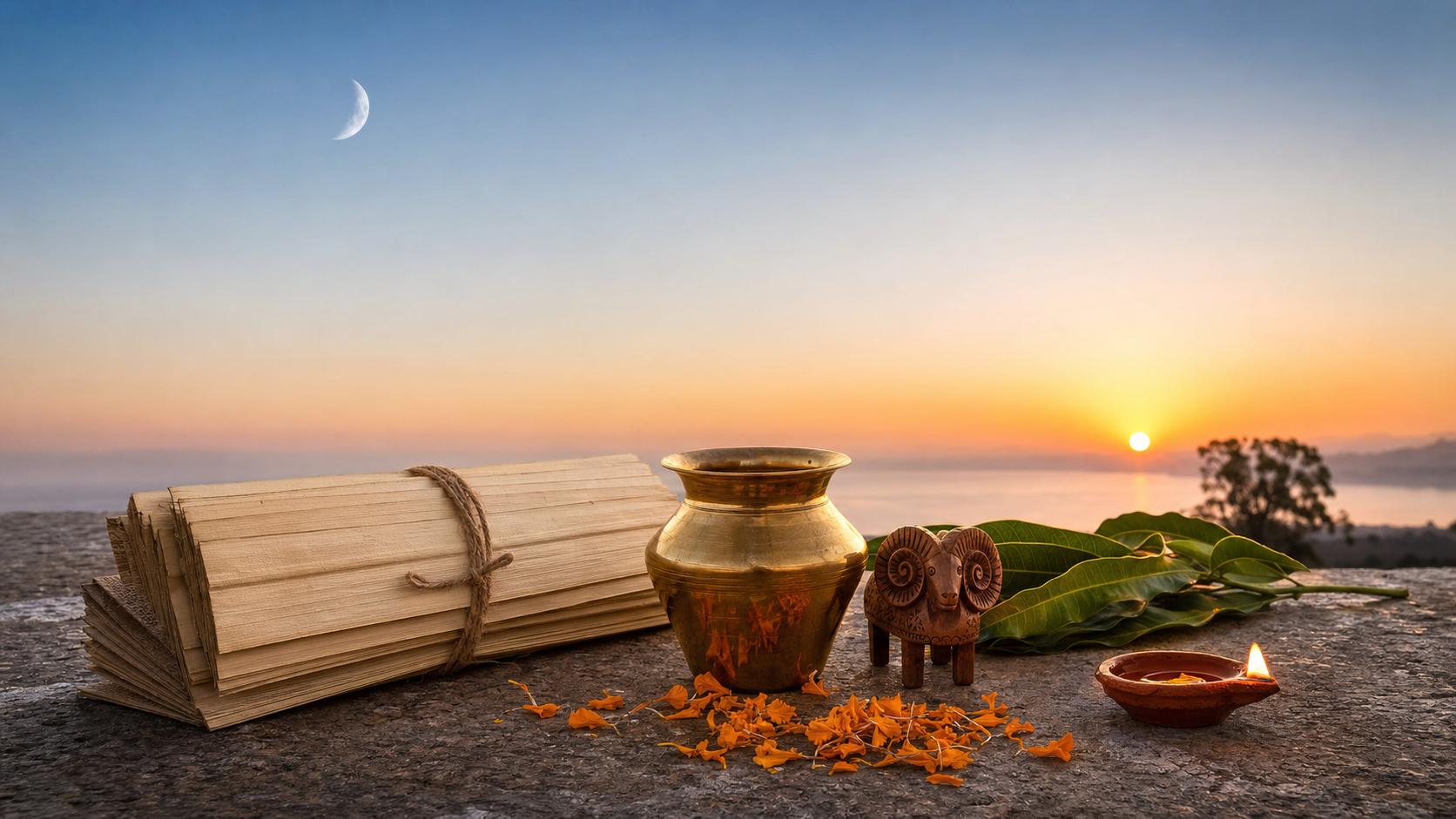
If you are consulting an April 2026 Panchang, the main difficulty is not finding a festival date. It is knowing which calendar layer you are looking at. A tithi can change during the afternoon, a solar month can begin at a precise ingress, and neither event is automatically tied to sunrise or midnight.
Two dates make that distinction practical. April 8 moves from Krishna Paksha Sashti to Saptami, while April 14 brings Mesha Sankranti and the Odia solar New Year. Mark both, but do not use them in the same way.
Read April through the lunar and solar clocks
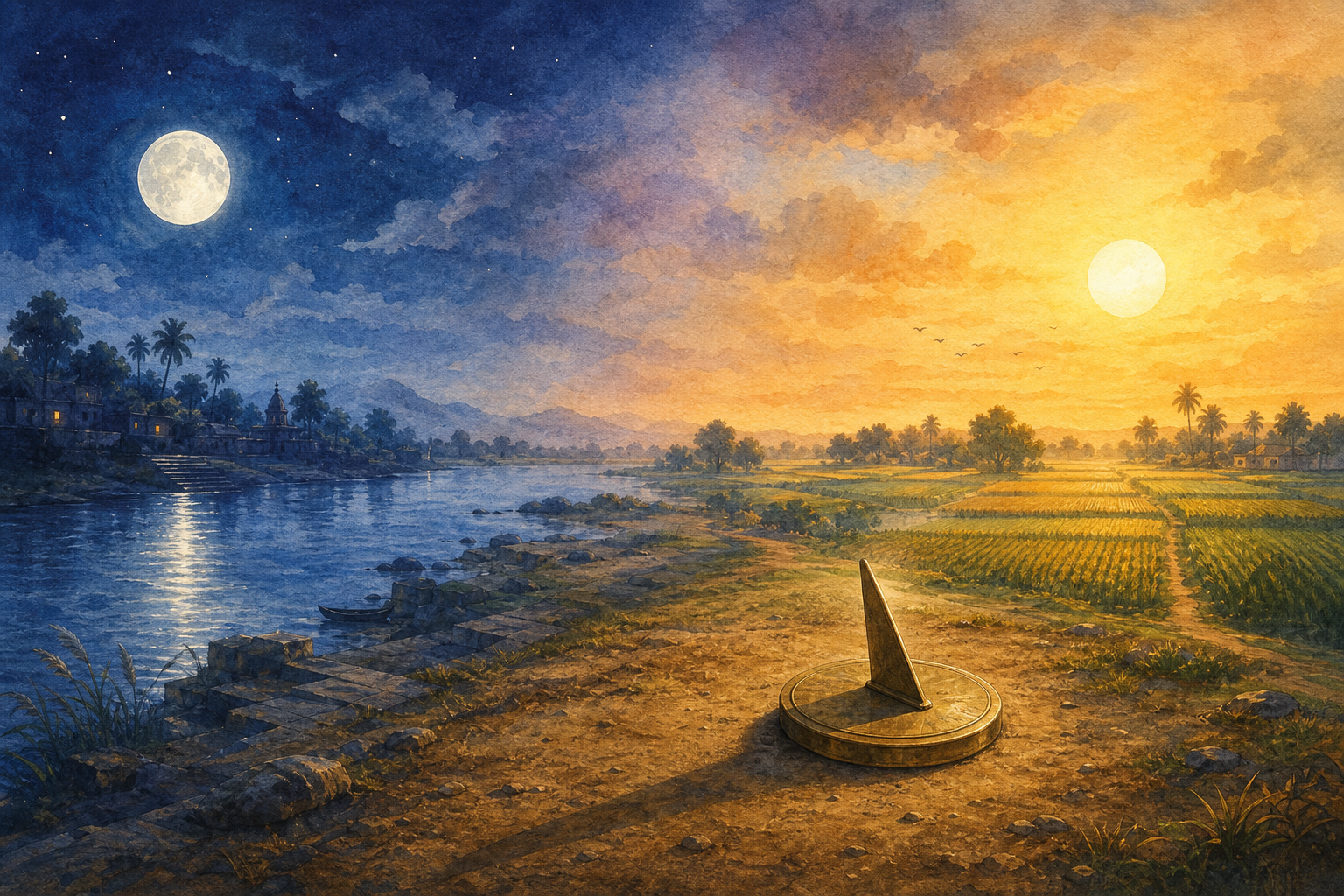
A daily Panchang combines several measures of time. Tithi follows the changing angular relationship between the Sun and Moon. Vara identifies the weekday. Nakshatra locates the Moon within the traditional stellar divisions. Yoga and karana further refine the day’s character. Sankranti belongs to another layer: it records the Sun’s passage from one sidereal rashi into the next.
| Calendar layer | What changes | April 2026 example | How you use it |
|---|---|---|---|
| Lunar | Tithi changes as the Moon-Sun relationship advances | Sashti ends and Saptami begins on April 8 | Daily puja, vrata, and tithi-sensitive planning |
| Solar | The Sun enters a new sidereal rashi | Mesha Sankranti occurs on April 14 | Solar month boundaries, regional New Years, and Sankranti observance |
| Local muhurta | Daylight and planetary periods are calculated for a place | Abhijit, Rahu Kalam, Gulika, and Yamaganda | Selecting or avoiding a clock-time window for a particular action |
This is why two Hindu New Year dates can both be correct. A solar month runs from Sankranti to Sankranti, so Mesha Sankranti opens Baisakh in Odisha’s solar reckoning. Lunar calendars place their month boundaries around Amavasya or Purnima, depending on whether the household follows an Amanta or Purnimanta tradition. Ugadi and Gudi Padwa therefore begin the year in lunar Chaitra, before the mid-April solar transition. The dates differ because the calendars are measuring different cycles, not because one community has miscalculated the year.
For your own calendar, write the system beside the date. Use labels such as “Krishna Paksha Saptami,” “Mesha Sankranti,” or “first day of solar Baisakh” instead of the unqualified phrase “New Year.” That small habit prevents most confusion when relatives, temples, and regional calendars appear to give different answers.
Use the April 8 tithi change as a Panchang checkpoint

On Wednesday, April 8, 2026, Krishna Paksha Sashti continues until 4:09 PM IST in most Indian regions, followed by Krishna Paksha Saptami. The end time matters. Calling the entire civil date “Sashti” would ignore the evening tithi; calling it entirely “Saptami” would erase the morning and early afternoon.
The Sashti portion is traditionally suited to protective worship, disciplined sadhana, family care, and prayers associated with Shashthi Devi or Kartikeya. Sashti also belongs to the Nanda tithi class, linked in muhurta practice with nourishment and growth. After 4:09 PM IST, Saptami brings a stronger Surya association and can be used for measured planning, health-oriented routines, or work seeking clarity and steady progress. Because April 8 is Budhavara, study, correspondence, commerce, and analytical work also fit the day’s traditional weekday character.
That does not make 4:09 PM a universal worldwide boundary. If you are outside the reference region, or planning a time-sensitive vrata, temple rite, or samskara, calculate the tithi for your location. Longitude, latitude, time zone, and local sunrise all matter. The nakshatra and Chandra Rashi must also be checked at the time of the intended act; they cannot be safely inferred from the tithi alone.
- Set the Panchang to the city where the observance will physically occur, not the city where your family originated.
- Confirm the tithi at the intended ritual time. Do not rely only on the tithi displayed at sunrise.
- Check the nakshatra, yoga, and karana if the undertaking is important enough to require a specific muhurta.
- Calculate Rahu Kalam, Gulika Kalam, and Yamaganda from the actual local sunrise and sunset.
- Use a locally calculated Abhijit Muhurat for a suitable general undertaking only when a more specific muhurta is unavailable.
- For a samskara, temple ceremony, or major life event, confirm the complete combination with a trusted priest rather than selecting a time from one Panchang element.
The familiar Wednesday rule of thumb shows why location matters. If daylight is assumed to run exactly from 6:00 AM to 6:00 PM, Rahu Kalam falls near 12:00-1:30 PM, Gulika near 10:30 AM-12:00 PM, and Yamaganda near 7:30-9:00 AM. Those are proportional daylight segments, not permanent clock appointments. A different sunrise or day length shifts every one of them.
Abhijit is similarly centered on local true solar noon, extending approximately 24 minutes before and after it. Noon printed on a clock and true solar noon are not always identical. If timing genuinely affects your decision, calculate rather than copy.
What actually changes at Mesha Sankranti on April 14

Mesha Sankranti occurs when the Sun’s nirayana longitude reaches 0 degrees of sidereal Aries. Lahiri ayanamsa is commonly used for this calculation in India. The present offset between the tropical and sidereal zodiacs is approximately 24 degrees, which places the tropical vernal equinox in March and the sidereal Mesha ingress in mid-April.
So April 14 should not be described as the current astronomical equinox. The name Maha Vishuva Sankranti preserves the memory of an older relationship with equinoctial balance, but precession has separated the two points. This distinction does not diminish the festival. It explains why inherited cultural language and present-day astronomical coordinates can refer to related but no longer identical moments.
The Sankranti is an instant, not merely a date label. Panchangs therefore identify Sankranti-kala, the precise ingress, and may also give Punya Kala or Maha Punya Kala for snana, japa, homa, and dana. These windows depend on the ingress and the observer’s location. If your calendar lists only “April 14” without a city and time, it is enough for remembering the festival but not enough for a time-sensitive rite.
Many traditions favor restraint around the ingress itself: avoid treating the exact transition as a generic launch window for a commercial or material undertaking unless your local tradition specifically permits it. Sankranti practice places the emphasis elsewhere – purification, meditation, worship, and giving. The practical decision is simple: use an independently selected muhurta for a new venture, and reserve the sanctified Sankranti period for sadhana and seva.
In Odisha, the same transition is Pana Sankranti, Maha Vishuva Sankranti, or Meru Sankranti. It begins the solar month of Baisakh and the Odia New Year. Its distinct ritual language belongs to Odisha, but the solar turn participates in a much wider civilizational rhythm. Vaisakhi in Punjab, Puthandu in Tamil Nadu, Vishu in Kerala, Rongali Bihu in Assam, Pohela Boishakh in Bengal, Nepal’s mid-April New Year, and the Sinhala and Tamil New Year in Sri Lanka gather around the same seasonal passage. Thailand’s Songkran, Laos’ Pi Mai, and Cambodia’s Chol Chnam Thmey extend the mid-April renewal and water symbolism into Theravada Buddhist-majority Southeast Asia.
These observances should not be flattened into one interchangeable festival. Their histories, theologies, foods, and community memories remain distinct. Their proximity does, however, reveal a shared dharmic grammar: renewal expressed through disciplined conduct, hospitality, water, food, and service. Vaisakhi holds particular importance in Sikh tradition. Jain New Year occurs after Deepavali, yet the Sankranti emphasis on dana and non-harmful care sits naturally beside Jain ethics of ahimsa. Unity becomes credible when it respects difference while acting on common duties.
A grounded Pana Sankranti observance at home
You do not need an elaborate public event to observe the transition meaningfully. The strongest household pattern joins a precise calendar, a simple act of worship, seasonal hospitality, and tangible care for another being.
- Confirm the local timing. Note the Mesha ingress and any Punya Kala given by a reliable regional panji or location-aware Panchang. If you live outside India, use the place where you will perform the observance and its local time zone.
- Begin with snana and sankalpa. Bathe, light a deepa, and state a modest intention for the new solar cycle. Aditya Hridayam or Surya Gayatri may be included according to your household practice.
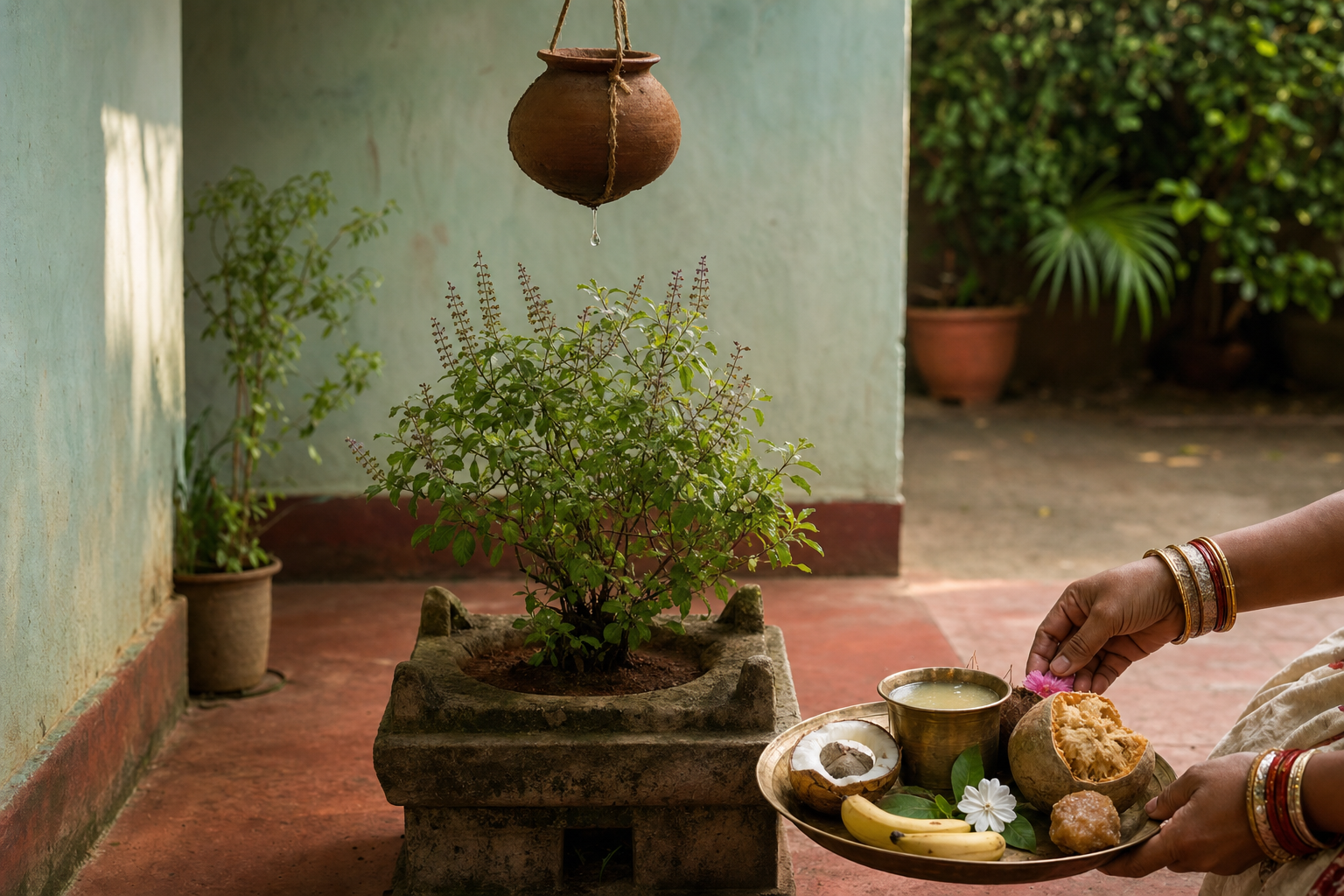
- Prepare pana with ingredients your household can use. Odia traditions include bela pana made with bael, chhatua pana with roasted gram flour or sattu, dahi pana with curd, and amba pana with raw mango. Jaggery, black pepper, and cardamom may be used in customary preparations. Diaspora households can preserve the seasonal principle by choosing suitable local ingredients when a traditional ingredient is unavailable.
- Offer before serving. Present the pana first to Jagannath, Vishnu, your Ishta Devata, or the deity honored in your family. Then share it with relatives, neighbors, or visitors. The movement from naivedya to hospitality is part of the practice, not an afterthought.
- Care for Tulasi and the surrounding earth. Suspend a clean earthen Basundhara theki with a tiny opening above Tulasi so water falls gradually. The slow drip turns the symbolism of jala-dana into regular summer care. Continue only where the arrangement can be kept clean and tended responsibly.
- Make dana concrete. Give drinking water, food, or useful essentials to people who need them. A reusable cup, earthen or metal vessel, and leaf or reusable serving ware keep the act from generating avoidable plastic waste. If your time is limited, prioritize the act of giving over decorative complexity.
The sequence matters: snana prepares the person, japa directs the mind, and dana carries the observance beyond the household. Pana is not merely a festival recipe in this structure. It is a cooling seasonal offering that converts hospitality into seva at the beginning of grishma. The Basundhara vessel makes the same point without words: renewal is credible only when care continues drop by drop.
A community observance can follow the same logic. Rather than limiting the day to a ceremonial gathering, organize a water-sharing station, an anna-dana effort, support for a community kitchen, or care for native and heat-resilient plants. Use washable tumblers and durable vessels. The aim is not to modernize the festival out of recognition, but to let its inherited ethic meet the conditions in which you actually live.
Key takeaways for your April 2026 calendar
- April 8 demonstrates how a civil date can contain two tithis: Sashti until 4:09 PM IST in the stated reference region, then Saptami.
- April 14 marks a different kind of change: the Sun enters 0 degrees of sidereal Mesha, beginning solar Baisakh and the Odia New Year.
- Mesha Sankranti is not the present-day vernal equinox, and it does not compete with lunar New Years such as Ugadi or Gudi Padwa.
- Do not copy tithi endings, Rahu Kalam, Abhijit, Sankranti-kala, or Punya Kala from another city without local adjustment.
- For Pana Sankranti, place snana, japa, dana, water-sharing, and care for Tulasi ahead of material launches at the ingress.
Before you act on any April entry, write three things beside it: the calendar layer, the location, and the exact local time. Then make April 14 practical by choosing one act of dana and preparing for it in advance. That is enough to turn a printed date into a disciplined observance.
References
- DharmaRenaissance Blog – Pana Sankranti 2026 on April 14: Odia New Year’s astronomy, rituals, and dharmic unity
- DharmaRenaissance Blog – April 8, 2026 Panchang: Precise Tithi Timings, Shubh Muhurats, Nakshatra & Rashi Guide