
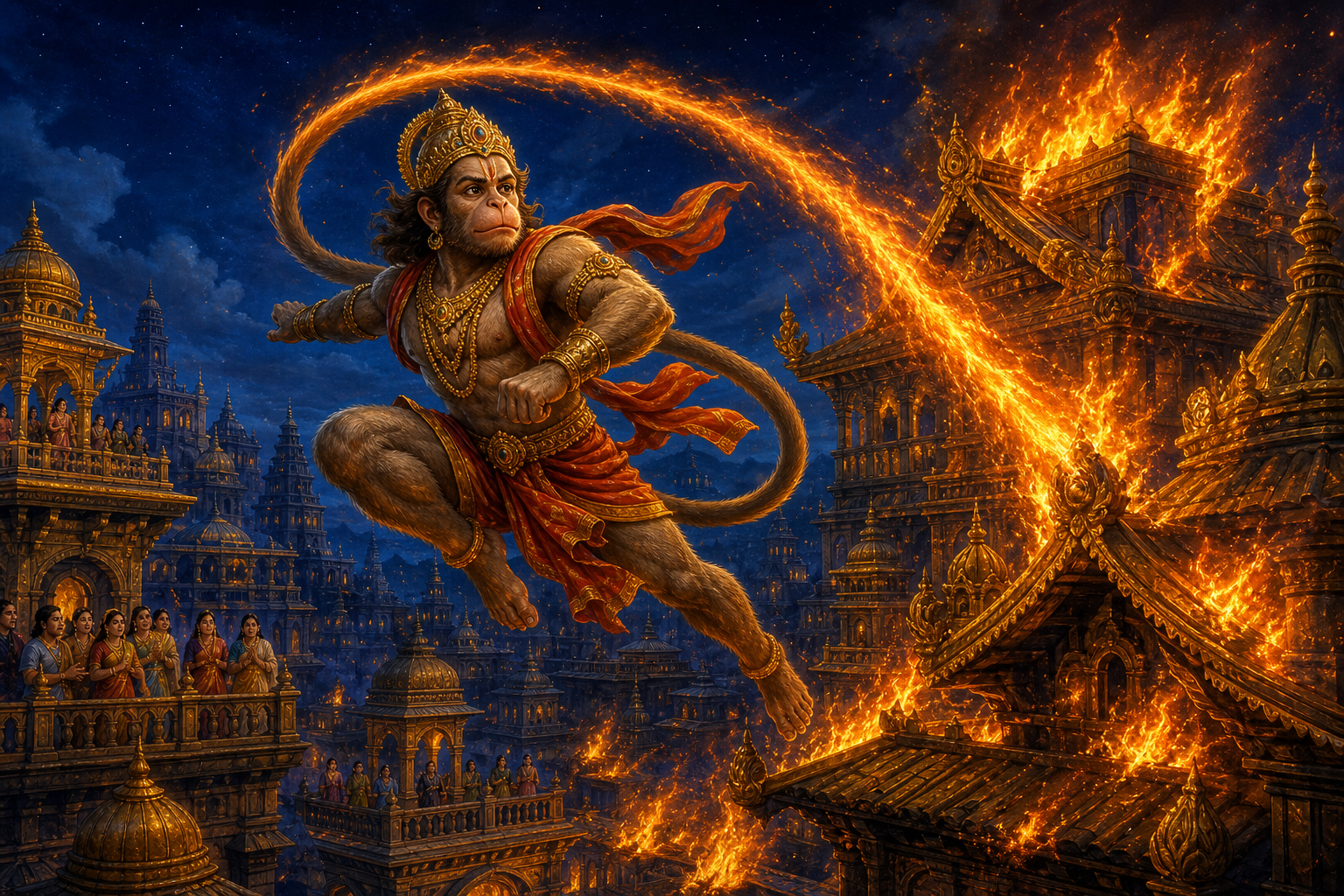
If you have heard a Ramlila audience roar as Hanuman’s tail consumes bale after bale of cloth, you may have wondered whether the laughter trivializes a sacred episode. That discomfort points to the right question: not whether a Ramayana retelling may be funny, but what the joke asks you to laugh at.
The folk expansion of Lanka Dahan offers a practical standard for judging satire. It laughs at arrogant power, reveals who pays for a ruler’s vanity, protects the dignity of the wronged, and carries the audience from amusement to moral clarity. You can use that standard when you hear a kathakar, stage the episode, teach it, or decide whether a modern political joke deserves to be shared.
The joke does not diminish Hanuman
The narrative must be placed in its proper sequence. Hanuman has crossed the ocean, found Sita, and entered Ravana’s court as Rama’s duta, or envoy. His presence is not a prank. He carries intelligence, represents Rama, and gives Lanka’s ruler an encounter with unwelcome truth. Ravana answers that truth by ordering the envoy’s tail wrapped in cloth and set alight.
That order is already a moral failure. Epic practice treats the messenger as protected even when the message is hostile. The Mahabharata’s Udyoga Parva likewise condemns abuse of an envoy. Ravana therefore does more than insult Hanuman: he allows personal fury to overrule a norm that keeps conflict from collapsing into lawless vengeance.
Valmiki’s Sanskrit Ramayana handles Lanka Dahan with heroic economy. Hanuman turns the intended humiliation against Lanka, remains protected, directs the fire with discrimination, and returns to Rama after confirming Sita’s condition. The scene is grave, purposeful, and governed by his mission.
Folk performance enlarges the preparation for that fire. Hanuman quietly lengthens his tail as servants wind cloth around it. More cloth is summoned. Bales leave warehouses, garments are collected, and palace hangings or public banners may be requisitioned. The punishment becomes a logistical farce: Lanka starts stripping itself before Hanuman burns anything.
This distinction matters. The ever-growing tail is not a detail you should attribute indiscriminately to every literary Ramayana. It flourishes especially in oral narration, village katha, seasonal Ramlila, and improvisational theatre. A responsible introduction is simple: In many folk retellings, Hanuman makes his tail grow as Lanka tries to wrap it. That wording honors both the textual core and the creativity of living tradition.
The laughter does not fall on Sita’s suffering, Hanuman’s devotion, or the vulnerability of a messenger. It falls on Ravana’s inability to stop. Each command meant to magnify his authority instead makes his judgment look smaller. Hanuman remains composed while the machinery of punishment becomes ridiculous. Devotion is not reduced by the comedy; tyranny is reduced to its proper size.
Why the expanding tail is such exact satire
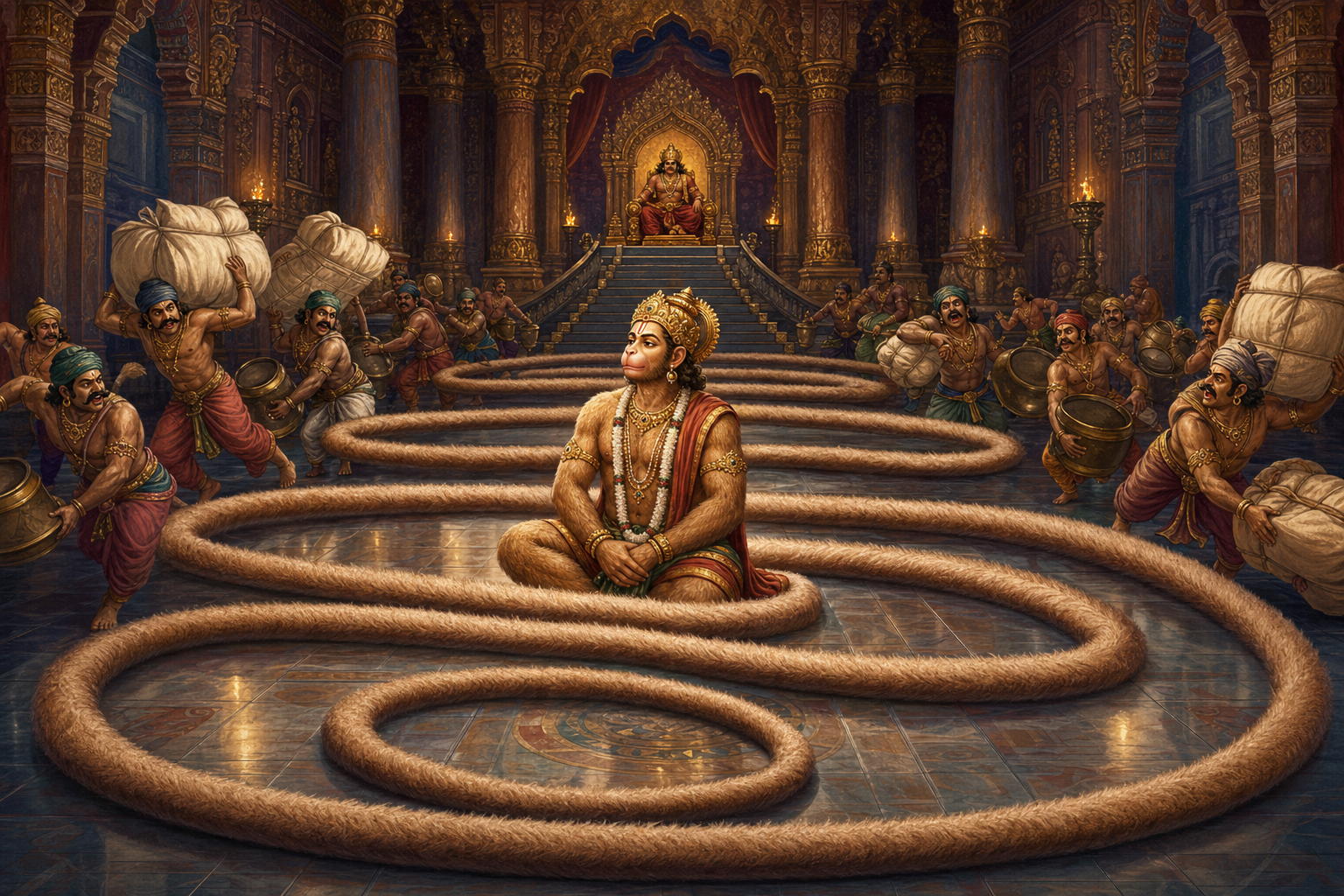
The folk joke works because every comic device also performs ethical work. Its first device is reversal. Ravana chooses the tail because he thinks it can be turned into a mark of shame. Hanuman turns the same tail into an instrument of exposure. The punishment does not merely fail; it reveals the punisher’s lack of self-command.
Its second device is accumulation. One strip of cloth would be an act of cruelty. An endless procession of cloth makes the scale of the ruler’s irrationality visible. Repetition gives the audience time to notice that a private grievance is consuming public goods. Every new bundle is evidence that no official around Ravana can say that enough is enough.
Cloth is especially effective because it is never just stage material. It represents labor, exchange, household dignity, rank, and modesty. When garments, turbans, sari borders, drapes, and banners are diverted into a royal punishment, the joke follows an authoritarian decision from court to marketplace and home. The city pays once in material wealth and again in public dignity.
This gives you a useful way to read political satire. Do not look only at the ruler’s intention. Follow the command outward. Who supplies the material? Whose work is interrupted? Who must pretend that a foolish order is wise? Who is placed at risk because advisers are frightened or compliant? Satire becomes ethically serious when it traces those consequences instead of merely inventing an insulting nickname.
The third device is exposure. Clothing ordinarily covers and distinguishes. In the folk image of Lanka losing its clothes, the stripping is political before it is physical. Ravana’s court loses its appearance of competence. The wealth that advertised magnificence becomes kindling for spite. Arrogance disrobes itself because it cannot recognize the moment when authority has become absurd.
The fourth device is a change of rasa. Hasya rasa opens the audience through laughter; vira rasa follows when Hanuman acts with courage and purpose. The performance then has somewhere to go. If it ended with servants running after cloth, it would remain a clever skit. Lanka Dahan changes the emotional register and forces the audience to face the consequence of adharma. The sequence is laughter, resolve, and recognition.
That sequence also places a limit on interpretation. The fire is not an invitation to enjoy indiscriminate destruction. Hanuman’s elemental association as Vayuputra, the protection attributed in some traditions to Agni, Sita’s blessing, or Rama-nama, and the emphasis on discriminating action frame the blaze as a reversal governed by dharma. The flames meant to shame the envoy return upon the order that created them. The moral center is accountability, not a fascination with ruin.
Four tests separate ethical satire from cruelty
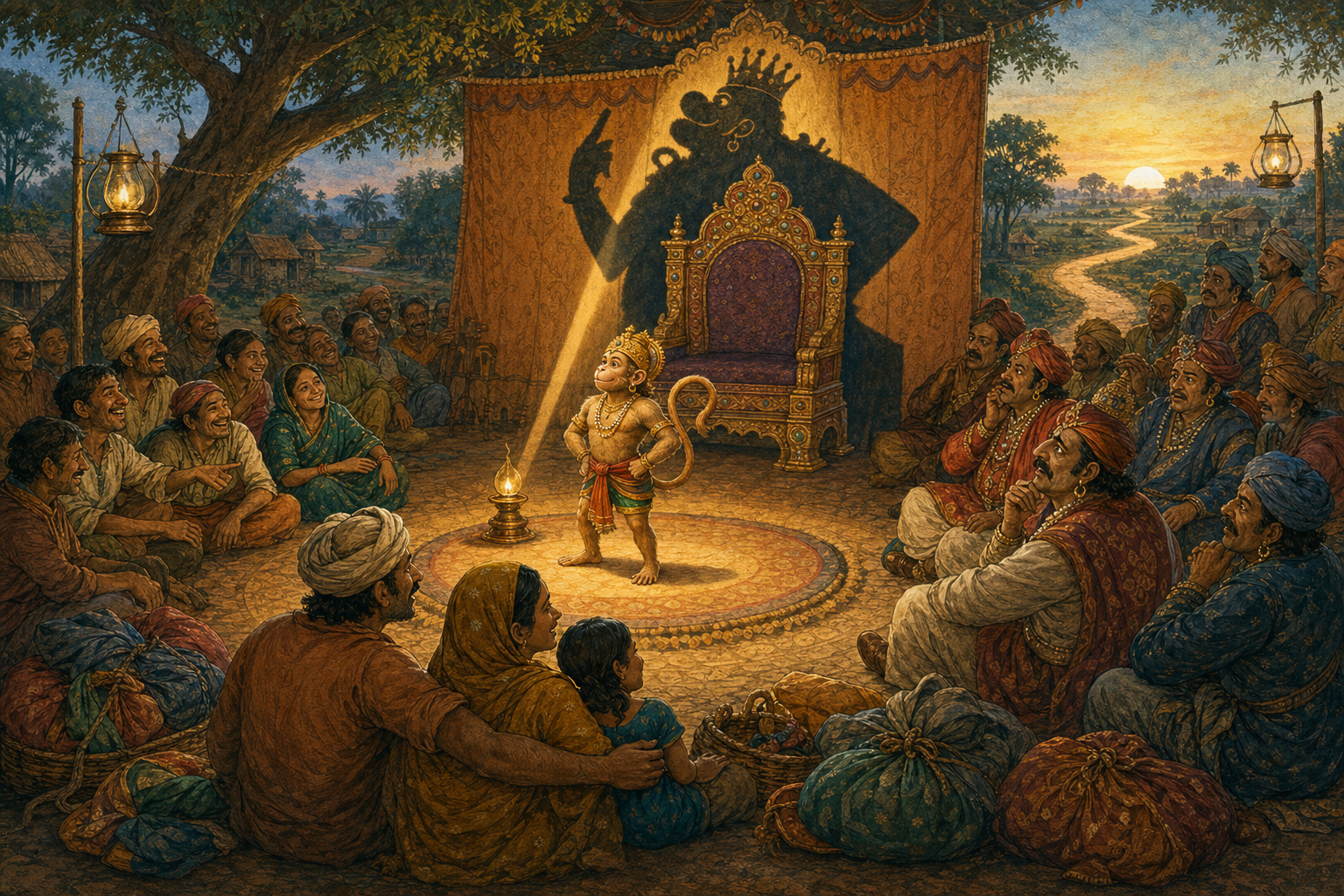
Hanuman’s folk humor gives you four tests for evaluating a joke, meme, monologue, or dramatic adaptation. Apply them before defending something merely because it is funny or politically convenient.
- Identify the real target. The Lanka joke targets Ravana’s spite, the court’s obedience, and the abuse of royal power. It does not need contempt for Sita, ordinary citizens, or the envoy. If a modern joke works only by degrading someone’s body, poverty, family, community, or vulnerability, its target has slipped away from misconduct and toward humiliation.
- Make the cost of adharma visible. The expanding tail converts an arbitrary decree into a ledger: more cloth, more labor, more disruption, and more complicity. Good satire shows the chain between a decision and the people forced to finance or enforce it. Mere abuse announces dislike; satire reveals a mechanism.
- Keep the response proportionate to the wrong. Hanuman does not lose himself in the humiliation intended for him. His wit remains tied to his duty as Rama’s messenger and to Sita’s rescue. A satirical response should expose wrongdoing without manufacturing allegations, inviting mob cruelty, or treating every person under a bad ruler as equally guilty.
- Leave the dharmic norm visible. The audience should know what ought to replace the failure: protect envoys, listen to counsel, conserve shared wealth, control anger, and do not turn public authority into an instrument of private revenge. If no corrective principle survives the laughter, the performance may generate contempt without wisdom.
A quick calibration helps when partisan feeling is strong. Imagine that the same joke is aimed at a leader or faction you favor. Would you still accept its evidence, target, and method? If not, you may be defending the pleasure of attack rather than the discipline of satire. Hanuman’s example does not authorize every insult made in the name of righteousness. His wit is credible because he possesses the strength he refuses to misuse.
Another warning sign is displaced punishment. Some folk variants show women surrendering odhnis or sari-pallu under royal demand; others let them assist the wronged messenger with sly sympathy. Either way, ordinary Lankans should not become disposable scenery. The more ethically alert reading distinguishes the ruler who commands, the officers who enforce, the people who comply under pressure, and those who retain conscience within a compromised polity.
That distinction matters far beyond epic performance. A regime is not identical to every resident living under it. A bureaucracy is not identical to every clerk inside it. A religious or political community is not reducible to its worst representative. Satire that cannot preserve these differences usually ends by reproducing the collective humiliation it claims to oppose.
How to retell the scene without flattening tradition
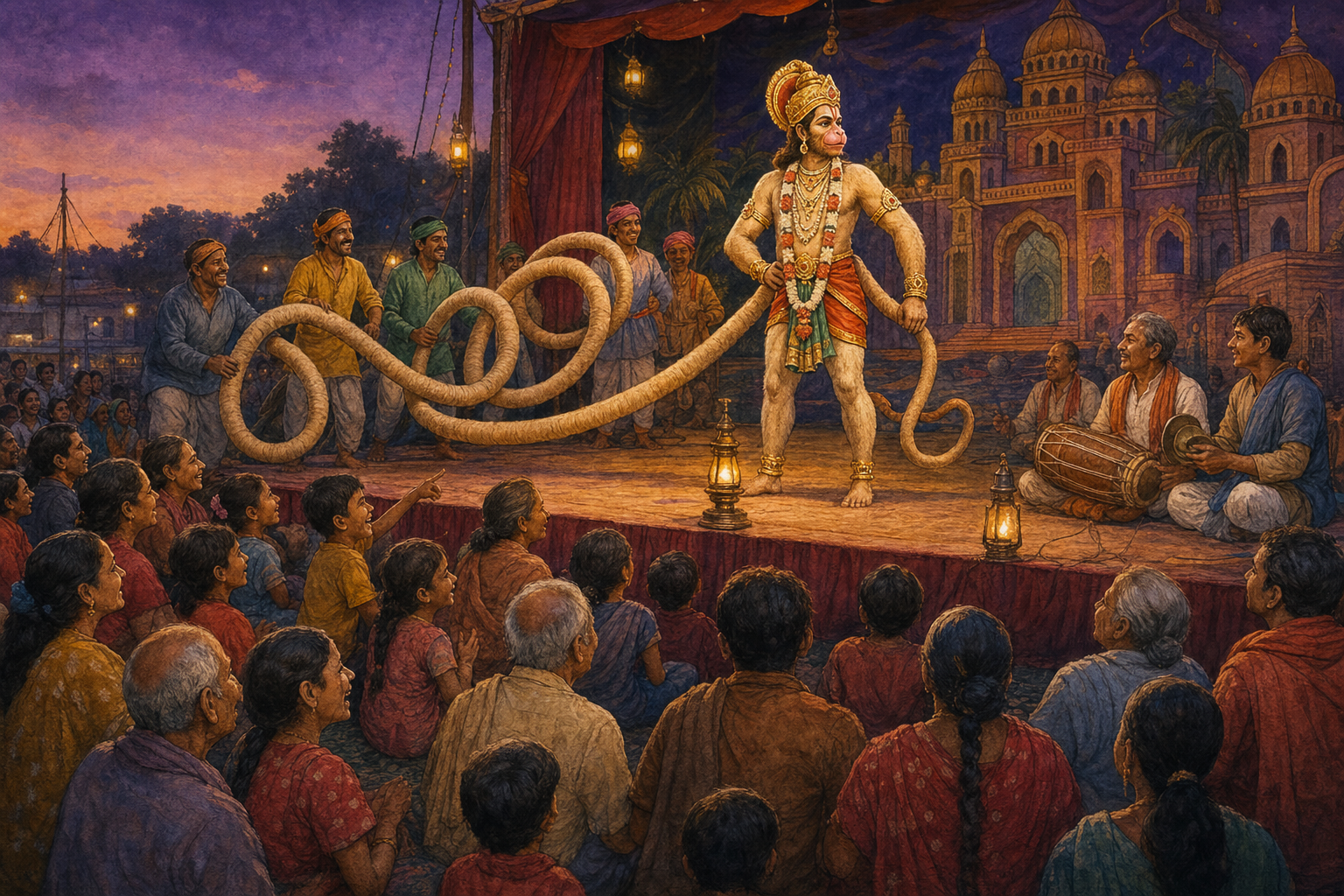
If you are teaching, speaking, writing, or staging Lanka Dahan, begin with three separate columns: textual core, folk expansion, and ethical question. Under the first, place Hanuman’s mission, capture, status as envoy, punishment, burning of Lanka, and return. Under the second, place the growing tail, exhausted cloth stores, mock levies, household collections, and improvisational repartee. Under the third, ask who violated dharma, who paid for the violation, and how Hanuman transformed the situation.
This simple separation prevents two common errors. One is textual fundamentalism that dismisses every popular flourish because it is not narrated identically in a chosen recension. The other is careless homogenization that labels every beloved stage gag as a uniform feature of the Ramayana. A living tradition can preserve a stable moral arc while allowing regions, languages, and performance communities to elaborate its comic possibilities.
Keep Sita and the duta principle in view. Without Sita, Hanuman can be reduced to a mischievous strongman setting a city alight. Without his envoy status, Ravana’s order looks like one more exchange in a feud. With both restored, the scene becomes a lesson in disciplined service: Hanuman has gathered the information Rama needs, spoken inside a hostile court, endured an unlawful punishment, and converted it into strategic advantage.
Then choose comic devices that reveal administration rather than merely decorate the action. A herald can announce a new cloth levy. A chorus can count each turn of the tail. Storekeepers can calculate what remains. Courtiers can compete to praise an obviously failing plan. These devices let the audience watch fear and flattery magnify a ruler’s first mistake.
Indian performance traditions already offer several ways to do this. Yakshagana and tala-maddale can make debate and repartee central. Tamil terukuttu and kattai koothu allow a commentator figure to break the dramatic frame and bring power down to street level. Bhavai, Swaang, and Ramlila can connect courtly vanity with the language of tax, market, and household scarcity. The local reference works best when it clarifies the old ethical conflict, not when it turns the sacred narrative into a vehicle for abusing a present-day community.
Give the laugh a landing. After the comic escalation, allow one line, image, or consequence to state what has happened: a ruler tried to dishonor a messenger and made his own kingdom bear the cost. Do not smother the humor with a sermon, but do not leave the audience with noise alone. Hasya prepares the heart; the turn toward vira and dharma completes the teaching.
Dharmic plurality can deepen that teaching without pretending that every tradition tells the same story. Jain tellings such as the Paumacariya reconfigure war and agency with a stronger concern for limiting slaughter. Buddhist Jataka analogues can present Rama’s conduct as moral education associated with a Bodhisattva. Hindu and Sikh devotional currents both honor fearlessness in righteous service. These differences should remain differences. Their value here is that they sharpen questions of restraint, courage, accountability, and moral pedagogy rather than making destruction the sole measure of victory.
The same discipline applies when adapting the scene into a meme or short video. Preserve the reversal: power creates the instrument of its own exposure. Preserve the ledger: show what the vain order consumes. Preserve the innocent: do not make coerced citizens the punchline. Preserve the norm: give the viewer a reason to choose better conduct, not merely another enemy to despise.
Key takeaways
- The expanding tail belongs especially to folk and performance elaboration; introduce it as a popular retelling rather than a uniform detail in every Ramayana.
- The joke protects the sacred center of the episode. It laughs at Ravana’s abuse of power, not at Sita, Hanuman’s devotion, or the vulnerability of an envoy.
- Cloth turns tyranny’s hidden cost into something the audience can count. Ethical satire should likewise connect a foolish command to the people, labor, and resources it consumes.
- Hasya rasa is the opening movement, not the destination. The turn toward vira rasa and moral consequence keeps laughter attached to courage and dharma.
- A responsible retelling distinguishes rulers, enforcers, coerced citizens, and quiet dissenters. It does not treat an entire population as guilty by association.
- Before sharing a modern satire, test its target, evidence, proportionality, and corrective norm. If it only humiliates, it has not learned Hanuman’s method.
The next time you encounter the endless tail, watch the court more closely than the cloth. Notice who keeps obeying, who bears the cost, and why no one tells Ravana to stop. Then carry that attention into the next joke you repeat about power. The most dharmic laughter does not merely wound an opponent; it helps a community recognize adharma early enough to refuse it.