
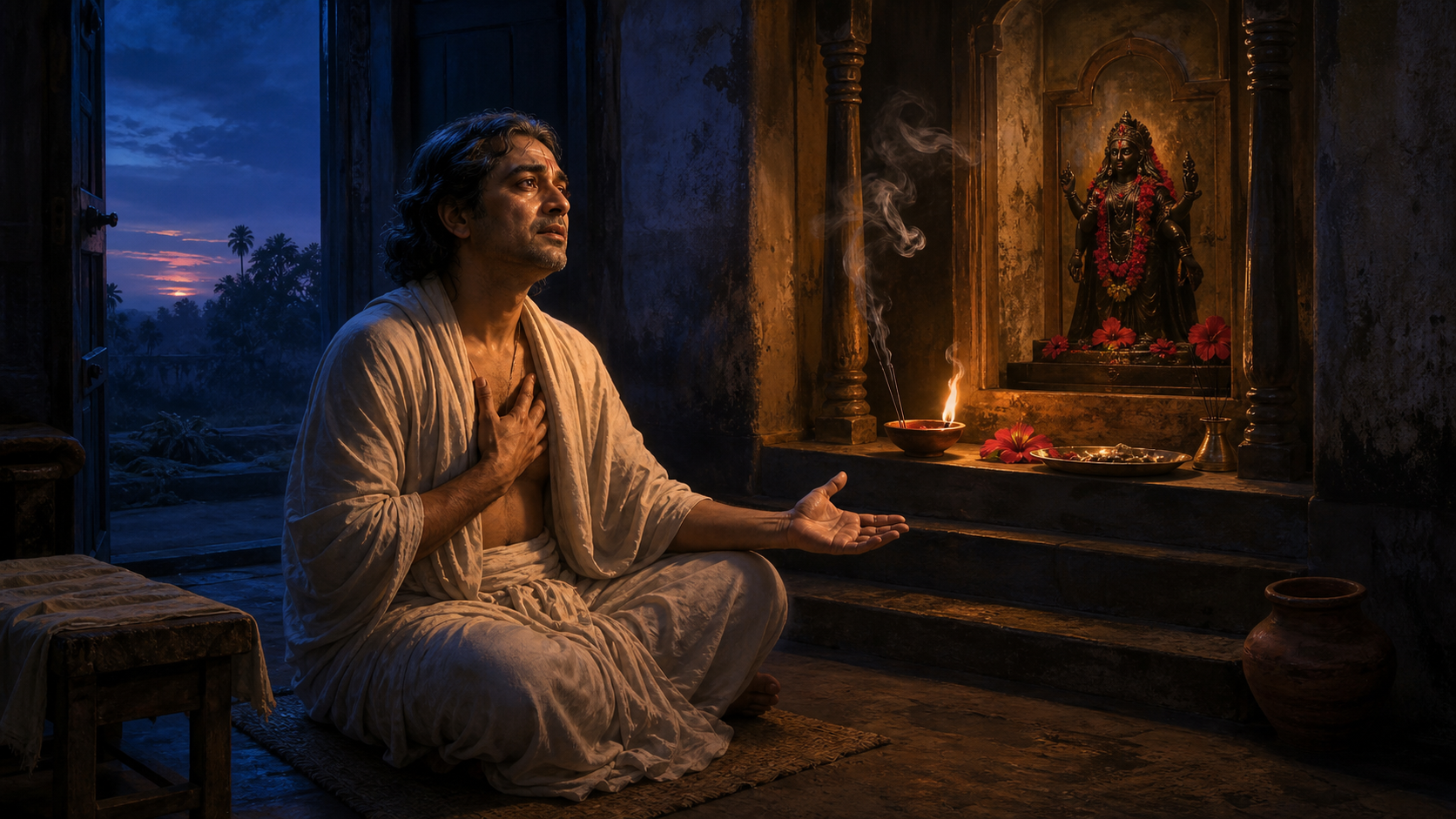
If your prayer becomes polite the moment it reaches the altar, it may never reach the part of you that most needs transforming. Fear, resentment, shame, and helplessness don’t disappear because you know the correct devotional language.
Ramprasad Sen offers you a more demanding path: bring the whole emotion to Maa Kali, speak without pretence, let sacred sound interrupt your first reaction, and then prove the prayer through your next action. His bhakti is transformative because it joins intimacy with truth, surrender with responsibility, and compassion with repair.
Key takeaways
- Ramprasad’s child-to-Mother voice allows you to pray from fear, anger, confusion, or disappointment without pretending that those states are already resolved.
- The encounter with Raghu the dacoit belongs to devotional memory and oral hagiography, not securely documented court history. Its value lies in the pattern of conscience awakening, not in treating every narrative detail as verified fact.
- Song can slow a reactive moment by changing breath, attention, and emotional tone. It can support wise action, but it is not a substitute for leaving danger or seeking practical help.
- Sharanagati, or surrender, means releasing the demand to control every outcome. It does not mean surrendering discernment, boundaries, or responsibility.
- The test of kripa, or grace, is not how intense the devotional experience felt. Look for stopped harm, honest accountability, restitution where possible, and sustained service.
Ramprasad’s bhakti begins where respectable prayer ends
Ramprasad Sen, who lived approximately from 1718 to 1775, is remembered not as a remote institutional authority but as a Bengali householder-poet. Biographical traditions portray him working as an accountant under a zamindar while composing songs to Kali. That setting matters. His spiritual life did not depend on escaping work, family, money, or ordinary frustration before turning toward the Divine.
His characteristic relationship with Kali is that of a child speaking to the all-powerful Mother. The child complains, bargains, cries, jokes at his own expense, and returns. This is not casual irreverence. It is confidence that the relationship can bear the truth.
You can use that distinction immediately. Devotional honesty says, “Mother, I am angry, and I don’t trust what I might do with this anger.” Indulgence says, “Because I am angry, whatever I do next is justified.” The first statement places the emotion inside a relationship larger than the emotion. The second makes the emotion sovereign.
Ramprasad’s Shyama Sangeet made this approach portable. Vernacular Bangla, memorable refrains, self-deprecating humour, and performance-friendly rhythms carried Shakta theology into homes, shrines, village gatherings, and daily routines. A person did not need to master an abstract theological system before addressing Maa. The song itself taught the relationship.
This is why his example remains useful even if you don’t speak Bangla or know a Ramprasadi melody. The essential discipline is not imitation of a particular performance. It is the movement from concealment to address: instead of merely having an emotion, you tell the truth about it in the presence of the Divine Mother.
When you feel spiritually dry, begin there. Name what you are actually carrying. Don’t manufacture sweetness. Don’t confuse devotional vocabulary with devotion. A complaint offered to Maa can be more spiritually serious than praise recited while your attention remains elsewhere.
What the encounter with Raghu can and cannot establish

The best-known narrative of Ramprasad’s transformative devotion places him in immediate danger. Raghu the dacoit and his band seize him while he is travelling, variously along a forested path or riverbank. Some retellings describe a robbery; others make the intended violence part of a sacrificial rite. Granted a final request, Ramprasad asks to sing to Kali. As he sings, Raghu’s resolve collapses, the weapons are lowered, and the captive is released. Some versions continue with restitution, guidance, or a turn toward service.
You should hold this account with both openness and discrimination. It has circulated through oral retelling and Shyama Sangeet performance, with variations in its setting and conclusion. It is therefore better approached as hagiography rooted in cultural memory than as a fully reconstructable incident supported by official records.
That classification does not make the narrative useless, and devotional importance does not require you to disguise uncertainty. Different kinds of truth are involved. The precise sequence of an eighteenth-century encounter is historically uncertain. The long preservation of the encounter is a fact about Bengali devotional culture. Its ethical claim is clear: a person who has committed himself to violence may still possess a conscience capable of awakening.
The narrative also places the decisive transformation in Raghu, not in Ramprasad’s skill at defeating him. Ramprasad does not overpower the dacoit, win an argument, or humiliate him. His surrender to Kali creates a moment in which the aggressor can perceive the intended victim differently. Fear does not simply vanish; its direction changes. The captive’s fear is offered as bhakti, while the aggressor begins to fear what he is becoming.
Don’t turn that theological pattern into reckless safety advice. If someone threatens you, create distance if you can, seek immediate help, and use the practical protections available to you. You are not required to remain in danger to demonstrate faith, nor should you assume that singing will stop an attacker. Devotion may help you act without panic, but it does not make ordinary precautions unnecessary.
The more responsible application begins before or after the emergency. Use sacred song to train the mind that meets fear, anger, and conflict. Use the Raghu narrative to remember that firm protection and belief in another person’s capacity for reform can coexist. Neither requires denying the harm that person may cause.
A Ramprasad-inspired practice for fear and anger
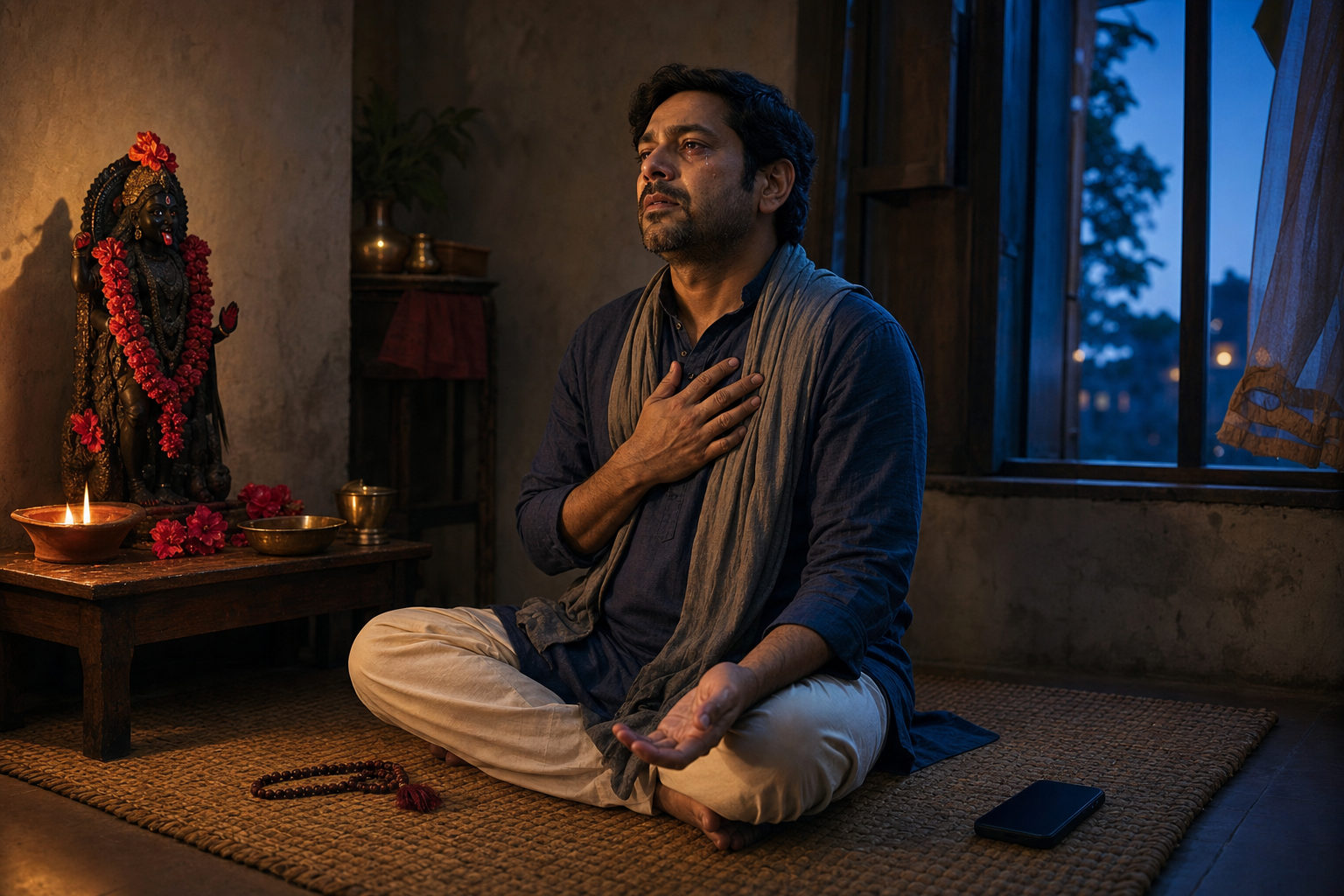
Ramprasad’s songs work through more than their ideas. Devotional singing commonly lengthens the exhalation, steadies attention, and interrupts the rapid loop between threat and reaction. Repeated melody and rhythm can also reduce the felt distance between people. These human effects don’t prove a miraculous interpretation of Raghu’s transformation, but they make the central movement psychologically recognisable: sacred sound can open a pause in which a different choice becomes possible.
You can build that pause into a nightly practice of a few minutes. Use an authentic Shyama Sangeet you know, read one aloud, or choose a simple devotional address without pretending it is a Ramprasad composition.
- Choose a stable form of address. Speak to Maa Kali, Devi, the Divine Mother, compassion, wisdom, or the nameless ground, according to your tradition. Consistency matters more than novelty because you are cultivating a relationship, not searching for a dramatic sensation.
- Name the unedited state in one sentence. Say, “I am afraid of what will happen,” “I want to hurt this person with my words,” or “I am hiding because I am ashamed.” Name the emotion without promoting it into a command.
- Sing or read slowly enough to hear yourself. Let the refrain carry attention through several natural breaths. Don’t force a special breathing pattern, chase a trance, or judge the practice by whether the feeling disappears.
- Ask what the emotion is trying to protect. Anger may be guarding a boundary; fear may be alerting you to danger; shame may be pointing toward harm you need to acknowledge. The emotion supplies information, not a complete moral verdict.
- End with one dharmic action. Delay the message written in rage. Make the safety call fear has shown you is necessary. Apologise without explaining away the offence. Return what is owed. State a boundary without adding humiliation. The practice is incomplete until it affects conduct.
This sequence turns bhaya, fear, toward bhakti, devotion, without asking you to deny either the body or the situation. It also clarifies sharanagati. You surrender the fantasy that you can control every person and consequence. You do not surrender the duty to choose your response.
Don’t use the practice to postpone a necessary conversation indefinitely. Sacred calm can become another form of avoidance if you repeatedly soothe yourself but never tell the truth, repair damage, or seek protection. Give the emotion to Maa so that you can act more clearly, not so that you can remain passive with a devotional explanation.
Kali devotion joins fierce truth to compassion
The Raghu narrative becomes intelligible within a Shakta vision of Kali as both raudra, terrible or fierce, and karuna, compassionate. These are not two unrelated deities. The same Mother who confronts violence also holds the violent person within the possibility of transformation.
This prevents two common distortions. Compassion without truth becomes sentimentality: it speaks tenderly about an offender while neglecting the person harmed. Fierceness without compassion becomes vengeance: it defines a person entirely by the worst thing that person has done. Kali’s double aspect refuses both evasions.
When you bring a conflict into prayer, ask three different questions. What must stop now? What or whom must be protected? What could still be restored? The first question honours fierceness. The second establishes responsibility. The third keeps punishment from becoming your only moral imagination.
This is especially important when the language of surrender is misused. Surrender to Maa is not consent to mistreatment. Compassion for someone who harmed you does not require renewed access, immediate reconciliation, or the removal of reasonable consequences. Forgiveness, reconciliation, and restored trust are separate matters. Trust may properly depend on demonstrated change over time.
The same distinction applies when you are the one who caused harm. Feeling forgiven is not the end of accountability. Kripa is unmerited grace, not an exemption from consequence. If devotion reveals your conduct clearly, accept that revelation as compassion: it gives you the chance to stop, admit, repair, and become trustworthy again.
Ramprasad’s childlike voice is crucial here. A child can protest to the Mother, but the Mother is not reduced to the child’s preference. You may ask Kali to remove an unbearable consequence, complain that life is unfair, or admit that you don’t want to change. The relationship remains real precisely because your demand is not mistaken for the whole of dharma.
Judge transformative grace by the repair it produces

The dramatic moment in the Raghu encounter is the lowering of weapons. The ethical completion lies in what some versions place afterward: guidance, restitution, or service. A temporary wave of tenderness may interrupt harm. Transformation requires the person to live differently once the feeling passes.
Use that standard for your own devotional experiences. Tears during a song may be sincere, but sincerity alone does not settle whether change has occurred. Look at the next recurring conflict. Do you recognise the reaction earlier? Can you stop before causing the familiar harm? Are your words more truthful and less cruel? Have you repaired what can be repaired? Are you willing to accept a boundary imposed by someone you injured?
This emphasis makes the narrative restorative without romanticising banditry. A wrongdoer is more than the wrong, but the wrong remains real. The community’s interest is not served by revenge alone, nor by declaring reform before there is evidence of it. A restorative path asks the offender to cease the harm, acknowledge responsibility, restore what is possible, and return through constructive participation.
The wider dharmic family preserves related patterns. Buddhist tradition remembers Angulimala, a feared brigand transformed through the Buddha’s presence and karuna. Sikh lore remembers Sajjan Thug changing through Guru Nanak’s shabad. Jain narratives place confidence in ahimsa and aparigraha as powers capable of taming violent or possessive impulses. These traditions are not interchangeable, but they converge on a demanding proposition: the highest response to wrongdoing seeks protection, accountability, and inner reformation rather than domination for its own sake.
That shared pattern can shape how we speak across Hindu, Buddhist, Sikh, and Jain communities. Unity does not require flattening Kali, karuna, shabad, ahimsa, and aparigraha into identical concepts. It begins by recognising a family resemblance: dharma addresses the agent of harm as a moral being who can still change, while refusing to call the harm acceptable.
Tonight, take one emotion you would normally conceal and address Maa without editing it into respectable language. Sing or read for a few minutes, then choose the concrete act that truth requires. If devotion changes only how you feel, continue the work. When it changes what you do next, Ramprasad’s lesson has begun to enter your life.