If you have ever wondered why Ganesha must be worshipped before another deity, a journey, or a serious undertaking, “remover of obstacles” is only the beginning of the answer. It explains what devotees ask of him, but not why his presence belongs at the threshold.
Tantric and Agamic traditions place unusual weight on beginnings because a sacred act is not simply ordinary activity with a prayer added to it. The worshipper, the purpose, and the ritual space must be brought into order. Ganesha presides over that change of state. Once you see this, his first place in worship stops looking like convention and begins to reveal a theology.
Vighneshwara is more than a remover of difficulties
Popular devotion and esoteric theology should not be placed in opposition here. A family asking Ganesha to bless a wedding and a practitioner invoking him before a carefully ordered rite are approaching the same deity from different circumstances. The outward needs differ, but both acts recognise that a beginning is vulnerable to disorder.
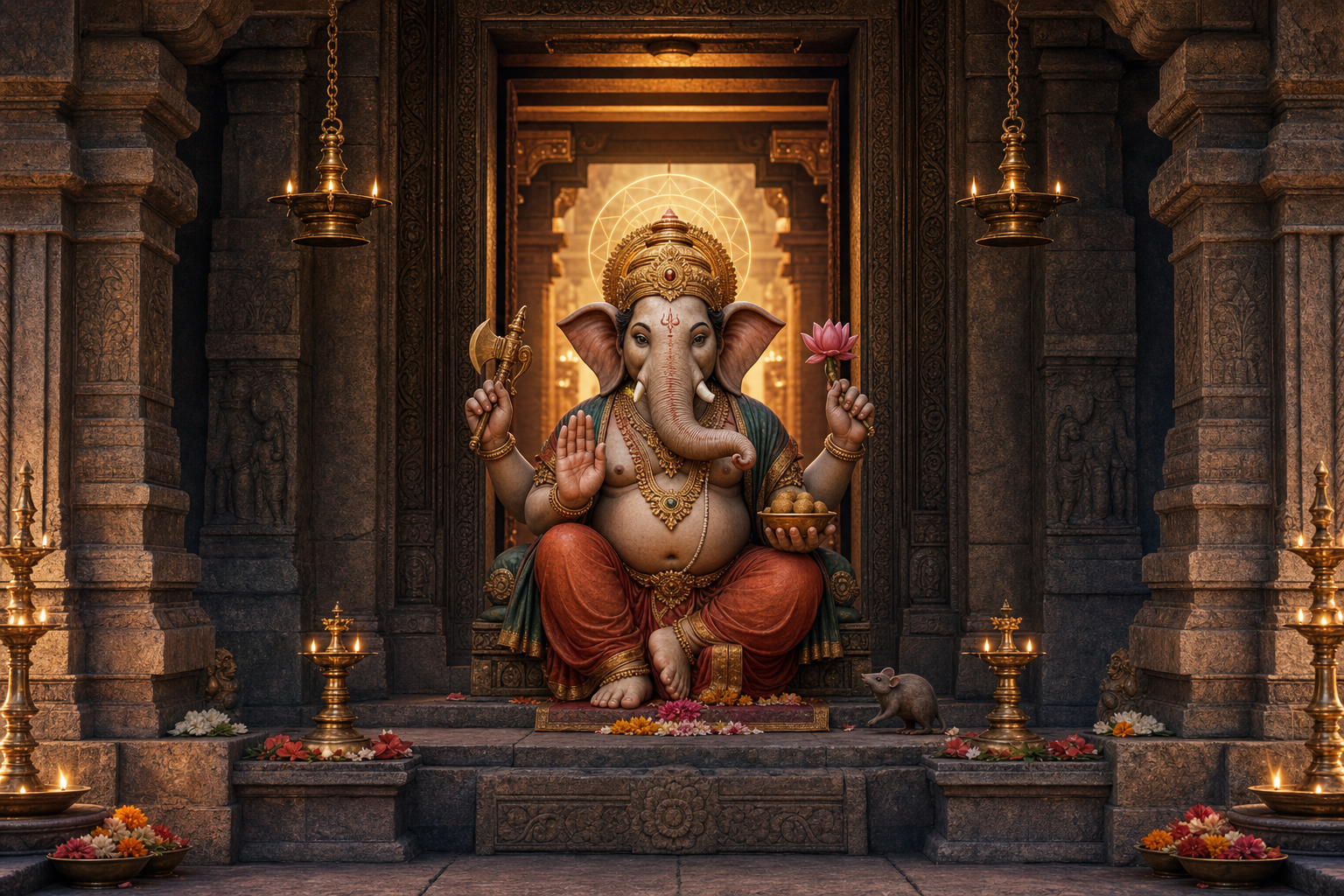
Within the Tantric and Agamic frame, Ganesha is the guardian of the threshold and the first gateway to realisation. A threshold is not merely a place where trouble is removed. It is where entry is granted, direction is established, and an unprepared person becomes ready to proceed.
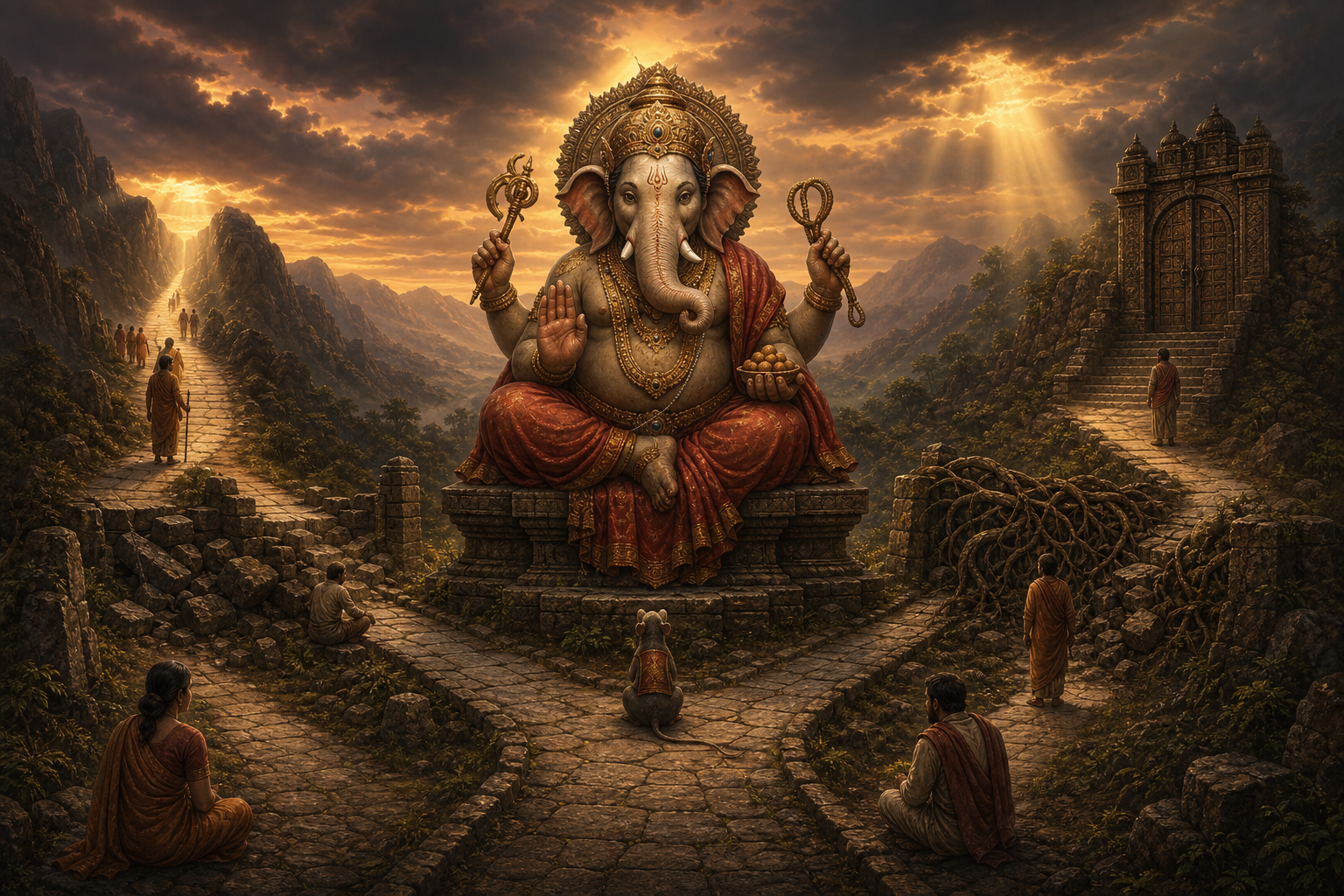
The name Vighneshwara sharpens the point. Vighna means an obstacle or interruption, while Ishwara conveys lordship. “Lord of obstacles” is therefore richer than “one who makes every difficulty disappear.” The title permits a more demanding interpretation: obstacles fall within Ganesha’s governance. He may be approached not only for their removal, but also for the discernment needed to understand them.
That distinction changes prayer. If you treat Ganesha as a divine mechanism for obtaining your preferred result, every delay appears to be a failure. If you approach him as Vighneshwara, a delay may also expose confused intention, careless preparation, pride, or an undertaking that should be reconsidered. This does not mean every setback carries a hidden supernatural message. It means Ganesha worship should make you more attentive and responsible, not less.
A useful way to read his threshold role is on three levels:
- At the practical level, the devotee asks that preventable difficulties be cleared from an undertaking.
- At the ritual level, Ganesha establishes an ordered beginning so that what follows is not approached casually.
- At the contemplative level, the worshipper confronts the inner confusion that obstructs sustained attention and right action.
These levels reinforce one another. You should still prepare carefully for the work in front of you. Invocation does not replace planning, competence, or ethical judgment. It places those duties within a sacred orientation.
Why ritual order is itself a theological statement
When Ganesha comes first, “first” does not necessarily mean that every tradition is declaring him superior to every other deity. Ritual position and sectarian supremacy are different questions. His position is functional: he governs commencement and passage.
Think of a temple entrance. The entrance is not the sanctum, yet you cannot reach the sanctum without crossing it. The threshold separates two modes of being in the same physical world. On one side, attention is dispersed among ordinary concerns. On the other, speech, gesture, intention, and awareness are directed toward sacred presence. Ganesha is not merely a doorkeeper standing outside that transformation. He is the divine power through whom the crossing becomes rightly ordered.
This is why sequence matters in Agamic and Tantric practice. The order of a rite teaches what the tradition believes must happen first. Before a more specialised act can begin, disorder must be acknowledged, attention gathered, and the path made fit. A preliminary invocation is therefore not empty ritual administration. It carries doctrine in enacted form.
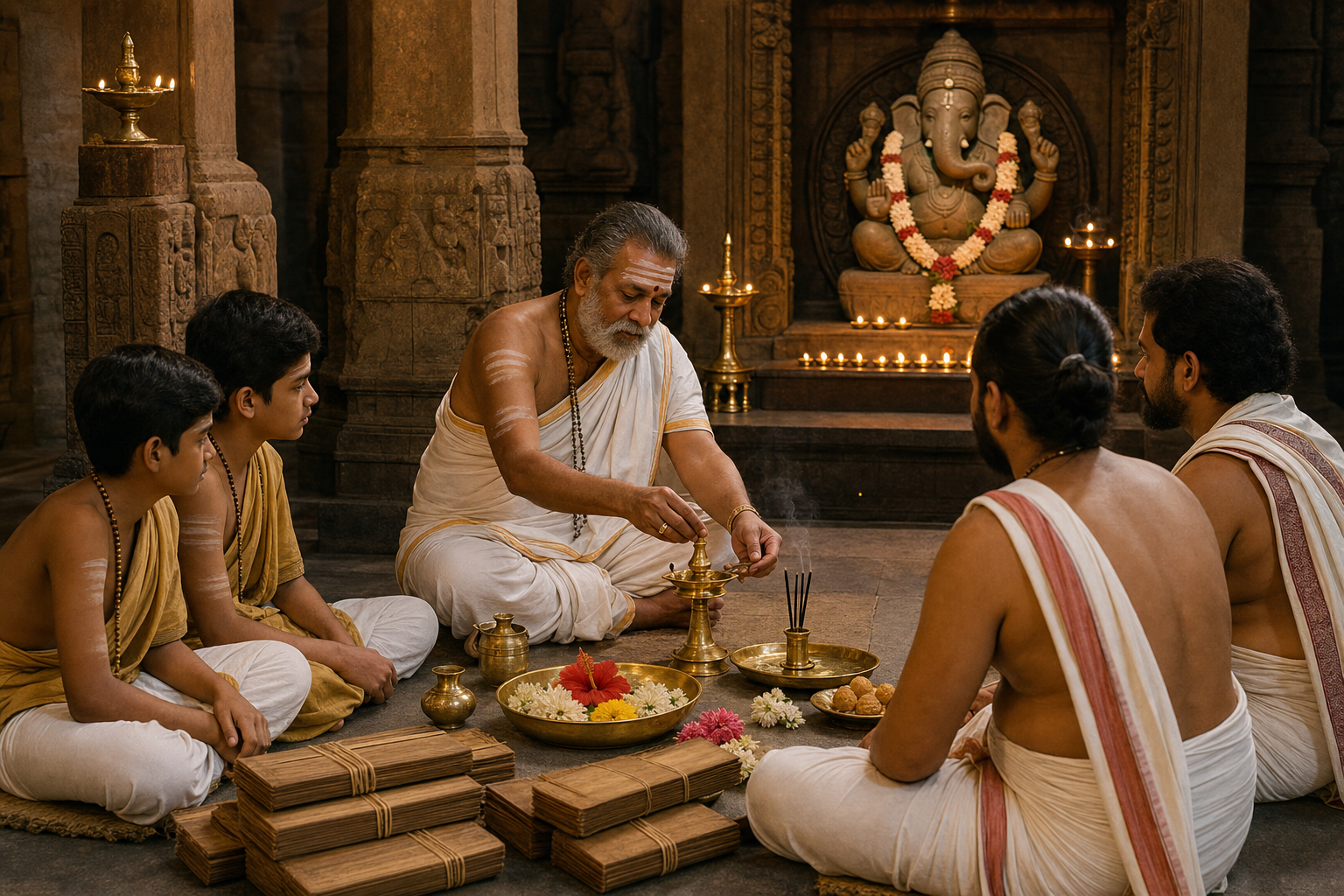
You can learn a great deal by watching the sequence of worship instead of concentrating only on its most visually impressive moment. The next time you attend a puja, notice:
- What undertaking is actually being commenced when Ganesha is invoked.
- Whether the invocation occurs once or marks more than one transition within the rite.
- What act immediately follows it, because that reveals the passage Ganesha has opened.
- Whether the emphasis is on removal, permission, protection, steadiness, or auspicious beginning.
- Which features belong to the local temple or lineage rather than to a supposedly universal formula.
This way of observing protects you from a common mistake: isolating one mantra or gesture from the sequence that gives it meaning. In an ordered ritual system, placement is part of interpretation.
It also corrects the idea that worship guarantees the success of whatever you have already decided to do. Dharma cannot be reduced to successful execution. If the intended act is harmful, dishonest, or poorly considered, asking for unobstructed progress does not make it righteous. Ganesha’s threshold should prompt an ethical question before a practical one: is this undertaking fit to begin?
The outer obstacle and the inner threshold belong together
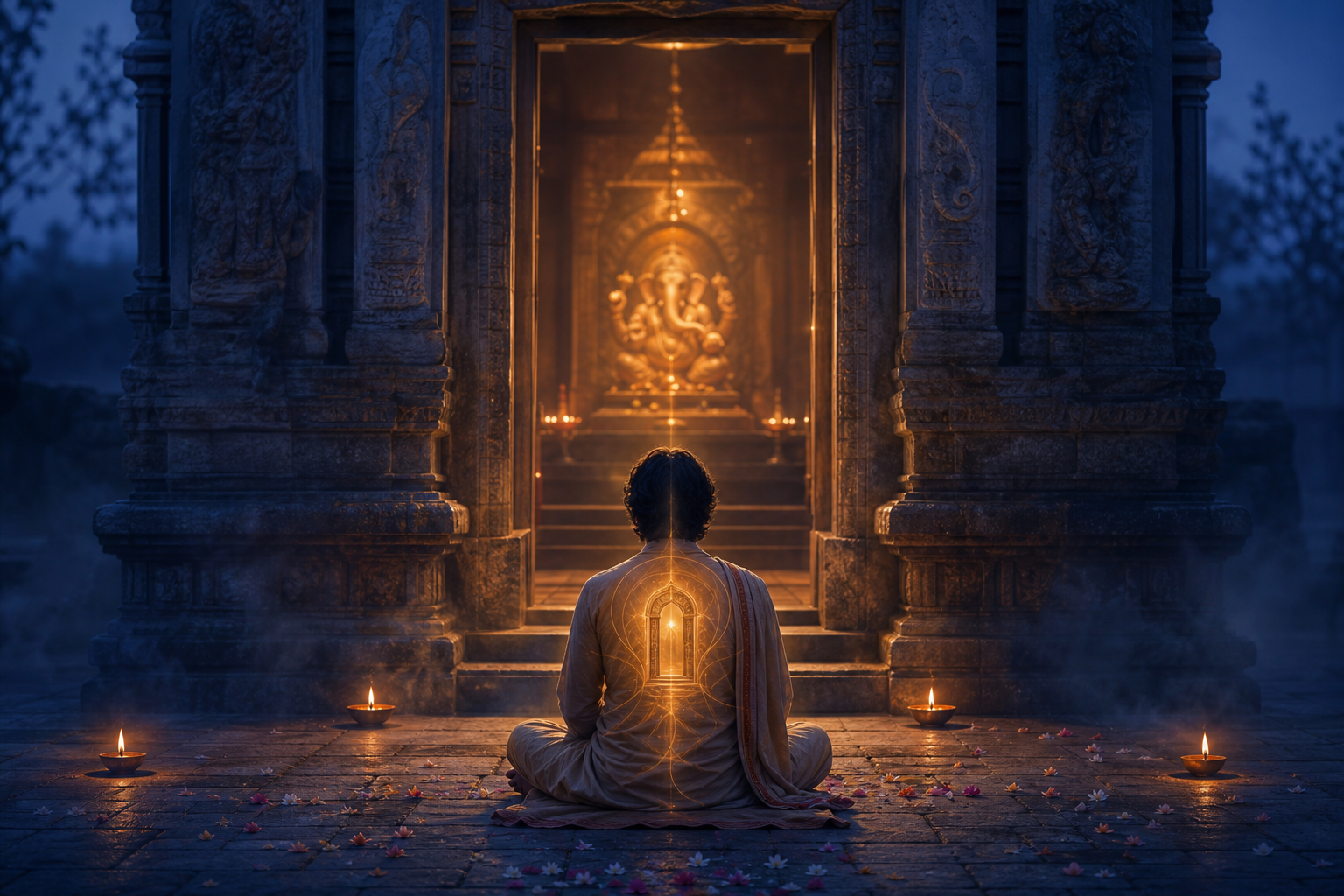
Tantric practice takes the conditions of consciousness seriously. The worshipper’s distraction, agitation, and self-importance are not irrelevant simply because every visible ritual action has been performed correctly. The outer rite creates a disciplined form in which inner disorder can be noticed and transformed.
An obstacle, in this setting, need not be a dramatic enemy. It may be fragmentation: one intention expressed in prayer, another pursued in conduct, and a third hidden in expectation. You ask for clarity but cling to a predetermined answer. You seek an auspicious beginning but refuse to correct an avoidable mistake. You perform reverence while treating the ritual as a shortcut to control. These divisions are themselves vighnas because they prevent wholehearted movement.
Ganesha’s first place asks you to become one-pointed enough to begin. That does not require manufacturing a mystical experience. It requires a simpler honesty: know what you are doing, know why you are doing it, remove the disorder you can remove, and place the remainder before the deity without pretending that desire is the same as dharma.
This is also a better way to approach sacred iconography. Do not turn every feature of Ganesha’s form into an improvised psychological slogan. Symbolic explanations can be useful, but their meanings may differ across texts, temples, and lineages. Begin with the ritual context: where is the image placed, how is it worshipped, what transition does it govern, and what teaching accompanies it? Context gives symbolism discipline.
The same caution applies to mantra. A familiar public prayer, a temple’s prescribed invocation, and a lineage-specific Tantric practice are not interchangeable simply because all are addressed to Ganesha.
| Form of engagement | What to notice | Responsible approach |
|---|---|---|
| Familiar household prayer or namaskara | Devotion, auspicious commencement, and the family’s inherited custom | Practise sincerely without claiming that the household form represents every tradition |
| Public temple worship | The deity’s place, the order of offerings, and the larger ritual sequence | Follow the temple’s discipline and ask a knowledgeable priest about unfamiliar elements |
| Lineage-specific mantra, visualisation, bija, or nyasa | Prerequisites, transmission, pronunciation, and the practice’s stated purpose | If initiation or direct instruction is required, learn from an authorised teacher rather than assembling a method from fragments |
This distinction is not elitism. It keeps practices connected to the frameworks that make them intelligible. A mantra is not merely an inspirational sentence, and a Tantric procedure is not made authentic by sounding secret or powerful.
How to approach Ganesha’s Tantric role without flattening it
“Tantra” and “Agama” refer to broad and internally diverse bodies of theology and practice. They should not be treated as a single system with one universal Ganesha ritual. Nor should Tantra be reduced to the sensational meanings often attached to the word in modern popular culture. When a practice matters to you, identify its actual setting before drawing conclusions from it.
- Identify the context. Ask whether you are looking at household devotion, public temple liturgy, a theological explanation, or an initiated discipline. The same symbol can do different work in each setting.
- Read the sequence. Find out what comes before and after the Ganesha invocation. This often tells you more than an isolated translation of the words.
- Clarify the undertaking. Before asking for obstacles to be removed, state plainly what you are beginning and whether its purpose accords with dharma.
- Remove the ordinary obstacles already within your control. Correct the missing preparation, broken promise, preventable confusion, or careless timing. Ritual seriousness includes practical seriousness.
- Respect lineage boundaries. If a teaching specifies initiation, pronunciation, observance, or supervision, do not treat those requirements as decorative.
- Judge the practice by its effect on conduct. A sound engagement with Vighneshwara should deepen steadiness, humility, discernment, and responsibility rather than encourage magical entitlement.
Three shortcuts to avoid
- Do not collect “powerful” mantras from unrelated traditions and combine them as though more ingredients must produce a stronger result.
- Do not interpret every inconvenience as spiritual opposition. Check ordinary causes before assigning extraordinary meaning.
- Do not dismiss a preliminary rite as less important than the central worship. In threshold theology, preparation is part of the sacred work.
These cautions leave room for both simple bhakti and advanced discipline. You do not need an elaborate Tantric practice to honour Ganesha meaningfully. You do need honesty about which kind of practice you are undertaking.
Key takeaways for your own worship and study
- Ganesha comes first because he governs the crossing from an unordered beginning into sacred action.
- Vighneshwara’s lordship over obstacles is broader than automatic obstacle removal; it calls for discernment about the path itself.
- Ritual sequence carries theology. Study where an invocation appears and what it prepares rather than extracting it from context.
- Outer difficulties and inner fragmentation are related, but neither should be used to invent supernatural explanations for every setback.
- Household devotion, public temple worship, and initiated Tantric disciplines deserve different forms of engagement.
- The practical test is not whether worship gives you control. It is whether you begin with greater clarity, humility, preparation, and alignment with dharma.
At your next beginning, pause before asking Ganesha to clear the road. Name the undertaking, examine its purpose, and correct the disorder that is already yours to correct. Then invoke him in the form your tradition has actually given you and proceed with attention.
If you move toward specialised Tantric practice, let your first question be neither “Which mantra is most powerful?” nor “How quickly will it work?” Ask instead: which tradition does this belong to, what does it prepare, and what qualifications does it require? That question is itself an act of honouring the threshold.