
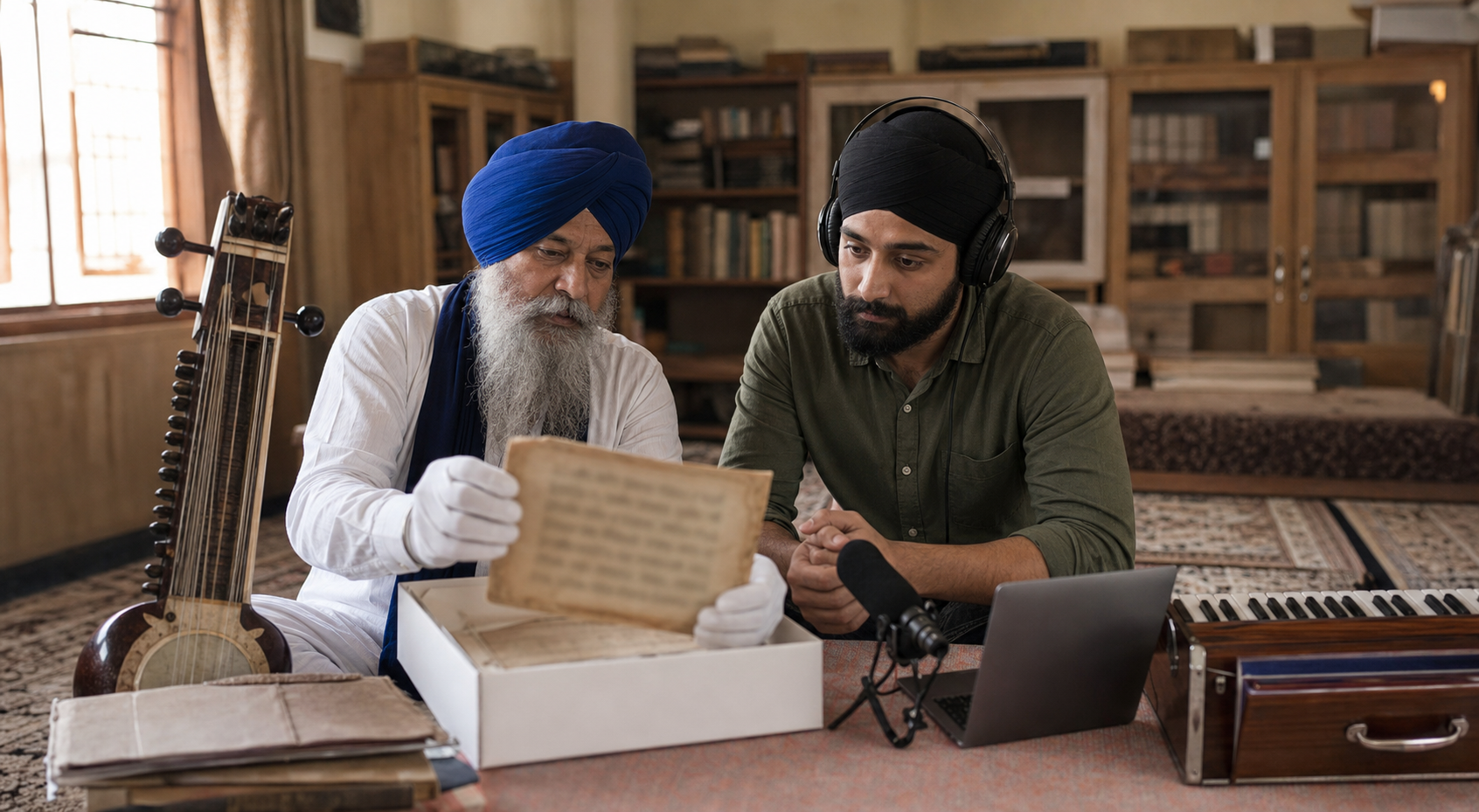
If you have been asked to save old kirtan recordings, handwritten Gurmukhi material or a calligrapher’s work, the hardest part is not buying a scanner or finding cloud storage. It is preserving enough context for another person to understand, verify and use what you save.
Your goal is to keep a living chain intact: sacred words in Gurmukhi, music learned through attentive practice, people who can read and sing, and the history that connects each item to a place and community. The following plan works for a family collection, a gurdwara archive, a raag darbar or a small cultural organisation.
Preserve the relationship, not only the objects
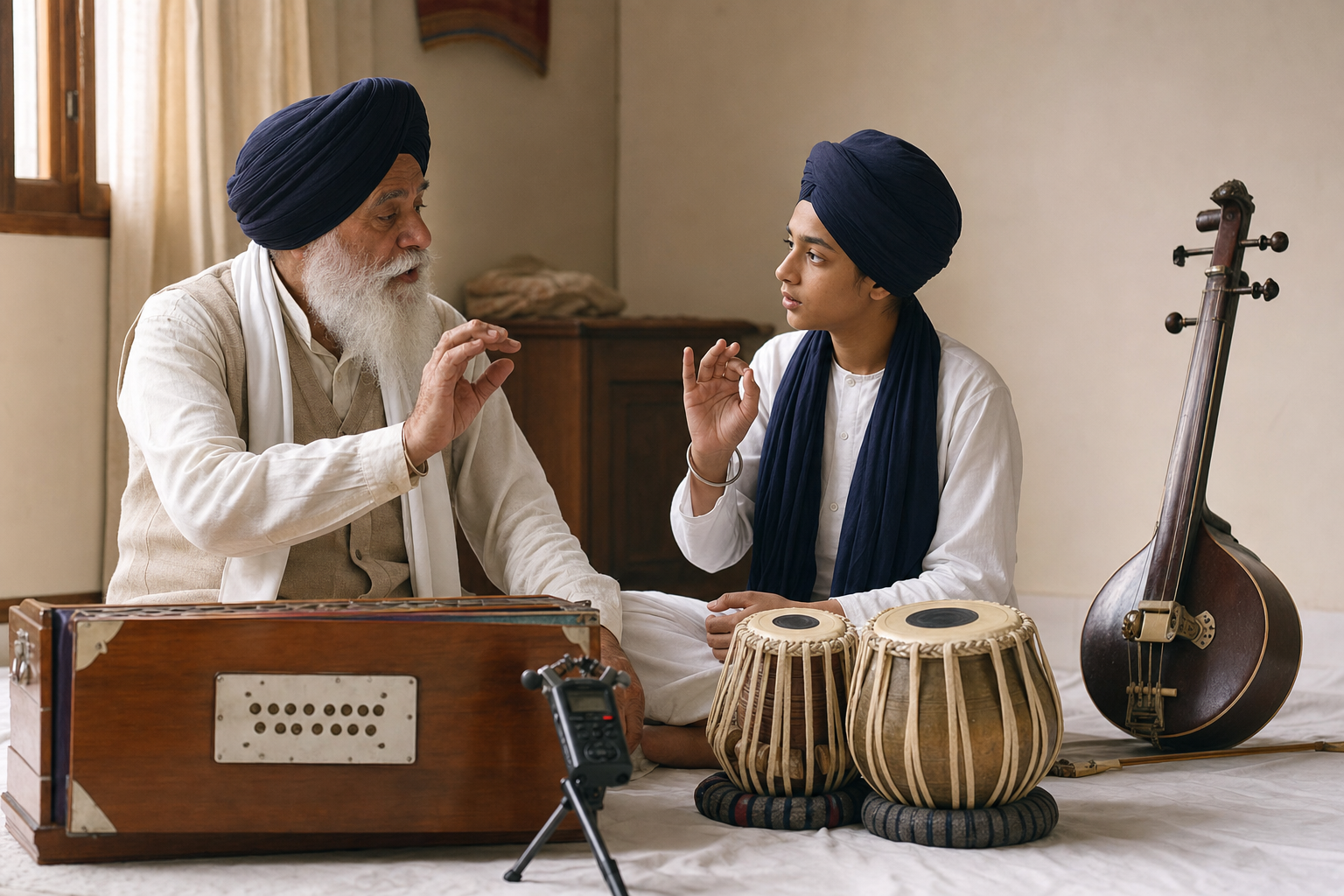
Words do not enter Sikh life as disembodied data. They are read, pronounced, heard, remembered and sung. A clear scan can preserve Gurmukhi letterforms, but it cannot preserve pronunciation or musical interpretation. An audio recording can preserve a voice and melody, but it cannot show the written form from which the shabad was read.
That is why sacred music and script should not be catalogued as unrelated collections. Link a recording to the text being sung whenever identification is possible. Link a handwritten page to the person who can read it, explain its content or demonstrate the hand that produced it. If the relationship is uncertain, record the uncertainty instead of supplying a confident guess.
Treat each preserved item as a bundle with several parts:
- The object or original digital file.
- A stable catalogue record describing what it is.
- The names of people who created, performed, owned or identified it.
- Musical, linguistic and historical context.
- Permission rules governing access and reuse.
- A practical way to return the material to reading, singing, calligraphy or teaching.
This distinction matters. A file can survive while its meaning disappears. Preservation succeeds only when a future learner can find the item, understand what is known about it and use it without depending on one person’s memory.
Begin with a collection you can actually finish
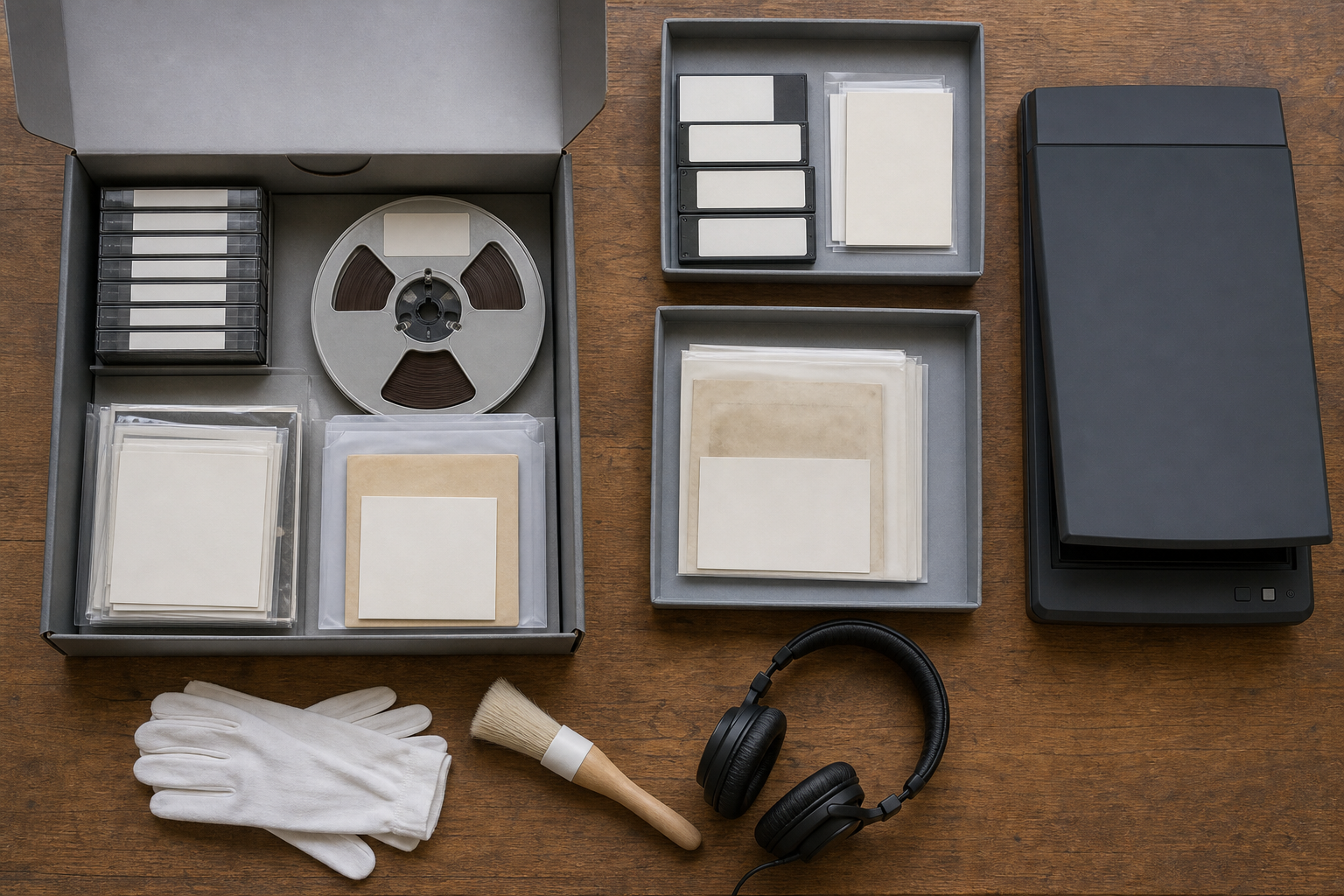
Do not begin with a promise to digitise everything. Choose one bounded collection: a single raag darbar, one musician’s recordings, one calligrapher’s folio, one shelf or one family donation. Completing a small collection establishes the naming rules, permissions and storage practices that later work will need.
Before moving or renaming anything, photograph the collection in its present order and assign a temporary identifier to every physical group and digital folder. Existing order can preserve relationships that are invisible at first. A recording next to a notebook, for example, may be connected even when neither carries a complete label.
| Catalogue field | What to record | Why it matters |
|---|---|---|
| Stable ID | A unique code that does not change when the title changes | Connects files, notes, permissions and physical objects |
| Content identity | First line or other verified identification of the shabad or written text | Avoids vague titles and mistaken matches |
| People | Performer, teacher, scribe, calligrapher, donor, owner and identifier, as applicable | Preserves human lineage and responsibility |
| Place and date | Exact information when known; approximate or unknown when not | Prevents later assumptions from becoming false facts |
| Musical description | Raag, taal, instruments and performance setting when verified | Makes a recording useful for musical study |
| Script description | Gurmukhi content, hand, material, dimensions and page sequence | Preserves textual and visual context |
| Basis and confidence | Who supplied an identification and whether it is confirmed, probable or unresolved | Keeps interpretation separate from evidence |
| Access status | Public, community-only, teaching use, restricted or awaiting permission | Prevents availability from being mistaken for consent |
Keep an untouched preservation master of every digital capture and make separate working copies for editing, transcription and public access. Use stable IDs in filenames rather than descriptions likely to change. Store independent copies on different media and in separate physical locations; a shared link should never be the only copy.
Verify that transferred files open before erasing or reusing a memory card. Check audio at the beginning, middle and end, and inspect images at full size for focus, glare and missing edges. Export widely readable files alongside any project file that depends on specialised software.
Physical intervention needs more restraint. Do not apply household cleaners, adhesive tape, pressure or improvised flattening to a fragile manuscript or calligraphic work. Those actions can be irreversible. Photograph the item’s condition without forcing it open, and seek a trained conservator’s advice before repair.
Record Gurmat Sangeet with enough context to teach it
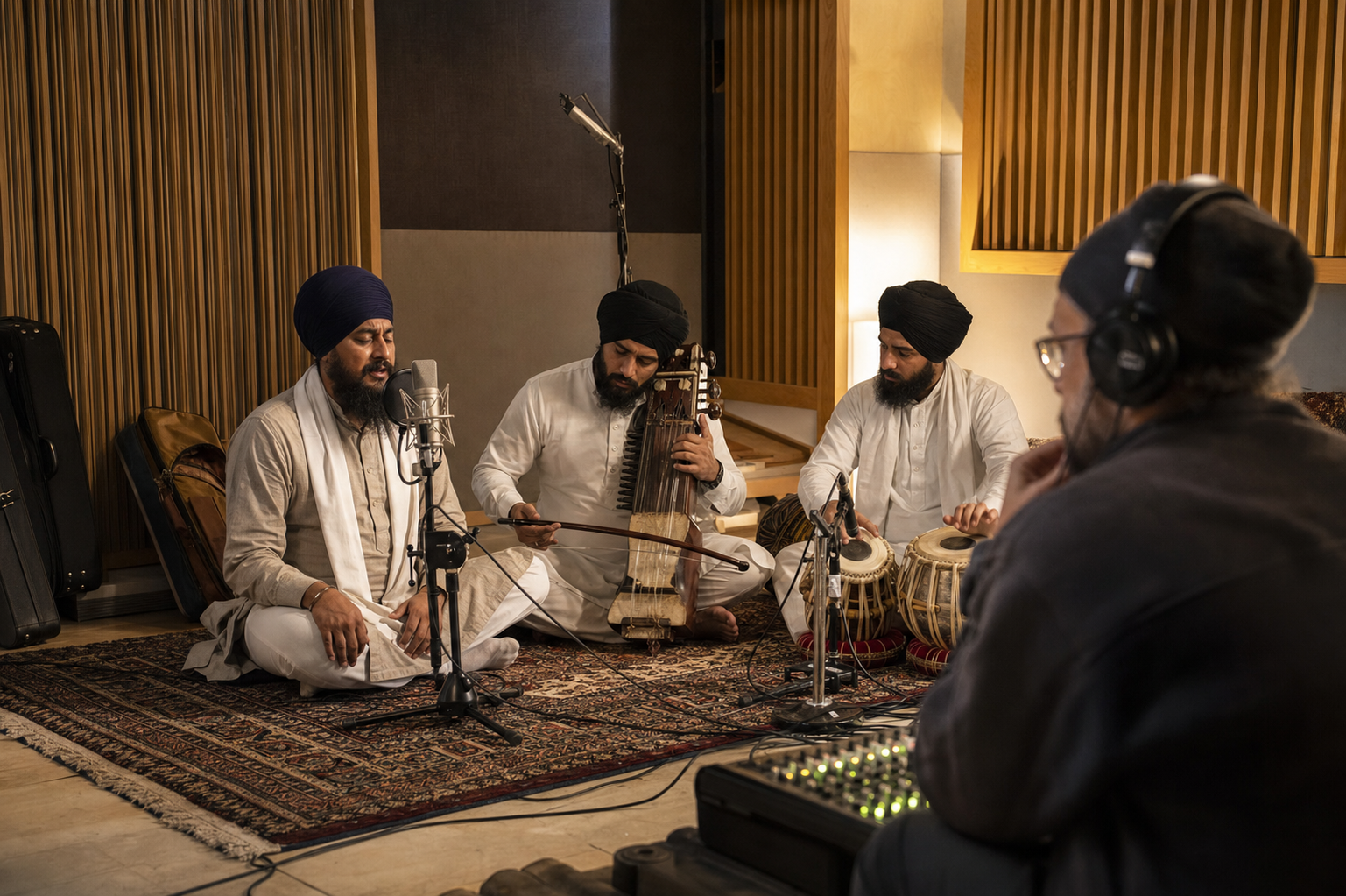
A polished excerpt may be suitable for sharing, but it is a poor preservation master. Capture the complete musical sequence when permission and circumstances allow. Keep the tuning, spoken introductions, transitions and closing context. These moments can reveal how performers prepared, named and connected the presentation.
Prepare the catalogue sheet before the gathering. For each performance, record:
- The stable recording ID and original filename.
- The shabad’s first line in Gurmukhi, copied from a verified text when available.
- Transliteration or translation only as an additional access aid, never as a replacement for Gurmukhi.
- The announced or independently verified raag and taal. If either is uncertain, mark it as unverified.
- The performers’ names, roles and preferred spellings.
- The instruments used.
- The venue, date, occasion and relevant teaching context.
- The recorder’s name and a short description of the recording setup.
- The permission granted for preservation, teaching, publication and reuse.
Do not infer a raag merely from an old filename or an unverified note. Retain the original label, record who supplied it and ask a competent practitioner to review it. That preserves the evidence without turning a tentative identification into an archival fact.
A Gurmat Sangeet Raag Darbar scheduled for July 31-August 2, 2026 offers a concrete opportunity to practise this approach. If you attend as an archivist or learner, obtain recording permission in advance, prepare session IDs, confirm how names should be written and ask who can verify the musical metadata. During worship or performance, documentation must remain unobtrusive and subject to the organisers’ direction.
Technical clarity matters, but context matters more. A modest recording with an identified shabad, named performers, verified raag and clear permission is more useful than a beautiful anonymous clip detached from its musical setting.
Document Gurmukhi as text, artwork and living skill
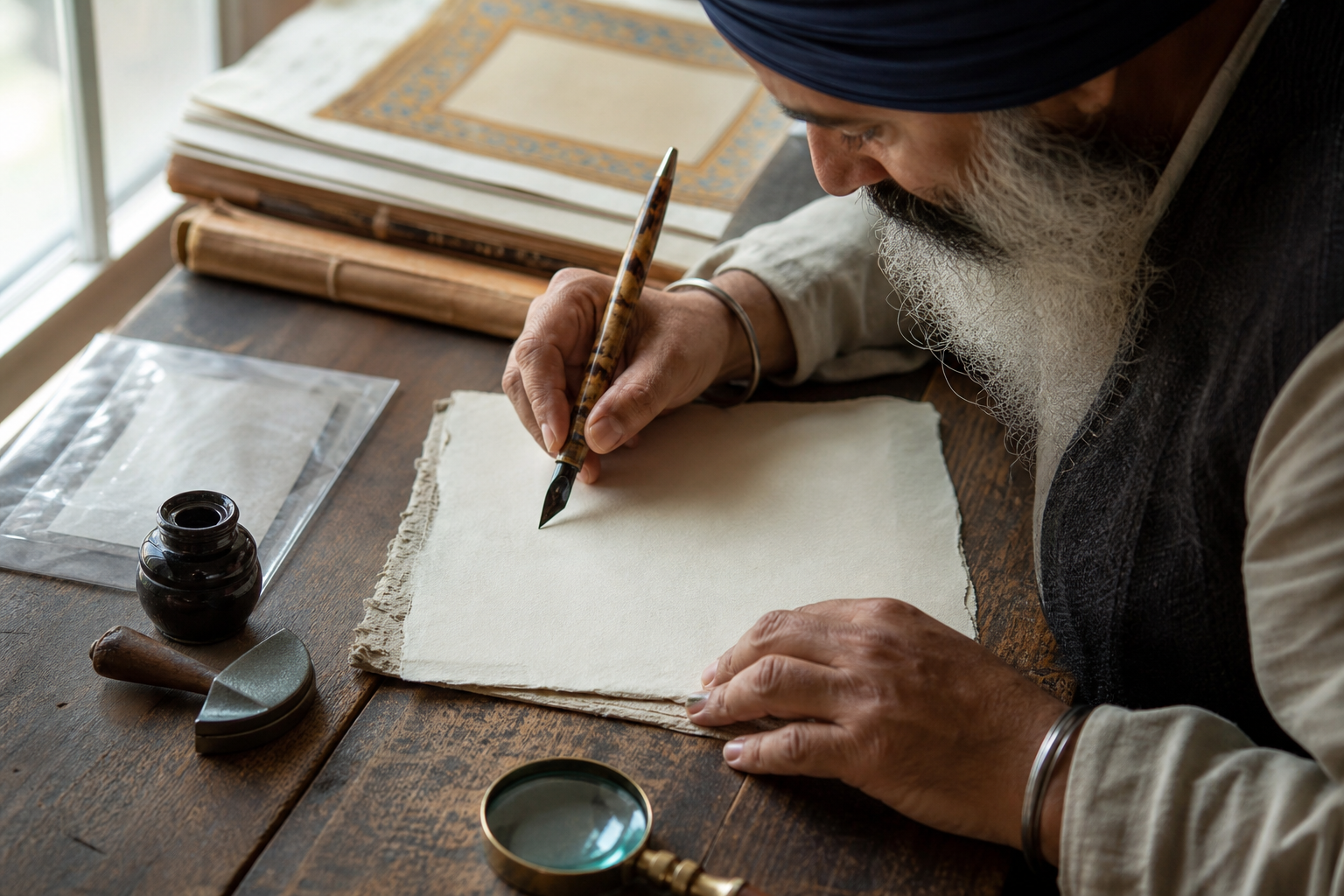
Gurmukhi preservation has three related tasks. You must retain the readable text, the physical or visual character of the page, and the knowledge required to form and interpret the letters. A transcription alone cannot preserve the calligrapher’s spacing, line weight, corrections, ornament or movement of the hand.
For a manuscript, notebook or calligraphic folio, begin with images that establish the whole object. Photograph the cover, binding, page sequence and full page before making close views of significant details. Include a neutral colour reference and measurement scale when this can be done safely without touching the work. Keep images in sequence and record any missing, loose or unnumbered pages.
Your descriptive record should distinguish observation from interpretation:
- Write what is physically visible before assigning a date, school or stylistic name.
- Record the scribe or calligrapher only when the attribution has a known basis.
- Preserve original spellings and visible corrections in a faithful transcription.
- Place normalised spelling, searchable text, transliteration and translation in separately labelled fields.
- Mark illegible or uncertain characters instead of silently completing them.
- Identify the person who checked the Gurmukhi transcription.
- Record ownership, custody and permission separately from authorship.
This layered method lets different readers use the same record without confusing one representation for another. A learner may need transliteration. A scholar may need the faithful transcription. A calligrapher may need high-resolution views of the original hand. None of those access versions should overwrite the preservation image.
The renewal of Gurmukhi calligraphy in Kashmir through Loveleen Kaur’s work also points to something a scanner cannot accomplish: a script remains alive when people practise it. Invite a skilled calligrapher to demonstrate letter formation, record the working process with permission, preserve examples from different stages and create supervised opportunities for learners to copy by hand. Commissioning new work and documenting how it was made can complement the preservation of older pages.
Do not reduce calligraphy to decorative imagery detached from the words. Catalogue the text represented, confirm how it should be displayed and let the calligrapher or an informed reader explain choices that are not visually obvious. The meaning of a sacred line and the integrity of its written form belong in the same record.
Give the archive permissions, owners and a route back into practice
Access and preservation are different decisions. A family may permit long-term storage without approving public release. A performer may allow a complete recording to be kept for teaching while approving only an excerpt for publication. A custodian may restrict photography or display of a sacred object according to local maryada. Record these decisions at item level rather than relying on a general assumption.
Use plain access labels such as public, community-only, approved for teaching, restricted and awaiting permission. Add the name of the person who granted permission, the uses discussed and a contact for future questions. If permission is unclear, restrict the item until the relevant custodian can decide. Possessing a file does not by itself establish a right to publish it.
Assign responsibility by function. Someone must safeguard the physical material, someone must maintain the catalogue, and qualified readers or musicians must verify specialist descriptions. The same person can hold more than one role in a small project, but every role needs a named owner and a handover record. An archive controlled through one person’s password and memory remains vulnerable even when its files are duplicated.
Then build a route from the archive back into community practice:
- Pair a recording with its Gurmukhi text and verified metadata for a listening session.
- Ask a practitioner to explain how the musical setting serves the shabad rather than presenting the audio as an isolated performance.
- Use a high-quality reproduction for calligraphy instruction while keeping the original protected.
- Let learners compare the preservation image, faithful transcription and optional transliteration so they understand what each layer does.
- Invite performers, scribes, descendants and custodians to correct descriptions, while retaining an edit history.
- Review unresolved identifications and permissions whenever knowledgeable community members are present.
Key takeaways
- Preserve sound, script, people, provenance and permission as connected information.
- Start with one bounded collection and finish its catalogue before expanding.
- Keep untouched master files, independent copies and separate versions for access or editing.
- Record a shabad’s identity, raag, taal and performers only to the level that can be verified.
- Preserve original Gurmukhi beside clearly labelled transcription, transliteration and translation layers.
- Return archived material to supervised reading, singing, calligraphy and teaching.
Choose one collection before your next community gathering and create its stable IDs, catalogue fields and permission labels. Then preserve one item completely – with its context, verification and teaching use – before adding the next. That finished record will do more for Sikh continuity than a drive full of unexplained files.