

You see a noose in a deity’s hand, a mouse beneath a throne, or a chain on a warrior’s banner. One caption calls it attachment, another calls it discipline, and a third calls it compassionate restraint. The important question is not which slogan sounds deepest. It is how you can tell which interpretation belongs to the image, how certain that interpretation is, and what it asks you to do.
Dharmic iconography becomes easier to read when you stop treating it as a one-to-one code. An object rarely has one meaning in every setting. Its significance arises from the figure who holds it, the action it performs, the attributes paired with it, the narrative around it, and the tradition through which it has been transmitted. The method below will help you separate observation from inherited meaning and personal reflection without draining a sacred image of its ethical force.
A sacred image is a moral relationship, not a rebus
A rebus asks you to replace each picture with a word. Dharmic iconography asks you to understand relationships. A weapon can protect or destroy. A noose can imprison, retrieve, restrain, or guide. A vehicle can indicate movement, mastery, dependence, companionship, or the disciplined use of a particular power. The same visible form may therefore carry different ethical meanings without becoming arbitrary.
The dhvajas of the Mahabharata offer a clear example. A battlefield standard was a practical marker, but it could also serve as a compressed declaration of identity, allegiance, virtue, and intent. The emblem did not merely name the warrior. It told observers how that warrior wished to be understood amid the confusion of battle.
A deity’s attributes work through a similar visual grammar. The attribute identifies a capacity. The gesture establishes a relationship with the devotee. The vehicle places a force under direction. The surrounding narrative shows how power is gained, misused, restrained, sacrificed, or transformed. When these elements are isolated from one another, interpretation quickly collapses into a collection of motivational slogans.
- Ask what the object physically does before asking what it symbolizes.
- Ask whether the figure controls the object, receives it, offers it, rides it, or struggles against it.
- Read paired attributes together. Restraint beside reward means something different from restraint beside a weapon.
- Notice whether the image presents power as possession, service, discipline, protection, renunciation, or consequence.
- Keep narrative context attached to the symbol. An object associated with a particular vow or event cannot safely be reduced to a universal dictionary entry.
This approach preserves an important Dharmic insight: strength is not ethically complete merely because it is impressive. Its meaning depends on what directs it, what limits it, whom it serves, and what consequences follow from its use.
Read the image in five passes
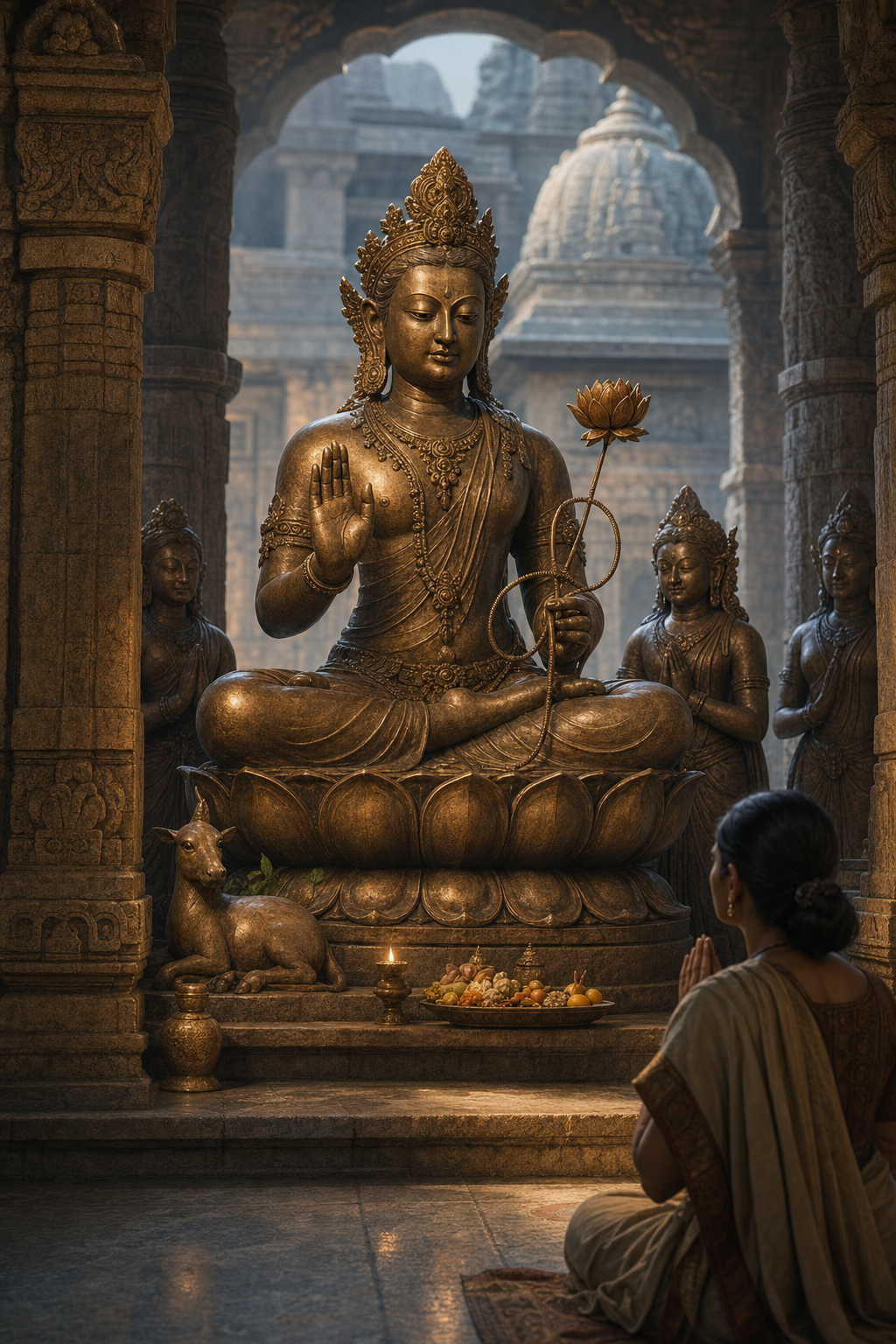
When you encounter an unfamiliar murti, painting, manuscript illustration, festival image, or banner, resist the urge to decode it immediately. Work through five passes in order. Each pass answers a different kind of question and prevents a different kind of error.
- Describe what is actually visible. Record the figure, posture, number of arms, hand gestures, objects, vehicle, companions, direction of movement, and setting. Do not interpret yet. If an object is damaged or unclear, say that it is unclear instead of silently completing it from expectation.
- Identify the figure and iconographic form. A familiar deity may appear in multiple forms, each with a different arrangement of attributes. Ganesha traditions, for example, describe thirty-two popular forms with differing postures and attributes. Do not force every image into the best-known modern arrangement.
- Recover the practical action of each object. A goad directs a powerful animal. A noose catches, draws, or binds. A sweet is consumed and enjoyed. A broken tusk records loss, adaptation, or use. Practical function narrows the field of responsible interpretation.
- Locate the image within a textual, ritual, regional, or artistic tradition. Ask whether the identification is widespread, restricted to a particular recension, elaborated in a later commentary, or preserved mainly in regional performance and art. Variation is evidence about transmission, not an inconvenience to conceal.
- Rank the interpretation by confidence and test its ethical consequence. Distinguish what you can see, what tradition identifies, what context strongly supports, and what you are personally contemplating. Then ask whether the reading clarifies conduct or merely flatters the interpreter.
A useful sentence pattern is: I can see this feature. It is traditionally identified in this setting as this attribute. Its practical action is this. In this composition it may express this ethical principle because of these accompanying details. For me, it raises this question of conduct.
The words “may express” matter when evidence is interpretive. They do not weaken the reading. They tell your listener where inherited identification ends and reasoned reflection begins. That distinction is especially important when teaching children, writing museum labels, posting images online, or explaining one sampradaya’s sacred art to people from another.
Two images that show the method in action
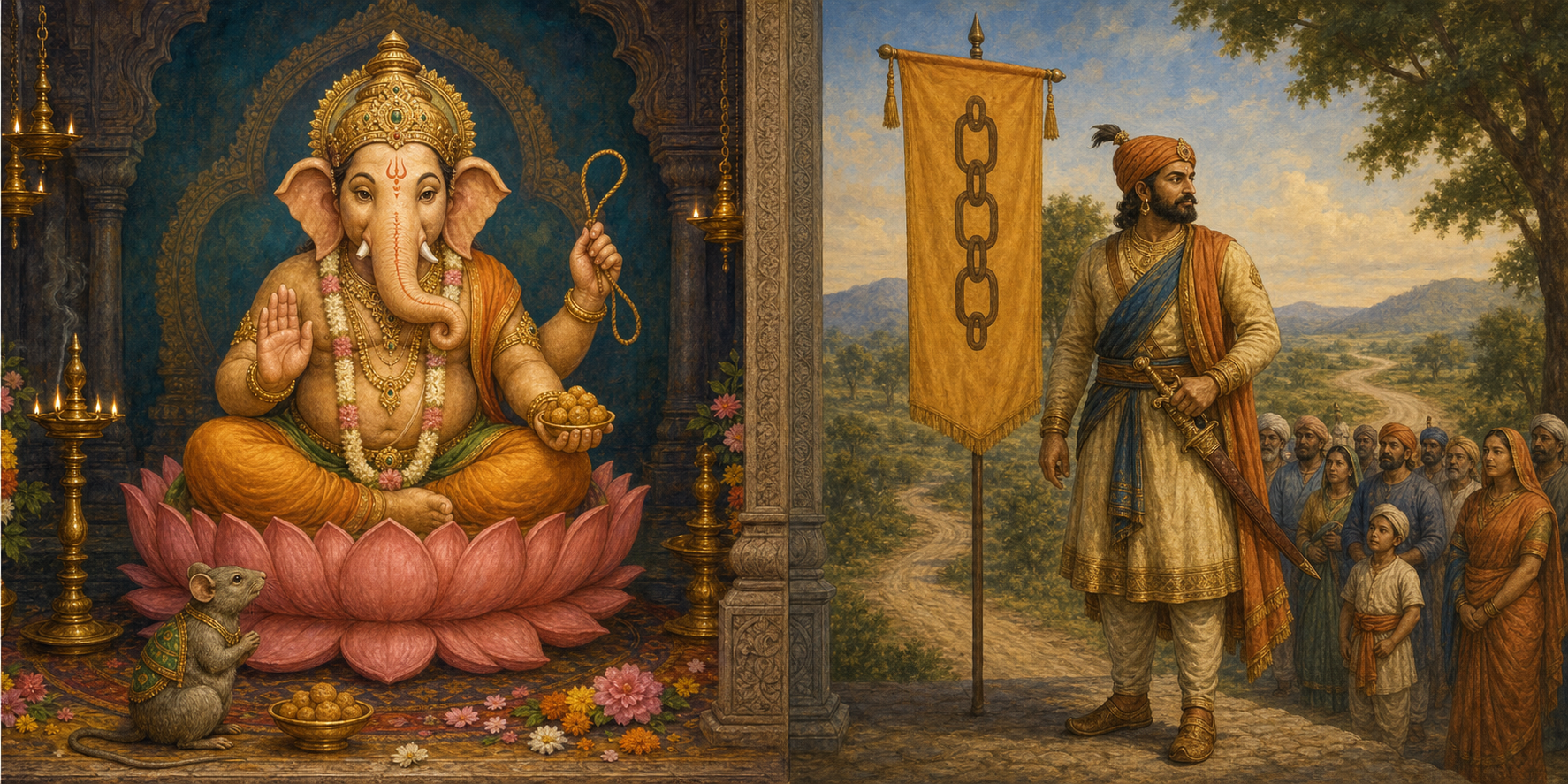
Ganesha: restraint, direction, sacrifice, and fruition
A common representation of Ganesha brings several ethical actions into one composition. The noose, goad, modaka, broken tusk, mouse, and gestures of protection or generosity should not be read as unrelated labels pasted onto a deity. They form a sequence of moral education.
The pasha, or noose, introduces restraint and guidance. It can remind you that something dispersed must be gathered, something dangerous may need to be checked, or someone wandering may need to be drawn toward the right path. Because a noose can also signify bondage, the image does not permit an easy celebration of control. It asks whether restraint serves clarity and protection or merely domination.
The ankusha, or goad, adds direction. Restraint alone can produce paralysis. Direction without restraint can produce reckless momentum. Read together, noose and goad suggest that ethical agency requires both a boundary and a next movement: know what must stop, then know where disciplined energy should go.
The modaka places sweetness within this demanding grammar. It is commonly associated with the bliss or fruit of inner knowledge. The reward is not mere indulgence detached from discipline; it appears beside instruments of guidance and mastery. The composition therefore resists a familiar mistake: wanting the fruit of wisdom without accepting the restraint, attention, and work by which wisdom becomes possible.
The broken tusk, associated in one well-known telling with Ganesha’s work as the Mahabharata’s scribe, makes the cost of knowledge visible. Other narratives explain the broken tusk differently, so the image should not be tied exclusively to one episode. Across the different tellings, however, Ekadanta can direct attention toward resilience, creative adaptation, and the priority of dharma or knowledge over an attachment to perfect outward form.
The mushika, Ganesha’s mouse vehicle, completes the psychological movement. The mouse is small, quick, and difficult to contain. Read ethically, it evokes restless impulses made useful under wise direction. The point is not that the small must be despised or crushed. The small and unruly can become capable when it is neither allowed to roam without limit nor denied a legitimate function.
You can turn this composition into a short threshold examination before beginning a course, project, journey, community responsibility, or period of study:
- Name the obstacle precisely. Separate an external impediment from an inner habit such as distraction, haste, fear, or unexamined desire.
- Choose the noose. State the boundary that will prevent your attention or power from scattering.
- Choose the goad. State the next concrete action toward the worthy goal.
- Name the tusk. Identify the preference, comfort, or concern with perfect appearance that you may need to surrender or adapt.
- Define the modaka. Decide what a genuinely good fruit would be: learning, service, completion of duty, clearer judgment, or another result consistent with dharma.
This is a contemplative application of the iconography, not a claim that the five-step exercise is a universally prescribed puja. Formal worship belongs within its ritual and sampradaya context. The exercise simply lets the visible relationships in the image question your conduct at the threshold where decisions are still changeable.
Karna’s elephant-chain: how to interpret a disputed emblem
Karna’s elephant-chain is a useful test of intellectual honesty because the first task is to preserve uncertainty. The association appears in some traditions and interpretive lists, but it is not a uniformly fixed identification across the Mahabharata’s manuscript traditions. The responsible opening is therefore not “Karna’s banner unquestionably was an elephant-chain.” It is “Certain traditions associate Karna with an elephant-chain emblem.”
Once that boundary is stated, the emblem supports a serious contextual reading. Chains, ropes, and harnesses had the practical function of managing the tremendous force of war elephants. The image can therefore signify power held under discipline rather than force released without limit. Sanskrit terms such as shringkhala and pasha also inhabit a semantic field of chains, bonds, and fetters. The emblem can speak simultaneously of strength being harnessed and a person being bound.
Karna’s life makes that double meaning ethically sharp. Gratitude to Duryodhana, loyalty expressed through vow, the identity of the unsurpassed giver, the concealment that brought Parashurama’s curse, and other accumulated consequences all place extraordinary ability inside tightening obligations. His courage remains real. So does the moral cost of allowing loyalty to a benefactor to harden into participation in that benefactor’s cause.
The emblem should therefore neither be used to glorify blind loyalty nor to dismiss loyalty as a virtue. It exposes the point at which a virtue becomes dangerous: gratitude becomes bondage when it forbids renewed moral judgment; steadfastness becomes attachment when it protects a person or faction against dharma; generosity becomes self-destruction when an identity must be preserved regardless of consequence.
You can apply this reading through a bond audit whenever a long-standing obligation begins to conflict with conscience:
- Name the bond without euphemism: gratitude, family loyalty, employment, friendship, status, vow, fear, debt, or public identity.
- Classify it as chosen, inherited, imposed, or sustained by habit. A chosen obligation still deserves review; an inherited one may still deserve honour.
- State the virtue the bond protects. If you cannot name one, habit or fear may be wearing the language of duty.
- State the harm the bond currently asks you to overlook, excuse, or enable.
- Ask what boundary would preserve the virtue without cooperating with adharma.
- Review the consequences already accumulating. The Mahabharata repeatedly shows that consequences become visible long before they become unavoidable.
This method does not reduce Karna to a warning label. It respects the tragic depth of a figure whose virtues, injuries, loyalties, choices, and fate cannot be separated cleanly. Ethical iconography is most valuable precisely when it refuses to make difficult lives morally simple.
Shared symbols do not erase doctrinal differences
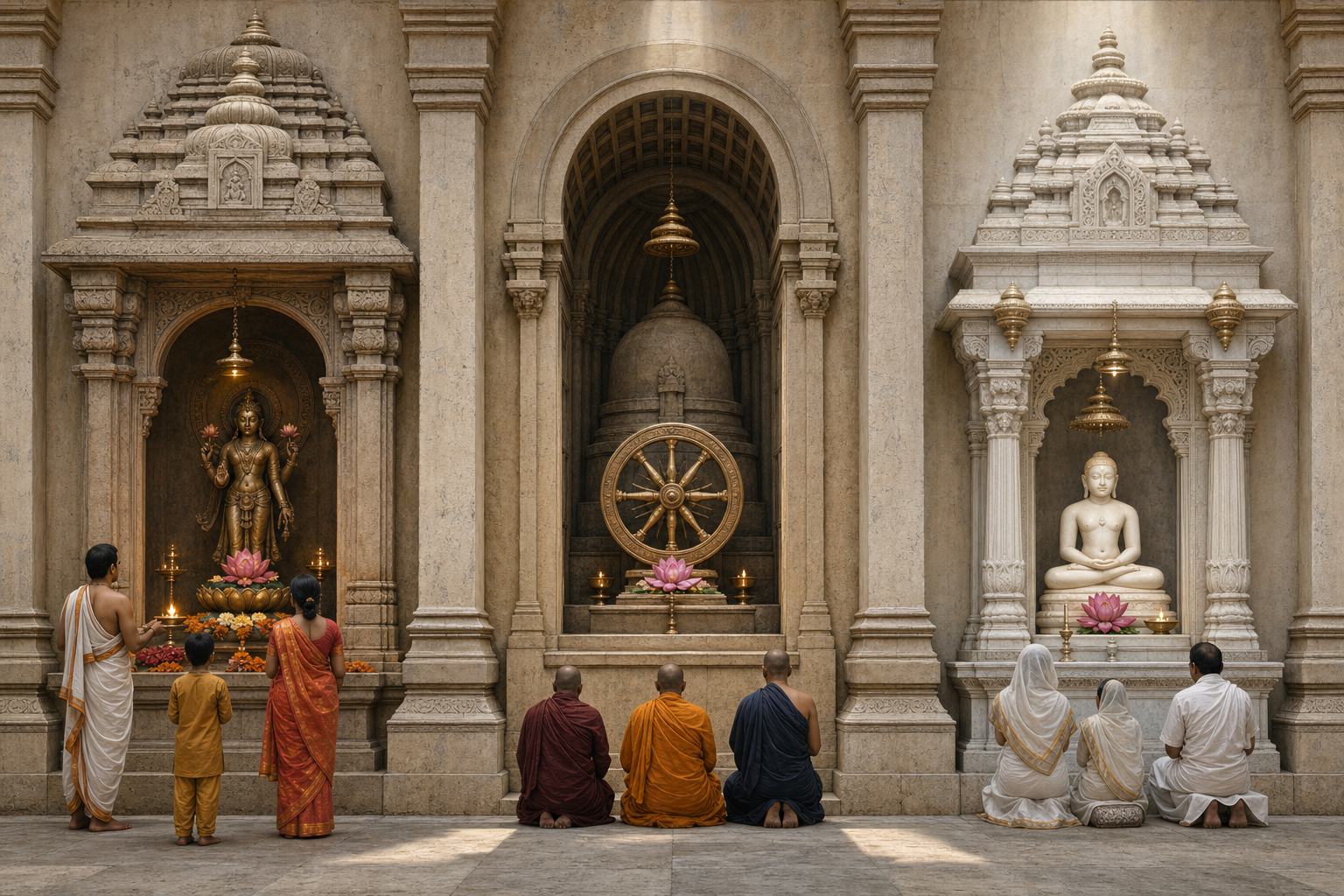
Words and images of bonds recur across Dharmic traditions, but recurrence is not identity. A careful comparative reading looks for a family resemblance and then preserves the distinct account of the self, karma, liberation, discipline, and grace within each tradition.
In Buddhist teaching, samyojana names fetters that bind beings to suffering, with ethical cultivation and wisdom directed toward their abandonment. Jain teaching describes karma-bandha as the binding of karmic matter to the jiva, thinned through right conduct and austerity on the path to moksha. Sikh teaching speaks of bandhan associated with haumai, with freedom sought through nam, seva, and righteous living. In Hindu iconographic interpretation, a pasha may signify worldly bondage, but in Ganesha’s hand it may also become an instrument of guidance and compassionate restraint.
The narrow comparison is the sound one: bondage, disciplined power, moral consequence, and liberation recur as ethical concerns. The metaphysical explanations and prescribed paths are not interchangeable. Saying that every chain simply means attachment erases too much. Saying that no comparison is possible misses a genuine shared concern with the forces that limit freedom and the disciplines that redirect human life.
When you compare a symbol across traditions, ask four separate questions:
- Does the symbol name a fetter to be cut?
- Does it name a karmic bond whose causes must cease?
- Does it name ego-bound existence transformed through remembrance, service, and righteous living?
- Does it show a dangerous or immense force being restrained and directed rather than eliminated?
Those questions prevent a loose claim about all Dharmic religions from replacing the teachings of the traditions themselves. Unity is made more credible, not less, when difference is stated accurately.
Key takeaways
- Describe the visible image before assigning meaning. An unclear attribute should remain unclear until you have better evidence.
- Interpret the whole composition. Attribute, gesture, vehicle, posture, companion figures, and narrative context modify one another.
- Begin with practical function. What an object does usually places firmer limits on interpretation than a memorized list of symbolic keywords.
- Separate observation, traditional identification, contextual inference, and personal contemplation. Do not present the fourth as though it were the second.
- Preserve textual and regional uncertainty. A compelling emblem can remain ethically valuable without being universal across every recension or school.
- Compare Dharmic traditions through precise shared questions, not by declaring their doctrines identical.
- Make the interpretation behavioural. Ask what must be restrained, redirected, sacrificed, reviewed, or released in the decision before you.
The next time you meet a sacred image, write one sentence at each level: what you see, what the tradition identifies, what the full composition supports, and what question it puts to your conduct. The goal is not to produce the cleverest caption. It is to let sacred form reveal where strength, loyalty, desire, knowledge, or restraint now requires a disciplined choice from you.
References
- DharmaRenaissance Blog — Karna’s Elephant-Chain Banner: Fate, Dharma, and the Unyielding Spirit of Kurukshetra
- HinduPad — 18 Research-Backed Facts about Ganesha: Iconography, Mantras, Festivals, and Global Legacy