

You may find the same Vaishakha observance listed under two month names, or discover that the date used by relatives in Bharat does not match the date on your local temple calendar. That does not necessarily mean one calendar is wrong. Hindu sacred time is governed by tithi, and the tithi must be calculated for the place where you will worship.
For 2026, two dates deserve a place in your Vaishakha plan: Parashurama Dwadashi on April 28 and Narada Jayanti on May 2 in the Indian calendar context. The practical task is to confirm when their operative tithis prevail locally, then give each day a form of worship suited to its distinct dharmic teaching.
The two sacred dates at a glance
| Observance | Operative tithi | 2026 civil date in India | Primary focus |
|---|---|---|---|
| Parashurama Dwadashi | Vaishakha Shukla Dwadashi, following Mohini Ekadashi | April 28 | Vishnu worship, disciplined strength, proper Ekadashi parana, seva and dana |
| Narada Jayanti | Krishna Paksha Pratipada immediately after Vaishakha Purnima; also called Vaishakha Bahula Pratipada in Amanta reckoning | May 2 | Bhakti, sacred sound, scriptural study, restrained speech and satsanga |
The table gives you reliable anchors, not universal appointments. A tithi is not a midnight-to-midnight date. It can begin during one civil day and end during the next, and its clock times shift with longitude and time zone. If you live outside India, do not merely convert Indian Standard Time into your local time. Open a panchang calculated for your own city.
The sequence also helps you read the month correctly. Parashurama Dwadashi falls late in the bright fortnight as the Moon approaches fullness. Narada Jayanti comes on the first tithi of the dark fortnight, immediately after Vaishakha Purnima. The civil dates are close, but the observances carry different ritual duties and should not be blended into one generic Vaishakha puja.
Why your panchang may use a different month name

A tithi is an astronomical interval
A tithi measures each 12-degree increase in the angular separation of the Sun and Moon. Because that interval does not match a fixed 24-hour civil day, a tithi may touch two dates, be absent at one sunrise, or cover the sunrise on one date while ending before a preferred puja period.
That is why a festival date cannot be settled by looking only at the number printed in a monthly calendar. For Parashurama Dwadashi, the sunrise status of Dwadashi and the prescribed Ekadashi parana window matter. For Narada Jayanti, the relevant question is when Krishna Paksha Pratipada prevails during the principal period used for worship in your tradition.
Amanta and Purnimanta calendars label the same day differently
In an Amanta calendar, the lunar month ends at Amavasya. The dark fortnight after Vaishakha Purnima therefore remains part of Vaishakha, making Narada Jayanti Vaishakha Bahula Pratipada or Vaishakha Krishna Pratipada. In a Purnimanta calendar, the month ends at Purnima, so the same post-full-Moon tithi opens Jyeshtha and is labelled Jyeshtha Krishna Pratipada.
This is a change of month reckoning, not a change of festival. If two calendars agree on Krishna Paksha Pratipada but one says Vaishakha and the other says Jyeshtha, compare the tithi timings before deciding that they conflict.
Four details to copy from your local panchang
- Confirm that the panchang is calculated for your city or a genuinely nearby location, not simply for India or for a distant national capital.
- Write down the local start and end times of Shukla Dwadashi or Krishna Paksha Pratipada, as applicable.
- Check which tithi prevails at local sunrise and during the period when you intend to perform puja.
- If you observed Mohini Ekadashi, record the prescribed Dwadashi parana window separately. Do not treat the festival date and the fast-breaking time as interchangeable.
If a temple, family priest or sampradaya calendar applies a more specific rule, follow that lineage consistently. The aim is not to assemble a personal ruling from several calendars, but to identify one competent local calculation and use the decision rule of the tradition you actually practise.
Observe Parashurama Dwadashi as disciplined strength

Parashurama Dwadashi is not another name for Parashurama Jayanti. The Jayanti is associated with Vaishakha Shukla Tritiya, widely observed as Akshaya Tritiya. Parashurama Dwadashi belongs to Vaishakha Shukla Dwadashi, the day after Mohini Ekadashi, and places greater emphasis on vrata, Vishnu worship and the disciplined use of personal power.
Parashurama brings together Brahmana learning and Kshatriya resolve. That combination supplies a useful test for the day: knowledge without courage may fail to protect what is right, while force without knowledge and restraint can become another form of adharma. Your observance should therefore join prayer to one concrete act of self-command or protective service.
A workable home puja
- On the previous evening, confirm Dwadashi and, if relevant, the Mohini Ekadashi parana window. Prepare simple satvika naivedya and the items you normally use for Vishnu worship.
- After bathing, clean the shrine and make a sankalpa for steadiness in dharma, purification of conduct and the welfare of all beings.
- Invoke Lord Vishnu and Lord Parashurama. Follow your customary shodashopachara sequence or a simpler panchopachara puja with sandal paste, flowers, incense, a lamp and naivedya.
- Offer tulsi to Vishnu where this is part of your practice. Do not substitute display or complexity for reverence; a small, orderly puja is sufficient.
- Recite the Vishnu Sahasranama, chant Om Namo Bhagavate Vasudevaya, or perform likhita japa if written repetition helps you remain attentive.
- Conclude with arati, prasada and a deliberate act of dana or seva.
The parashu, or axe, can be used as an interior discipline rather than as a celebration of anger. Name the tendency that most often distorts your strength: kama, krodha, lobha, moha, mada or matsarya. Then choose the situation in which you will interrupt it. If anger governs your speech, postpone the retaliatory message. If pride keeps you from repairing a mistake, make the correction that day. The symbol becomes useful when it cuts a habit, not merely when it decorates the shrine.
Handle fasting and parana as separate duties
If you fasted on Mohini Ekadashi, parana is performed on Dwadashi after sunrise during the prescribed local window while Dwadashi prevails. Treat that timing as part of the Ekadashi vrata. Breaking the Ekadashi fast correctly does not prevent you from keeping the rest of Parashurama Dwadashi simple and satvika.
Some traditions also maintain a dedicated Dwadashi fast with fruit, milk or water, while others emphasize a satvika diet rather than another full fast. Do not combine the strictest rules from unrelated customs. Follow your family or sampradaya practice, and adapt the food austerity if age or a medical condition makes it unsafe. A water-only fast is not the measure of your devotion; use a food-assisted observance and follow clinical guidance when your health requires it.
Dana should express Parashurama’s protective force in constructive form. Annadana, clothing donation, useful support for workers or artisans, environmental care, and service at a temple or community institution all turn private resolve into public benefit. Choose one act you can complete rather than making an expansive intention that disappears after the puja.
Observe Narada Jayanti through sound, study and speech
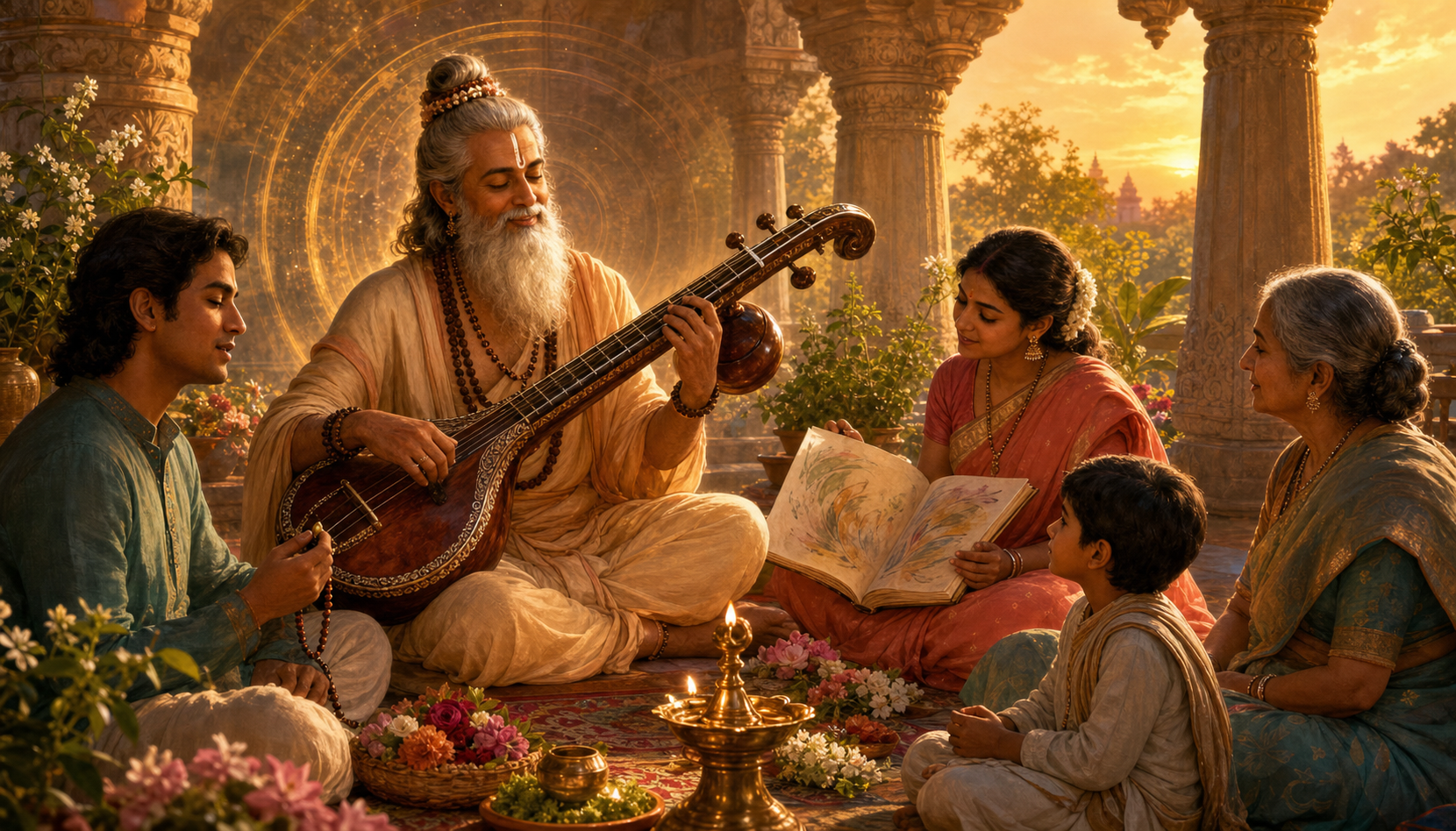
Narada Jayanti honours Devarshi Narada, remembered as Brahma Manasa Putra, a traveller across the three worlds and a catalytic teacher of bhakti. His veena, the remembrance of Narayana and his movement between households, courts and spiritual communities make this an especially fitting day for nama-japa, kirtan, attentive listening and morally serious conversation.
In 2026, the observance falls on May 2 in the Indian calendar context. Outside India, confirm the local span of Krishna Paksha Pratipada. If the tithi crosses two civil dates, use the local festival ruling rather than assuming that India’s May 2 must be copied unchanged.
A home observance with a clear centre
- Prepare a clean place for a lamp and sacred texts. An image of Narada is welcome but not required; you may worship Vishnu, Lakshmi-Narayana or your Ishta Devata while invoking Narada as the teacher of devotion.
- Make a sankalpa on Krishna Paksha Pratipada. Offer flowers, water and naivedya. Offer tulsi when worshipping Vishnu according to your custom.
- Chant Narayana-Narayana, Om Namo Bhagavate Vasudevaya, the Vishnu Sahasranama, or the divine name used in your lineage.
- Read a focused selection rather than moving hurriedly through many texts. The Narada Bhakti Sutra is suited to reflection on selfless devotion. Bhagavata Purana 1.5 presents Narada’s guidance to Vyasa; 4.8-4.12 follows his instruction of Dhruva; and 7.5 illuminates the devotional formation associated with Prahlada.
- Use the evening for bhajan, kirtan, pravachan or family storytelling. If you cannot gather a group, sing or recite at home with full attention.
- Conclude with arati, prasada and one act of service that helps another person hear, learn or practise dharma.
If your available time is limited, keep three elements: the divine name, one passage studied carefully, and one correction in the way you use speech. Those three elements reflect Narada more faithfully than an elaborate programme performed without attention.
Make restraint of speech part of the vrata
Narada is sometimes reduced in popular retellings to a figure who creates trouble. His interventions are better understood as dharmic catalysts: they expose concealed motives, redirect people toward devotion, and force necessary moral decisions. That does not give you permission to provoke conflict in his name. It asks you to distinguish truth-telling from gossip, correction from humiliation, and sacred communication from the desire to be noticed.
Before forwarding a claim, entering an argument or repeating private information on Narada Jayanti, pause and ask what the communication will actually serve. If a conversation needs correction, speak accurately and without malice. If nothing dharmic will be gained, silence may be the more faithful offering. This turns the voice itself into part of the shrine.
Fasting on Narada Jayanti is flexible. Some devotees fast until evening arati, some take fruit or milk, and others maintain an ordinary but strictly satvika diet. The more distinctive discipline is clarity of mind and speech directed toward nama, kirtan and beneficial conversation. Choose a form that lets you remain attentive to worship and responsible for your ordinary duties.
A family containing different Dharmic affiliations can centre the day on sacred sound, ethical storytelling and service without pretending that all traditions have identical theology or ritual. Hindu bhajan and kirtan, Sikh shabad kirtan, and the didactic storytelling cultivated in Jain and Buddhist communities each show how sound and narrative can train attention. Honour that kinship with precision: share what genuinely connects the practices while allowing each path to retain its own language and discipline.
Key takeaways for the date you will actually observe
- Use the civil dates as planning anchors: Parashurama Dwadashi is April 28 and Narada Jayanti is May 2 in India in 2026. Use a city-specific panchang to settle your local observance.
- Do not mistake different month labels for different festivals. Narada Jayanti can be called Vaishakha Krishna Pratipada in Amanta reckoning and Jyeshtha Krishna Pratipada in Purnimanta reckoning.
- Keep Parashurama Dwadashi distinct from Parashurama Jayanti on Vaishakha Shukla Tritiya, or Akshaya Tritiya.
- If you observed Mohini Ekadashi, record the Dwadashi parana window separately and break the fast according to your local tradition.
- Let Parashurama Dwadashi discipline the use of strength. Let Narada Jayanti discipline the use of sound, information and speech.
- Choose a fasting form compatible with your health and duties. The vrata should sharpen worship and conduct, not turn avoidable physical strain into a test of faith.
Open your local panchang now and write down the relevant tithi span, sunrise status, puja period and any parana window. Then prepare one short plan for each day: the text you will read, the mantra you will repeat, the offering you will make and the action through which the teaching will enter your conduct.
When the date arrives, you will not need to improvise or debate month names. You can enter the living tithi with a settled mind and give its dharma a visible form.
References
- HinduPad – Narada Jayanti 2026: Date, Tithi, Puja Vidhi and Devarshi Narada’s Timeless Legacy
- HinduPad – Parashurama Dwadashi 2026: Auspicious Date, Puja Vidhi, Fasting Rules, and Profound Significance