
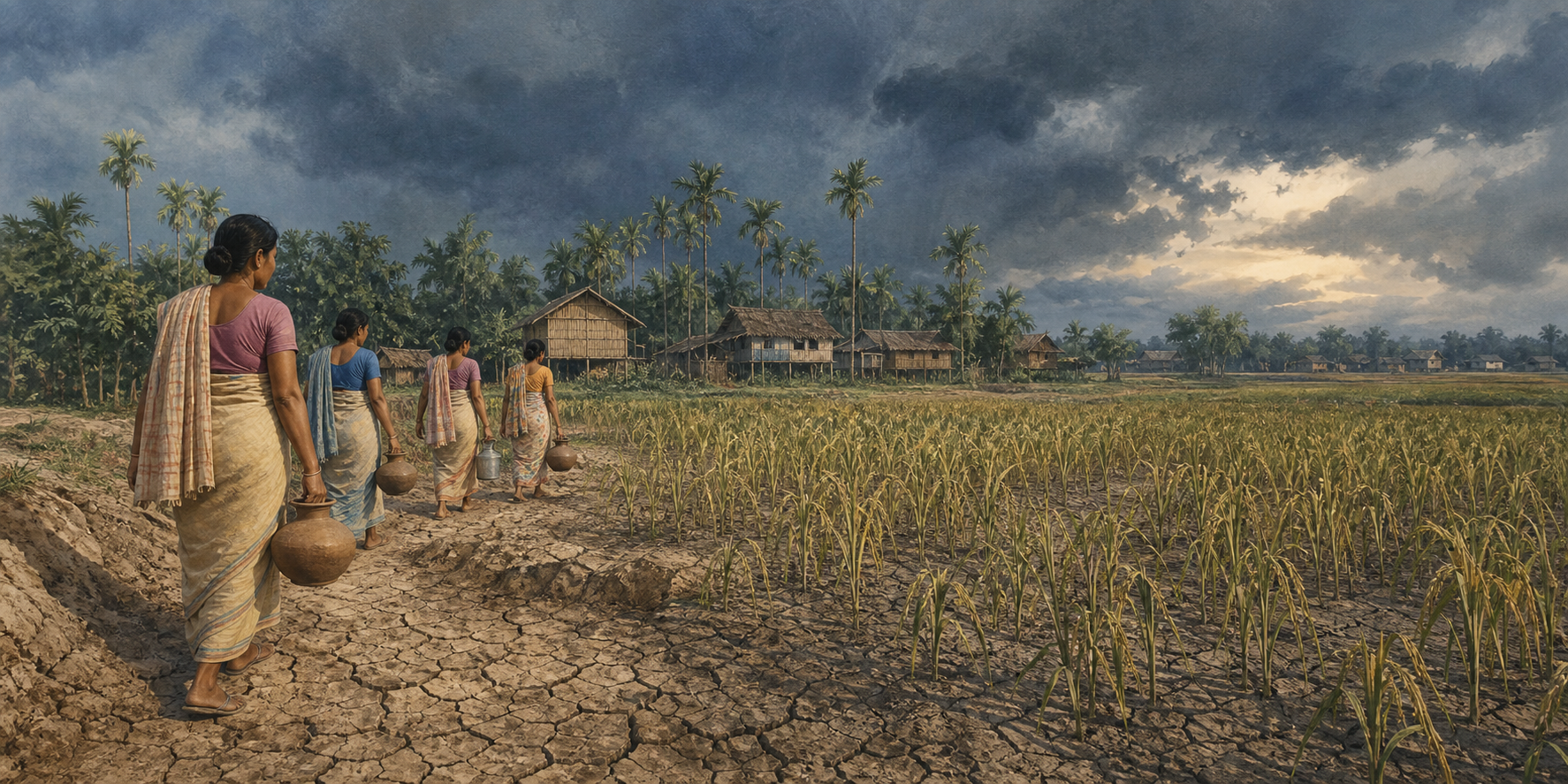
If you first encountered Hudum Puja through a provocative image or a stray description of its night-time customs, you were shown the least useful place to begin. The first question is not why one detail appears unusual. It is what a village facing a failed monsoon needs to repair, prepare, and say together.
Once you begin with drought, the rite becomes coherent. Prayer for rain, women’s ritual authority, candid songs, water offerings, field preparation, and communal self-correction belong to one response. Hudum Puja is sacred ecology in action: the village appeals to the sky while making itself ready to receive whatever rain comes.
Begin with the drought, not the spectacle
Hudum Puja is observed among Koch Rajbongshi communities in western Assam and adjoining North Bengal. Its better-known regional settings include Goalpara, Dhubri, and Kokrajhar in Assam, and Cooch Behar and Jalpaiguri in North Bengal. It is called forth by acute water stress rather than assigned a fixed annual date.
That timing matters. Paddy cultivation has narrow seasonal thresholds. Delayed rain can disrupt nursery preparation, postpone transplantation, leave seedlings at the wrong stage, and compress the work that must be completed once usable water arrives. Hudum Puja appears at this point of collective anxiety, when waiting passively would make the village even more vulnerable.
You should therefore be cautious when a calendar calls Hudum Puja an annual festival with a universal date. The more accurate answer to “When is it performed?” is: when local cultivators judge that delayed or inadequate rain threatens the agricultural cycle. Its timing, sequence, songs, and ritual objects can vary by locality because the ecological problem itself is local.
When you evaluate any description of the rite, establish four coordinates before interpreting a dramatic detail: the particular Koch Rajbongshi locality, the water problem that prompted the observance, the stage of paddy work at risk, and the community rules governing participation. Without those coordinates, a living response to drought is easily mislabelled as folklore performed for entertainment.
The rite works in three connected registers
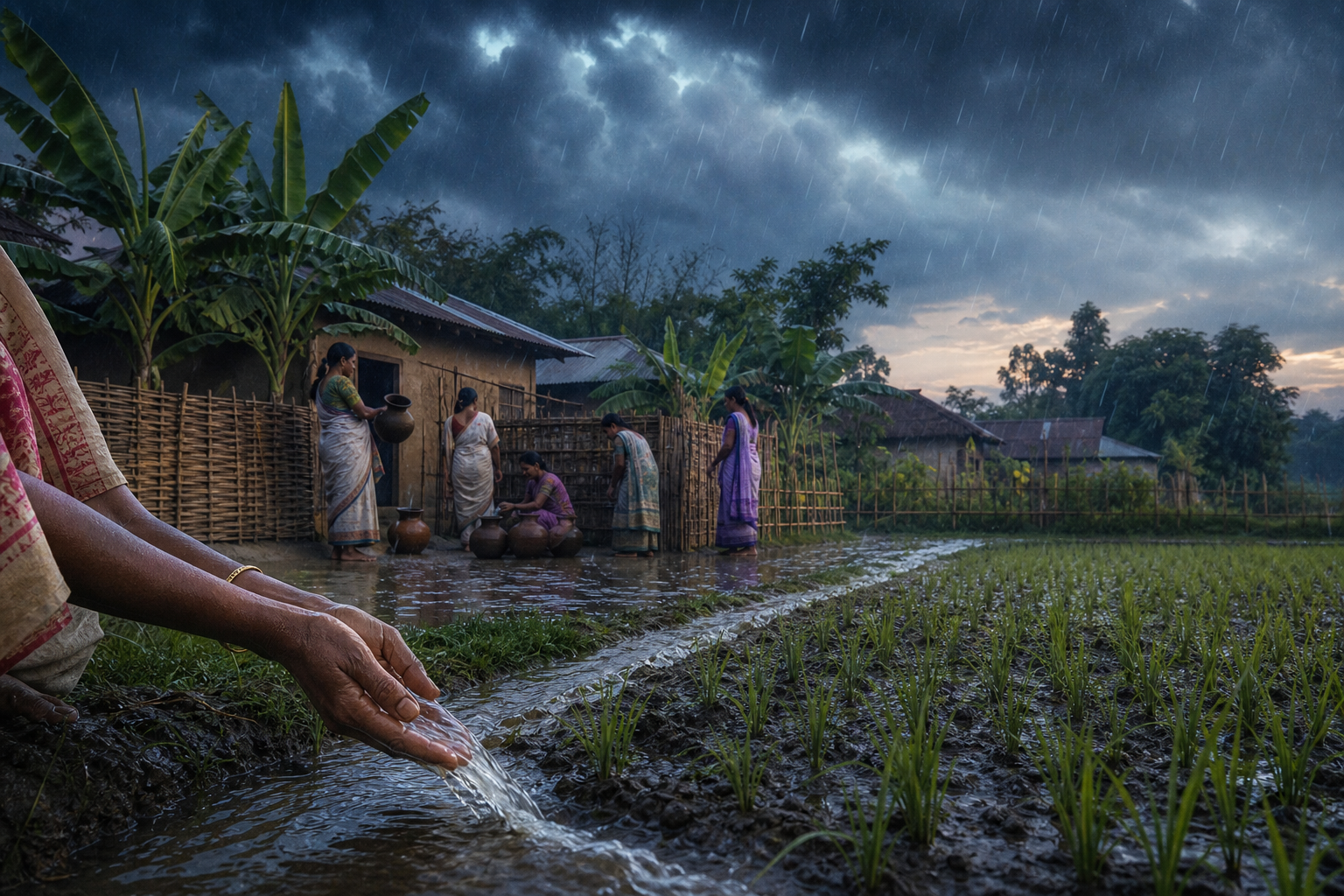
Hudum Deo is approached as a rain and fertility power associated with clouds, crops, soil fecundity, seed, livestock, and the well-being of the cultivated landscape. Some oral interpretations place Hudum near the rain-bearing qualities associated with Indra or Varuna. That resemblance can help a wider Dharmic audience orient itself, but it should not erase Hudum Deo’s place-bound identity.
- Supplication: The community asks for rain through offerings and invocations. Water, uncooked rice, seasonal fruit, betel leaf and areca nut, turmeric, oil lamps, tender paddy seedlings, bamboo, or an agricultural implement may connect the prayer directly to household and field life.
- Correction: Hudum geet can voice tensions that ordinary politeness leaves untouched. Humor, satire, and frank language expose failures of cooperation, work, kinship, or conduct. In some local forms, night-time ritual inversion temporarily relaxes everyday decorum. Its purpose is not public titillation; it creates a protected interval in which the community can release strain and confront itself.
- Regeneration: The rite redirects anxiety toward readiness. Field boundaries, seedbeds, water channels, ponds, tools, granaries, and the distribution of labor return to collective attention. The village is not merely waiting for rain. It is preparing soil and social relations for the next agricultural move.
These registers should not be separated. Prayer without preparation would leave the first monsoon pulse poorly used. Farm work without restored cooperation could fail because households do not act at the same time. Satire without ritual limits could deepen conflict rather than discharge it. Hudum Puja binds the appeal, the correction, and the work into one sequence.
This also gives you a careful way to discuss efficacy. A rainfall event cannot be isolated from the wider weather system simply because it follows a rite. The observable ecological strength of Hudum Puja lies elsewhere: it can synchronize attention at a seasonal threshold, reduce coordination failures, and help ensure that seedbeds, bunds, channels, and labor are ready when water becomes available. Respect for sacred meaning does not require careless meteorological claims.
Women’s authority and ritual privacy are inseparable

Women, often married women from cultivating households, commonly lead the procession, carry ritual objects, sing Hudum geet, and conduct the central invocations. Their authority is not ornamental. It extends household knowledge of seed, food, ritual rhythm, and agrarian continuity into the village’s public response to ecological danger.
In some communities, men keep their distance during the core observance. This is not an empty taboo waiting to be defeated by a camera. Male absence protects both the sanctity of the rite and the ritual agency of its women. A visitor, journalist, researcher, or younger community member does not acquire a right to watch merely by being curious.
Some sub-regional forms have included partial or symbolic disrobing among older married women, away from the male gaze and under established community restrictions. Many villages conduct Hudum Puja without disrobing of any kind. Songs, water, seedlings, offerings, and field-edge invocations can carry the appeal in full.
That variation changes how you should interpret sensational claims. An unusual practice in one locality is not the definition of Hudum Puja everywhere. Nor does ritual permission within a guarded women’s space amount to permission to photograph, record, circulate, or recreate it. Consent to participate is not consent to publication.
Three warning signs reveal a distorted portrayal: it makes nudity or sexual language the headline; it omits the drought and paddy context; or it treats restricted access as evidence that outsiders should expose what the community protects. If any of these signs appears, look for the missing voices of the women who actually hold ritual authority.
Sacred ecology is visible in materials and work
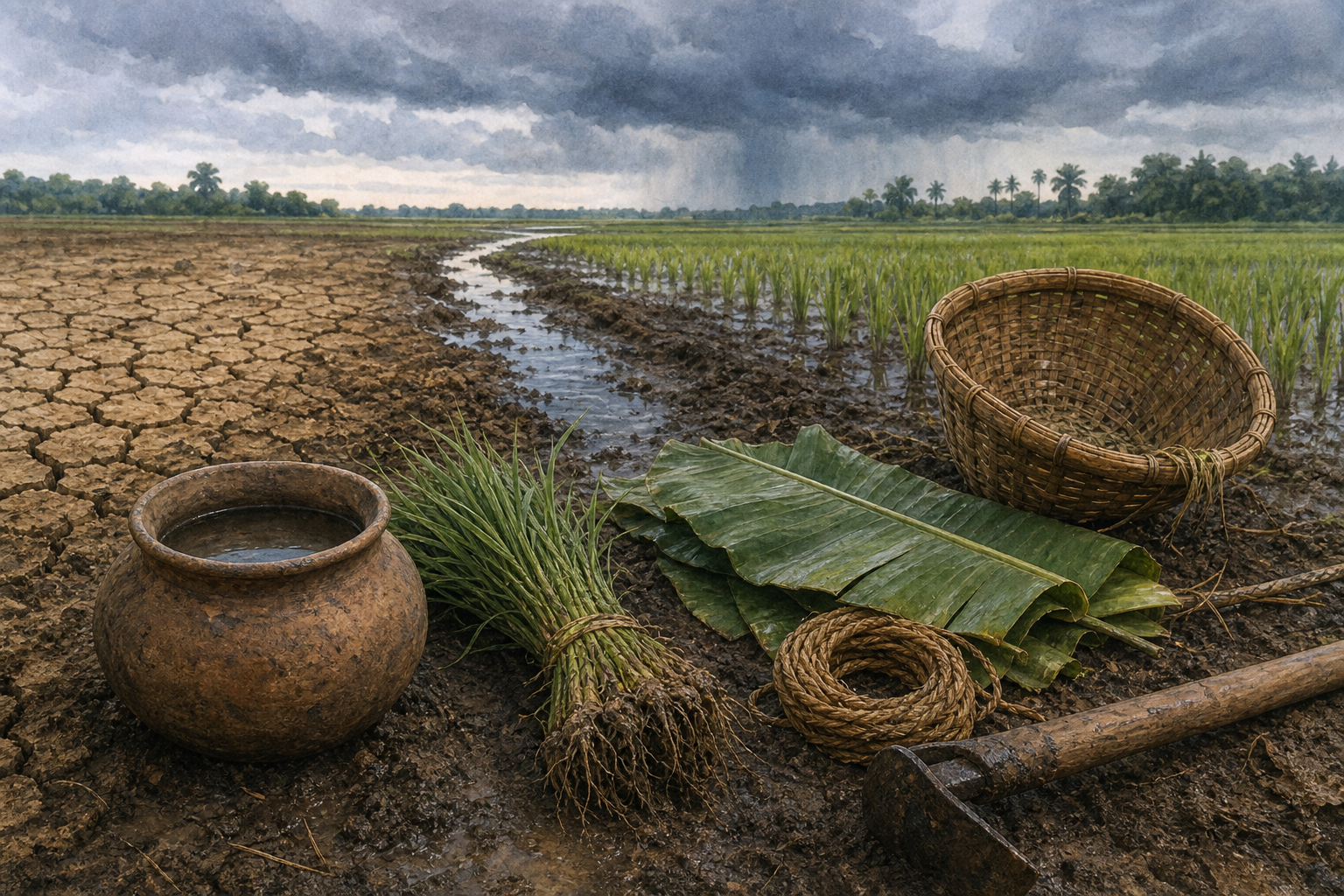
“Sacred ecology” can become a vague compliment unless you look at what the rite actually joins. Its customary offerings are modest, local, and closely related to agrarian life: rice, fruit, turmeric, betel leaf, areca nut, water, and an oil lamp. Tender paddy plants can embody the crop in danger. A bamboo staff or plough implement can bring the tools of cultivation into the sacred field.
The setting carries the same logic. A procession may move from household courtyards toward fields, field margins, or a communal water body. Water may be sprinkled on seedlings, field boundaries, granaries, or seed trays. These acts do more than symbolize fertility. They direct attention toward the exact places where rainfall must be held, guided, and converted into a viable crop.
The practical work associated with this threshold can include repairing bunds, reopening field channels, desilting ponds, readying seedbeds, and organizing labor for transplantation. The ritual’s ecological intelligence lies in the sequence: first acknowledge dependence, then restore cooperation, then prepare the landscape. A village cannot command the monsoon, but it can reduce the amount of rain lost through poor preparation.
Key takeaways
- Hudum Puja is a drought-responsive rain rite, not necessarily a fixed-date annual festival.
- Its prayer, satire, and agricultural coordination are three parts of one communal response.
- Women’s leadership and rules of privacy are central features, not side details.
- Local variants should be documented as variants rather than turned into universal rules.
- Its practical value is clearest in water stewardship, field readiness, and synchronized labor; rainfall after a rite is not by itself proof of meteorological causation.
Preserve the relationship, not just the performance
If you want to document, teach, or support Hudum Puja, begin by treating its custodians as authorities rather than raw material. A recording can preserve a song, but an intrusive recording can also violate the conditions that allow the song to be sung. Preservation that damages trust is not preservation.
- Ask whether the observance is open at all. Permission to enter the village does not automatically include permission to attend the core rite. Men must respect any requirement to remain absent.
- Name the precise locality. Record whether the practice belongs to western Assam or North Bengal and identify the local community description being offered. Do not turn one village’s sequence into a rule for all Koch Rajbongshi people.
- Obtain separate consent for observation, recording, and publication. These are different permissions. If a sensitive practice cannot be shared publicly, document non-restricted elements or do not publish it.
- Record the ecological trigger. Ask what happened to the rain, which crop operation was threatened, which water bodies or channels mattered, and what work the community organized around the rite.
- Preserve songs with context. Hudum geet may carry humor, rebuke, desire, agricultural vocabulary, and local memory at once. Record who may sing a song, when it may be sung, and what cannot be detached from its ritual setting.
- Do not request a staged reenactment of guarded elements. A performance created for an outsider’s camera may misrepresent the tradition while pressuring participants to cross their own boundaries.
A useful heritage record should therefore contain more than striking visuals. It should preserve women’s explanations, song repertoires, names of ritual objects, field and water practices, rules of access, local variation, and the agricultural conditions that made the invocation necessary. The relationship among these elements is the heritage.
Place Hudum Puja within Dharma without flattening it
Hudum Puja belongs comfortably within a wider Dharmic understanding that moral order, social conduct, and ecological well-being are related. Vedic invocations of Indra and Varuna connect rain and water with cosmic order. Buddhist paritta traditions, including recitation of the Ratana Sutta in times of communal peril, join truth-speaking and collective virtue. Jain aparigraha disciplines possession and consumption. Sikh Ardas, seva, sarbat da bhala, and the care of shared water embody responsibility for collective welfare.
These parallels reveal a shared ethical grammar: dependence should produce humility; prayer should reshape conduct; and care for the commons should accompany appeals for well-being. They do not prove that every tradition worships the same deity, performs the same ritual, or arrived through the same historical route. Hudum Deo remains rooted in Koch Rajbongshi land, memory, and agrarian life.
This distinction matters if you want a genuinely plural Dharmic account of Bharat. Unity does not require reducing every local deity to a renamed pan-Indian figure. A stronger unity recognizes family resemblances while allowing a community’s own name, ritual authority, ecological setting, and inherited boundaries to remain intact.
The next time Hudum Puja enters a conversation, ask three questions: What ecological stress called it forth? What practical and social repair did it organize? Whose permission governs what may be seen? If you are helping preserve it, give the songs, ponds, bunds, seeds, and women’s authority as much attention as the ceremony. That is where this living heritage will endure.