

You see a report of a temple worker killed, a shrine threatened, or a Hindu speaker arrested, and the pressure to react is immediate. The first account is usually incomplete. Silence can look evasive, while anger pushes people to announce a verdict before the evidence can carry it.
You don’t have to choose between defending Hindu rights and defending due process. The durable response does both. It protects families, preserves evidence, tests the State’s conduct, and turns public concern into demands that police, prosecutors, and courts must answer.
Defend Hindu rights with one legal and moral standard
Rule of law is not passivity, and procedural fairness is not a concession to an opponent. A careless investigation can deny justice to a Hindu victim. An unnecessary arrest can deny liberty to a Hindu accused. Selective policing can do both at once. The common failure is arbitrary state power.
A serious pro-Hindu position therefore asks the same questions in every case: What is known? What remains alleged? Which legal elements must be proved? What action did the authorities take? Was that action necessary, equal, and properly documented? These questions make advocacy harder to dismiss and easier to sustain.
Key takeaways
- Separate verified facts, allegations, inferences, and unknowns before making a communal or criminal claim.
- After violence, preserve the scene, medical evidence, witness accounts, digital records, and an exact timeline before arguing about motive.
- In a speech case, test two issues separately: whether the words satisfy the alleged offence and whether arrest or detention was actually necessary.
- Prove selective enforcement with comparable cases, not a collection of unrelated grievances.
- Build temple security around reporting, evidence preservation, safe travel, property records, and accountable police liaison rather than confrontation.
India and Bangladesh share constitutional ideas such as equality, religious freedom, and accountable government, but their statutes and procedures are not interchangeable. If a person faces arrest, a family is pursuing a death investigation, or temple land is under threat, obtain counsel qualified in that jurisdiction. A civic checklist cannot decide whether an individual should seek bail, challenge a case, disclose a device, or make a public statement.
Make the first public statement narrower than your anger

The opening statement shapes everything that follows. If it asserts an unproved motive, names an uncharged person, or circulates private evidence, it can expose witnesses, prejudice proceedings, and give officials an excuse to treat legitimate concerns as rumor.
Consider the April 2026 death of a 40-year-old Hindu priest and temple caretaker in Cox’s Bazar. The initial position included a missing-person sequence, discovery of the body, a police case, an inquest, and medico-legal procedures. Motive, manner of death, and responsibility had not yet been officially established. The correct response at that stage was neither silence nor a confident theory. It was a precise demand for preservation, investigation, protection, and verified updates.
Use a five-part holding statement whenever the facts are still developing:
- State what is confirmed. Identify the person, place, event, and source of confirmation without adding motive.
- Record official action. Note whether a complaint, case, inquest, medical examination, arrest, or court appearance has occurred.
- Name the unknowns. Say plainly when cause, intent, identity, or communal connection remains unconfirmed.
- Make specific requests. Ask for evidence preservation, witness safety, a competent investigator, a responsible contact, and a time-bound progress process.
- Commit to verified updates. Correct earlier information openly if the record changes.
The distinction between an allegation and an inference matters. A threat referring to the victim’s faith is evidence that investigators must examine; it is not, by itself, a completed finding about motive. A temple land dispute is also relevant, but it does not make religious intimidation irrelevant. Ask investigators to test communal, property-related, personal, and opportunistic explanations against the evidence. That preserves the Hindu dimension without forcing the conclusion before the case can support it.
Keep witness names, graphic images, private messages, phone numbers, and raw location data out of public circulation. Give material to counsel and investigators through a documented channel. Public exposure may invite intimidation, alter recollections, or break the evidentiary trail that a court will later need.
In a violent case, build an evidence pathway before a narrative
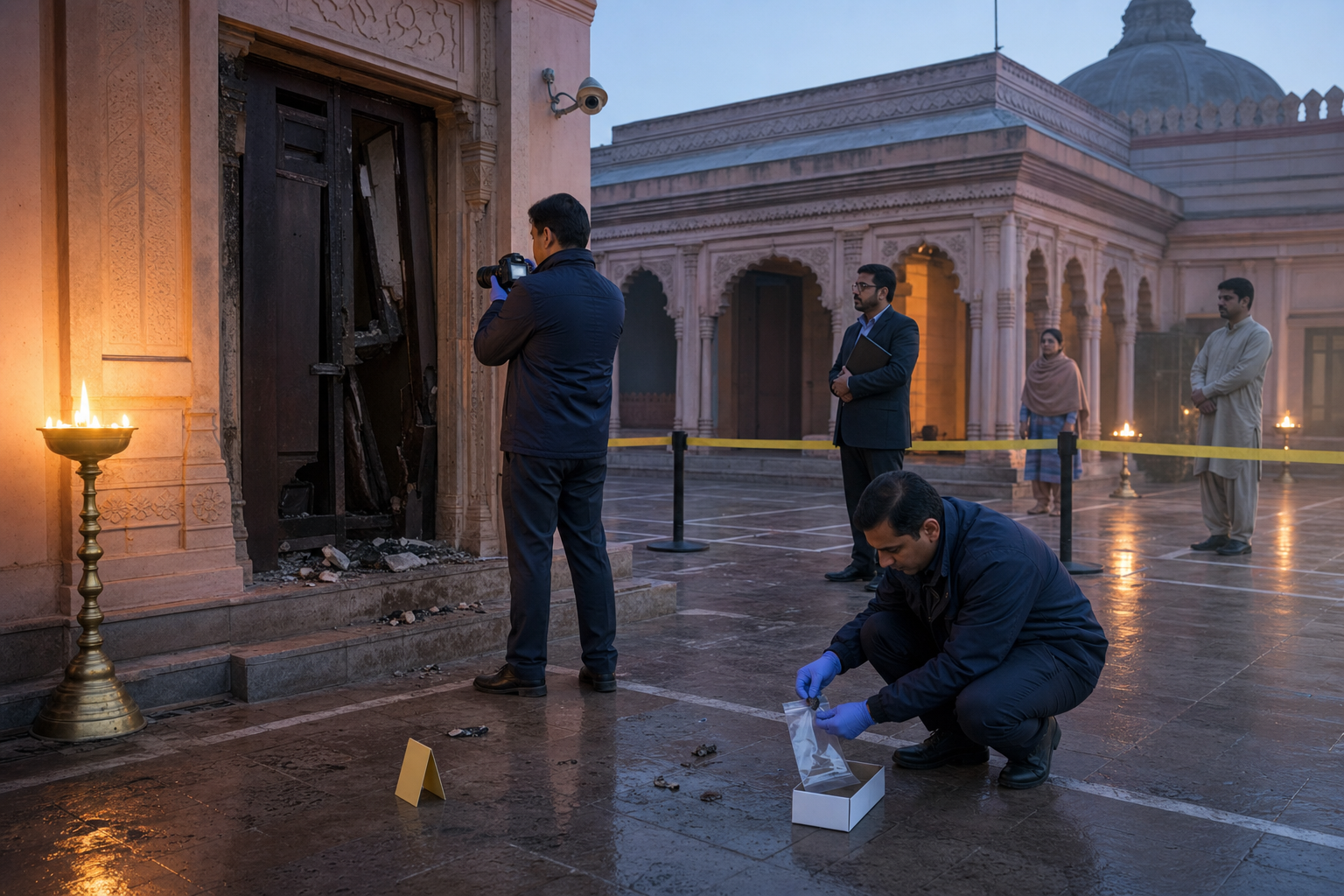
A community committee should not try to become a parallel police force. It should make evidence harder to lose and official inaction easier to document. Assign separate roles as soon as possible: a family liaison, legal coordinator, evidence custodian, police liaison, and spokesperson. One person should not control every conversation and every file.
Build the case record in three tracks:
| Track | Records to preserve | Question it answers |
|---|---|---|
| What happened | Last-seen timeline, scene records, inquest material, medical findings, CCTV, device and call evidence obtained lawfully | What sequence and cause can the evidence establish? |
| Why it happened | Threats, disputes, temple duties, property pressure, asset issues, recent communications, and patterns of intimidation | Does the evidence support a personal, opportunistic, property-related, communal, or mixed motive? |
| How the State responded | Complaint or case number, names of responsible officers, evidence requests, submissions, court dates, protection requests, and official replies | Did authorities act promptly, impartially, and competently? |
Start the timeline with exact events rather than conclusions. Record who last saw the person, where, through which route, and how each time was established. Note whether a time comes from a witness, camera, call record, receipt, or device. Conflicting times should remain visible until they are reconciled; quietly replacing an early account destroys confidence later.
Send written preservation requests for relevant CCTV before routine recording cycles erase it. Identify approach roads, nearby businesses, transport points, entrances, and likely travel routes. Investigators may also need call data, handset location analysis, and digital communications, but community volunteers should not obtain private records by deception or unlawfully enter an account. Ask the lawful authority to collect them and record when the request was made.
Medical and physical evidence require an unbroken chain of custody. Through counsel, seek confirmation that a qualified examination occurred, exhibits were labelled, transfers were recorded, and the inquest and autopsy process addressed the injuries and estimated sequence relevant to the case. Do not circulate medical material for political effect. Public distribution can violate the family’s dignity without strengthening admissibility.
Victimology is not victim-blaming. A careful review of the person’s routine, temple responsibilities, recent threats, property disagreements, financial pressure, and changes in behavior helps investigators identify likely contact points and motives. In a temple case, it should include disputes involving adjoining land, access, donations, stored assets, staff, and prior intimidation.
In Bangladesh, the legal demands can be tied to identifiable duties: constitutional equality and religious freedom, Penal Code Section 302 and Sections 295-297 where their elements apply, and inquest or inquiry powers under Sections 174-176 of the Code of Criminal Procedure. A community should not declare which charge must succeed before the evidence is known. It should insist that every relevant offence and motive be examined, that witnesses be protected, and that decisions be recorded.
A Special Investigation Team is useful only when it answers a real capacity or independence problem, such as dispersed evidence, specialist digital work, multiple jurisdictions, or a credible conflict concern. If you request one, also request a written mandate, a named coordinating officer, a method for transferring existing exhibits, and a progress-reporting process. The label alone does not preserve evidence.
In a speech case, test the offence and the arrest separately

Speech disputes produce a dangerous shortcut: people assume that if words were offensive, arrest was lawful, or that if arrest was excessive, the words must have been lawful. Neither follows. The content of the speech and the necessity of custody are distinct legal questions.
Begin with the speech itself. Preserve the complete recording, original upload, surrounding exchange, date, audience, language, and any reliable translation. A clipped segment may omit a qualification, but a longer recording may also make intent clearer. Preserve both rather than choosing the version that helps your side.
Where Indian case papers invoke IPC Sections 153A, 295A, or 505(2), a section number is not proof. The inquiry must address the exact words, the group allegedly targeted, the context, the speaker’s intention or knowledge, and the connection between the expression and a genuine risk of public disorder. Section 295A carries the additional requirement of a deliberate and malicious design; hurt feelings alone do not establish every element. The constitutional analysis under Articles 19(1)(a) and 19(2) also requires attention to context and lawful public-order restrictions. The advocacy-incitement distinction associated with Shreya Singhal prevents mere support for an idea from being treated automatically as criminal incitement.
Then examine the arrest. In a case governed by the cited CrPC framework, Sections 41 and 41A require attention to necessity rather than treating custody as an automatic consequence of an FIR. Relevant questions include whether the person may abscond, interfere with evidence, repeat an alleged offence, or refuse to cooperate. Arnesh Kumar requires reasoned attention to those criteria. If appearance through a notice can secure cooperation, police should be able to explain why arrest was still necessary.
D.K. Basu safeguards make the custody record testable. Check for an arrest memo, notice to a nominated person, access to counsel, and medical examination. Record any missing safeguard accurately. Do not embellish a procedural breach; the documented omission is more useful than a dramatic claim that cannot be proved.
Section 196 CrPC is also commonly misunderstood. Its prior-sanction requirement concerns a court taking cognizance of specified speech offences; it is not a blanket statement that police may perform no investigation beforehand. Counsel should check whether the required sanction exists at the stage when it becomes legally necessary and whether the decision reflects independent review.
If you receive a notice or face arrest, use a disciplined sequence:
- Obtain the notice, FIR, grounds, invoked provisions, and available arrest records through counsel.
- Preserve the full speech and its original digital context. Do not delete posts, messages, files, or devices that may be evidence.
- Respond to a lawful appearance notice on time with counsel and verified contact details unless a court directs otherwise.
- Do not pressure a complainant or witness, coordinate stories, or publish private case material.
- Ask counsel to assess bail, quashing, territorial jurisdiction, sanction, and consolidation if substantially identical FIRs have been filed in several places.
- Maintain a dated log of cooperation and every procedural safeguard requested or supplied.
The immediate political demand should match the legal defect. If the words do not meet the alleged elements, challenge the charge. If investigation may proceed but custody is unnecessary, challenge the arrest or seek bail. If several duplicative proceedings create harassment, examine consolidation. A vague demand to drop everything can obscure the strongest available argument.
Turn equal treatment into proof and prevention

Document selective enforcement with matched cases
Article 14 concerns become serious when similarly situated people receive materially different treatment. That comparison requires more than placing two offensive statements beside each other. Build a matrix containing the exact words, alleged target, surrounding context, invoked provision, evidence of public-order risk, use of notice or arrest, custody period, bail position, sanction status, prior conduct considered by authorities, and final outcome.
Compare like with like. A direct call for violence is not equivalent to a harsh theological opinion. An edited viral clip is not automatically equivalent to a complete speech delivered to a different audience. Prior non-cooperation may affect an arrest decision, while political pressure may distort one. Record those differences instead of hiding them. If unequal treatment remains after relevant differences are accounted for, the claim becomes far stronger.
Ask institutions for changes that can be audited: published arrest thresholds for speech cases, independent legal vetting in borderline matters, written reasons when a notice is not used, time-bound sanction decisions, periodic review of unresolved minority cases, and outcome data that distinguishes complaints, arrests, charges, acquittals, and convictions. Equality becomes credible when outsiders can inspect the process.
Criminal law should remain focused on conduct that meets its legal elements. Counterspeech, correction, dialogue, and proportionate platform moderation may address offensive but non-criminal expression more effectively. This is not weakness. It keeps penal power for genuine threats while preserving room for Hindu, Buddhist, Jain, Sikh, and other citizens to debate faith and identity without every dispute becoming a police case.
Make temple safety routine rather than reactive
Temple protection cannot begin after a caretaker disappears or property is damaged. Give every temple committee a controlled security file and an incident protocol. The file should not be a public registry that exposes vulnerable sites; access should be limited to people who need it.
- Map entrances, low-traffic approaches, blind spots, late-duty routes, emergency exits, and nearby cameras.
- Test lighting, CCTV coverage, timestamps, recording quality, storage, and lawful access. Document who can retrieve footage and how preservation requests are handled.
- Create a check-in and safe-commute plan for priests, caretakers, and volunteers working during quiet hours.
- Use verified access procedures for keys, restricted rooms, donations, valuable objects, and contractors. Conduct staff checks only through lawful and non-discriminatory processes.
- Maintain an emergency contact sheet linking the temple, police control room, district administration, legal counsel, medical assistance, and trusted community representatives.
- Keep copies of land records, boundary information, pending claims, prior complaints, and significant correspondence in secure on-site and off-site locations.
- Agree on a confidential witness channel and designate one person to record an incident without exposing the reporter publicly.
- Coordinate non-confrontational volunteer presence during vulnerable periods and major festivals. Volunteers should observe, report, and assist; they should not search, detain, threaten, or punish anyone.
Property records deserve special attention because temple intimidation can intersect with disputed land, access roads, or management rights. Digitized records, clear custody of originals, prompt legal responses to encroachment, and a dated history of threats can prevent a later criminal case from beginning with years of missing context.
Interfaith allies can help without diluting the Hindu claim. They can support the bereaved family, encourage witnesses to speak safely, join a peace appeal, and reduce retaliation while the legal process continues. Ahimsa here does not mean abandoning accountability. It means choosing methods that protect the innocent and keep the evidence fit for justice.
At your next committee meeting, do not end with a resolution alone. Put names beside five responsibilities: family support, legal coordination, evidence custody, police liaison, and public communication. Test the cameras and emergency contacts, assemble the property packet, and approve a short holding-statement template. When the next alert arrives, your community will be ready to act before rumor, lost evidence, or arbitrary power decides the case.
References
- DharmaRenaissance Blog — Cox’s Bazar Hindu Priest Found Dead: Urgent Call for Justice, Rule of Law, and Minority Safety
- DharmaRenaissance Blog — Goa Police arrest of Hindu activist Gautam Khattar: nationwide outrage and constitutional scrutiny