
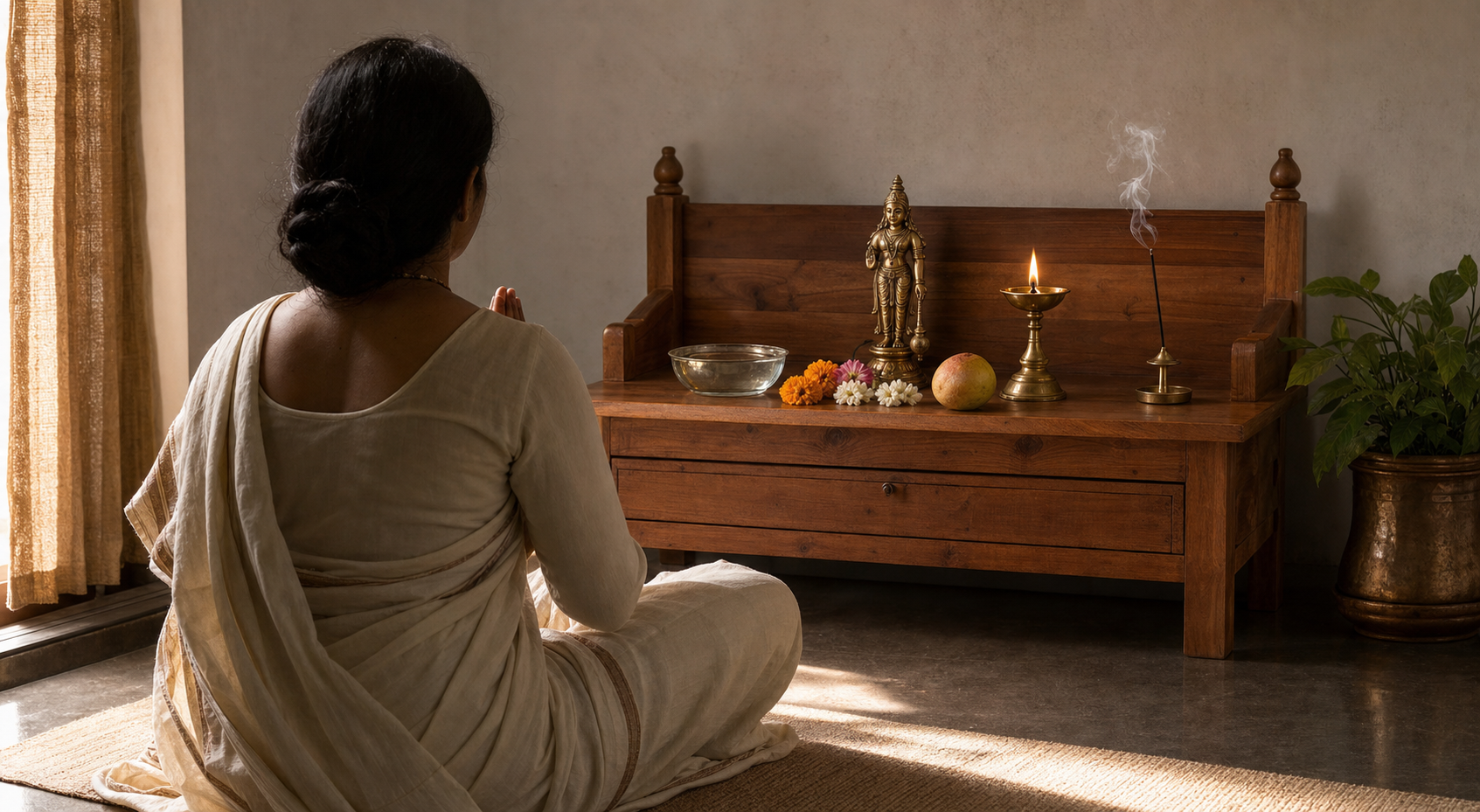
If you want to begin puja at home, the hardest part may be uncertainty rather than devotion. Which items are essential? Does the order have to be exact? Is a short puja somehow less authentic than an elaborate one?
Begin with a smaller and more useful question: how can you receive the Divine with attention and offer what you have with reverence? Once you understand puja as sacred hospitality, its history, materials, and sequence become much easier to navigate.
Puja began as an act of honour, not a test of complexity
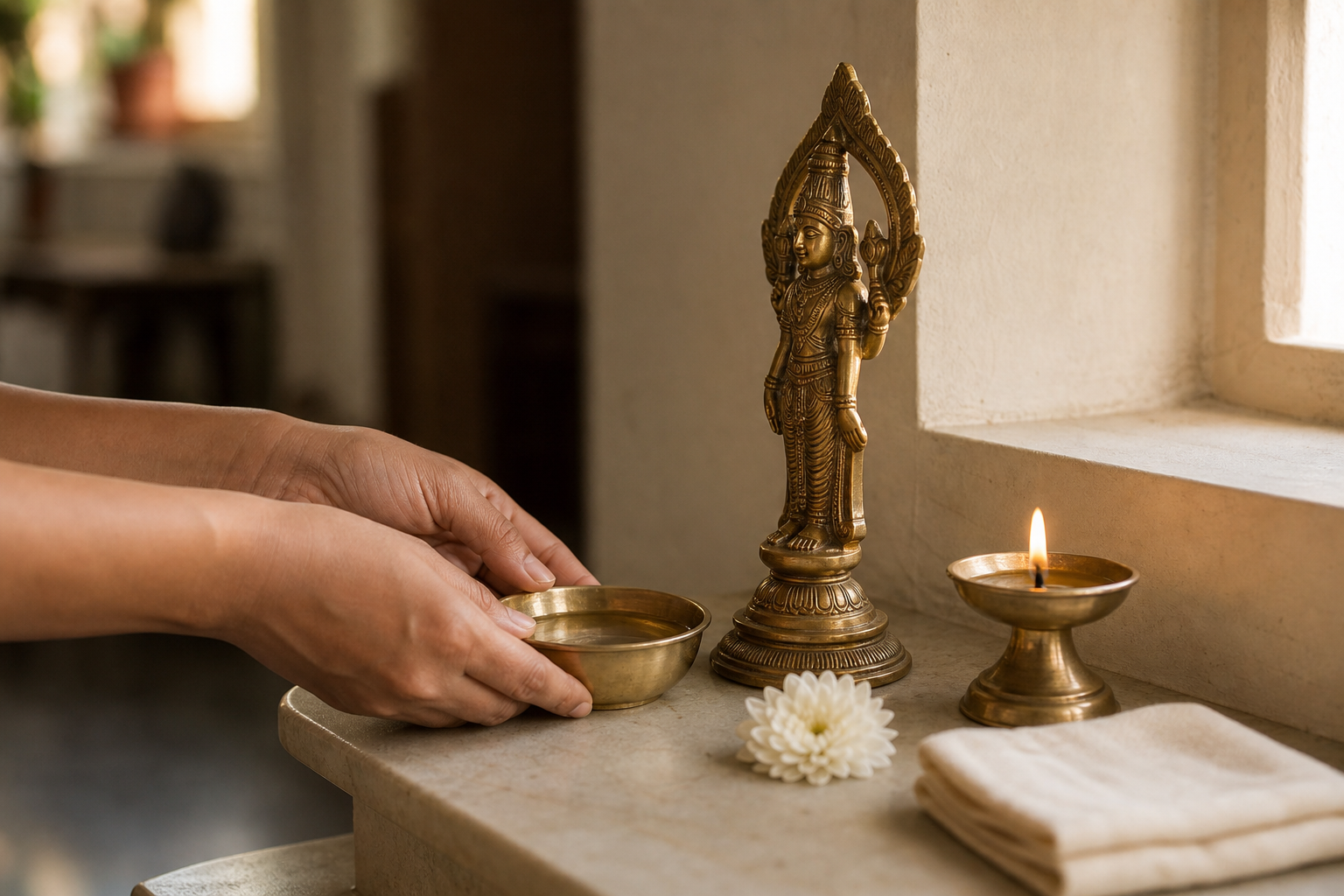
Puja is best understood as a family of practices for honouring a sacred presence. It can be inward or outward, domestic or public, as simple as folded hands and a flower or as detailed as a temple liturgy preserved by a particular sampradaya.
Its name carries more than one historical resonance. Many philologists connect the Sanskrit word puja to the verbal root puj, meaning to honour or revere. A complementary interpretation points to Tamil pu, flower, and pujai or pucai, worship. These Sanskrit honorific and Dravidian floral associations need not be forced into a single, exclusive origin. They may preserve a cultural confluence in which honour and the offering of a flower became closely joined.
That distinction matters because the familiar claim that puja simply means “flower worship” is too neat. The flower is central, but the governing idea is honour. A fresh bloom became a particularly fitting expression of that honour because it brings beauty, fragrance, fragility, and impermanence into one small offering.
The ritual setting also changed over time. Early Vedic worship centred strongly on yajna, the sacrificial rite. Forms described as upasana, attentive or inward worship, and archana, honour through offerings or praise, became increasingly prominent in later Vedic and classical religious life. Household manuals, Dharmashastras, Puranas, Agamas, and Tantras then developed structured forms of domestic and temple puja.
This development did not produce one universal Hindu ceremony. Vaikhanasa and Pancharatra traditions formed detailed Vaishnava systems. Shaiva Agamas preserved their own frameworks, while Shakta Tantras developed forms centred on Devi. A temple priest following an Agamic order and a householder offering a lamp are therefore not performing competing versions of the same ritual. They are working at different levels within related traditions of sacred attention.
The most practical way to understand their shared grammar is to imagine receiving an honoured guest. You prepare the place, invite the presence, offer a seat and water, present fragrance, light, flowers, and food, express praise, bow, and conclude respectfully. Puja turns ordinary hospitality toward the Divine.
What the offerings do: the inner logic of puja
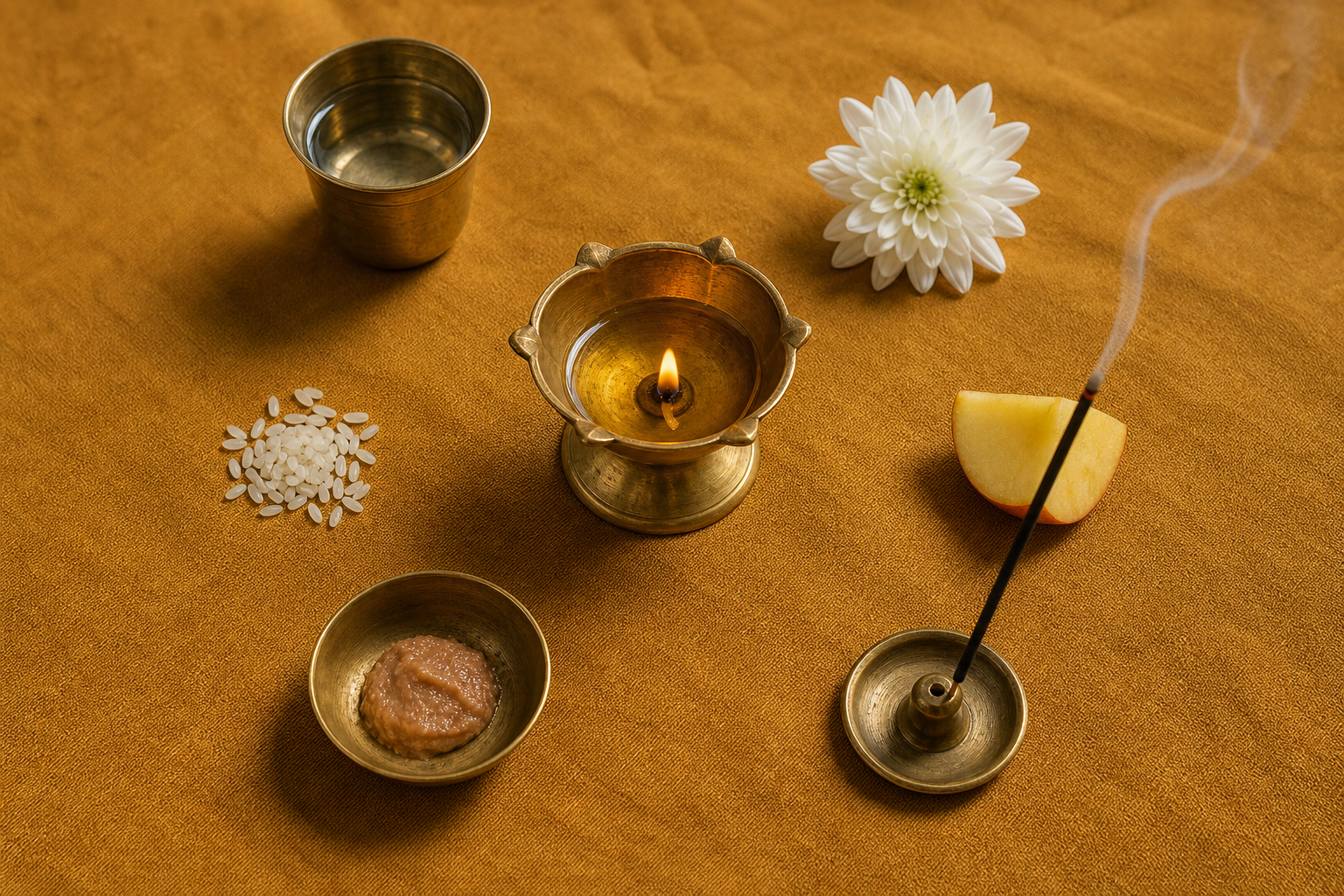
A common five-offering pattern is called panchopachara. Its components are gandha, fragrance or sandal; pushpa, flowers; dhupa, incense; dipa, a lamp; and naivedya, food. Together, these five sensory offerings gather the body and its surroundings into worship.
| Offering | Practical form | What to notice while offering it |
|---|---|---|
| Gandha | Sandal paste or another suitable fragrance | Pleasantness is being offered rather than kept merely for personal enjoyment. |
| Pushpa | A fresh flower, an appropriate leaf, or a non-harmful substitute | Beauty does not need to be permanent in order to be worthy. |
| Dhupa | Incense, where smoke can be used safely | Fragrance changes the atmosphere while the shifting smoke makes transience visible. |
| Dipa | A safely placed lamp | Light directs sight and attention toward the sacred presence. |
| Naivedya | A modest portion of suitable food | Nourishment is received with gratitude and returned as prasada. |
None of these items is a payment made to obtain divine favour. The offering trains you to loosen possession. What you normally label “mine” is first recognised as given: fragrance, food, light, beauty, effort, and attention. When naivedya returns as prasada, the food may look unchanged, but your relationship to it has changed. It is received rather than merely consumed.
The expanded shodashopachara form develops the hospitality model through sixteen acts: avahana, invitation; asana, seating; padya, water for the feet; arghya, honouring water; achamaniya, water for sipping; snana or abhisheka, bathing; vastra and alankara, clothing and adornment; gandha, fragrance; akshata, unbroken grains; pushpa, flowers; dhupa, incense; dipa, light; naivedya, food; tambula, betel; pradakshina and namaskara, circumambulation and bowing; and visarjana, the ceremonial conclusion. This longer sequence makes the logic of sacred hospitality explicit.
Do not mistake a longer sequence for a ranking of devotion. The sixteen-offering form can preserve theological meaning, temple discipline, and inherited practice. The five-offering form concentrates the same hospitality into fewer acts. A still smaller household practice can retain its centre through a clean place, water, a flower or substitute, a lamp, and a short prayer.
- Use a minimal sequence when you are establishing a sustainable daily practice or have limited materials.
- Use panchopachara when you can give each of the five offerings proper attention.
- Follow a fuller inherited order when it belongs to your family, temple, initiation, or sampradaya.
- Do not reconstruct a specialised Agamic or Tantric rite from a checklist alone. Learn its deity-specific rules from a qualified practitioner within that tradition.
A simple home puja you can perform with care
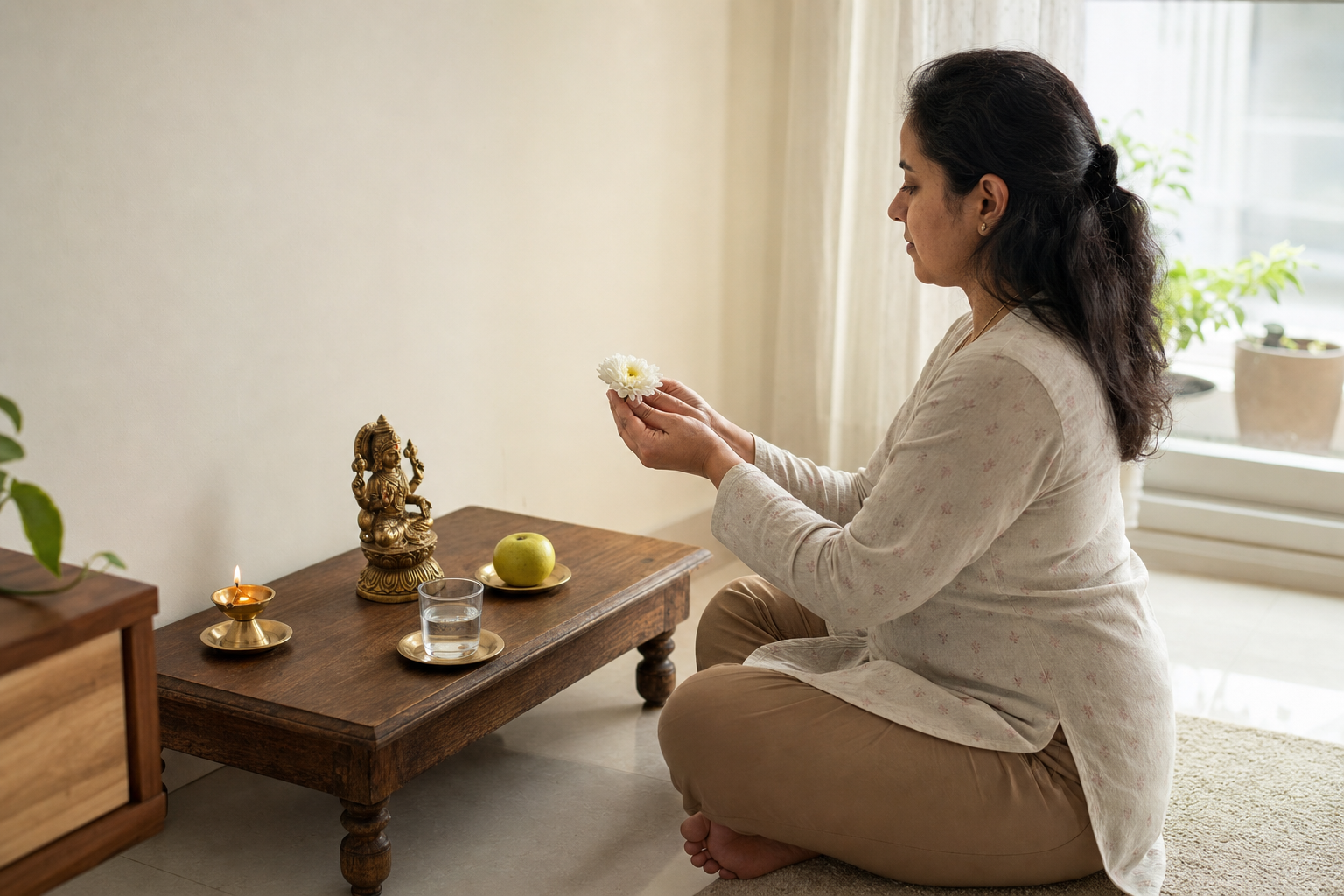
The following order is a concise household practice, not a replacement for a rite transmitted by your family or sampradaya. You need a clean surface, a chosen sacred focus, a small vessel of water, a flower or appropriate substitute, a lamp, a little food, and an optional fragrance or incense.
- Prepare the space. Clear away clutter and remove old offerings before they decay. Place each item within easy reach so that searching for materials does not interrupt the worship.
- Make the lamp safe before lighting it. Use a stable, heat-resistant base and keep the flame away from cloth, paper, children, and animals. Never leave it unattended. If incense smoke is unsuitable for the room or anyone in it, omit the incense.
- Become still. Sit or stand before the sacred focus, settle your breathing, fold your hands, and establish a clear intention. The purpose is not to manufacture a dramatic feeling but to become present.
- Offer avahana. Welcome the Divine in the form you worship. If your tradition supplies a mantra, use it. Otherwise, make a brief and respectful invocation in words you understand.
- Present water and fragrance. Place the water before the deity. Offer sandal or another appropriate fragrance only in the manner permitted by your shrine materials and family custom; an application suitable for a stone murti may damage a paper image.
- Offer the flower. Hold it carefully, bring your attention to its colour, fragrance, freshness, and short life, and place it without tossing. Let the action carry your gratitude rather than treating the flower as ritual inventory.
- Offer incense and light. Move them only as your established custom directs. If you do not know a formal movement, place them safely before the sacred focus and avoid inventing an elaborate gesture.
- Offer naivedya. Present a modest amount of food with gratitude. Extravagance is unnecessary; the governing movement is from possession to offering and then from offering to prasada.
- Recite a short mantra, stotra, name of the deity, or prayer. Choose something you can repeat attentively. One verse offered steadily is more useful than a long recitation performed while your attention is elsewhere.
- Bow and dedicate the practice. Offer namaskara, remember your family and community, and extend the benefit of the worship toward all beings. Conclude according to your tradition. Receive the food as prasada and deal with the remaining offerings without waste.
Keep the order recognisable from one session to the next. Repetition reduces the mental burden of remembering what comes next, allowing attention to move from logistics to relationship. Add another offering only when you understand its purpose and can care for it properly.
If you miss a step, do not turn the mistake into the centre of the worship. Pause, return to reverence, and continue. Precision matters greatly in specialised liturgies whose disciplines you have undertaken to follow. In a simple personal practice, anxious performance can defeat the very attention the sequence is meant to cultivate.
Choose offerings by tradition, non-harm, and restraint
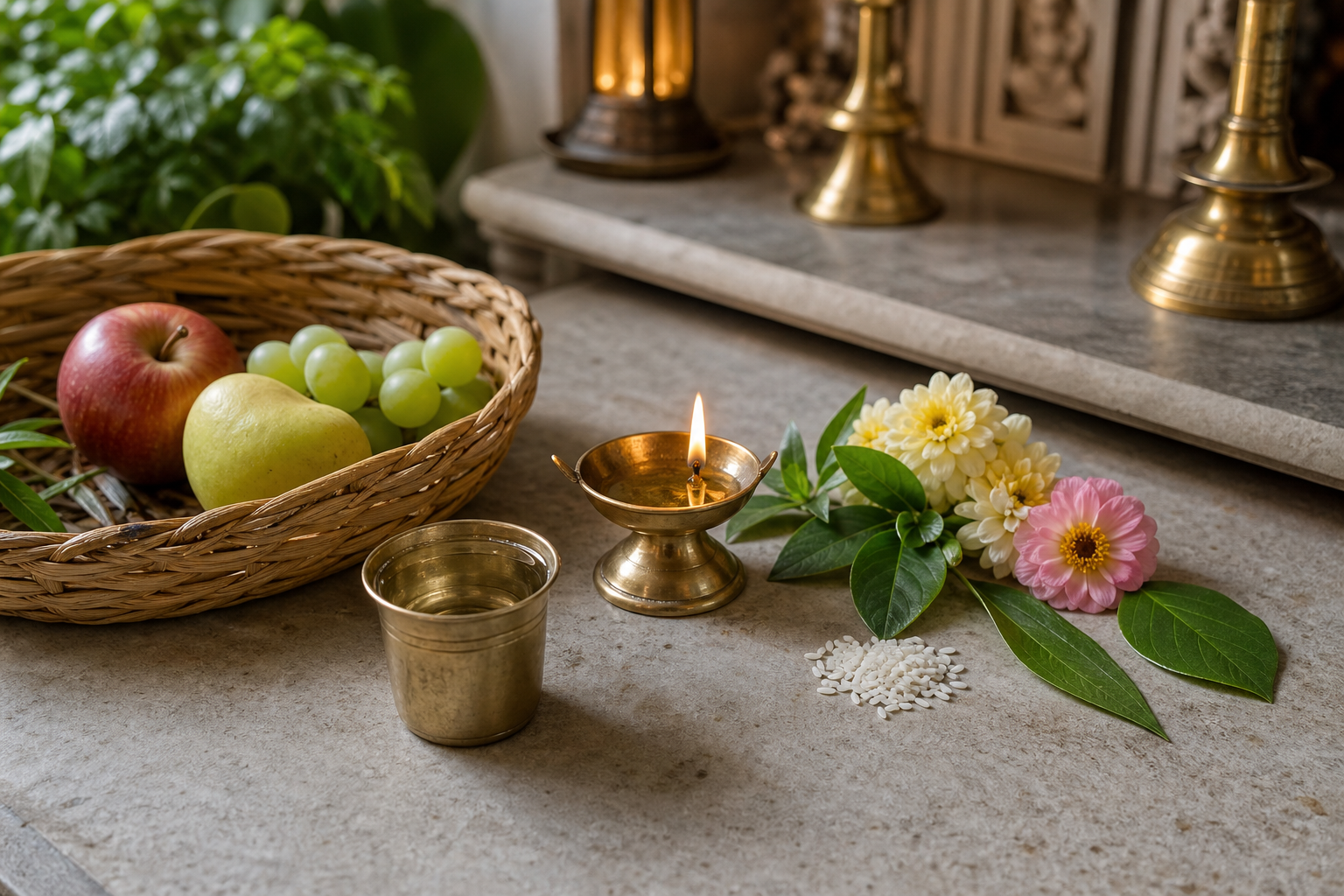
A flower is not automatically suitable for every deity
Botanical offerings carry particular relationships within Hindu traditions. Tulasi is cherished in Vaishnava worship and signifies loving devotion. The three-part bilva leaf is closely associated with Shiva. The lotus, rising clean above muddy water, conveys purity and spiritual ascent across Hindu, Buddhist, and Jain imagery. Vivid hibiscus is especially associated with forms of Devi. Ketaki, by contrast, is avoided in worship of Shiva within traditions shaped by its Puranic story. These deity-specific associations and restrictions show why “any flower for any deity” is not a reliable universal rule.
Treat those examples as orientation, not as a complete permission list. Regional and sectarian customs differ. If your household or temple has a clear rule, follow it rather than replacing living practice with a generic list found elsewhere.
Freshness should not become wastefulness
The finest offering is not necessarily the rarest or most expensive. Seasonal and locally grown flowers can better express restraint than imported blooms wrapped in plastic. Avoid artificial decorations, chemical dyes, and non-biodegradable materials that turn a brief act of worship into persistent pollution. Compost clean plant offerings where appropriate, and never place plastic or chemically treated material into natural water. These ecological choices align puja with ahimsa and stewardship.
If a fresh flower is unavailable, use a suitable leaf or a symbolic, reusable substitute accepted in your context. Do not cause disproportionate harm merely to satisfy the outward appearance of devotion. The flower teaches non-possessiveness and impermanence only when the way you obtain and discard it supports those values.
Recognise kinship without erasing differences
Puja language and offering practices extend across the Dharmic family, but the same material does not always perform the same theological function.
- Buddhist traditions commonly use flowers and lamps, and the seven-limb puja turns confession, rejoicing, offering, aspiration, and dedication into disciplines of mind and conduct.
- Jain worship includes the ashtaprakari puja, an eightfold pattern of water, sandal, flowers, incense, lamp, food, fruit, and arghya. Ahimsa shapes how flowers are obtained and when non-harmful substitutes should be preferred.
- Sikh practice places the emphasis on Shabda, remembrance, kirtan, and seva rather than image-oriented ritual. Flowers may respectfully adorn a sacred space, but they should not be used to recast Sikh worship as a form it does not claim.
These related but distinct forms of offering reveal shared ethical instincts: attention should overcome spectacle, generosity should loosen possession, and reverence should change conduct. When you enter another Dharmic community’s sacred space, notice both the family resemblance and the boundary. Respect requires both.
Questions that commonly stop beginners
Do I need all sixteen offerings for a complete puja?
No. Shodashopachara gives a full hospitality sequence, but panchopachara and carefully performed minimalist forms retain the essential movement of invitation, offering, prayer, and reverent conclusion. Use the fuller form when it belongs to your tradition, not because you fear that the Divine measures devotion by the length of your checklist.
Can I perform puja if I do not know Sanskrit?
You can begin with a short mantra or verse you have learned accurately and supplement it with respectful prayer in a language you understand. Do not imitate long Sanskrit recitations merely for their sound while remaining unaware of what you are doing. If you later undertake a specialised liturgy, learn its pronunciation, meaning, and ritual setting from someone qualified to teach it.
What can I offer when flowers or incense are unavailable?
Use an appropriate leaf, a symbolic substitute, water, light, food, or simply folded hands and attentive prayer, depending on your tradition. Incense is optional when smoke would be unsafe or disruptive. Absence of a material need not become absence of reverence.
Is an elaborate puja spiritually better than a short one?
Elaborate rites can carry inherited theology, communal memory, artistic discipline, and exact responsibilities. Their value should not be dismissed. But expense and duration do not automatically create attention. A short puja can be spiritually serious when each action is deliberate; a long one can become empty when materials and performance displace devotion.
For your next puja, choose the smallest sequence you can perform without haste: prepare the place, welcome the Divine, offer water, a flower or substitute, light and food, say one prayer attentively, and bow. Let consistency deepen the practice before complexity enlarges it.