
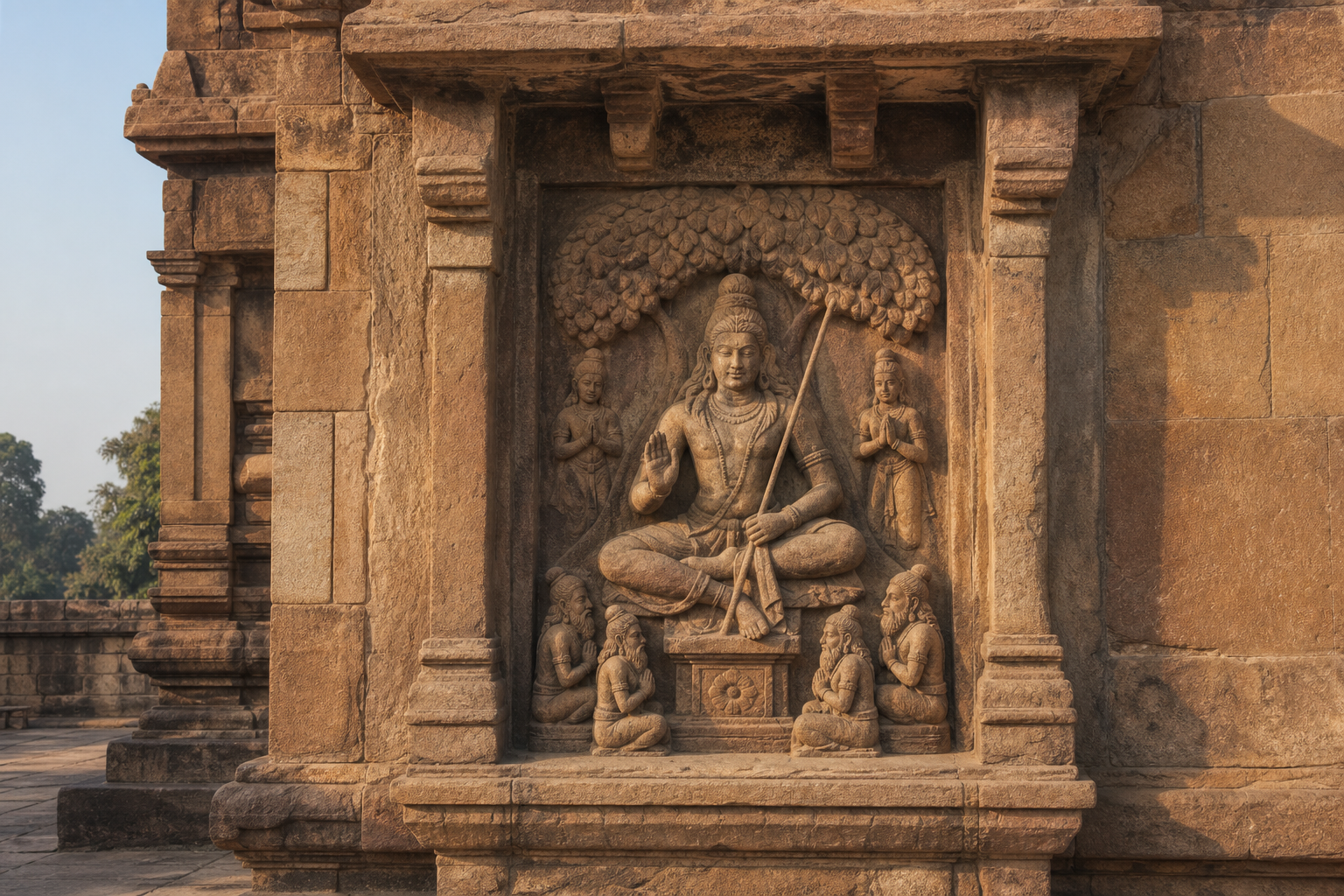
You are standing beside a Shaiva temple’s southern wall. The figure before you is recognizably Shiva, yet he is seated as a teacher and holds a slender staff rather than displaying the more familiar trident. That staff is the decisive clue: you may be looking at Lakuti, or Lagudi, Dakshinamurti.
To identify the form reliably, do not isolate one object and guess. Read the whole composition: direction, posture, hands, attendants, pedestal and setting. Once those elements agree, the staff becomes more than a name-bearing attribute. It reveals how Shaiva iconography joins authority, discipline and contemplative steadiness in a single image.
Key takeaways
- Lakuti Dakshinamurti is distinguished principally by a staff, called a lakuta or laguda, held with composure rather than brandished as a weapon.
- The strongest identification combines the staff with a southern temple niche, Shiva’s seated teacher-form, Apasmara beneath the right foot, a banyan setting and attending sages.
- The staff can be read on three connected levels: rajadanda, the authority of dharma; yogadanda, disciplined practice; and merudanda, the centered inner axis.
- A circular knowledge gesture, rosary, manuscript, flame or deer supports the identification, but regional sculptors sometimes combined features belonging to different Dakshinamurti variants.
- Lakuti Dakshinamurti should not be identified with Lakulisha merely because both carry a stick or club. The surrounding iconographic grammar matters.
Identify the figure before interpreting the staff
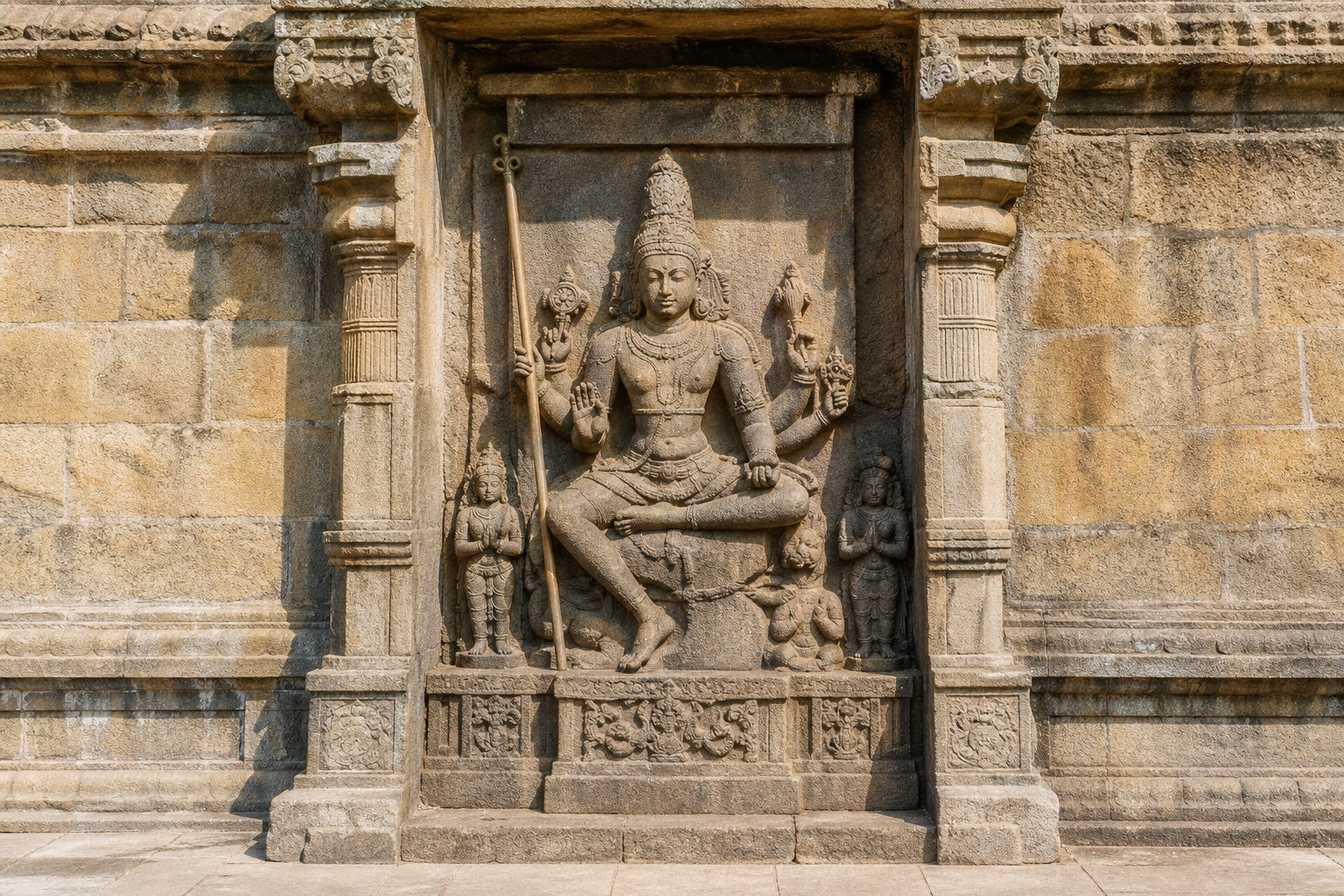
Begin with location. Dakshinamurti normally occupies the exterior southern niche of a Shaiva garbhagriha. South is not an incidental compass direction here. It is associated with Yama, dissolution and the inward-moving current of withdrawal. The guru faces that direction as an image of knowledge meeting mortality without evasion. The name also carries a second resonance: dakshina can mean the offering made in relation to teaching, while murti is embodied presence. The result is an image in which direction, instruction and realization converge.
Location alone is not proof. Architectural elements can be displaced, museum labels can be incomplete and surviving fragments may have lost their original setting. Use this five-part identification sequence instead:
- Find the teaching setting. Look for a seated Shiva placed beneath or associated with a banyan tree. Aerial roots may frame the figure or appear as abbreviated foliage above him.
- Locate the principal attribute. Lakuti or Lagudi means that a stick, baton or club is central to the form. In a clear example, it is held steadily. It does not dominate the scene through violent motion.
- Check the body and crown. The deity may sit in virasana or padmasana on a low pedestal. A jatamukuta establishes Shiva’s ascetic identity, sometimes accompanied by the crescent or a suggestion of Ganga.
- Examine the lower register. The right foot commonly restrains Apasmara, the dwarf who personifies forgetfulness or ignorance. Nearby sages may represent Sanaka, Sanandana, Sanatana and Sanatkumara, the four Kumaras receiving instruction.
- Read the remaining hands. A teaching or knowledge gesture may appear with a rosary, manuscript, flame or deer. These secondary attributes confirm the pedagogical character even when the staff is damaged.
A practical confidence test
| Surviving evidence | Identification confidence | What you should do |
|---|---|---|
| Southern niche, seated teacher, staff, Apasmara and sages | High | Read the image as Lakuti Dakshinamurti unless an inscription or reliable catalogue identifies another form. |
| Seated Shiva with staff and several teaching attributes, but original location is unknown | Moderate | Use posture, pedestal and attendants to test the identification; record the missing architectural context. |
| Only a staff-bearing or club-bearing ascetic survives | Low | Do not force the label. Consider Lakulisha and other ascetic Shiva forms, then look for provenance, inscriptional evidence or related sculptures from the same program. |
This method is especially important with weathered stone. A broken musical instrument can resemble a rod, and a damaged tree branch can be mistaken for a staff. Build the identification from converging features, not from the object you noticed first.
Read the staff on three connected levels
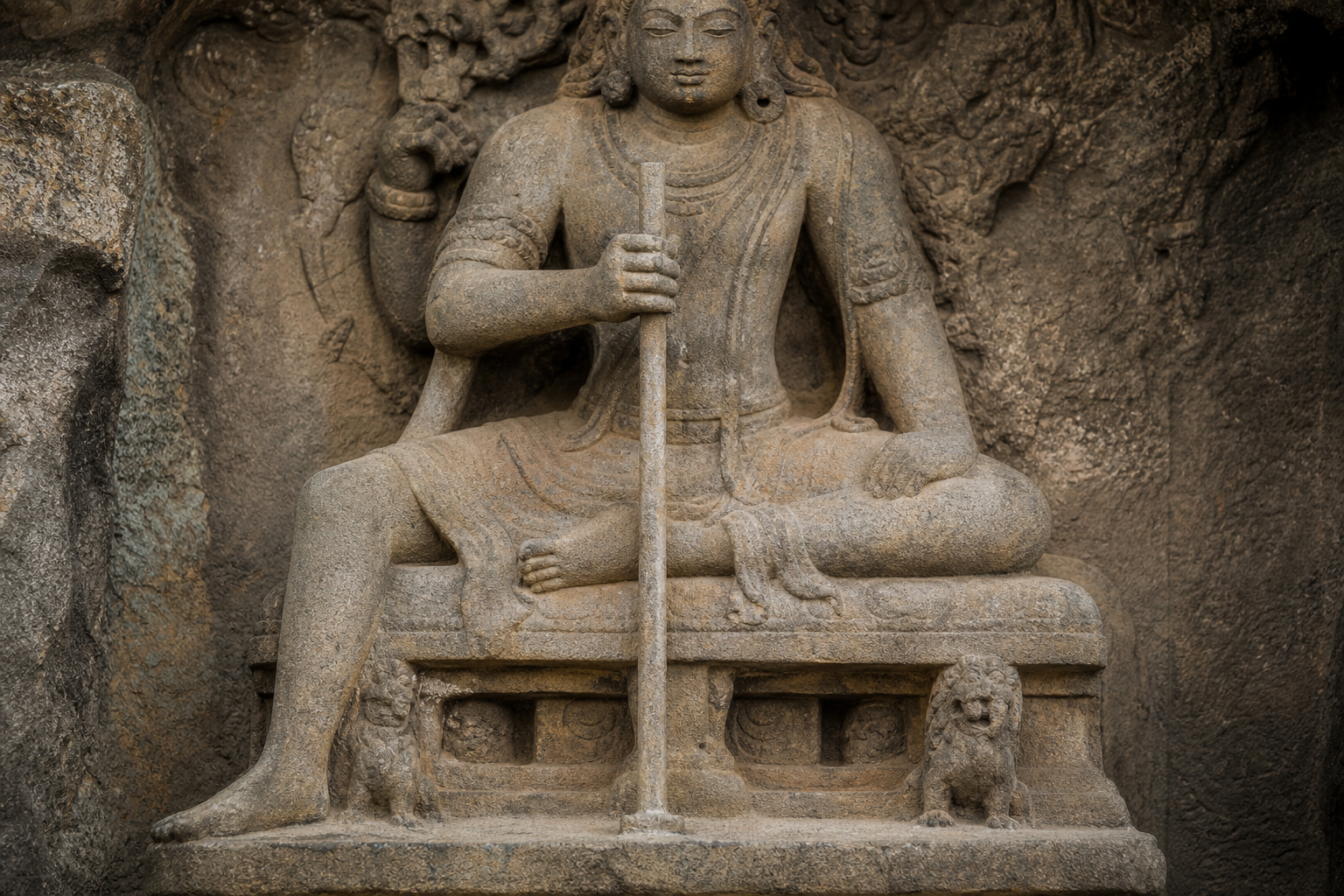
The visible fact is simple: Shiva holds a staff. Its meaning is deliberately layered. The rajadanda, yogadanda and merudanda readings do not cancel one another. Together they move from public order to personal discipline and finally to inner realization.
Rajadanda: authority governed by dharma
As rajadanda, the staff resembles the ruler’s scepter and the authority by which order is maintained. Yet Shiva does not wave it in anger. Its upright calm changes the meaning of power. The real sovereign first governs his own senses, speech and conduct. Authority over others, where it exists, follows from fidelity to dharma rather than intimidation.
When you view the image, notice the relationship between hand and staff. A relaxed grip communicates control without aggression. If a description reduces the object to a weapon, it misses the pose’s most important qualification: this is power already mastered.
Yogadanda: practice that gives steadiness
As yogadanda, the staff evokes the support used to maintain meditative alignment. The corresponding lesson is practical. Insight needs a structure that can carry it: regular remembrance, restraint, study and attention. The staff stands because discipline has made wavering less authoritative.
This reading also explains why the rosary sometimes accompanies the form. A revelation that is never revisited fades into memory; repeated practice turns it into character. When staff and rosary appear together, read them as stability and continuity rather than as unrelated accessories.
Merudanda: the centered inner axis
As merudanda, the staff mirrors the spinal axis. In a tantric reading, its steadiness points toward prana becoming collected along sushumna rather than remaining caught in the alternating tendencies associated with ida and pingala. The sculpture turns an invisible contemplative principle into an upright visible line.
Treat this as an aid to contemplation, not as proof that every staff encodes one secret physical technique. The useful observation is simpler: the teacher is composed around a stable center. You can respond by letting your posture become natural and upright, your breathing unforced and your attention less scattered.
Let the supporting symbols test and deepen your reading
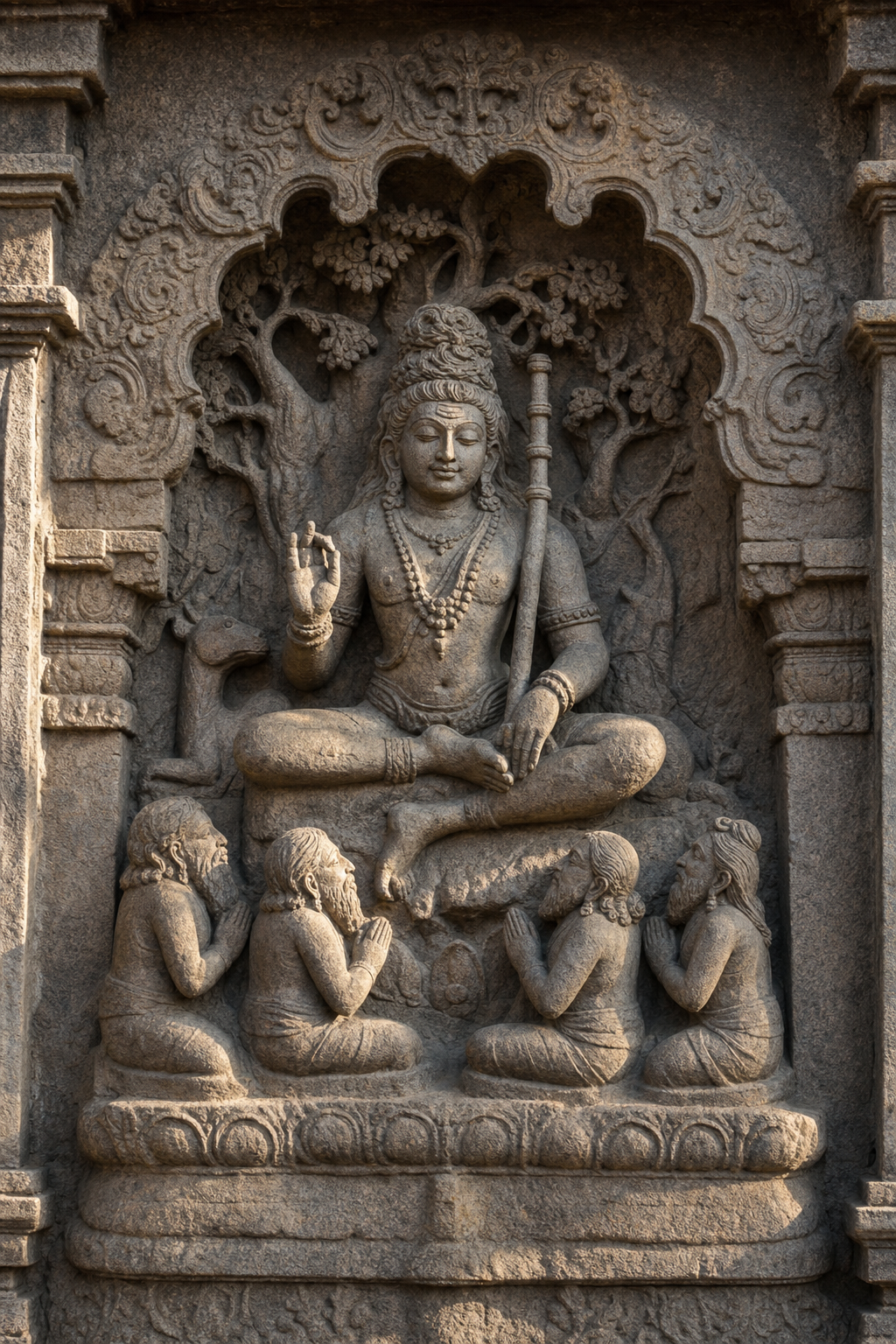
Shaiva iconography works through clusters. Each attribute contributes a distinct part of the teaching, while the staff gives Lakuti Dakshinamurti his particular emphasis. Use the visible details below as checks, not as a rigid requirement that every sculpture must preserve every feature.
| Visible feature | Iconographic function | What to notice |
|---|---|---|
| Staff | Dharma, disciplined authority and the centered axis | It is a slender, stabilizing attribute rather than a weapon in active combat. |
| Jnana, chin or teaching gesture | Knowledge and instruction; the joined thumb and index finger evoke the identity of the individual self and the Absolute | Do not identify the variant from this gesture alone, because it belongs broadly to Dakshinamurti imagery. |
| Akshamala | Continuity of practice and recollection | Look for a sequence of beads rather than mistaking a damaged loop for another object. |
| Pustaka | Scriptural knowledge serving realization | A palm-leaf manuscript supports the teacher identity, but knowledge is not reduced to possession of a book. |
| Agni | Tapas and the clarification produced by disciplined heat | A small flame may be highly stylized, especially in a worn relief. |
| Mriga | The quick, skittish mind brought into steadiness | The deer introduces movement into an otherwise composed teaching scene. |
| Apasmara | Forgetfulness or ignorance held under control | The dwarf beneath the right foot is restrained, not made the center of a violent drama. |
| Banyan and Kumaras | Rooted transmission through the guru lineage | Tree roots, foliage and listening sages turn a seated deity into a complete teaching assembly. |
| Serpent girdle, when present | Controlled vital force and a tantric register | Use it as supporting evidence, never as the sole reason for naming the image. |
Apasmara deserves special attention. The dwarf is not merely an enemy being crushed. He represents the forgetfulness that makes the transient appear ultimate and the misperceived appear real. Keeping him beneath the foot shows that ignorance has lost command. It also prevents a sentimental reading of silence: the guru’s stillness is active mastery, not passivity.
The Kumaras complete that lesson. Sanaka, Sanandana, Sanatana and Sanatkumara can be approached as capacities required of a serious student: inquiry, discrimination, perseverance and the ability to remain with what has been seen. Their presence asks you to identify not only the teacher but also the quality of listening that the teaching requires.
Distinguish Lakuti from related Dakshinamurti forms
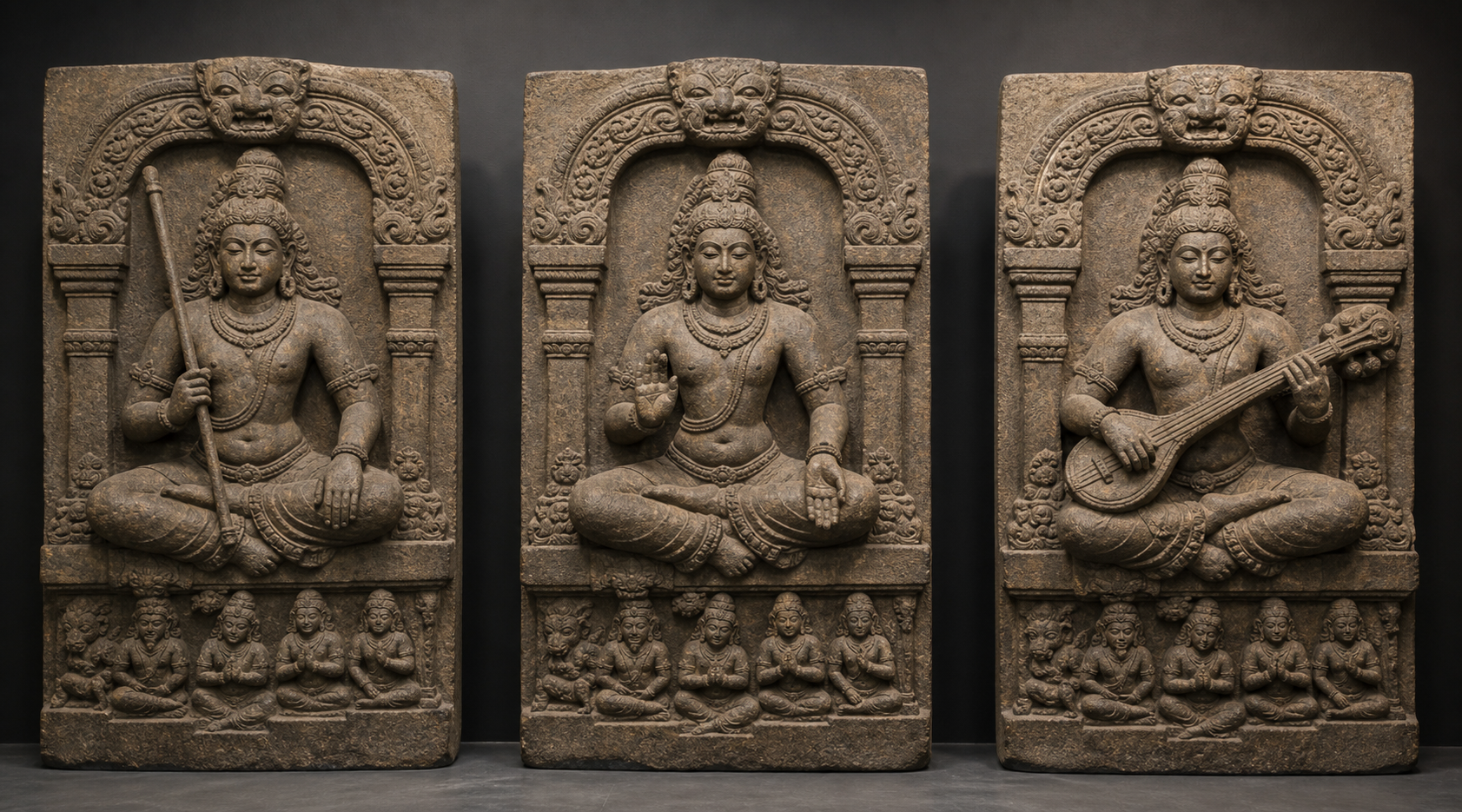
Dakshinamurti is a family of forms rather than a single unchanging template. Four commonly distinguished pedagogical modes help you classify what you see:
- Vyakhyana Dakshinamurti emphasizes explanation and the gesture of instruction.
- Yoga Dakshinamurti emphasizes meditative absorption and interior stillness.
- Vina Dakshinamurti emphasizes music and the harmonizing of inner currents.
- Lagudi or Lakuti Dakshinamurti emphasizes the staff as the integration of conduct, contemplation and lawful authority.
Regional ateliers did not always keep these modes in sealed compartments. Pallava- and Chola-period temple programs can combine gestures and attributes. Classify the image by its dominant visual argument. An unmistakable vina spanning the body points first toward Vina Dakshinamurti; a composed baton organizing the figure points toward Lakuti. A teaching gesture in either image does not erase that distinction.
The harder confusion is Lakulisha. The words lakuta and laguda denote a stick or club, and the staff-bearing teacher preserves a visual kinship with the club-bearing ascetic associated with the Pashupata stream. That kinship can indicate an encounter between Pashupata ascetic imagery and South Indian Agamic temple theology, but it does not make every staff-bearing Shiva the same icon.
Use context to separate them. A southern niche, banyan, teaching posture, Apasmara and listening sages strongly favor Lakuti Dakshinamurti. A club-bearing ascetic without that teaching assembly requires a different inquiry. If the sculpture has left its architectural setting, provenance and comparison with neighboring figures become essential.
The Kāmikāgama, Suprabhedāgama, Kāraṇāgama, Mayamata, Manasara and Shilparatna belong to the Agamic and shilpa-shastra world associated with this iconographic grammar. A catalogue that invokes one of these names is locating the sculpture within a textual tradition; it is not giving you permission to ignore what survives in the stone.
You can examine Dakshinamurti variations at Kanchipuram’s Kailasanatha Temple, Brihadeeswara at Thanjavur, Airavatesvara at Darasuram and Gangaikondacholapuram. These sites are useful precisely because the staff-bearing variant is not universal. Compare the niche, posture and attribute ensemble rather than arriving determined to find Lakuti in every example.
Turn recognition into a disciplined darshan
Correct identification is only the beginning. The image was organized as instruction, and you can let its visible sequence organize a brief contemplation. Follow the temple’s customs, avoid obstructing other devotees and never touch or apply substances to an image without permission.
- Establish the direction. Notice that you have turned toward the south. Let the orientation raise a direct question: what fear, ending or uncomfortable truth have you avoided looking at clearly?
- Find the central line. Rest your gaze on the staff. Allow your own posture to become upright without stiffness and keep the breath easy. The aim is collected attention, not a forced breathing exercise.
- Notice what is underfoot. Identify one form of apasmara operating in you now: distraction, forgetfulness, mistaken certainty or refusal to examine an assumption. Do not dramatize it; simply stop giving it the highest seat.
- Choose one supporting attribute. Let the rosary ask what practice needs repetition, the manuscript what needs study, the flame what requires disciplined effort, or the deer where attention is still darting.
- End in silence. Do not rush to manufacture an answer. The youthful guru’s teaching is conveyed through presence as much as through gesture. Remain for a few unforced breaths, then carry one concrete correction into your conduct.
Traditional observance may include abhishekam with vibhuti and sandal paste, particularly on Thursdays, Pradosha and Maha Shivaratri. Japa and a quiet pause at the southern niche extend the same logic: repeated outer action trains recollection of the inner teacher. If you are a visitor rather than a ritual participant, attentive darshan is already a complete and respectful response.
On your next pradakshina, begin with four observations: who is teaching, what holds the center, what has been brought under control and which practice supports the teaching. When the staff makes those elements cohere, you have done more than recognize Lakuti Dakshinamurti. You have allowed the icon to turn upright seeing into upright conduct.