
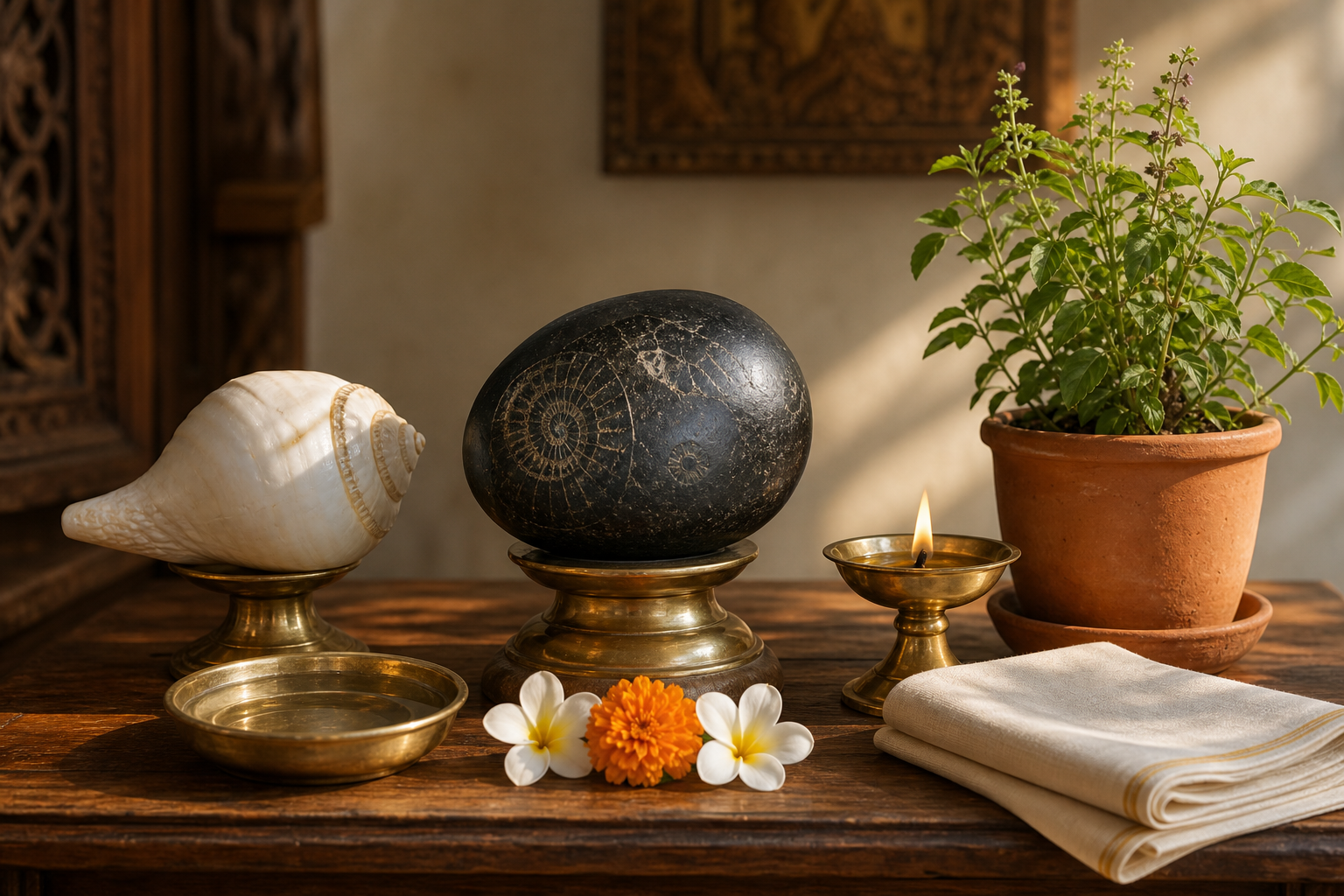
If you are setting up Vishnu worship at home, the difficult question is not which sacred object is most auspicious. It is how to receive each one correctly without turning your altar into a collection or your daily worship into a burden you cannot sustain.
Shaligram, Shankha, and Tulsi answer that problem when you understand them as one discipline. The Shaligram gives your worship a sacred centre, the Shankha orders sound and water, and Tulsi makes devotion a living responsibility. You need a clean arrangement, a repeatable daily sequence, and enough restraint to follow your sampradāya rather than combining every ritual instruction you encounter.
One altar, three distinct forms of service
A Shaligram is not an ordinary stone later converted into a deity through human workmanship. Vaishnava tradition receives it as a self-manifest form of Bhagavan Vishnu that requires no formal prāṇa-pratiṣṭhā. This makes Shaligram worship accessible in a household, but it does not make the Shila casual. You are receiving a form to be served, not acquiring a religious ornament.
Most Shaligrams are dark ammonite fossils found in the Kali Gandaki basin of Nepal, particularly around Muktinath. Their spirals and natural suture patterns can resemble chakra markings associated with Vishnu’s Sudarshana Chakra. Their geological history does not compete with their sacred identity. The fact that mountain, ancient sea life, river, and immense spans of natural time meet in one uncarved form is part of what makes the Shaligram such a powerful expression of divine presence in creation.
The Shankha serves a different purpose. Vishnu’s conch, Pañchajanya, represents the proclamation of dharma through sacred sound. A conch blown during ārati gathers wandering attention and marks the movement from ordinary activity into worship. A second conch can hold and pour water for abhiṣeka, arghya, or prokṣaṇa. Sound and water therefore belong to the same sacred form, but the instruments used for them should remain separate.
Tulsi is neither an accessory placed beside the other two nor merely a convenient leaf for archana. As Tulasi or Vrinda, she is beloved of Vishnu and embodies the devotee’s loving offering. Caring for a Tulsi plant turns bhakti into a daily relationship with soil, water, sunlight, growth, and restraint. The altar does not end at the edge of the worship tray; it extends to the living plant from which the offering comes.
Key takeaways
- Shaligram is the central divine form and is traditionally regarded as inherently sacred, without a separate consecration rite.
- Use one Shankha for pouring sanctified water and another for blowing during ārati.
- Offer Tulsi as an act of bhakti while also treating the care of the living plant as part of that bhakti.
- Natural markings matter; carving, drilling, polishing, or artificial enhancement works against the very character of a Shaligram.
- A short practice performed steadily is better than an elaborate sequence that soon becomes irregular.
Build an altar you can actually maintain
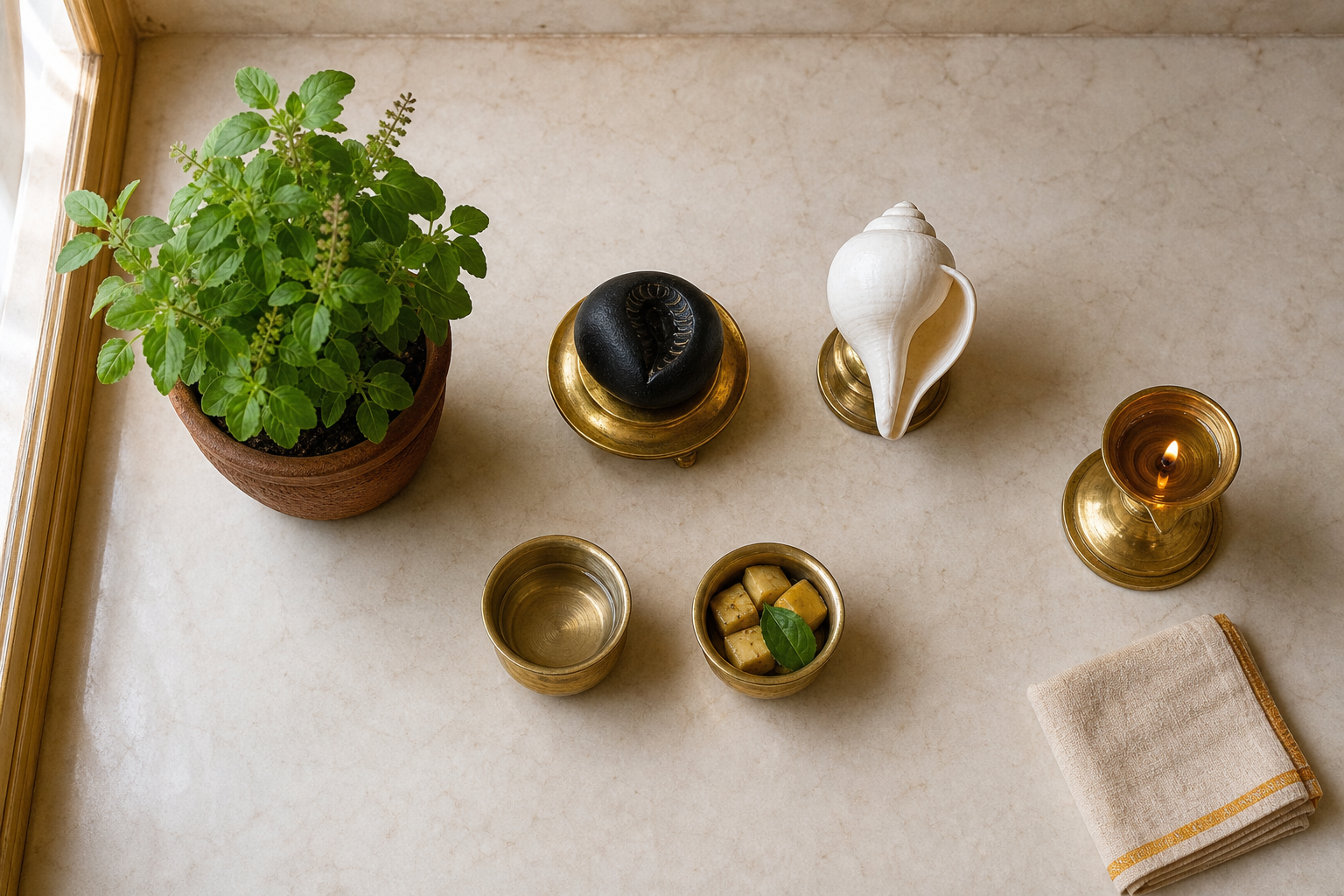
Begin with the daily action, not the display. If a setup takes too long to prepare, clean, and put away, the friction will eventually weaken your routine. Keep the Shaligram on a dedicated pīṭha in a clean place, with the regular materials close enough that worship does not require searching through cupboards every morning.
A practical household arrangement includes:
- A dedicated pīṭha or stable altar surface for the Shaligram.
- Clean water and a clean cloth used only for worship.
- A Shankha reserved for abhiṣeka water, or a clean pouring vessel until you obtain one.
- A separate Shankha reserved for blowing.
- Tulsi leaves or manjaris obtained with reverence and according to your customary rules.
- Gandha, flowers, incense, a lamp, and suitable naivedya for pañcopacāra worship.
- The five ingredients of pañcāmṛta—milk, curd, ghee, honey, and sugar—only when your tradition permits that form of abhiṣeka and you can clean the Shila properly afterward.
The separation of the two conches is both ritual and practical. A conch placed at the mouth should not later become the vessel from which water is poured over the deity. If you possess only a blowing conch, keep using a different clean vessel for abhiṣeka rather than making one Shankha perform both roles.
You may encounter labels such as vāmāvarti and dakṣiṇāvarti while choosing a conch. The commonly encountered vāmāvarti form turns to the left, while the rarer dakṣiṇāvarti form turns to the right and is traditionally associated with auspiciousness and prosperity. Rarity, however, is not a substitute for correct service. Do not allow an expensive claim about orientation to distract you from the more important questions: Was the conch obtained responsibly? Is it intact and usable? Have you assigned it one clear ritual function?
Apply the same discipline to a Shaligram. A genuine Shila is naturally formed and should show no carving or artificial improvement. Do not buy merely because a seller assigns an impressive avatāra name to every line and opening. Ask how the Shila was obtained, whether its movement from Nepal was lawful, and whether the person identifying it is trusted within a living Vaishnava tradition. If those answers are unclear, waiting is the more dharmic choice.
Before bringing a Shaligram home, also ask whether you can offer simple, regular attention. No formal prāṇa-pratiṣṭhā is required, but that should reduce ceremonial barriers rather than reduce reverence. If your family or sampradāya has inherited rules about placement, handling, food offerings, or daily service, those rules should shape your setup.
A complete daily sequence without unnecessary complexity
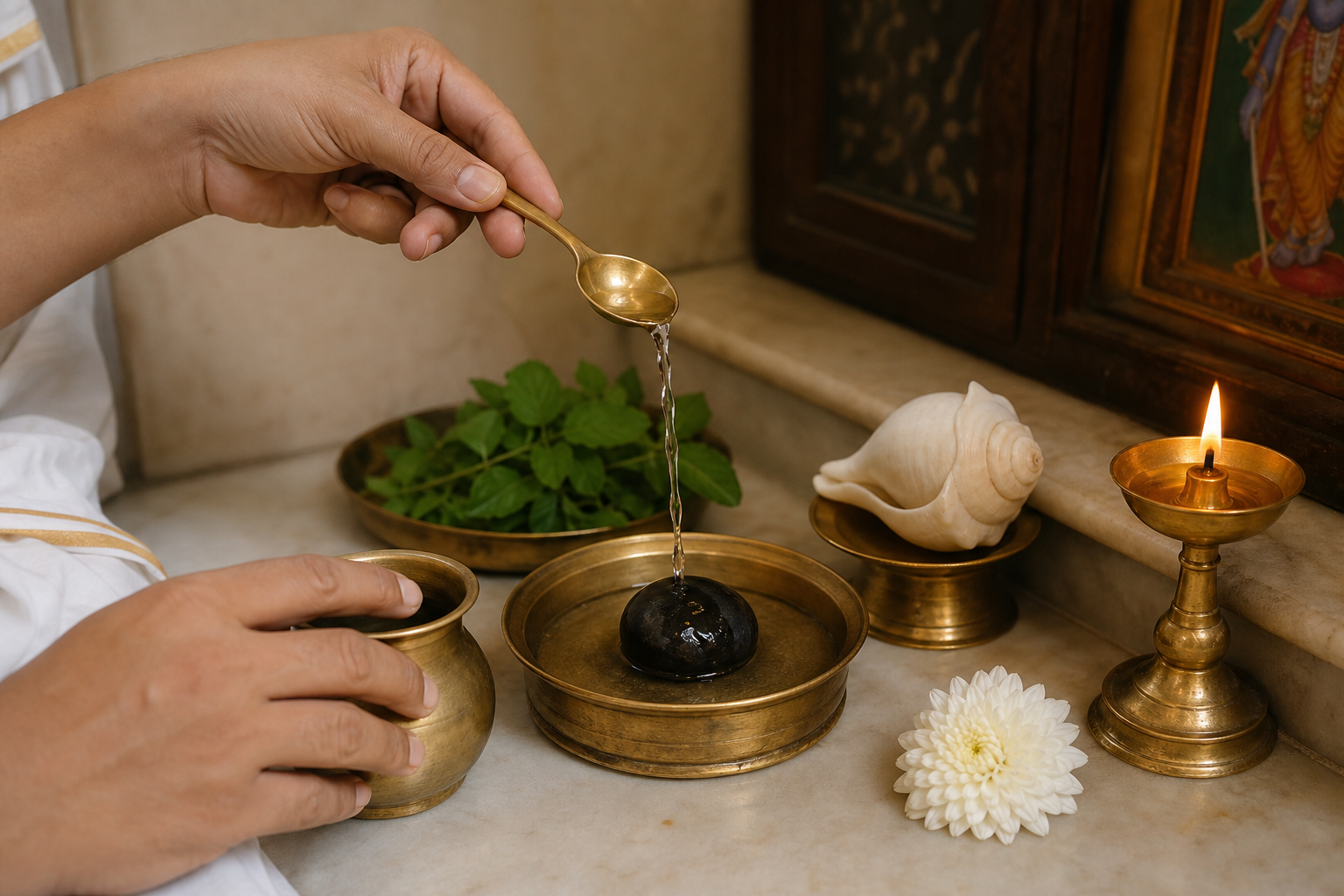
The purpose of nitya-pūjā is remembrance made steady. A workable sequence should lead you from preparation to service and then close cleanly, without leaving the Shaligram wet or the altar disorderly. The following pattern reflects common Vaishnava household practice, but your family tradition or ācārya may prescribe a different order.
- Prepare yourself and the space. Perform ācamanam according to your tradition, settle the mind, and make a simple saṅkalpa. The intention can be modest: to worship Bhagavan Vishnu with attention and devotion.
- Gently rinse the Shaligram with clean water. Do not scrub, scrape, or attempt to make the natural markings look more dramatic.
- If your tradition permits, perform pañcāmṛta abhiṣeka with milk, curd, ghee, honey, and sugar. This is optional, not the measure of whether the worship is complete.
- Pour pure water from the abhiṣeka Shankha to rinse away the pañcāmṛta. If you do not keep a water conch, use a clean vessel reserved for worship.
- Dry the Shaligram gently and return it to the dedicated pīṭha. Leaving ritual liquids on the Shila is not an added act of reverence.
- Offer gandha, flowers, incense, and the lamp as prescribed in your tradition.
- Offer Tulsi leaves or manjaris while reciting Vishnu-nāma. Om Namo Nārāyaṇāya and Om Namo Bhagavate Vāsudevāya are two widely used mantras for this worship.
- Present naivedya with a quiet mind. The value of the offering lies in its suitability and the devotion with which it is given, not in excess.
- Perform ārati. Blow the sound Shankha at the customary point, keeping it distinct from the conch used for water.
- Conclude according to your household practice, restore the altar to order, and make sure the Shaligram and ritual vessels are clean and dry.
On a day when a longer abhiṣeka is not practical, do not abandon worship because you cannot perform the fullest version. A sincere Tulsi archana with Vishnu-nāma can be spiritually complete. Pañcopacāra—gandha, pushpa, dhūpa, dīpa, and naivedya—also gives you a compact structure without reducing pūjā to a hurried gesture.
This distinction protects your practice from an avoidable cycle. Devotees sometimes begin with a festival-scale procedure, discover that it cannot fit ordinary mornings, and then feel that a simpler rite is inadequate. Establish the minimum you can maintain first. Add pañcāmṛta, longer nāma-archana, or additional recitation on days when you genuinely have the time and capacity.
The conch call can help make that transition deliberate. It is not background noise or a demonstration of lung strength. Blow it with control, at the appropriate point, and let the sound gather the household’s attention. Its ritual purpose is served when it directs the mind toward Bhagavan.
Correct the small mistakes that weaken daily worship
Do not improve what is sacred because it is natural
A Shaligram’s openings, spirals, and chakra-like forms should remain as nature formed them. Do not carve a clearer chakra, drill a mounting hole, polish away unevenness, or apply chemical cleaners. Such interventions do not reveal the Shila’s identity; they erase part of the natural form on which its identity depends.
Use clean water and gentle handling. When you perform pañcāmṛta abhiṣeka, rinse the Shaligram thoroughly with pure water and dry it afterward. Elaborate substances do not compensate for careless cleaning.
Do not confuse the two functions of Shankha
The Shankha that touches the mouth belongs to sacred sound. The Shankha used to hold and pour water belongs to abhiṣeka and purification. Mark their storage positions or keep them on different sides of the altar if members of the household might confuse them. A clear physical arrangement prevents a repeated ritual and hygiene mistake.
You also do not need a rare dakṣiṇāvarti conch before you can worship Vishnu properly. Its traditional auspicious associations deserve respect, but ordinary daily service does not become inferior because your blowing or pouring conch has the more common orientation.
Do not reduce Tulsi to consumable altar material
If Tulsi is honoured as Vrinda, the way you maintain the plant matters as much as the moment you place a leaf before Vishnu. Give the plant suitable soil, water, light, and attentive care. Follow your sampradāya or household rules for collecting leaves and manjaris rather than improvising from conflicting instructions.
Tulsi’s place in Ayurveda is not the reason she is offered in this rite. Ritual worship centres on sanctity and bhakti. Do not turn a sacred offering into an unsupported health promise or confuse devotional use with individualized medical guidance.
Do not flatten every sampradāya into one procedure
Śrī Vaishnava, Gaudiya Vaishnava, and other household traditions may differ in mantras, purity rules, the order of offerings, and the scale of daily service. Their shared devotion to Vishnu does not eliminate those distinctions. Choose a coherent procedure rooted in your family or sampradāya. If you are unsure about a specific rule, ask a qualified ācārya or experienced practitioner within that tradition instead of assembling a hybrid rite from isolated instructions.
Let worship protect the sacred world from which it comes

The origin of each member of this triad creates an ethical duty. The Shaligram comes from a sacred Himalayan river landscape. The Shankha comes from marine life. Tulsi depends on living soil and water. Worship becomes internally inconsistent when acquiring a sacred form damages the place or life through which that form reaches us.
For a Shaligram, responsible acquisition means respecting Nepal’s heritage rules, the Kali Gandaki ecosystem, and the communities for whom the river is sacred. For a conch, it means asking whether it entered trade without destructive or unlawful pressure on marine ecosystems. For Tulsi, it means treating cultivation itself as seva rather than neglecting one plant while repeatedly replacing it with another. If ethical provenance cannot be established, do not rush merely to complete a matching set.
This care also reveals why the triad speaks beyond one household ritual. Muktinath, called Chumig Gyatsa by Buddhists, is revered by Hindus and Buddhists. The white conch appears among the Aṣṭamaṅgala in Buddhist and Jain traditions as a sign of truth carried outward. These parallels do not make the traditions interchangeable. They show a wider Dharmic recognition that landscape, sound, disciplined conduct, and living nature can carry sacred meaning.
Daily worship can then expand into the calendar without becoming disconnected from ordinary life. Ekadashi invites greater simplicity and inward attention. During Kartika, Tulsi Vivah—commonly observed on Ekadashi or Dwadashi—ceremonially joins Tulsi and Shaligram as Vishnu-Lakshmi. Days dedicated to Vishnu’s avatāras can add the corresponding nāma, archana, or study to the same stable altar routine. The daily form remains the foundation; the festival gives it seasonal depth.
If you are beginning, make one durable commitment: prepare a clean place, establish a simple Vishnu-nāma practice, and care for Tulsi consistently. Acquire a Shaligram and the appropriate conches only with trustworthy guidance and ethical provenance. Let the altar grow at the pace of your capacity to serve it. That is how sacred presence becomes a household discipline rather than a possession.