

Perhaps you turn to Narasimha because something entrusted to you feels exposed: your family is under pressure, your mind is being pulled by fear, a temple is vulnerable, or dharma is being treated with contempt. Asking for protection is natural. The harder question is what that prayer requires from you after you rise from worship.
Prahlada’s example gives a demanding answer. Take refuge without abandoning judgment. Resist adharma without cultivating hatred. Protect people, traditions, and sacred objects with disciplined action rather than slogans. Narasimha bhakti is not fear dressed as religion; it is fierce compassion governed by dharma.
Read Narasimha’s fierce form through Prahlada, not through anger
The safest place from which to understand Narasimha is beside Prahlada. The five-year-old devotee faces coercion, attempted killing, and the wrath of his own father, yet he does not allow fear to determine what he worships. His steadiness is neither submission to abuse nor a hunger for retaliation. It is freedom from the tyrant’s attempt to rule his inner life.
The manner of Narasimha’s manifestation matters just as much as its ferocity. Hiranyakashipu had tried to place himself beyond death through carefully framed protections: not by man or beast, indoors or outdoors, by day or night, on earth or in the sky, or through a conventional weapon. Narasimha appears at twilight, on a threshold, in a form that is neither man nor ordinary beast, places the tyrant on his lap, and uses his nails. Divine justice does not discard order in a burst of rage. It exposes the limits of cleverness used to shelter cruelty.
This is why the episode cannot honestly be used as permission to brand people, religions, castes, or political opponents as demons. Daivic and asuric describe dispositions that can arise in anyone. Truthfulness, compassion, courage, and self-restraint are daivic. Arrogance, domination, intolerance, and cruelty are asuric. If you invoke Narasimha while feeding the same contempt you condemn, the fierce image has become a mask for the ego.
Before calling your response dharmic, ask three questions:
- What exactly needs protection? Name the person, freedom, duty, institution, or sacred object. A vague feeling of being offended is not the same as an identifiable threat.
- What action will actually reduce the harm? Evidence, a firm boundary, a safety procedure, lawful reporting, charitable support, or calm public advocacy may protect more effectively than hostile rhetoric.
- Will the response remain accountable? A dharmic action should withstand scrutiny from trusted elders, responsible institutions, and the facts themselves.
If you cannot answer those questions clearly, pause before acting. Narasimha’s fierceness is precise. It is directed toward the cessation of harm, not the gratification of anger. Prahlada’s faith therefore offers you two protections at once: courage before external pressure and vigilance against becoming inwardly shaped by the pressure you oppose.
Build a devotional practice that turns fear into duty
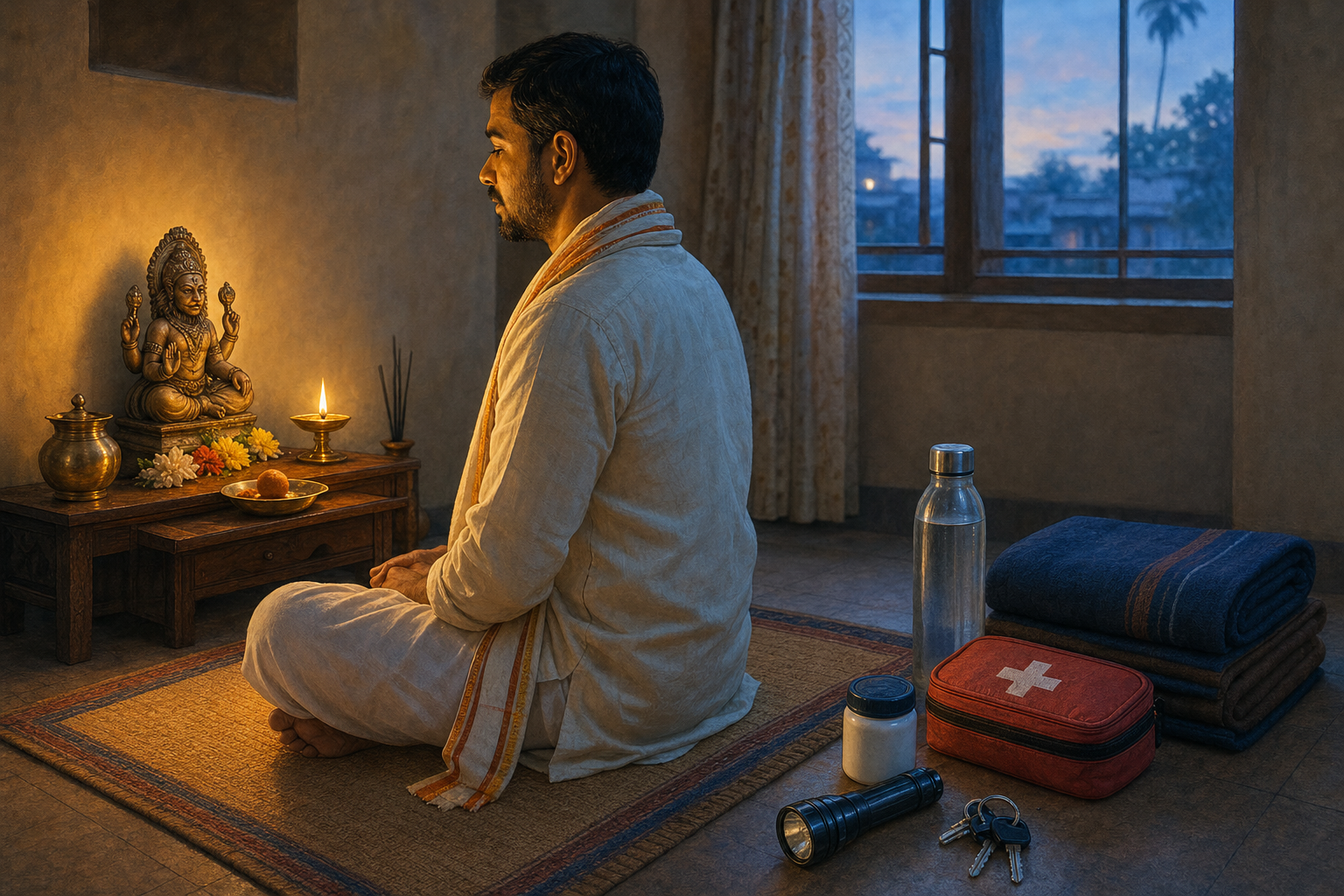
Fear tends to make prayer either vague or transactional: remove this problem, punish that person, guarantee this result. A steadier Narasimha practice moves from refuge to discernment and then to action. You can use the following sequence at home, while respecting the ritual discipline of your own sampradaya.
- Name the trust. Say plainly what you are trying to protect: a child, freedom of worship, your capacity to speak truthfully, a congregation, or an object offered in seva. This keeps prayer focused on duty rather than hostility.
- Remember Prahlada. Read or retell an episode from the Bhagavata Purana’s Seventh Canto. Notice that Prahlada preserves devotion under pressure without imitating his persecutor’s disposition.
- Recite within your lineage. Many devotees use Sri Nrisimha Kavacha or the invocation ugram viram mahavishnum jvalantam sarvato mukham nrisimham bhishanam bhadram mrityur mrityum namamy aham. Recitation should steady attention and intention; it is not evidence that your suspicions about another person are true.
- Choose the next responsible action. Before ending, identify something concrete: check on the vulnerable person, document a safety concern, speak to a trustee, correct an inventory entry, seek qualified help, or make the boundary you have been avoiding.
On Narasimha Caturdashi, traditionally observed on Shukla Chaturdashi in the month of Vaishakha, many communities fast and worship during the evening period associated with the manifestation, around sandhya or pradosha. Exact observance and parana depend on the applicable panchanga and lineage, so do not copy a clock time from another region without checking locally. If fasting could interact with a medical condition or medication, seek individual guidance from a qualified clinician rather than treating physical risk as a test of faith.
Temple and household observances may include abhishekam with panchamrita, tulasi offerings, kirtan, scriptural remembrance, prasada, and charitable giving. Use the form appropriate to the murti and tradition. Ritual liquids should not be improvised on ornaments or materials that may be damaged by moisture or residue. Devotion is not diminished by careful handling; careful handling is part of devotion.
It also helps to reject a common misunderstanding: spiritual protection is not a promise that hardship will never reach you. Prahlada’s story includes severe trial before deliverance. Its practical promise is that coercion need not own your conscience and that action aligned with dharma need not be driven by hatred. A mantra can anchor that orientation, but it does not replace a lock, a medical professional, a police report, a safeguarding procedure, or a difficult truthful conversation.
Treat sacred ornaments as seva with a chain of custody
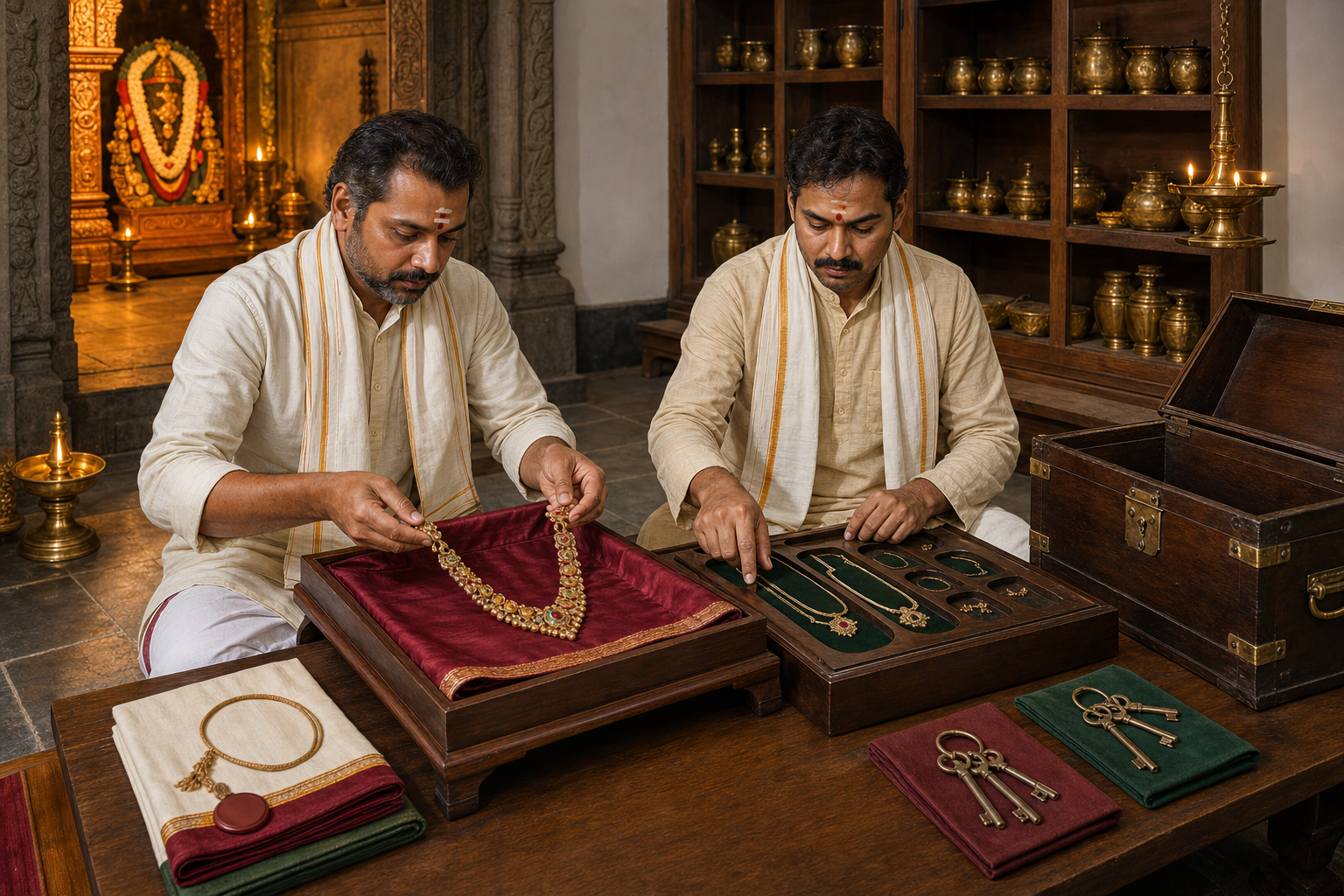
When a crown, necklace, or jewel is offered to a murti, its market value tells only part of the story. Alankara belongs to a living cycle of worship. Within the sequence commonly called shodashopachara, or sixteen offerings, garments, garlands, and ornaments express love, royal honour, and service. For Narasimha, they also make visible the majesty of the protector. A missing ornament is therefore both a property loss and an interruption of an intimate act of seva.
Good stewardship begins by studying movement rather than merely buying equipment. Risk rises when custody changes: festival crowds, processions, late-night re-adornment, handovers between teams, renovations, external repair, and transfers between the sanctum, preparation area, and treasury. These are the moments at which a normally careful community can rely on memory, assume someone else signed, or allow one person to carry too much responsibility.
A temple that has never formalised its process can begin with this minimum standard:
- Give every ornament a unique identity. Record its metal, stones, weight, dimensions, hallmarks, distinctive marks, condition, and usual ritual use. Photograph it sharply from several angles. For especially important objects, photogrammetry or another suitable three-dimensional record can strengthen identification.
- Maintain a living movement register. Record adornment, removal, storage, cleaning, repair, and return. Each entry should identify the item, time, destination, purpose, releasing custodian, and receiving custodian.
- Require two-person integrity. No individual should handle valuable ornaments alone. Two authorised people should witness opening, counting, transfer, sealing, and return. This protects honest sevaks as much as it protects property.
- Use tamper-evident storage. Place items in identified pouches or containers, apply tamper-evident seals, and have both custodians countersign. A broken or mismatched seal should trigger a documented check, not an informal explanation.
- Separate access by role. Sanctum access, preparation-room access, treasury access, keys, codes, and inventory records should not automatically belong to the same person. Keep time-stamped access logs and review them instead of merely collecting them.
- Store for preservation as well as security. Remove residual moisture and ritual substances gently after abhishekam, following appropriate conservation and ritual guidance. Use inert, acid-free materials and avoid rapid environmental fluctuations that encourage tarnish, corrosion, or failure of threads and settings.
- Layer physical and digital safeguards. Use adequate lighting, controlled sightlines, CCTV with redundant storage, restricted access, and secure offsite backups of the inventory. Digital records should have role-based access and version history. RFID or discreet microdot marking may add recoverability for high-value objects when custodians and conservation specialists judge it appropriate.
- Rehearse the exceptional days. Write festival and procession procedures before the crowd arrives. Establish a supervised clean zone near the sanctum, identify authorised workers visibly, log temporary transfers, and decide who can make an emergency exception. Every exception should be recorded and reviewed.
The purpose of this discipline is not to import suspicion into the temple. It is to remove ambiguity. When duties are clear and witnessed, priests and volunteers are less exposed to false accusation, trustees can answer questions with evidence, and the community is not forced to choose between blind trust and corrosive rumour.
Insurance and outside vendors require the same seriousness. Obtain professional valuations at suitable intervals and check whether coverage addresses festivals, processions, ritual liquids, external repair, and overnight storage. Verify the identity, references, and work location of cleaners or jewellers before releasing an object. Document each handover, limit unnecessary disclosure, and inspect and record the item when it returns. Donations of valuable jewellery also require provenance and legal checks; piety does not make an undocumented acquisition safe.
In Bharat, depending on the age and legal status of the object and the institution involved, stewardship may engage the Antiquities and Art Treasures Act, 1972, associated rules, and state religious-endowment law. If an object may have crossed borders, the UNESCO 1970 framework and INTERPOL’s Stolen Works of Art database can become relevant. Documentation, professional valuation, reporting, and recovery channels work only when internal custody records are reliable. Trustees should obtain advice for their actual jurisdiction rather than assuming that a general temple custom settles a legal obligation.
Dharmic institutions can also learn from one another without flattening their distinct rituals. A Hindu temple can study the solemnity of witnessed handovers in a gurdwara, the detailed cataloguing found in Jain bhandars, or the care with which a Buddhist vihara documents reliquaries. The point is not to copy another tradition’s sacred form. It is to adapt the administrative wisdom: identify the object, witness the transfer, preserve continuity, and treat accountability as sacred service.
If an ornament is missing, preserve facts before telling a story
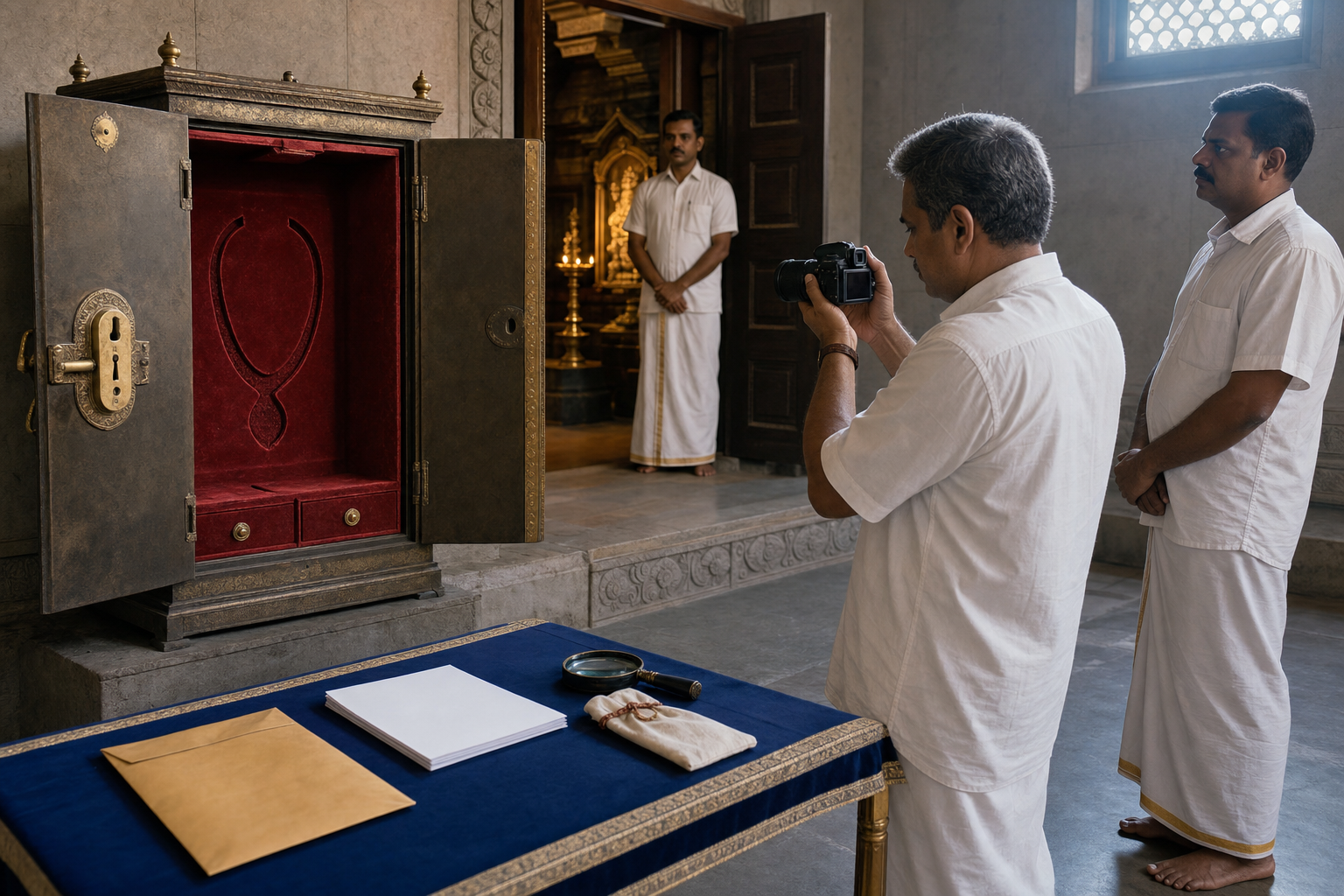
An empty pouch or inventory mismatch is not yet a proven theft, but it is serious enough to activate the response plan. Do not let embarrassment produce delay, and do not let alarm produce an accusation. The first task is to preserve the facts while recovery options remain open.
- Stop further movement. Secure the relevant sanctum, preparation space, cabinets, containers, and treasury access. Pause routine cleaning or rearrangement that could destroy traces or make the timeline harder to reconstruct.
- Document the scene with witnesses. Have authorised custodians photograph work surfaces, containers, seals, locks, and the location where the item should have been. Record the time and the names of those present.
- Start with the last confirmed sighting. Work forward through adornment records, removal logs, photographs, repair notes, key registers, and witnessed handovers. Separate what someone remembers from what a record confirms.
- Preserve surveillance records immediately. Secure relevant CCTV footage before the system’s overwrite cycle removes it. Retain access logs and digital inventory history in their existing form.
- Escalate through designated authority. Notify the responsible trustees and follow the temple’s reporting protocol. Based on the facts and jurisdiction, involve law enforcement, the insurer, legal counsel, and cultural-property channels. Do not run a public amateur investigation or pressure volunteers into informal confessions.
- Communicate verified facts. Tell the community what is known, what action has been taken, and when another update can reasonably be expected. Do not publish access codes, vault layouts, camera gaps, or other details that create a second vulnerability.
A usable first statement: During a scheduled check, we identified a discrepancy involving a sacred ornament. The relevant areas and records have been secured, authorised trustees are following the established reporting process, and we will provide another update when information has been verified. This wording is deliberately limited. It informs the community without pretending that an unexplained discrepancy is already a solved crime.
Ritual response can proceed alongside procedural response. Special arati, kirtan, prayer, vrata, or Narayana-seva may help the community direct grief toward solidarity and service. They should never be used to avoid reporting, evidence preservation, or institutional accountability. Bhakti and competent administration are not rival explanations of protection; they are duties operating on different parts of the crisis.
If an item is recovered, preserve the chain of custody and follow the instructions of investigating authorities before handling it further. Assess its condition, update the inventory, document how it returned, and only then arrange its ritual restoration under appropriate guidance. Recovery should also trigger a review of the failed control. Gratitude is proper, but gratitude without correction leaves the same opening in place.
Key takeaways for a protective Narasimha practice
- Narasimha’s fierceness protects dharma and the vulnerable; it does not sanctify personal rage or collective dehumanisation.
- Prahlada models inner freedom under coercion. His steadiness is active fidelity, not passivity toward harm.
- Prayer becomes actionable when you name what is entrusted to you, clarify the next duty, and choose a response that remains accountable.
- Mantra, fasting, puja, kirtan, and charity cultivate remembrance, but none replaces medical judgment, physical safeguards, lawful reporting, or truthful communication.
- Sacred ornaments need unique records, witnessed transfers, two-person handling, suitable storage, restricted access, and rehearsed festival procedures.
- When an item is missing, secure the area, preserve evidence and CCTV, reconstruct the last confirmed movement, notify the appropriate authorities, and communicate only verified facts.
Before your next puja or temple meeting, choose one inward and one outward act. Identify the asuric tendency you need to restrain in yourself, then close one practical gap in the trust placed in your care. That pairing is where Narasimha devotion becomes more than an appeal for rescue. It becomes the courage, restraint, and stewardship through which protection is made visible.
References
- Dandavats — Unraveling Nrsimhadev’s Missing Jewels: Sacred Trust, Heritage Security, and Hope
- Dandavats — Fierce Compassion on Narasimha Caturdashi: Dharma’s Triumph, Prahlada’s Faith, Rituals and Meaning