
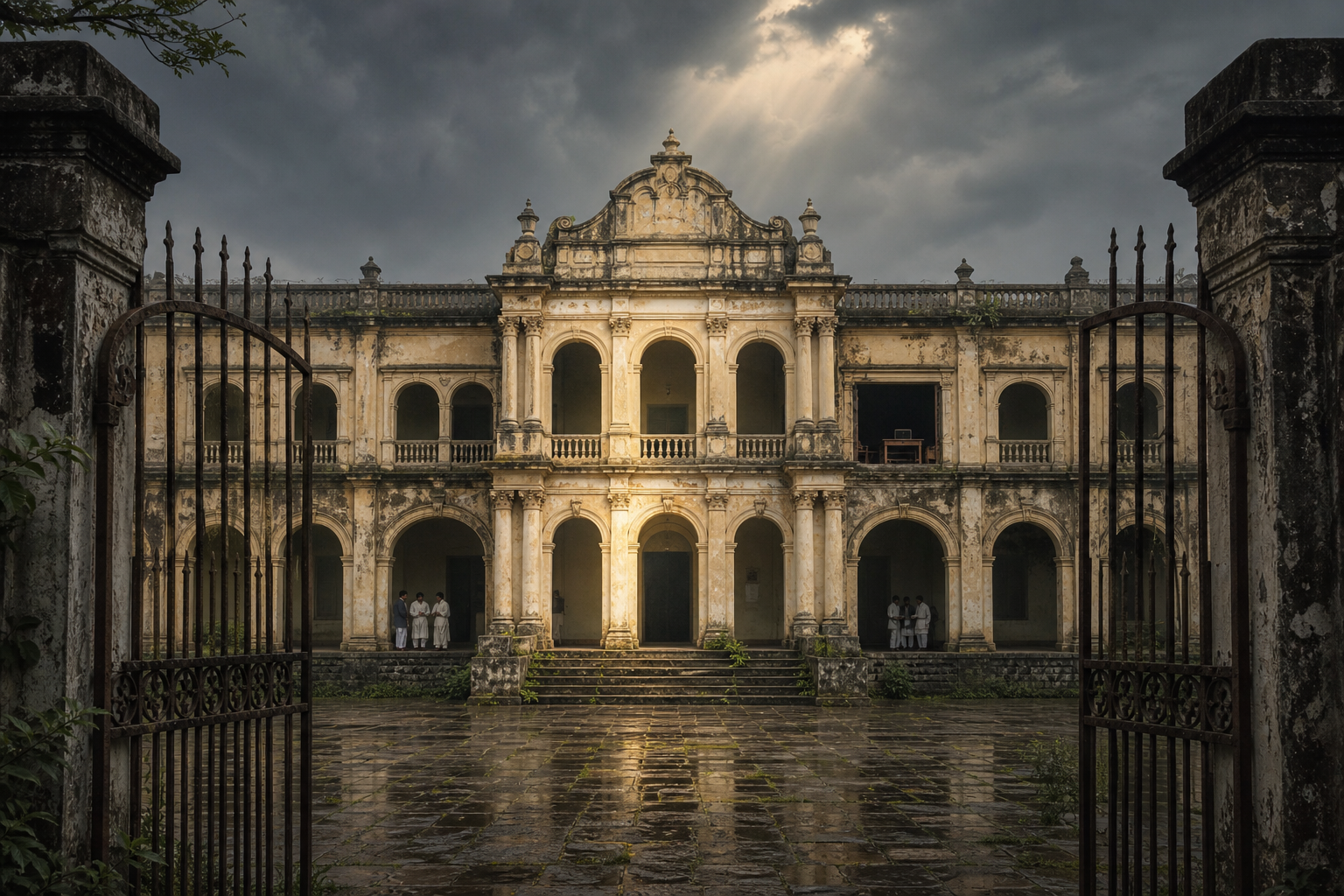
If you are trying to understand how a celebrated college can lose its scholarly character, don’t begin with its damaged rooms. By the time neglect becomes visible on a wall, in a corridor, or behind a staircase, the decisive damage has usually occurred elsewhere.
The political decline of Maharaja’s College was not one dramatic fall. It was a chain of smaller institutional surrenders: appointments shaped by faction, students organized around personal loyalty, subjects assigned caste identities, and academic authority detached from scholarship. That sequence also tells you what genuine restoration must repair.
What Maharaja’s College possessed before it declined
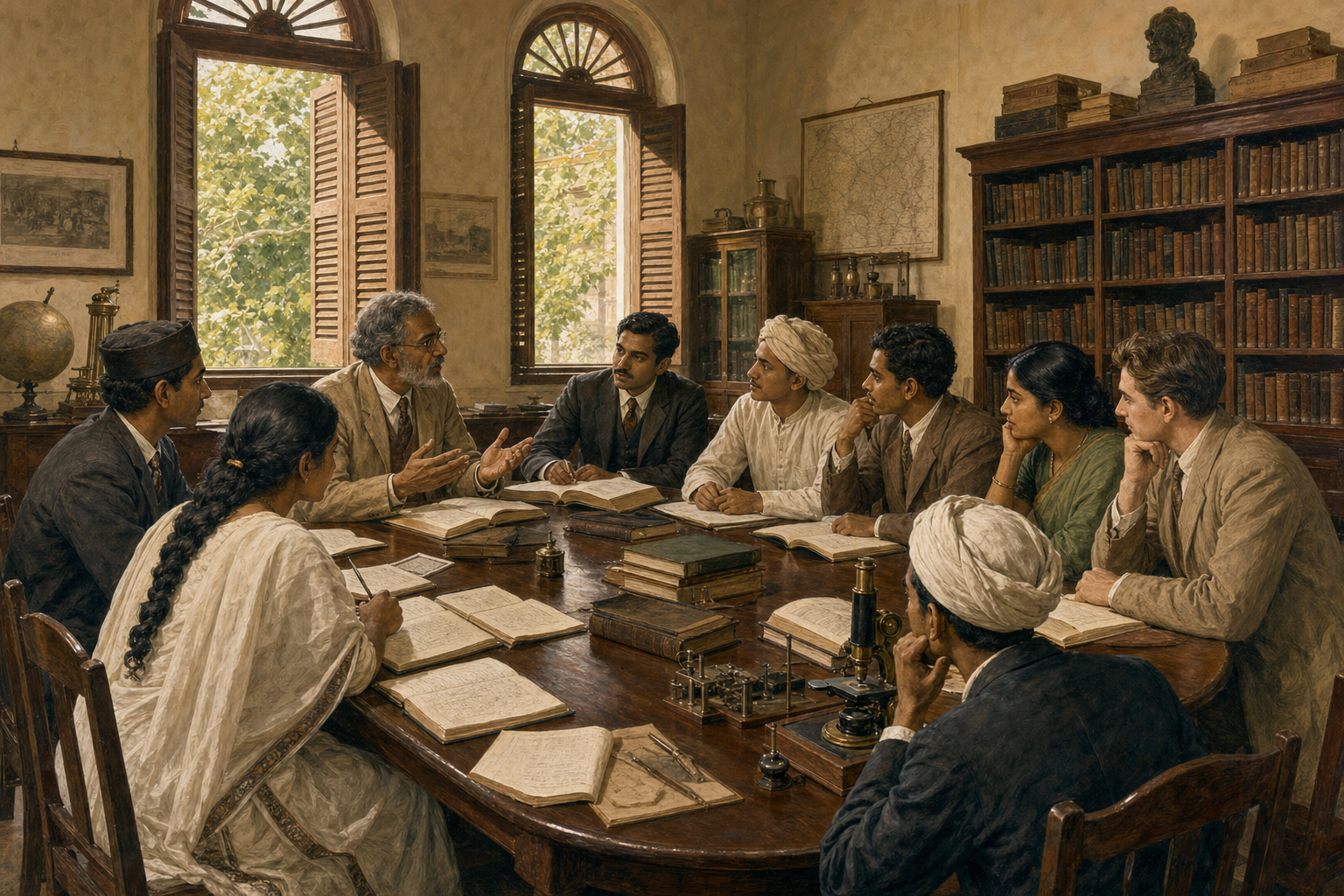
To judge decline honestly, you need a demanding baseline. An old building is not a great institution merely because distinguished people once occupied it. Maharaja’s College mattered because its architecture, teachers, curriculum, publications, and daily habits once supported the same purpose: serious learning.
The wider University of Mysore inherited a civilizational ambition shaped by Krishnaraja Wodeyar III’s cultural renewal, Krishnaraja Wodeyar IV’s consolidation of it, and M. Visvesvarayya’s modernizing administrative drive. Maharaja’s College stood within that educational ecosystem. It was expected to produce more than degree holders. It was meant to cultivate capable minds rooted in Bharata and conversant with the wider world.
That combination is crucial. The college’s older intellectual culture did not require students to choose between Indian learning and modern critical inquiry. Teachers and students could engage Kalidasa and Bhavabhuti alongside Aeschylus and Shakespeare. Tyagaraja and Muthuswami Dikshitar belonged in the same cultivated life as Greek drama and English literature. Rootedness did not mean enclosure.
This is one useful meaning of a dharmic institution. It need not impose a sectarian syllabus. It treats knowledge as a responsibility held in trust; the teacher’s standing comes from vidya, disciplined conduct, and the ability to awaken thought in students. Engagement with another civilization need not require contempt for your own.
During the remembered high period extending from the university’s establishment to the departure of Kuvempu, students crowded rooms to hear teachers such as M. Hiriyanna, B.M. Srikantaiah, S.V. Ranganna, D.L. Narasimhachar, S. Srikanta Sastri, Sarvepalli Radhakrishnan, and others. Some crossed faculty boundaries simply to attend a compelling class. The attraction was not institutional branding. It was the substance available in the room.
Old issues of Prabuddha Karnataka provide another practical measure of vitality. A college is alive when teaching generates discussion, discussion produces writing, and writing enters a durable intellectual record. Informal reading, literary conversation, music, collegial humor, and formal scholarship then reinforce one another instead of competing for attention.
If you want to assess what was lost, therefore, don’t ask only whether the classrooms remained open. Ask whether accomplished teachers still attracted students by force of learning, whether colleagues read together, whether journals preserved new work, and whether academic duty could be experienced as a form of shared intellectual pleasure. Those are observable institutional qualities, not sentimental memories.
How political capture travels into academic life
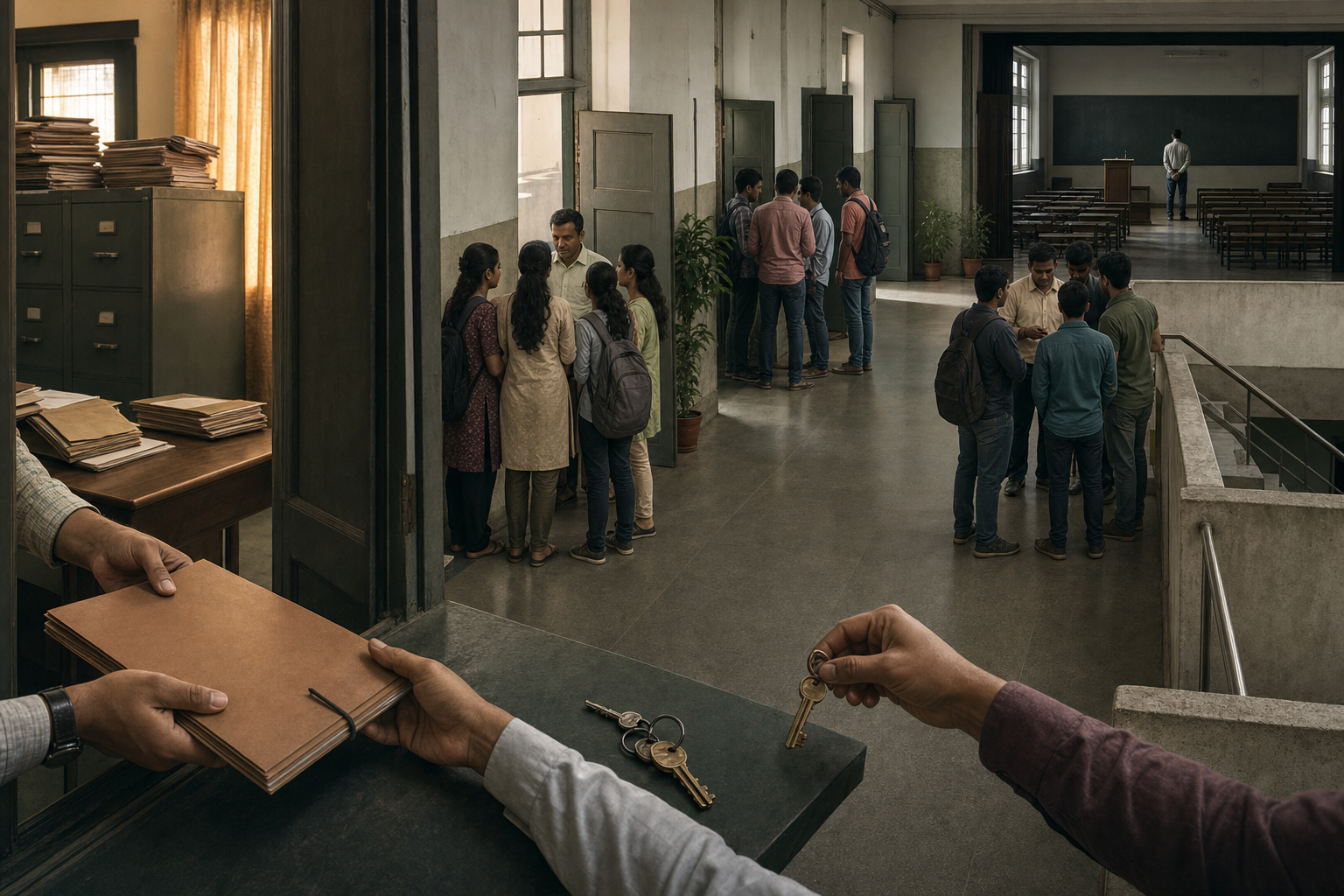
The most shocking image associated with the later college comes from B.G.L. Swamy. On returning to familiar rooms after roughly forty years, he remembered lower staff playing cards, Professor Rollo’s portrait hanging upside down, and cows occupying the English lecturers’ hall. The point is not that animals caused the decline. Their presence showed how completely a room’s scholarly purpose had ceased to command institutional care.
Physical neglect was the last visible stage. S.L. Bhyrappa described earlier warning signs: caste-favored appointments, obstruction of meritorious teachers, sudden advancement of undeserving candidates, campaigns against faculty placed in an enemy camp, and attempts to close subjects branded as Brahmin. These are serious allegations, and responsible readers should treat recollection as evidence of institutional experience rather than as a complete administrative archive. The value lies in the recurring mechanism it exposes.
- An appointment becomes a factional prize. A candidate’s usefulness to a caste, ideological, or personal camp begins to count more than subject knowledge, teaching ability, or scholarly work.
- The successful camp builds a student following. Students learn that proximity to a powerful professor can affect access, recognition, and opportunity. Loyalty becomes safer than independent judgement.
- Academic disagreement acquires an identity label. A rival is no longer merely wrong about history, literature, or language. The rival is treated as a representative of a hostile community.
- Faculty circles become personal courts. Meetings, recommendations, promotions, and intellectual recognition flow through networks of allegiance. Formal rules survive, but informal power decides how they are applied.
- Stewardship loses prestige. Once academic office is valued chiefly as a resource for a faction, maintaining classrooms, portraits, archives, journals, and collegial standards feels secondary. Material decay follows moral and procedural decay.
This sequence matters because it prevents a cosmetic diagnosis. Paint can repair a wall, and a ceremony can revive a name for an afternoon. Neither can make students intellectually independent or make an appointment committee trustworthy. If the first four stages remain intact, repair of the fifth is preservation work, not institutional renewal.
Use the recollections to identify questions, then test claims about particular people against appointment files, promotion records, syllabi, subject-closure orders, committee minutes, and the scholarly work produced during the relevant period. That distinction protects two things at once: the truth about systemic decay and the fairness owed to individuals.
The useful diagnosis is institutional, not a caste roll call

Caste and ideology cannot be omitted from this history. The Aryan-Dravidian controversy travelled beyond philology and entered organized political mobilization. Justice Party networks formed part of the wider environment in which identity claims reached higher education. Inside an academic institution, that vocabulary could turn a contest over appointments or curriculum into a struggle between supposedly permanent social camps.
But it would be a mistake to conclude that one caste, region, or political formation is the whole explanation. That merely reproduces the logic of factionalism. If opaque appointments remain opaque when the beneficiaries change, the institution is still captured. If a deserving scholar needs a patron from the correct bloc, replacing one bloc with another has not restored merit.
Merit must also mean more than a slogan used by a losing faction. In a college, it should be made visible through subject competence, serious teaching, sustained scholarship, intellectual honesty, and fair peer scrutiny. Published criteria and reasoned decisions make those qualities contestable without making them arbitrary. Secrecy lets every camp call its preferred candidate meritorious.
The same principle applies to intellectual pluralism. Several competing patronage networks do not create a plural university. Genuine pluralism allows incompatible arguments to be taught, challenged, and defended by evidence. Patronage merely gives each faction its own protectors, clients, and prohibited questions.
It is equally misleading to blame students alone. A student coterie becomes institutionally powerful when teachers cultivate it, reward it, or use it against colleagues. Faculty members remain long enough to transmit habits across several student generations; they can therefore preserve standards or normalize their abandonment even as governments and student leaders change.
Nor should political decline be confused with total institutional destruction. The University of Mysore was spared the most intense cycles of disruption experienced by several other Indian universities after Independence, but it was not untouched by party influence and identity blocs. Its decline could be quieter: fewer spectacular confrontations, yet a steady weakening of trust, standards, and scholarly purpose.
When you encounter a claim that a particular community either ruined or rescued the college, ask a harder question: did the rules become more transparent, did students become freer to disagree, and did scholarship regain authority over patronage? Those tests travel across caste and party lines.
How to tell whether a restoration is real
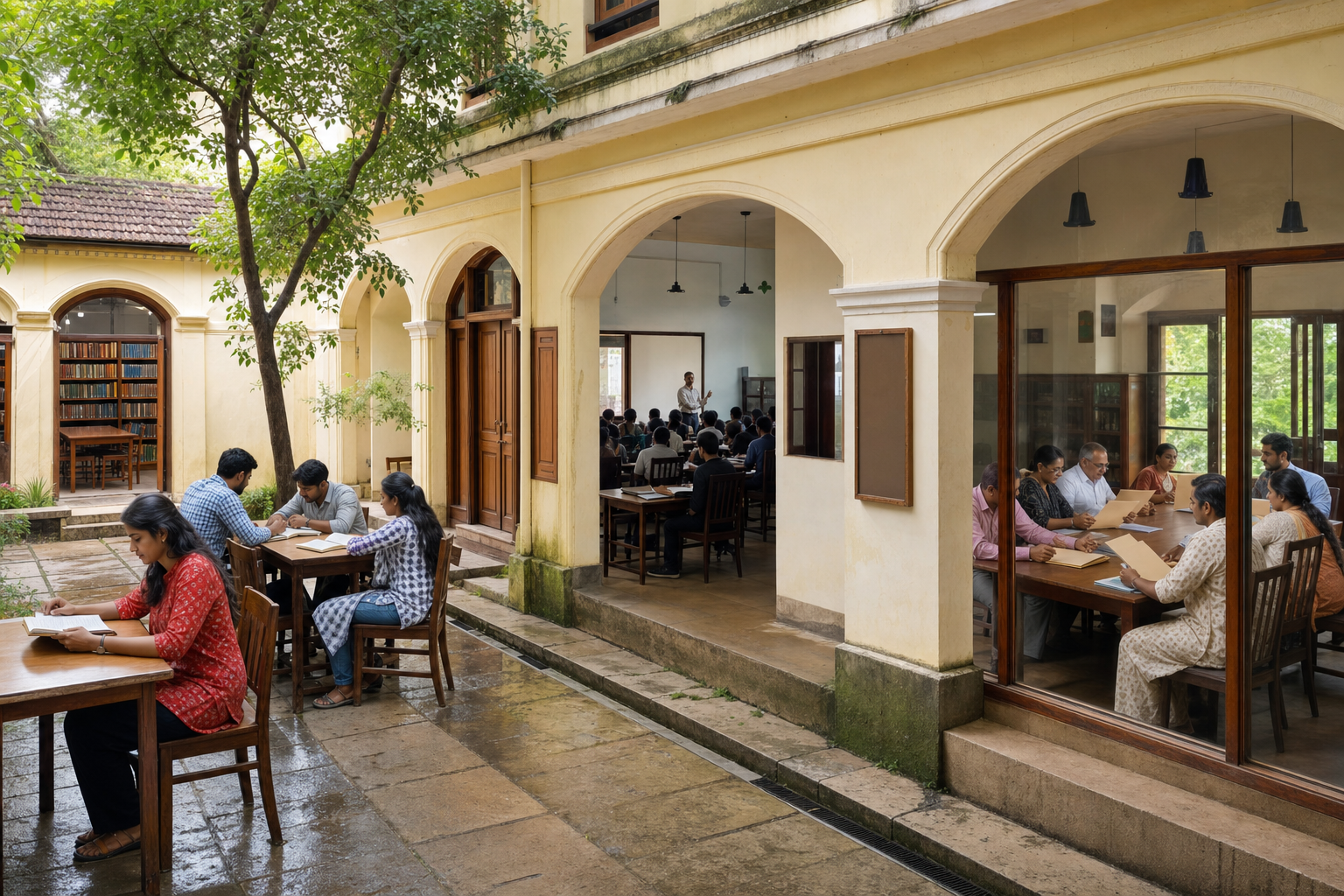
A restored facade is worth preserving, but it cannot certify a restored college. If administrators, alumni associations, public bodies, or donors announce a revival, ask for one visible artifact behind every claim of improvement. An assurance without a record should remain an unresolved question.
- Recruitment and promotion: Are academic requirements published before selection? Are conflicts of interest declared and managed? Can an informed observer see that the same criteria were applied to every candidate?
- Curriculum: Does every decision to open, rename, reduce, or close a subject have a written academic rationale? A field should be judged by intellectual value, teaching capacity, and a defensible educational purpose, not by attaching a caste identity to it.
- Student independence: Can students seek guidance from more than one faculty circle, disagree with a mentor, use a credible grievance process, and participate in academic life without declaring personal allegiance?
- Daily scholarship: Is there a public schedule of lectures, reading groups, seminars, and publications? Celebrity events cannot substitute for recurring intellectual work conducted through the academic year.
- The institutional archive: Are surviving issues of Prabuddha Karnataka, departmental papers, faculty records, photographs, and relevant correspondence catalogued and preserved? Digitization should include provenance and descriptive records, not merely a folder of unlabelled scans.
- Academic use of physical space: Is there a room-by-room inventory of classrooms, collections, portraits, and heritage material? A room should have a named custodian, a defined academic purpose, and a maintenance record rather than being cleaned only before a public function.
Different readers can act at different points. If you are a student, ask where curriculum and grievance decisions are recorded. If you are an alumnus, request a specific preservation or teaching plan before contributing money; otherwise, a donation may improve appearances without changing governance. If you are a faculty member, press for published selection criteria, rotating academic responsibilities, and proceedings that preserve the substance of seminars. If you are a citizen or researcher, help make the archive discoverable and use it to ask precise questions.
The work should proceed on two tracks. Fragile records and heritage objects may require immediate protection; delaying that work until every governance dispute is settled could result in irreversible loss. Institutional reform, however, must proceed at the same time. Preservation without transparent governance can turn a living inheritance into a museum display for the same factions that weakened it.
A modest but credible revival is better than a grand, unmeasurable promise. One catalogued journal collection, one appointment process with published criteria, or one recurring seminar selected by a rotating committee gives the public something it can inspect. Each establishes a norm that can be repeated.
Key takeaways
- Maharaja’s College declined first as a culture of scholarship and only later as a physical place.
- Caste rivalry and party influence mattered because opaque institutional processes converted identity into appointments, student loyalty, and curricular power.
- Replacing one faction with another is not reform. Merit requires published criteria, consistent application, and decisions open to scrutiny.
- Real restoration can be tested through recruitment records, student independence, recurring scholarly activity, archival stewardship, and accountable use of academic space.
If you want to help recover the college’s inheritance, choose one result that can be examined a year later: a catalogued collection, an open academic program, a transparent rule, or a room returned to sustained scholarly use. The Wodeyar-Visvesvarayya vision will be honored less by ceremonial praise than by making institutional duty visible again.