
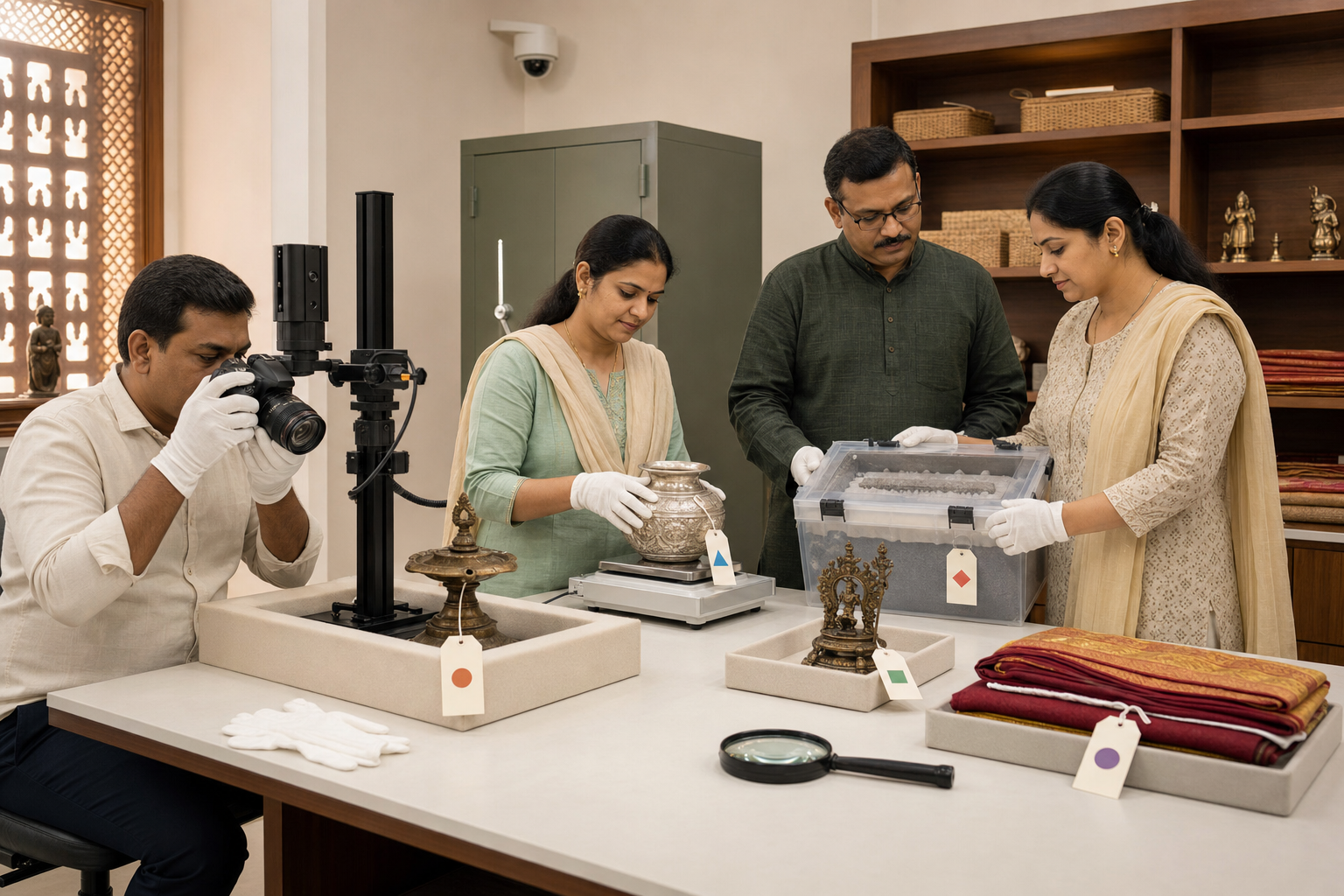
If you serve on a temple trust, donate precious metal, supervise restoration, or simply want to ask responsible questions as a devotee, begin with one test: can the institution prove what it holds, where each object is, who last handled it, and what changed during that handoff?
When those answers depend on memory, personal reputation, or an old ledger nobody can reconcile, both sacred heritage and innocent custodians are exposed. Good custody is seva translated into evidence. It protects the deity’s property, the artisan, the donor, the honest trustee, and the credibility of any later investigation.
Key takeaways
- Assign one accountable custodian to every sacred asset, but never give one person unilateral power to remove, transfer, or alter it.
- Treat installed cladding, doors, reliefs, crowns, vessels, donation metal, and stored fragments as inventoried assets rather than undifferentiated temple property.
- Create a dated visual and physical baseline. Record identity, location, dimensions, weight where direct weighing is possible, composition, condition, provenance, and every detachable component.
- Make each movement a closed chain: written purpose, dual approval, before-record, sealed transfer, recipient acknowledgement, return inspection, and reconciliation of metal, fragments, scrap, or receipts.
- When a discrepancy appears, preserve the place and records before discussing blame. A reported shortage is not proof of who caused it.
- For a historic murti in police or official custody, lawful release, conservation, ritual custody, and permission for public installation are separate decisions. Resolve each one on paper.
Map custody before buying security equipment
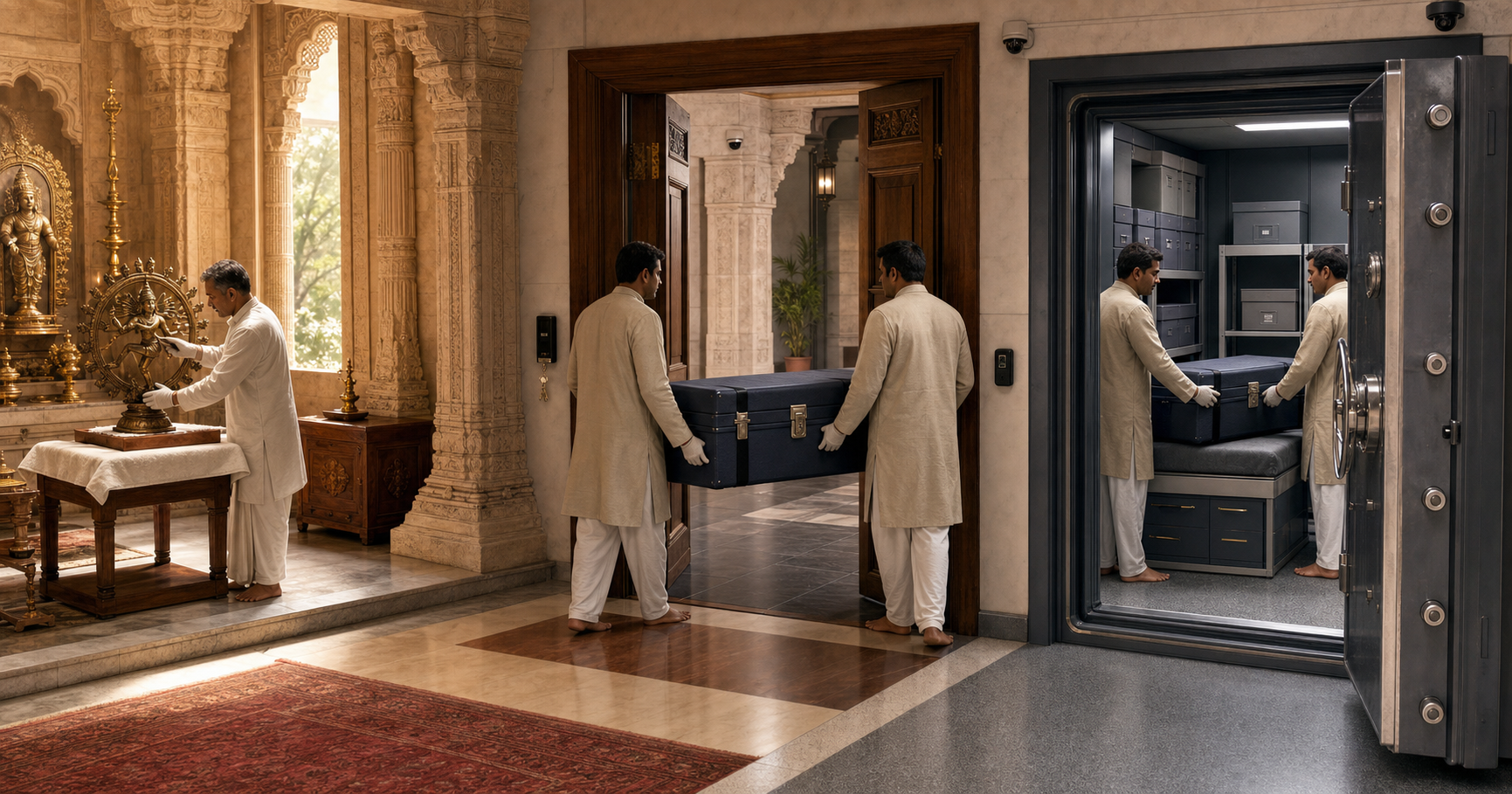
A camera cannot repair an undefined chain of responsibility. Before purchasing scanners, tags, or stronger locks, classify every important object by its current custody state.
- Installed: The object is fixed to a shrine, doorway, pillar, railing, plinth, or iconographic frame. Its exact position and method of attachment belong in the record.
- Stored: The object is in a strongroom, treasury, cabinet, sealed tray, or repository. Record its precise container and seal, not merely the room.
- In ritual use: The object is temporarily issued for abhishekam, procession, decoration, festival service, or another defined purpose. Name the receiving ritual team and expected return point.
- With an outside custodian: The object has gone to an artisan, conservator, assayer, valuer, insurer, photographer, transporter, or another temple. A work order is not a substitute for a custody receipt.
- In official custody: The object is held by police, a court, an archaeology department, a museum, or another public authority. The file number, legal status, competent forum, and conditions governing access or release must be known.
For each state, write down four distinct roles: who is answerable for the object, who may physically handle it, who may approve a movement, and who independently verifies the return. If the same person fills all four roles, the control has failed before anything goes missing.
Ownership, physical custody, and ritual authority are also different questions. A trust may claim lawful stewardship while an artisan temporarily holds an object and a priest determines how it may be touched. A sound procedure respects all three without allowing any one of them to erase the others.
Official custody requires a lawful exit, not an informal handover
A historic murti cannot be removed from a police repository merely because the devotional claim is compelling. Its identity, provenance, condition, case status, and legal custodian have to be established first. In the Pune Hanuman matter, the documented pathway involves police chain-of-custody records, antiquities scrutiny, an application to the competent forum, and conservation planning before any transfer or installation.
If an object may qualify as an antiquity, verify its status under the Antiquities and Art Treasures Act, 1972, with the relevant authorities. For property held in connection with a criminal proceeding, qualified counsel should identify the currently applicable procedure, the competent court, and the evidence needed for release. The Pune roadmap identifies CrPC Sections 451 and 457 and the conservation-first reasoning associated with Sunderbhai Ambalal Desai v. State of Gujarat (2002), but trustees should not copy statutory citations from another matter without legal advice on their own file.
Release does not itself authorize installation. The proposed custodian still needs a prepared site, conservation approval, security, insurance for movement where appropriate, civic permission, and a written agreement allocating responsibility. That agreement should cover condition reporting, access, ritual use, temporary withdrawal for conservation, production before a court if required, and dispute resolution. Acting without the necessary order or permission can jeopardize both the object and the community’s claim to durable stewardship.
Build an inventory that can survive a change of trustees
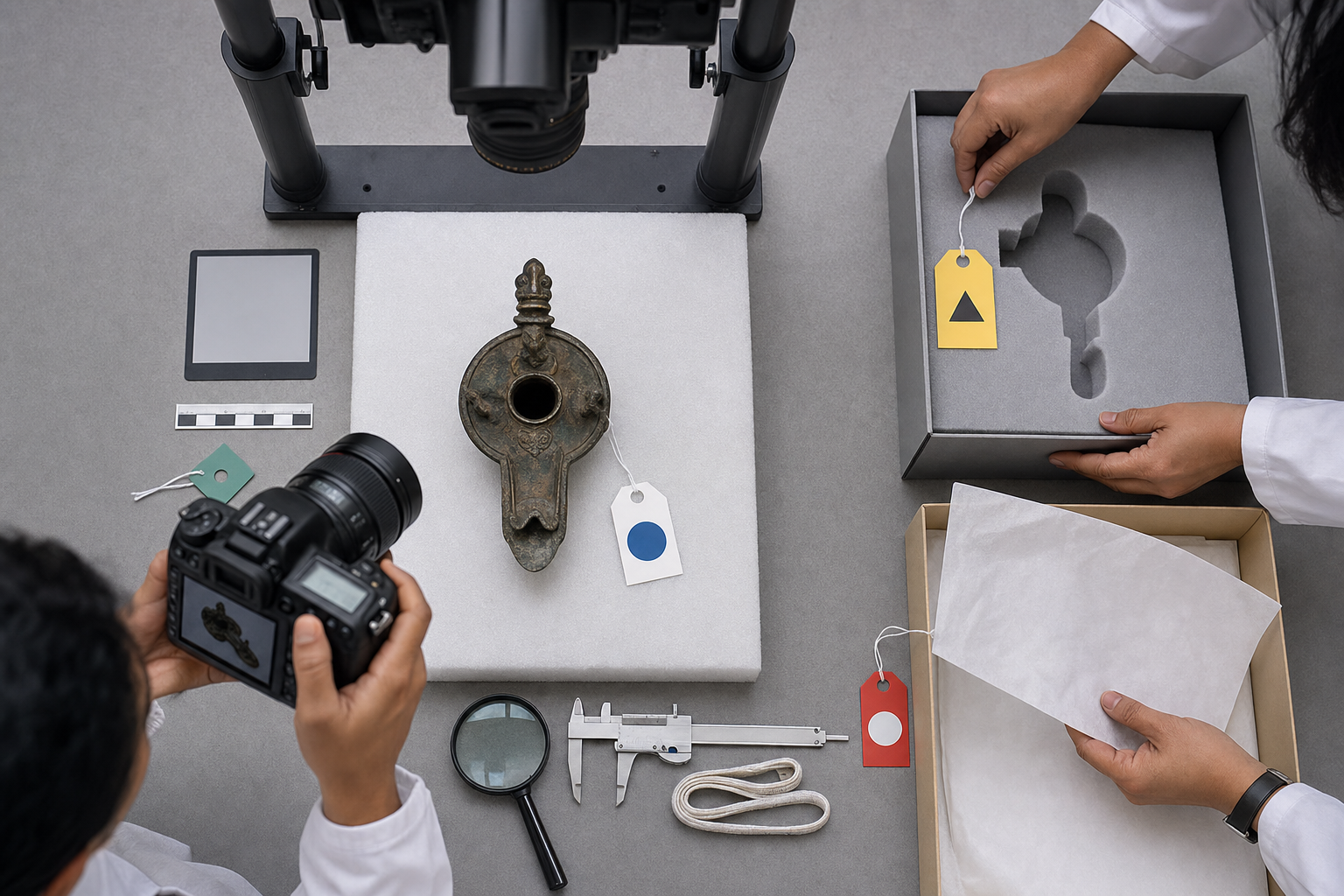
An inventory is not a spreadsheet containing entries such as silver work, old idol, or ornaments. It must allow a person unfamiliar with the object to identify it, locate it, compare its present condition with an earlier baseline, and reconstruct its movements.
| Inventory field | Minimum usable record | Question it must answer |
|---|---|---|
| Identity | Stable asset ID, accepted name, object type, iconographic description, and number of components | Which exact object is this? |
| Location | Shrine position, strongroom, cabinet, tray, mount, or repository reference | Where should it be found without relying on memory? |
| Material and quantity | Recorded composition, dimensions, directly measured weight where possible, hallmark or inscription, and the method and date of measurement | What physical baseline is being protected? |
| Condition | Cracks, corrosion, losses, deformation, biological growth, earlier repairs, attachment points, and vulnerable areas | Was a later change theft, damage, treatment, or an already documented defect? |
| Visual record | Dated front, back, side, detail, scale, and in-situ photographs; 3D documentation where complexity warrants it | Can the current object and each component be compared with the baseline? |
| Provenance | Donation receipt, acquisition record, maker or artisan, invoices, former asset numbers, and restoration history | How did the institution acquire and maintain it? |
| Custody | Named responsible office, authorized handlers, access roles, key or seal references, and handover acknowledgements | Who was responsible at each stage? |
| Movement | Purpose, approval, time out, destination, recipient, condition on exit, time returned, return condition, and reconciliation result | Can every absence and alteration be explained? |
Precious-metal cladding requires particular discipline. Silver plates and reliefs may be removed legitimately for polishing, repair, replacement, or treatment after corrosion. A record must therefore distinguish the original piece, metal added during repair, metal removed, fragments or offcuts returned, bullion or cash received in settlement, and the final installed configuration.
The cost of ambiguity is visible at Saptashrungi Gad, where an audit reportedly found approximately 22.5 kilograms of silver unaccounted for and a criminal inquiry involving former trustees remains unresolved. That reported discrepancy warrants a rigorous investigation. It does not, by itself, establish when the difference arose, what process caused it, or who is legally responsible.
Use measurement tools for the question they can actually answer
Different tools establish different facts. Portable X-ray fluorescence can help verify the elemental composition of retained metal. It does not prove the historical weight of a missing panel. Photogrammetry or structured-light scanning can model the volume of complex relief work and support an estimate of probable weight, but the result remains an estimate dependent on geometry, material assumptions, cavities, backing, and the quality of the surviving record.
Direct weights from earlier work, artisan invoices, prior audit entries, dated photographs, attachment traces, and measurements of surviving companion pieces should be reconciled together. Record the method, assumptions, uncertainty, and operator for every estimate. Never convert a technical approximation into a categorical accusation.
For a historic stone or metal murti, add a conservation condition sheet. Document fractures, loose sections, surface deposits, salt activity, biological growth, prior repairs, mounting stress, and areas that cannot safely bear a strap or tag. A new image set taken from the same angles at each inspection makes later comparison far more useful. For significant historic objects in active custody, a six-to-twelve-month condition-reporting cycle is a practical benchmark identified in the Pune conservation roadmap; the responsible conservator should adjust the interval to the object’s condition and environment.
Make every handoff a closed, two-person chain
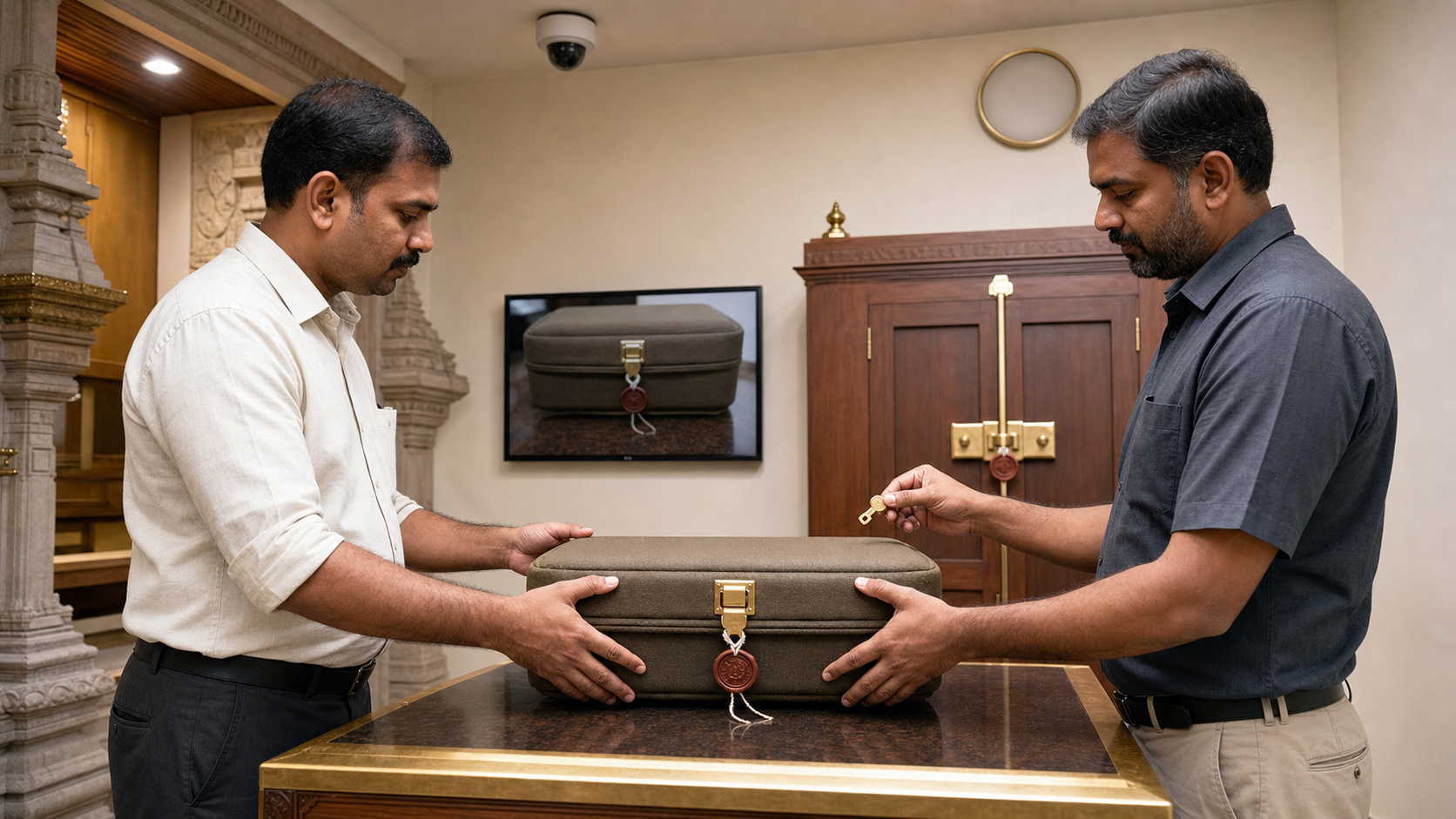
Most custody failures occur at transitions: the ornament leaves its tray for a festival, a panel goes to an artisan, a key changes hands after an election, or repaired metal returns in a form nobody compares with the dispatch record. The remedy is a movement packet that stays open until the object and every by-product are reconciled.
- Open a written request. State the asset ID, purpose, destination, requested duration, proposed handler, transport method, and exact work authorized. Phrases such as repair as needed give away too much control.
- Create the exit baseline. Photograph the object and its attachment points, note its condition, count every component, record weight or dimensions where appropriate, and identify the instrument or method used.
- Obtain dual authorization. One authorized person approves the purpose; another independently verifies that the object leaving matches the record. Required ritual permission should be documented without treating it as a replacement for administrative approval.
- Seal and record the transfer. Use a suitable tamper-evident container where the object permits it. Record the seal reference, release time, names and signatures of both releasing officers, carrier, destination, and planned recipient.
- Require receipt at the destination. The artisan, conservator, laboratory, or other custodian should acknowledge the asset ID, package condition, seal, time, and any discrepancy noticed on arrival.
- Document the work. Keep photographs, treatment notes, materials added, material removed, revised measurements, invoices, assay results, and the identity of anyone who handled the object.
- Reconcile the return. Compare the returned object with the exit baseline. Account separately for offcuts, fragments, scrap, replacement metal, unused material, bullion, and cash receipts. Photograph and sign the result before reinstalling or returning the object to storage.
- Close or escalate. Close the movement only when every difference is explained and approved. An unresolved mismatch becomes an incident; it must not be carried forward as a note for the next committee.
Ritual urgency should trigger a prepared fast path, not an undocumented exception. Keep standard forms, approved handlers, suitable containers, and a camera available before festival season. If an emergency makes a normal step impossible, record which control was bypassed, who authorized the exception, why it was necessary, and when the missing verification will occur.
Apply technology to the container and custody environment before modifying a sacred or historic surface. Barcodes can identify trays. RFID can monitor controlled strongroom movements. Access-control logs can show who entered. Time-delayed locks, two-person opening rules, sensors, and CCTV with retained backup can reduce opportunity and preserve evidence. Micro-engraving or discreet tagging should be considered only where it does not affect darshan, ritual treatment, structural integrity, or conservation value.
Audit the controls as well as the metal. A camera that was offline, a seal log completed after the event, a shared access credential, or an unreviewed exception register creates the appearance of security without reliable custody. Schedule checks around major festivals and restoration cycles, and include some unannounced verification so that compliance does not become a performance prepared for one predictable date.
Respond to a discrepancy without sacrificing evidence or fairness
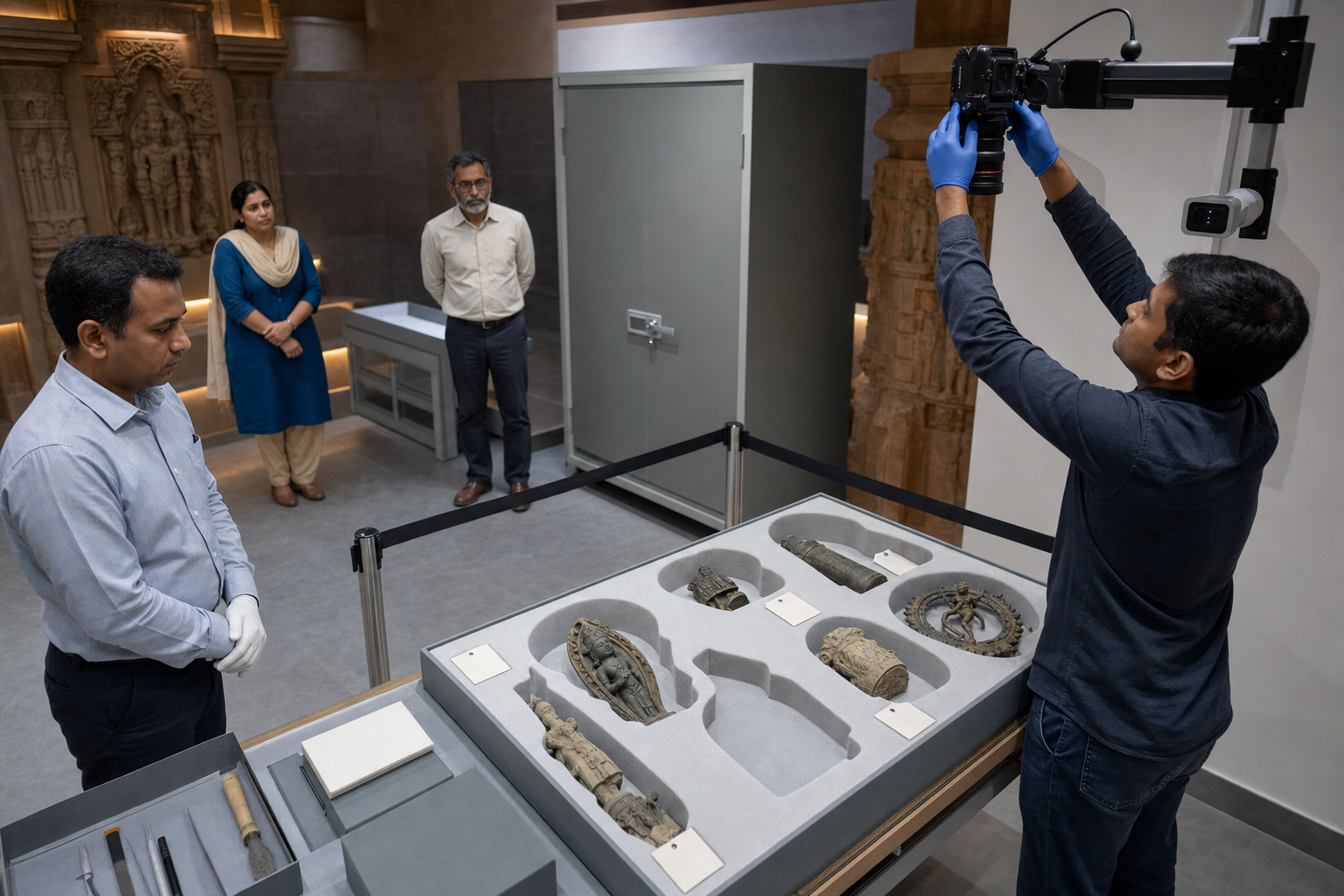
The first institutional question is not who should be blamed. It is what must be secured now so that the facts can still be established. Trustees should follow the directions of competent authorities and obtain qualified legal, conservation, and forensic advice for the actual object and jurisdiction.
- Pause non-essential movement. Secure the relevant shrine area, repository, keys, seals, and access credentials without disturbing potential evidence.
- Count what is present. Prepare a detailed panchnama or other legally appropriate inventory of extant objects, components, serial references, hallmarks, seals, mounting traces, and condition. Photograph the process.
- Preserve the record universe. Safeguard current and former inventories, audit reports, donation receipts, artisan invoices, sanction notes, work orders, bullion and cash receipts, key registers, access logs, CCTV, correspondence, and trustee handover files.
- Reconstruct each movement. Arrange events by asset ID and date. Compare who approved, who released, who carried, who received, what work occurred, what returned, and who accepted the reconciliation.
- Choose technical tests narrowly. Use assay for composition, professional valuation for value, direct measurement for extant objects, and scanning for geometry. State clearly where a conclusion rests on inference rather than measurement.
- Notify the proper parties. Legal duties may involve the relevant trust authority, police, court, archaeology authority, insurer, auditor, or another regulator. The order and form of notification should be settled with qualified advisers, not improvised through public statements.
- Protect due process. Interview former office-bearers, staff, priests, artisans, guards, and vendors through the proper investigative process. Preserve the presumption of innocence while evidence is assessed.
Tell devotees what is known, provisional, and still being tested
Silence allows rumor to fill the gap, but premature certainty can damage an investigation and unjustly stain reputations. A useful public notice states the verified discrepancy, the period or assets under review, what has been secured, which competent body is handling the matter, what remains uncertain, and when the institution expects to issue another factual update. It does not speculate about motive or guilt.
Accountability should continue after the immediate alarm. Publish concise audit summaries, major donation records, restoration notices, and the status of corrective actions without revealing security-sensitive details. Record whether the underlying weakness was an incomplete trustee handover, undocumented repair, excessive concentration of access, an inactive camera, mismatched asset numbering, or a failure to reconcile returned material. Give each correction an owner and require independent verification that it was completed.
As a trustee, ask for two documents before the next precious object moves: the current reconciled inventory and the movement form that will follow it out and back. As a devotee or donor, ask whether those documents exist, whether two people authorize access, whether restoration material is reconciled, and whether audit summaries reach the public. These are not hostile questions. They are the questions an honest custodian should want answered.
Begin with unique IDs, dated photographs, named responsibility, dual signatures, sealed handoffs, and an exception log. Add stronger rooms, RFID, scientific testing, and digital twins where risk and significance justify them. A temple protects its heritage when every generation can receive the custody record, verify the objects, and pass both forward intact.
References
- DharmaRenaissance Blog – Saptashrungi Gad Shock: 22.5 kg of Sacred Silver Missing, Criminal Probe Targets Ex-Trustees
- DharmaRenaissance Blog – Colonial-Era Hanuman Idol in Pune Police Custody: Lawful Roadmap to Restore a Sacred Icon