
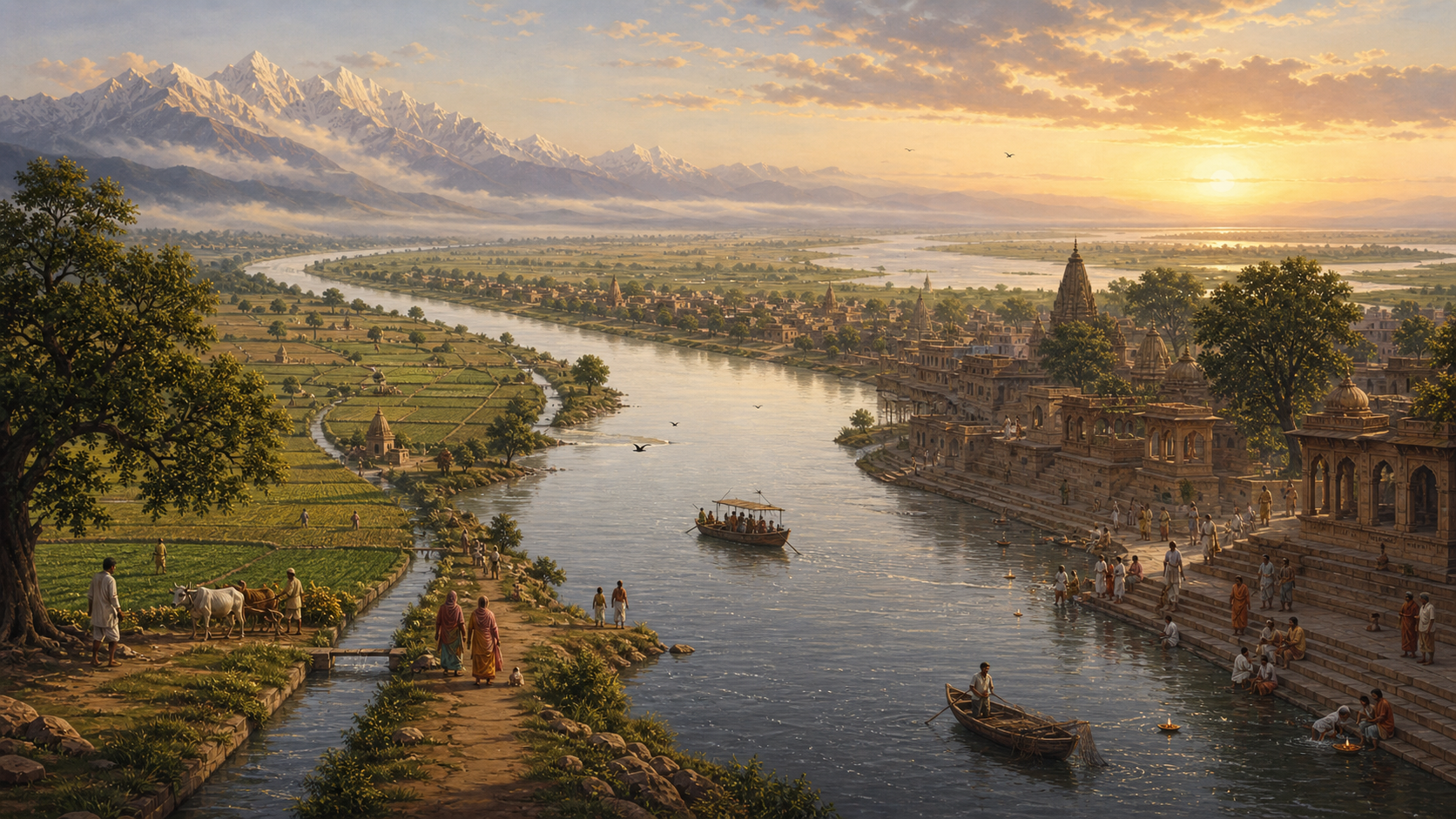
If you are trying to understand India’s sacred rivers, memorizing a list of names will only take you so far. The real question is why a river can be a goddess, a pilgrimage route, a source of food, a setting for family rites, and a public responsibility at the same time.
You can answer that question by reading every river in several layers: as flowing water, as a tirtha, as inherited memory, as civic infrastructure, and as a duty of care. This approach is useful whether you are planning a pilgrimage, teaching a child, studying Indian history, or deciding what meaningful river conservation should look like.
Begin with the crossing, not the list of holy places
A physical map tells you where water flows. A civilizational map tells you how people have learned to live beside that flow. In the Dharmic understanding of sacred geography, desha is place, kshetra is a field of sacred action, and tirtha is both a ford across water and a passage from ordinary awareness toward the sacred.
That double meaning matters. A river is not holy merely because a story has been attached to it. Its current, banks, seasons, settlements, rituals, and paths of pilgrimage participate in the meaning. The material river and the sacred river are not rival explanations. They are two dimensions of the same relationship.
Three common practices make this relationship concrete. Snana places the body in contact with water. Darshana trains attention on the presence represented by the river. Seva turns reverence into conduct. If you keep only the first two and neglect the third, sacred geography becomes something you consume rather than something you help sustain.
Use the following sequence whenever you study or visit a river:
- Trace the flow. Locate the source region, tributaries, confluences, floodplain, settlements, and eventual movement toward the sea.
- Identify the form of encounter. Is the local emphasis on bathing, darshana, ancestral offerings, lamps, circumambulation, a seasonal festival, or a combination of these?
- Look for the supporting landscape. Ghats, temple tanks, stepwells, canals, embankments, groves, and shaded gathering places show how devotion entered public life.
- Find the calendar. Ask how monsoon, flood, harvest, pilgrimage, and festival seasons relate to one another.
- Ask who maintains the place. Desilting, flood repair, offering collection, waste segregation, and bank protection reveal whether reverence has become an organized responsibility.
This method prevents two common mistakes. The first is to reduce a river to symbolism while ignoring its actual water and watershed. The second is to reduce it to a resource while dismissing the memory, discipline, and affection through which communities have protected it.
Each river is a regional chapter in a shared sacred grammar
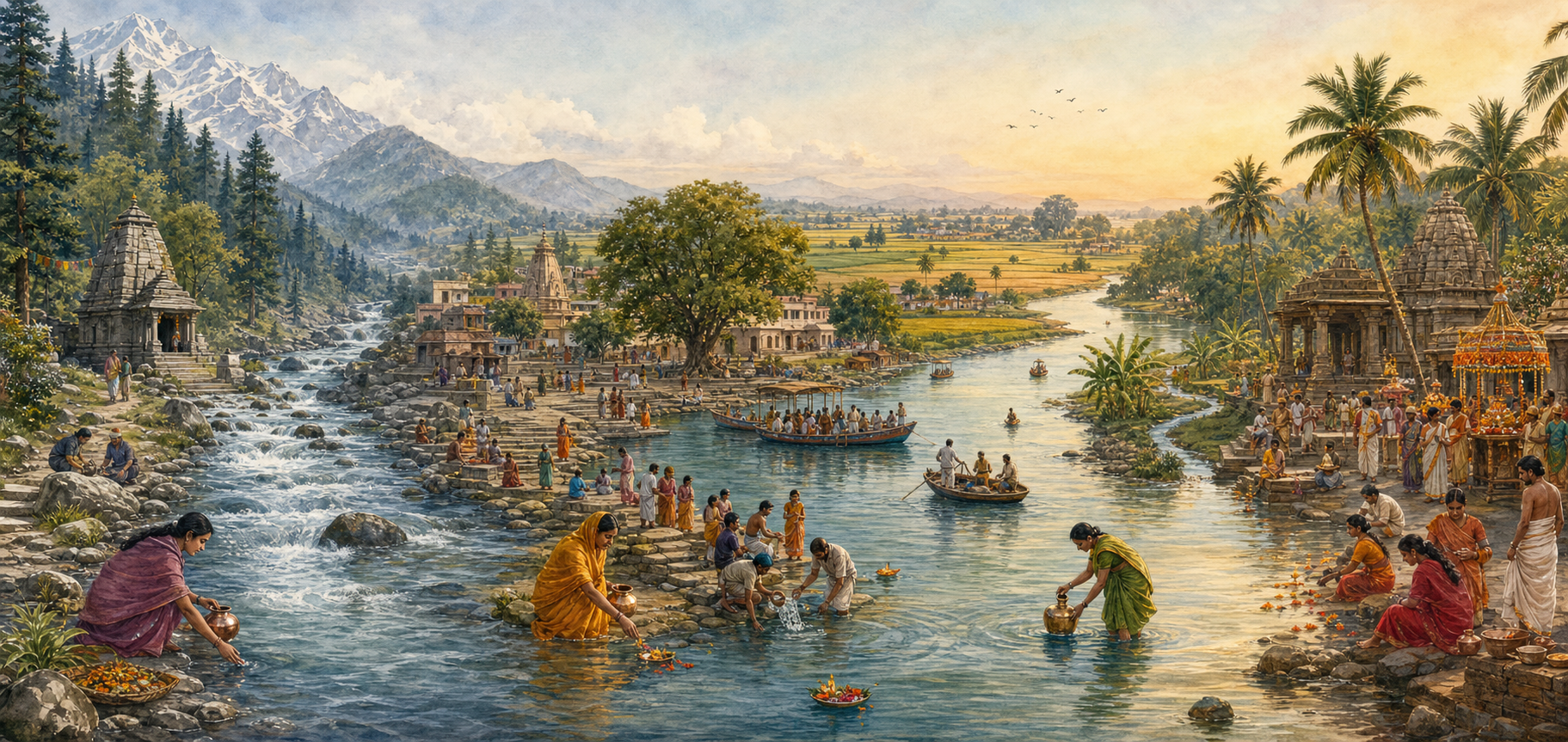
India’s major sacred rivers do not tell the same story under different names. Each joins geography, theology, ritual, and livelihood in a distinct way. Read the differences carefully, and a common civilizational grammar becomes visible without turning the rivers into a hierarchy.
| River | Geographic focus | Sacred expression | What to notice |
|---|---|---|---|
| Ganga | Himalayan source routes, Prayagraj, and the great riverfront ghats | The descent of Ganga, her identity as Tripathaga, ritual bathing, aarti, and life-cycle rites | How a riverfront becomes shared civic space for worship, mourning, remembrance, and renewal |
| Yamuna | The confluence at Prayagraj and the floodplains of Braj | Krishna’s lila, bhakti, intimacy, and seasonal remembrance | How devotional calendars grow from a particular landscape rather than from an abstract idea of purity |
| Saraswati | The remembered third current at the Triveni Sangam | Learning, speech, inspiration, and the presence of what is not immediately visible | How sacred memory can remain culturally powerful while geomorphological debates about paleochannels continue |
| Godavari | Trimbakeshwar, Nashik, and the wider Deccan landscape | Dakshina Ganga, the Nashik Kumbh, and meeting points among Shaiva, Vaishnava, and Shakta traditions | How pilgrimage, tanks, canals, and embankments join regional devotion to water management |
| Narmada | The long river corridor followed in Narmada Parikrama | A demanding circumambulation of roughly 2,600-3,000 km and a strong emphasis on darshana | How sustained movement beside a river turns geography itself into a spiritual discipline |
| Kaveri | Kodagu, river islands such as Srirangam, and the Tamil and Kannada temple regions | Kaveri Sankramana, temple worship, and agrarian observances | How seasonal change, cultivation, hydrology, and temple life form a single regional rhythm |
The honor given to one river does not require the demotion of another. Godavari can be revered as Dakshina Ganga while remaining unmistakably Godavari. Narmada darshana can be understood as purifying in a manner compared with bathing in Ganga without making the two practices identical. Sacred equivalence allows regions to belong to a common world while keeping their own language, landscape, deity traditions, and disciplines.
This is a useful correction whenever someone asks which river is the most sacred. The better question is what relationship a particular community has been taught to maintain with its river. Look for the mode of devotion, the route of pilgrimage, the seasonal duty, and the institutions built around the water.
The river map carries scripture, memory, and plural Dharma
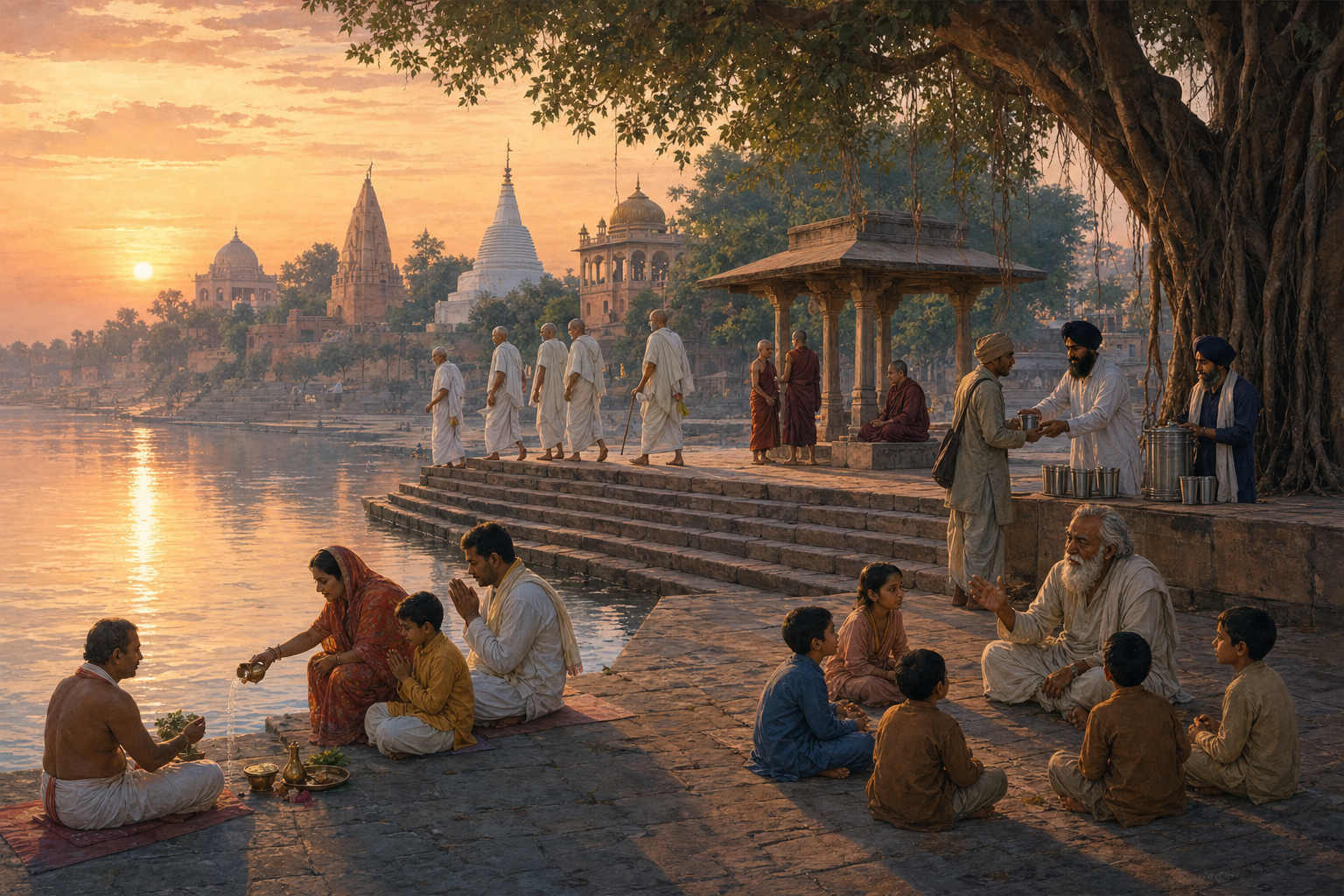
India’s sacred river map has a textual layer as well as a physical one. The Nadistuti hymn of the Rigveda, 10.75, celebrates rivers including Sindhu and Saraswati. The Ramayana remembers Bhagiratha’s vows and the descent of Ganga. The Mahabharata presents Ganga as both mother and divine presence. Water also belongs to the Panchamahabhutas, placing it within a wider understanding of the elements that constitute embodied existence.
These narratives do not function as substitutes for hydrology. They teach people how to interpret dependence on water: through gratitude, restraint, continuity, and obligation. In the same way, physical investigation does not make sacred memory disposable. Saraswati’s cultural association with speech and knowledge does not stand or fall on a single reconstruction of an ancient channel. Geological claims should remain as careful as their evidence, while the religious meaning should be understood in its own register.
The symbolism of passage also reaches across Dharmic traditions, but it does so without erasing their differences:
- In Buddhism, the image of reaching the other shore expresses liberation, while important monastic landscapes developed across the Ganga plain.
- In Jainism, Tirthankara means a ford-maker: one who shows a passage across samsara. The river crossing becomes a precise spiritual metaphor, not merely decorative language.
- In Sikh tradition, ishnan gives water a place within disciplined religious life, while Guru Nanak’s transformative experience at the Kali Bein connects immersion with ethical awakening.
The unity here is civilizational, not doctrinal. Hinduism, Buddhism, Jainism, and Sikhism do not offer interchangeable teachings about water, liberation, ritual, or the self. They do, however, share a cultural world in which crossing, cleansing, disciplined conduct, and responsibility can be thought through rivers.
When you teach or discuss this unity, use three checks. First, name the shared image or practice. Second, state the distinct meaning it carries in each tradition. Third, reconnect it to an actual place, community, or discipline. That keeps unity from becoming vagueness and diversity from becoming fragmentation.
Water infrastructure shows how reverence entered public life
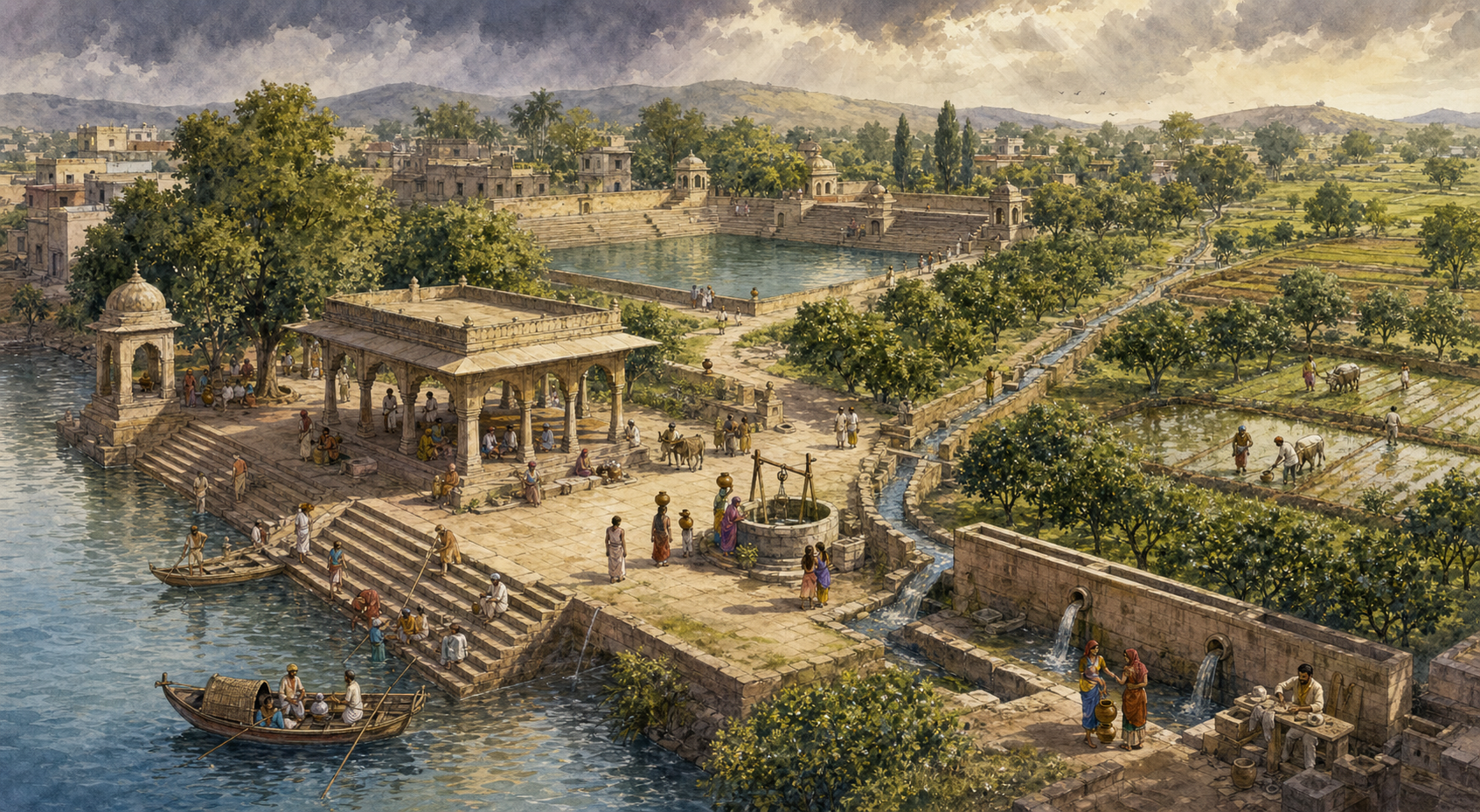
Sacred geography is easiest to recognize at a famous ghat, but its deeper institutional history often sits behind the riverfront. Stepwells, temple tanks, ghats, canals, and stepped embankments gave communities access to water, stored it across seasonal variation, and created places where worship and maintenance met.
Endowments for desilting, flood repairs, and management of nirmalya show that ritual systems could finance recurring work. This is an important distinction. Building a sacred structure is a visible achievement; maintaining the water system year after year is the harder civilizational habit. Whenever you assess an old tank or ghat, look beyond its ornament and ask what culture of repair once kept it functioning.
The economic layer is equally important. Alluvial plains, Deccan terrain, and coastal deltas support different combinations of aquifers, fertile silt, fisheries, and cultivation. Monsoon variability made storage, canals, flood knowledge, and seasonal planning necessary. Festivals and regional almanacs helped communities remember ecological changes because religious time and agricultural time were not sealed off from one another.
Pilgrimage routes expanded this awareness beyond a single settlement. The Chota Char Dham links Gangotri, Yamunotri, Kedarnath, and Badrinath, bringing source regions and shrine networks into the same mental map. The pan-Indian Char Dham joins Badrinath, Dwarka, Puri, and Rameswaram, connecting inland, riverine, and coastal sacred worlds. Such routes teach scale: the water at a ghat belongs to a much larger journey.
Riverfront cities such as Varanasi, Prayagraj, Haridwar, Nashik, and Ujjain developed as processional landscapes. Ghats, parikrama paths, festival schedules, and public ritual spaces helped organize movement as well as worship. Sacred design therefore had practical consequences for access, gathering, crowd distribution, and the performance of samskaras.
A field reading for your next river visit
You do not need specialist equipment to begin seeing these layers. Use this sequence at a ghat, confluence, temple tank, or smaller local tirtha:
- Before arriving, trace the water upstream and downstream on a map. A sacred site is a point within a watershed, not an isolated destination.
- At the site, notice how people approach the water. Steps, platforms, shaded areas, paths, and separate ritual zones reveal who the place was designed to serve.
- Look behind the ceremonial frontage. Find drains, offering-collection points, tanks, embankments, groves, wetlands, or other systems that affect the river’s condition.
- Read the calendar displayed or practiced there. Connect festivals and pilgrim seasons with rainfall, river level, cultivation, and local forms of worship.
- If caretakers or clear signage are available, find out who handles nirmalya, waste, repairs, and desilting. Responsibility is part of the sacred landscape even when it is less visible than a shrine.
- After the visit, trace where the river goes next. This simple step turns a memorable location into source-to-sea awareness.
Also notice the vegetation. Riparian forests stabilize banks, while sacred groves can shelter both biodiversity and worship. Peepal and banyan trees are not incidental decorations in this landscape. Their shade, longevity, and role as gathering places help explain why rivers, trees, and sacred sites have so often been understood together.
Reverence becomes credible when it protects the river
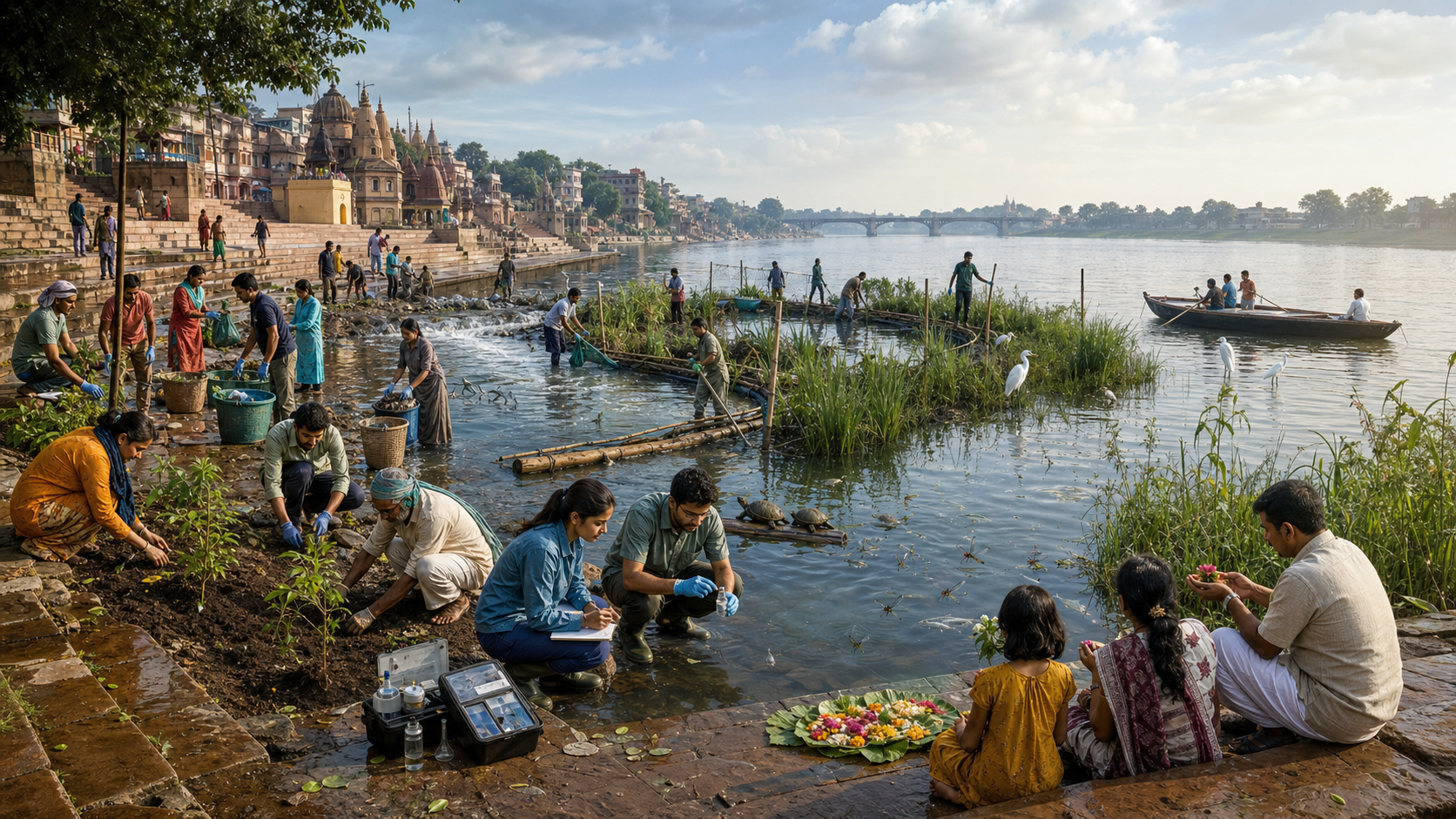
Pollution, sand mining, wetland loss, and encroachment expose the difference between honoring an image of a river and caring for the river itself. Ritual purity cannot compensate for damaged water. In a Dharmic frame, shuddhi also concerns intention, reduced harm through ahimsa, and alignment with rta. Those principles require changes in conduct, not only expressions of devotion.
Your most useful action depends on your role:
- As a pilgrim, use designated nirmalya and waste-collection systems, follow local instructions, and include practical seva in the visit. Material that is natural or biodegradable should still be handled through a managed system rather than automatically released into the current.
- As a shrine or festival organizer, make the path of offerings and waste visible. Arrange segregation, maintain collection points, protect access to the water, and assign responsibility for the work after the gathering ends.
- As a parent or educator, pair a hymn, river story, or festival with a watershed map. Add observation of a local tank, stream, ghat, grove, or wetland so that affection develops alongside ecological understanding.
- As a community group, connect cleanup work with wetland restoration, riparian planting, and reliable water-quality observation. A clean ceremonial frontage alone does not show whether the river system is recovering.
- As a policymaker or institutional leader, work with mathas, temples, gurdwaras, monastic bodies, and local groups that already organize trust and volunteer labor. Define measurable outcomes such as improved water condition, protected banks, restored vegetation, and resilient river-dependent livelihoods.
Debates about giving rivers legal personhood pursue a related idea: guardianship instead of unrestricted extraction. The legal form may vary, but the practical test remains stable. Who has the duty to speak for the river, what powers do those guardians hold, how are competing interests handled, and what evidence will show that the water and watershed are healthier?
Before supporting a river campaign, ask whether it addresses the mechanism of damage. Does it reduce pollutants before they enter the water? Does it protect wetlands and riparian cover? Does it confront destructive mining or floodplain encroachment? Is maintenance funded after the public event? Can progress be observed rather than merely announced? These questions separate durable stewardship from symbolic activity.
Key takeaways
- A sacred river is simultaneously a water system, a tirtha, an inherited memory, a public institution, and a responsibility.
- India’s rivers participate in a common civilizational grammar without losing their regional stories, rituals, languages, and landscapes.
- Dharmic unity does not mean doctrinal sameness. It becomes clearer when shared metaphors of crossing and cleansing are taught alongside each tradition’s distinct purpose.
- Ghats, tanks, stepwells, groves, pilgrimage paths, and maintenance endowments are part of sacred geography, not secondary additions to it.
- Reverence is incomplete unless it changes how pilgrims, institutions, communities, and governments treat the water and its watershed.
Choose a river that already matters to you. Trace its route from source toward sea, mark its tirthas and seasonal observances, identify the structures that support life around it, and find a concrete act of care tied to that place. The map will stop looking like a collection of holy dots. It will become a network of relationships you have a reason to inherit and a duty to pass on.