
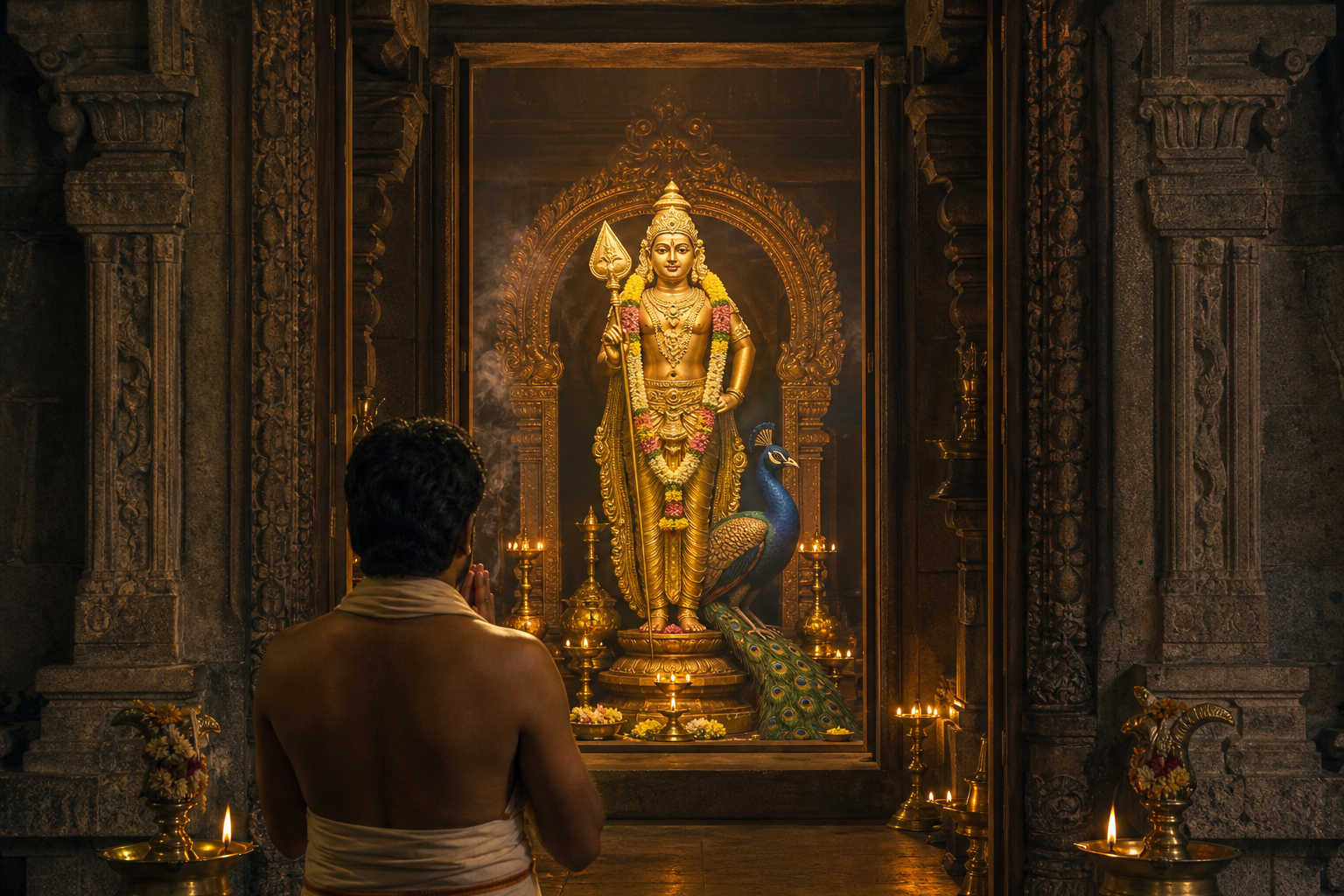
You may know how to bow before Murugan and still be unsure what to do with the peacock. Is it simply the deity’s identifying animal, a warning against pride, or a sign of victory? The most useful answer appears when you stop reading the mayil by itself.
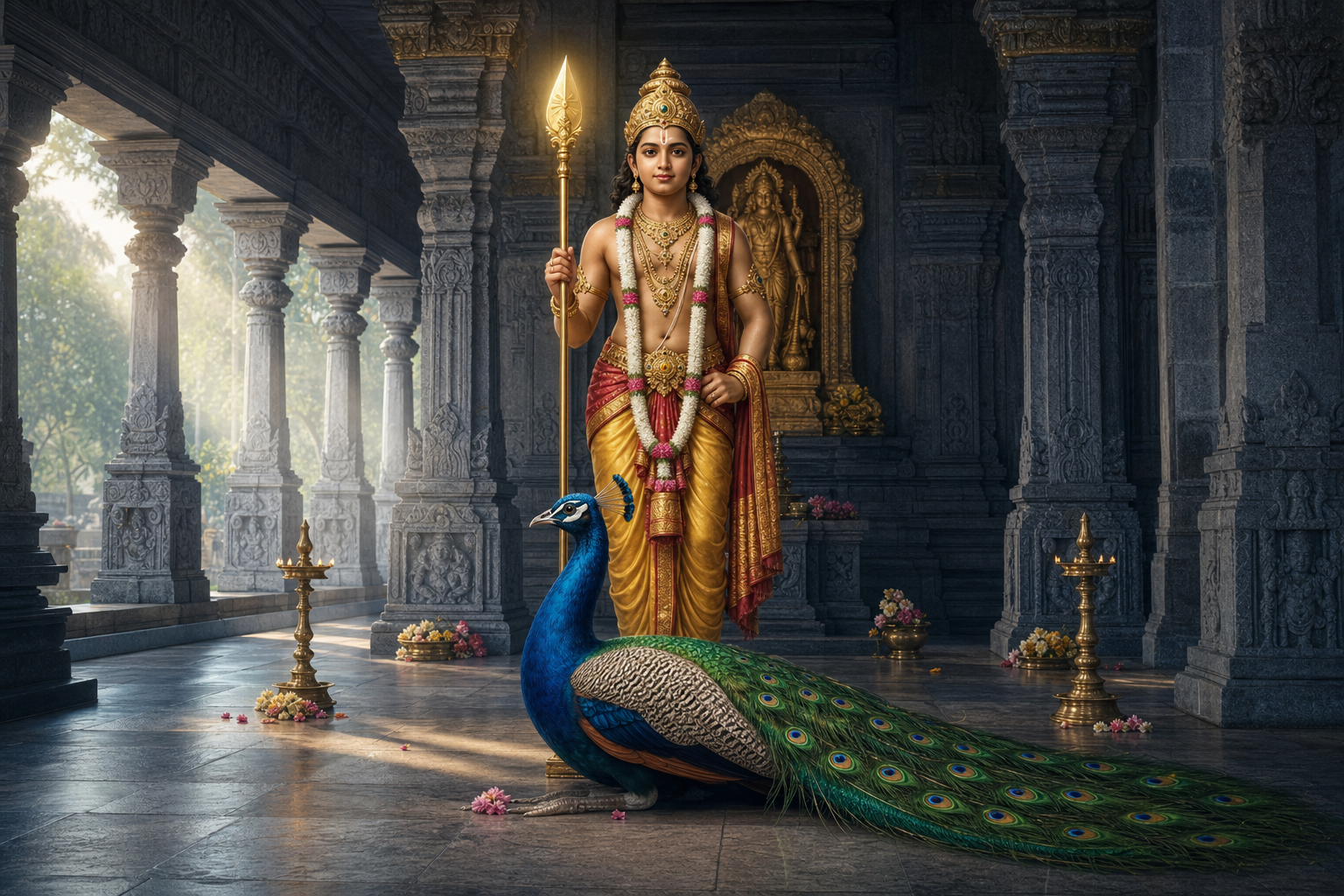
Murugan, the Vel, and the peacock form one spiritual instruction. Your abilities, ambition, beauty, anger, and desire for recognition do not have to be denied. They have to be governed by discernment and placed in the service of dharma. Read that instruction carefully, and darshan can give you more than inspiration: it can give you a discipline to carry home.
Read Murugan and the peacock as one sacred image
Vahana comes from the Sanskrit root vah, to bear or carry. The animal carries the deity in the visible image, but it also carries a teaching into the devotee’s mind. This is why a vahana is more than transportation, ornament, or a divine pet.
A practical way to read this visual grammar is to see the deity as awakened consciousness and the vahana as a force of nature. The force may be instinctive, dazzling, restless, powerful, or dangerous when left undirected. Its position beneath or beside the divine presence does not declare the animal evil. It shows energy accepting a rightful governor. Across Hindu iconography, the governing principle is mastery and integration rather than the destruction of instinct.
The peacock is especially fitting for Murugan. Its splendour evokes charisma, accomplishment, beauty, pride, and the exhilaration of victory. Those qualities can support dharma, but they can also make a capable person vain, theatrical, or careless with power. Murugan does not flee from that brilliance. He rides it. The image asks whether your gifts answer to a higher purpose or whether your sense of importance has begun to direct you.
| What you see | What it can represent | Question to carry into darshan |
|---|---|---|
| Murugan | Courage, conscious command, and power aligned with dharma | What must lead me here? |
| The Vel | Lucid discernment that penetrates confusion and cuts bondage | What do I already know but keep refusing to face? |
| The peacock | Beauty, pride, charisma, ambition, and dynamic energy | Which strong quality in me needs direction? |
| Valli and Deivayanai, where present | Complementary paths of devotion and wisdom | Am I balancing heartfelt commitment with clear understanding? |
The symbolism acquires another layer through the traditional association of peacocks with snakes. In this imagery, poison is not allowed to remain poison; it becomes vitality. Applied inwardly, envy can become honest admiration followed by effort. Anger can become the courage to set a necessary boundary. The wish to be noticed can become willingness to accept responsibility. This is sublimation: the energy remains strong, but its destination changes.
The Vel makes that change possible. At Thiruporur Kandaswamy Temple, Murugan’s Vel, peacock, and divine consorts form a coherent language of discernment, disciplined ascent, devotion, and wisdom. Do not isolate the attractive bird from the weapon of insight or the divine presence that commands them both.
Bring one unruly energy to darshan
A general prayer for success may be sincere, but it gives the symbolism little room to work on you. Before entering the temple, identify one force that is active in your present situation. Be precise. Pride after a promotion is more useful than ego. Resentment toward one person is more useful than anger. The pressure to appear successful is more useful than attachment.
- Name the energy without condemning yourself for having it. Ambition, competitiveness, attraction, indignation, and the desire for appreciation are forms of power before they become virtues or faults.
- Identify both sides of that energy. Ask what it helps you do and what it is beginning to distort. Ambition may sustain hard work while tempting you to exaggerate your contribution.
- Look to the peacock and acknowledge the energy. Look to the Vel and ask what confusion, excuse, or excess must be cut. Look to Murugan and ask what courageous action would place the remaining power under dharma.
- Form the prayer as a direction, not an escape. Instead of asking for all ambition to disappear, ask that it become disciplined effort. Instead of asking never to feel anger, ask for anger to become protection without cruelty.
- Let the temple’s ritual cadence steady the intention. Abhishekam, adornment, food offering, and deepa aradhana move worship from purification toward illumination. You do not have to invent a private ritual or interrupt the established order.
- Choose one behaviour that can prove the prayer has entered your life. Give credit to a colleague, stop embellishing an achievement, apologise without defending yourself, complete a neglected duty, or use your influence to protect someone with less power.
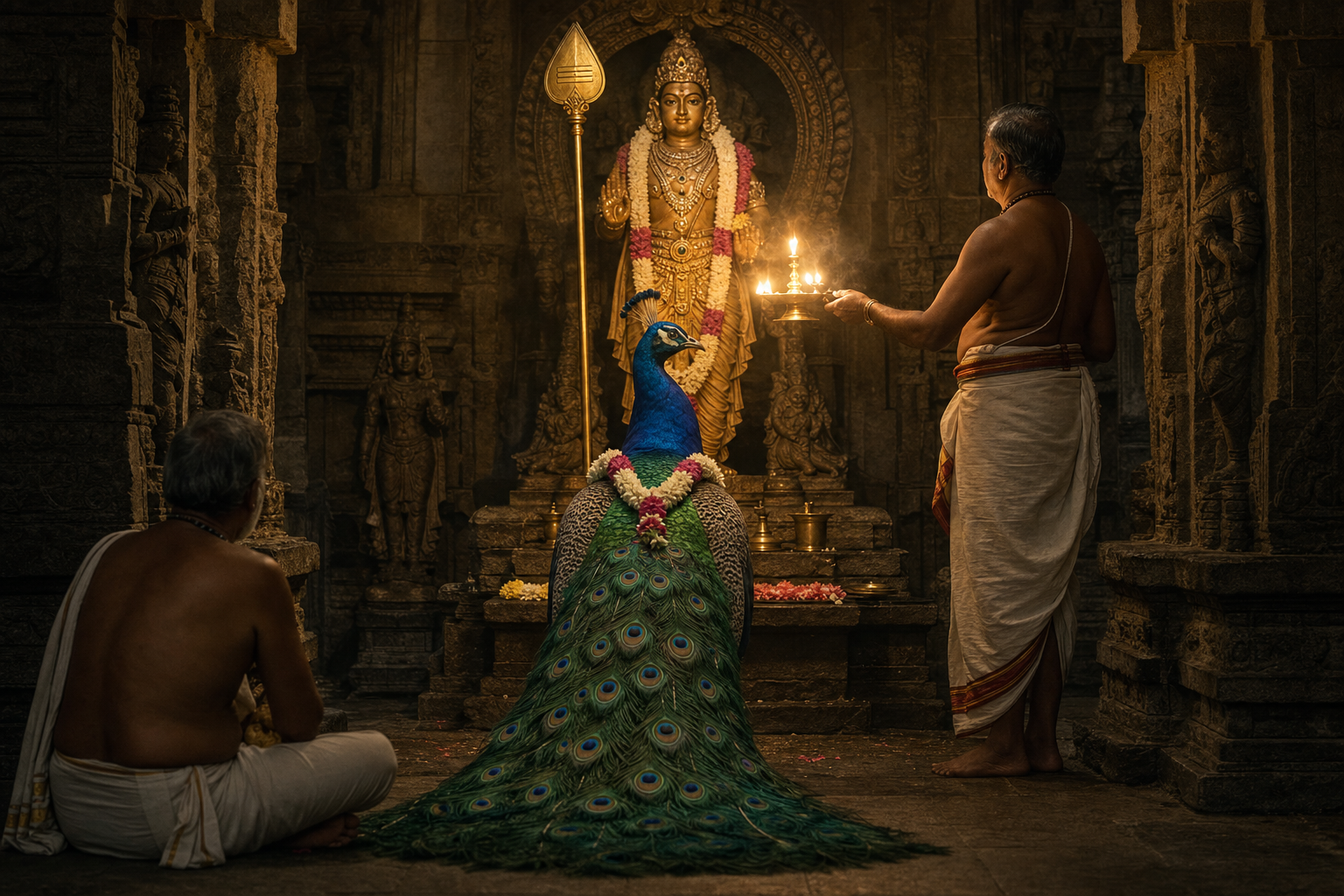
This contemplative sequence is not a replacement for the temple’s Agamic worship. It is a way to make your participation attentive. At Thiruporur, purification, abhishekam, alangaram, naivedyam, and deepa aradhana unfold within a Saiva Siddhanta ritual order. Archana, pradakshina, and recitation of Tiruppugazh or Kandar Anubhuti can hold your intention inside that inherited rhythm.
Self-mastery should not be confused with self-disgust. The peacock remains magnificent after Murugan mounts it. Your strength need not become dull, timid, or invisible. The question is whether it can remain brilliant without demanding sovereignty over you.
Choose a worship setting that matches your purpose
A quiet weekday darshan and a major Murugan festival do different work. Neither is automatically more spiritual. Choose the setting according to the discipline you need, rather than choosing only by the size of the celebration.
Use an ordinary morning for a difficult decision
If you need to examine pride, motives, or a consequential choice, a calmer visit gives you time to look rather than merely pass through a queue. Thiruporur’s listed darshan windows are 6:30 am to 12:30 pm and 3:30 pm to 8:00 pm, with early mornings generally offering a quieter experience. Its daily cycle includes kalasanthi, uchikalam, sayaraksha, and arthajamam. Local schedules can change for festivals or temple requirements, so confirm the time before making a special journey.
On an ordinary visit, carry one question and leave your mental list of unrelated requests outside. If the issue is whether to accept a visible role, for example, do not pray only for the role. Ask whether you can carry its authority without becoming ruled by praise. That is a question the peacock and Vel can answer together.
Use Sashti or Krithigai for recurring accountability
Monthly Sashti and Krithigai observances give Murugan devotees a natural review point. If your chosen discipline needs more than one emotional moment, begin it at darshan and assess it at the next observance. Ask a concrete question: Did you direct the energy differently, or did you merely admire the symbol?
You can use the interval to keep one modest vrata. It might be a restraint connected to the problem, a regular act of seva, or a daily recitation you already understand. The useful measure is not how impressive the vow sounds. It is whether the vow changes the conduct that first brought you to Murugan.
Use a festival when you need communal resolve
- Skanda Sashti and the Soorasamharam enact victory over adharma. Bring an inner impediment you are prepared to confront, rather than treating the event only as a spectacle of an external battle.
- Thai Poosam is suited to vow, steadfastness, and fulfilment. Kavadi, paal kudam, and collective devotion make discipline bodily and communal. Follow the temple’s directions if you undertake an offering.
- Vaikasi Visakam and Aadi Krithigai place worship in a celebratory congregation of abhishekam, lamps, music, and service.
- Panguni Uthiram directs attention toward divine marriage, fidelity, vows, and the ethical foundations of family life.
When Murugan’s mayil vahana enters a procession, an inward teaching becomes a shared public act. The moving image asks a community, not only an individual, whether splendour, authority, and collective power are serving dharma. Join the procession with that question in mind. The crowd is part of the worship, but it need not erase reflection.
Festival participation also requires ordinary care. Arrive early, wear modest clothing, carry water where permitted, and expect longer queues. Confirm photography rules near the sanctum. If you want a particular archana or abhishekam, ask at the temple counter about its time and ticket before joining the main line.
Avoid the readings that flatten the vahana
- Do not reduce the peacock to a mascot. It identifies Murugan, but it also places a psychological and ethical question before you.
- Do not conclude that pride must simply be crushed. Vanity must lose command, but confidence, beauty, ambition, and competence can be consecrated. Suppression wastes energy; indulgence lets it rule; discipline gives it a dharmic task.
- Do not treat the vahana’s size as a hierarchy of divine importance. Hindu deities appear with vehicles ranging from a mouse to an elephant or Garuda. Function and relationship carry the meaning, not physical scale.
- Do not insist on one exhaustive decoding. The peacock can evoke pride, splendour, victory, charisma, sublimation, and ascent. These layers reinforce one another, but no short label contains the whole tradition.
- Do not separate victory from ethics. Soorasamharam becomes personally useful when the defeated adharma is also sought in your own conduct.
- Do not honour an animal symbol while becoming indifferent to living beings. Vahana symbolism places human spiritual life within the wider living world. Ahimsa, considerate treatment of animals, and mindful consumption are natural tests of whether that reverence has crossed the temple threshold.
The crucial distinction is between conquest and direction. Murugan’s victory is not permission for undisciplined aggression. Courage becomes dharmic when it protects rather than humiliates. Authority becomes dharmic when it accepts responsibility rather than demanding submission. Brilliance becomes dharmic when it illuminates more than the person displaying it.
Key takeaways
- Read Murugan, the Vel, and the peacock together: consciousness governs energy through discernment.
- The peacock does not teach hatred of strength or beauty. It teaches you to direct pride, charisma, ambition, and victory toward dharma.
- Bring one precisely named tendency to darshan, then connect your prayer to one observable change in conduct.
- Choose an ordinary morning for quiet discernment, a monthly Sashti or Krithigai for accountability, and a major festival for communal resolve.
- Measure worship after leaving the temple. If the same energy now produces service, truthfulness, restraint, or protection, the symbolism has begun to work.
Before your next Murugan darshan, complete two sentences: The energy I need to train is ____. The action by which it will serve dharma is ____. Carry those words to the peacock, the Vel, and Murugan. Then give the second sentence a date. A vahana has fulfilled its purpose when it carries the teaching out of the temple through you.
References
- DharmaRenaissance Blog – Thiruporur Kandaswamy Temple: Legends, Ritual Science, Darshan Timings, and Festival Guide
- DharmaRenaissance Blog – Why Hindu Gods Ride Animals: Transformative Psychology, Ecology, and Dharma of Vahanas