
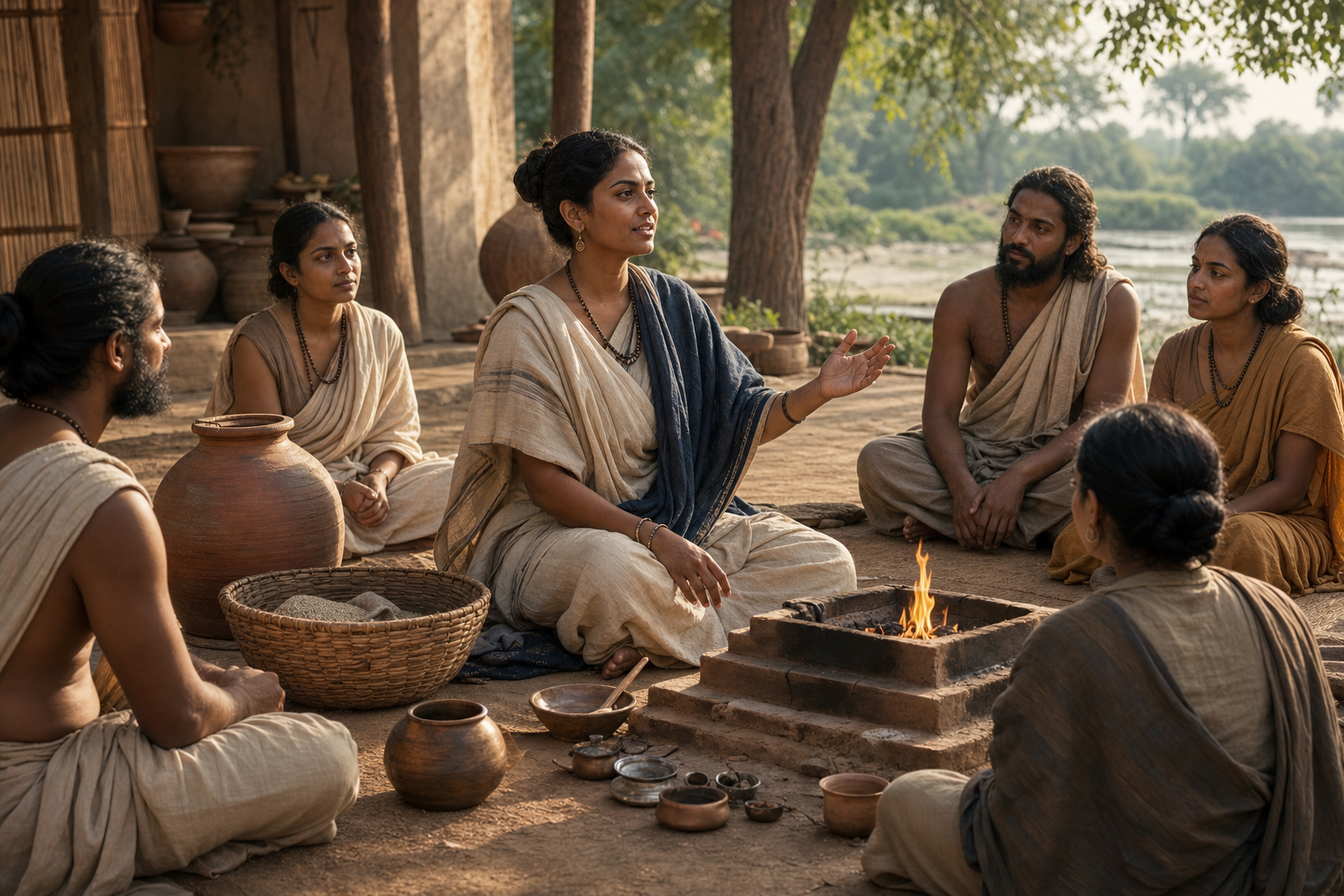
You may have arrived after hearing one of two sweeping claims: Vedic culture gave women perfect equality, or it denied them meaningful authority. Neither claim is careful enough to trust. Both flatten centuries of thought and practice into a slogan.
A firmer answer begins with what women were recognized as capable of doing. Could they seek sacred knowledge, speak with authority, participate in ritual, exercise choice, possess resources, and obtain protection from harm? Those questions reveal a substantial tradition of women’s agency without asking you to pretend that every woman, region, or period embodied the ideal equally.
Read the claim through five concrete tests
Rights and sacred agency overlap, but they are not identical. Modern rights usually refer to legally enforceable claims held by individuals. Sacred agency is broader: it is the recognized capacity to pursue knowledge, make morally significant choices, perform consequential acts, and bear responsibility within a religious order.
This distinction matters because an ancient culture need not use modern constitutional language to recognize a woman as a knower, property holder, ritual participant, or spiritual adept. It also prevents the reverse mistake. Reverence for Devī does not, by itself, prove that every woman enjoyed education, safety, or control over property. Theology supplies a standard; institutions and conduct show whether people honored it.
Key takeaways for a careful reading
- Women appear as seers, philosophical interlocutors, and seekers of liberating knowledge, not merely as subjects discussed by men.
- Female learning had recognized forms, although access varied by school, period, region, and social setting.
- The wife was indispensable to many Vedic rites and acted within specified liturgical roles; her presence was not simply ornamental.
- Property, consent, and protection received juridical recognition, but recognition in a normative framework does not prove universal access or consistent enforcement.
- Śakti, Devī, and metaphysical complementarity offer a civilizational measure for conduct. They should never be used to conceal an institution’s actual treatment of women.
These tests let you avoid two common errors. The first is presentism: demanding that an ancient society express every principle in contemporary language. The second is romanticism: treating a scriptural ideal or an eminent woman as proof of uniform social conditions. A serious Dharmic reading commits neither.
Women speak from within Vedic knowledge
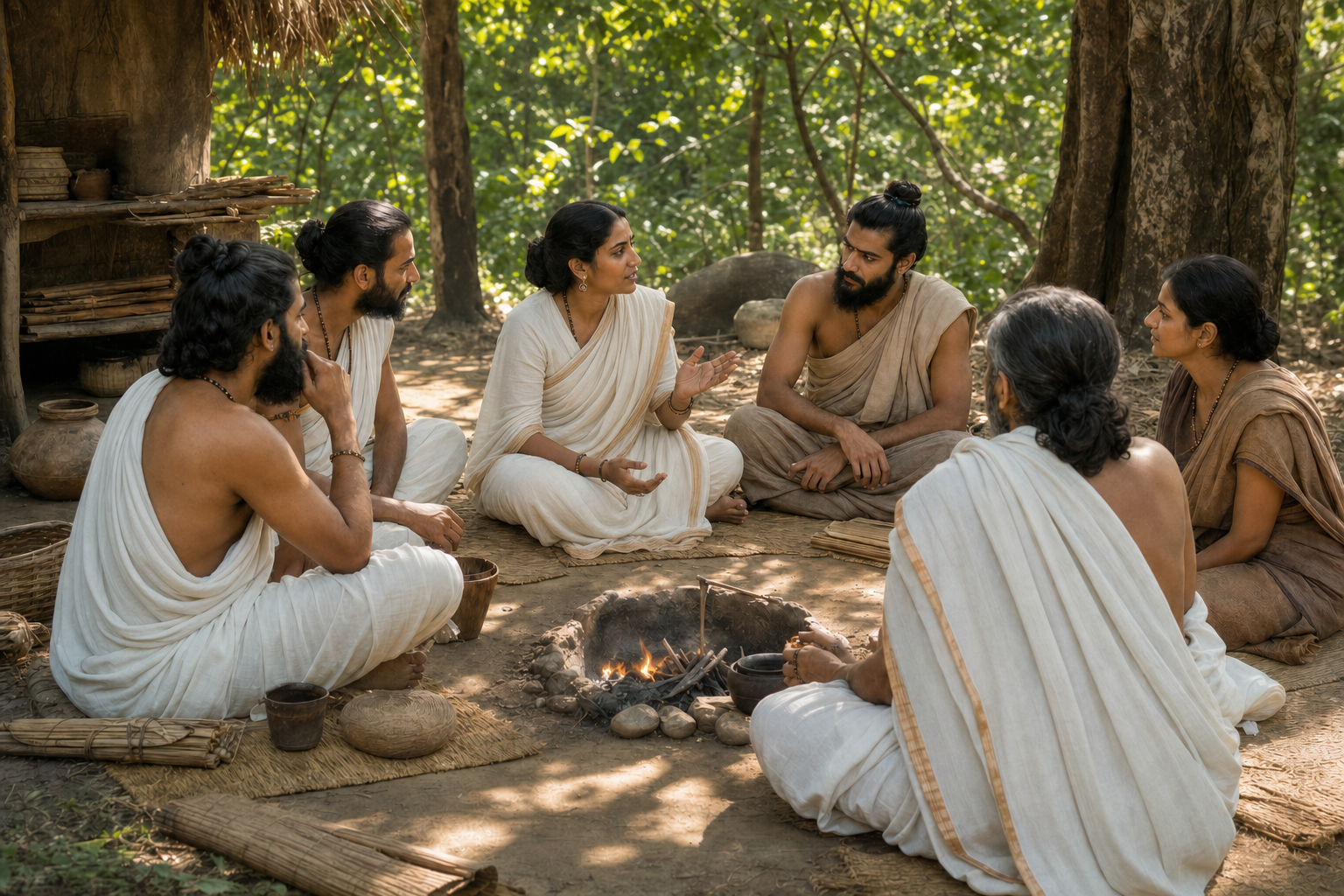
Start where authority is hardest to dismiss. Women are present within the formation and transmission of sacred knowledge itself. Lopāmudrā, Viśvāvarā, Ghoṣā, and Apalā are remembered among the female seers associated with Vedic hymns. Their importance is not exhausted by inclusion in a list. A ṛṣikā is connected to revealed insight, disciplined perception, and authoritative utterance.
Rigveda 10.125 goes further. In the Devī Sūkta, Vāk Ambhṛṇī speaks in the voice of the feminine power that moves through the cosmos, sustains beings, and grants efficacy. The feminine is not a decorative object inside someone else’s theology. She is the speaking center of the hymn. That is a claim about reality and knowledge before it is a claim about social organization.
The Upanishadic setting makes women’s intellectual agency even more explicit. Gārgī Vācaknavī challenges Yājñavalkya in public philosophical inquiry. She is not praised merely for devotion or familial loyalty; she presses a metaphysical argument. Maitreyī asks whether wealth can yield immortality and turns the discussion toward ātman and amṛtatva. One figure tests a renowned teacher in an assembly. The other refuses to confuse possession with liberation. Both act as philosophical subjects.
You should not inflate these examples into the claim that every girl received the same education. You should not minimize them as irrelevant exceptions either. Exceptional participants can prove that a path was conceptually and institutionally intelligible, even when they cannot establish how widely it was available.
The term brahmavādinī identifies a woman devoted to sacred study and discourse. Traditions also distinguish her from the sadyovadhū, who undertook learning before entering household life. The scope and form of women’s education differed among schools, periods, and regions, so neither term should be turned into a universal biography. Their value lies in showing that learned womanhood was a named possibility rather than an unthinkable breach of order.
When you teach this history, do more than insert Gārgī or Maitreyī into a commemorative sidebar. Ask students to identify the question each woman poses, the assumption she challenges, and the spiritual end she seeks. That restores intellectual agency. A name on a poster does not.
Ritual partnership made the household a sacred unit

Ritual participation is another strong test because rites assign consequential actions rather than offer general praise. In many Śrauta and Gṛhya settings, the patnī is necessary to the sacrifice. Soma rites and domestic fire rituals include her in specified offerings and vows. The relevant ritual actor is therefore not always an isolated male sacrificer. It is often the married household.
Calling this presence symbolic understates it. A required participant whose vow, offering, or presence affects the completeness of a rite is exercising liturgical agency. At the same time, co-agency does not mean that every function was interchangeable. Vedic ritual commonly distributes roles. The defensible conclusion is structured partnership: differentiated acts ordered toward a shared sacred purpose.
The ideal of the sahadharma-cāriṇī captures this relationship. She is the one who walks in dharma with her partner, not an accessory added after his religious identity is complete. Household prosperity, moral instruction, hospitality, continuity, and ritual responsibility meet in this role. Its dignity depends on the word saha, meaning with. Remove partnership, and the ideal becomes a hollow honorific.
Later Hindu theology gives this complementarity a cosmic vocabulary. Sarasvatī, Lakṣmī, and Durgā embody knowledge, flourishing, and protection. Ardhanārīśvara presents masculine and feminine in one form, while Śākta traditions place divine power at the heart of manifestation. These forms resist the idea that the feminine is spiritually secondary.
Yet a temple cannot answer a question about women’s participation merely by pointing to a goddess in the sanctum. Sacred symbolism and institutional practice are related, but they are not substitutes. If a local custom excludes women from a role, ask whether that boundary belongs to the rite, a particular sampradāya, a stage of life, or a later habit now presented as timeless scripture. The answer may preserve a genuine liturgical distinction. It may also reveal that nobody has examined the custom carefully.
Families can apply the same test without rewriting a ritual. Teach daughters and sons the meaning of the saṅkalpa, vows, offerings, and invocations instead of training one to understand while asking the other merely to be present. Participation becomes agency when the participant knows what is being undertaken and why.
Property, consent, and protection reveal both reach and limits
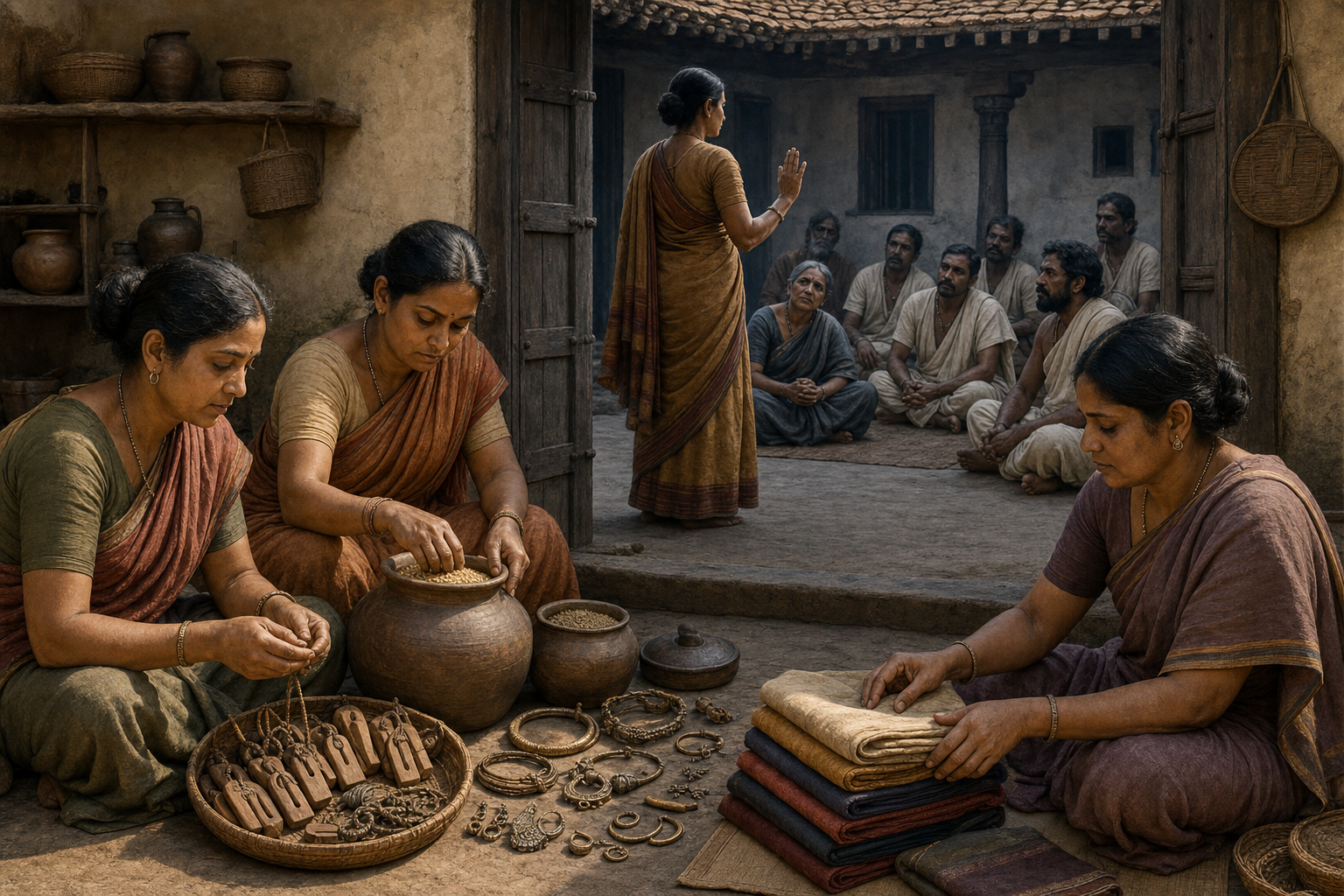
Sacred status becomes socially consequential when it reaches property, personal choice, and protection from injury. Strīdhana is therefore not a minor technical term. It denotes forms of property associated with a woman, including gifts received from parents, relatives, and her spouse at marriage and afterward. Juristic traditions recognized that such property could be owned, managed, and transmitted by a woman.
Yājñavalkya and Nārada, followed by the Mitākṣarā and Dayābhāga schools, did not resolve every question in the same way. Inheritance, guardianship, and the contents or devolution of property remained matters of interpretation. That disagreement is important. It shows a developed legal category, but it also warns you against describing one rule as the unchanging position of all Hindu jurisprudence.
Inscriptions recording donations, endowments, and land grants by queens and noblewomen add evidence of exercised economic agency. They show that women could act as donors and patrons, not only as beneficiaries. Because many such records concern elite women, they cannot tell us that every woman possessed comparable resources. They demonstrate practice within a real social setting, not universal distribution.
Marriage requires similar precision. The recognition of multiple marriage forms and consent-oriented practices such as svayaṃvara shows that a woman’s choosing role was intelligible within the tradition. It does not prove that all marriages were self-chosen or that social pressure was absent. Niyoga, accepted under tightly controlled conditions in some earlier settings and narrowed in later jurisprudence, likewise shows that norms changed over time.
Protection from violence also appears in classical legal reasoning. Within Dharmashāstra and Arthaśāstra jurisprudence, harassment and physical harm could attract fines, restitution, or corporal penalties calibrated to the offense. The existence of a penalty establishes normative concern. It does not establish that every victim could report safely, that rulers enforced the rule uniformly, or that social power never obstructed justice.
| Question | What can responsibly be affirmed | What must not be assumed |
|---|---|---|
| Could women hold property? | Strīdhana provided a recognized category of women’s property, and some women exercised substantial donor and patronage roles. | Its definition, inheritance rules, and practical availability were identical everywhere. |
| Did marriage include female choice? | Consent-oriented forms such as svayaṃvara preserved a recognized choosing role for women. | Every marriage was voluntary by a modern legal standard. |
| Were offenses against women punishable? | Classical jurisprudence prescribed consequences for harassment and physical harm. | Written norms were always enforced or eliminated vulnerability. |
| Did sacred status create social equality? | Theology, learning, ritual, and law supplied several foundations for women’s dignity and agency. | Religious reverence automatically produced uniform conditions in daily life. |
This three-part distinction—recognition, reach, and enforcement—is the most reliable way to assess a historical right. First ask whether a capacity was recognized. Then ask who could realistically exercise it. Finally ask what happened when others obstructed it. A claim that answers only the first question is incomplete; a claim that ignores recognition because practice was imperfect is incomplete too.
Do not use an ancient category to settle a present inheritance, marriage, or ownership dispute. Current law governs current legal rights, and it differs by jurisdiction. Where property or personal safety is at stake, use qualified legal help and applicable law. Historical jurisprudence can illuminate Dharmic values, but it is not a substitute for enforceable advice in your case.
Use this inheritance as a living standard, not a slogan
The wider Dharmic family reinforces women’s complete spiritual capacity through distinct institutions. Buddhism established the bhikkhunī saṅgha, Jain communities sustain sādhvī traditions, and Sikh teachings affirm spiritual and social equality. Mai Bhago embodies Sikh courage, while sangat and langar organize shared religious life around participation and service. These paths converge on spiritual capacity without becoming interchangeable. Each must be understood through its own doctrines, disciplines, and history.
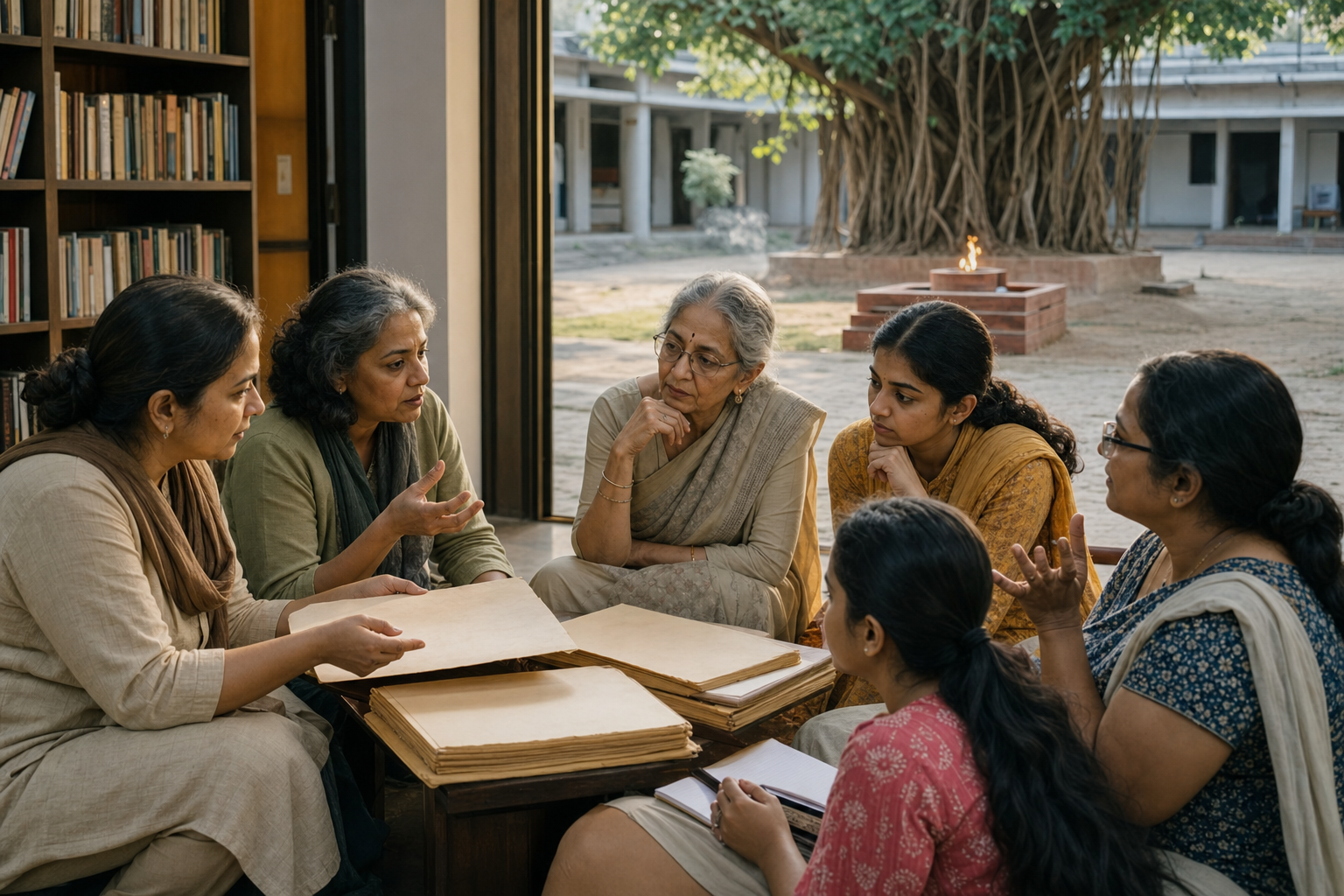
If you want to know whether a family, temple, school, or cultural organization honors this inheritance, run a practical audit:
- Learning: Are girls and women given serious access to Sanskrit, scripture, philosophy, and history? Are lineage-specific distinctions explained honestly rather than hidden behind vague appeals to tradition?
- Intellectual voice: Can a woman ask a difficult theological question, disagree respectfully, or teach without being treated as disruptive merely because she speaks with authority? Gārgī is meaningful only if inquiry remains honorable.
- Ritual agency: Where women have prescribed roles, are those roles understood and performed rather than reduced to ceremonial presence? Where roles differ, can the community state the textual or lineage basis for the distinction?
- Economic agency: Can women exercise transparent control over their own lawful property, income, donations, and institutional budgets? Honorific language cannot compensate for financial dependence imposed by others.
- Consent and safety: Does the institution have a clear way to report harassment or coercion? A rule is ineffective when reporting itself brings retaliation or when the accused person’s allies control the entire response.
- Historical honesty: Does teaching identify the relevant period, genre, school, and social setting? A Vedic hymn, an Upanishadic dialogue, a Dharmashāstra rule, an inscription, and a later regional custom answer different kinds of questions.
Not every difference in ritual function proves injustice, and not every inherited restriction proves fidelity. Ask what the distinction is for, where its authority comes from, and whether it closes every route to learning, responsibility, resources, or spiritual attainment. That is more demanding than either automatic rejection or automatic defense.
A pro-Dharma response to criticism does not need an imaginary golden age. It needs confidence in the tradition’s own highest standards and honesty about the distance between a standard and its observance. The presence of ṛṣikās, learned interlocutors, ritual partners, property holders, patrons, renunciants, and defenders gives us a strong inheritance. Our obligation is to make its principles visible in actual conduct.
Choose one institution you can influence and one correction you can verify: add the female seers and philosophers to its curriculum, explain the wife’s actual role in a household rite, clarify control of property or donations, or establish a credible safety process. Sacred agency endures when women can know, choose, act, and be heard. That is where civilizational memory becomes dharma in the present tense.
References
- Dandavats — Women in Vedic Culture: Rights, Scholarship, and Sacred Agency Across Dharmic Traditions