

You may meet Naraśaṁsa in an Aprī hymn, look for the familiar biography of a deity, and find almost none. That doesn’t make him an incidental name. It tells you to change the question: at this point in the rite, what must human speech become before it can address the devas?
That question opens the ritual meaning of Narashamsa. Whether you’re reading a translation, studying the structure of sacrifice, or learning sacred recitation, you need to notice the threshold he marks. Ordinary human utterance is being shaped into praise that can invite, accompany, and sustain divine-human exchange.
Read the name in both directions

The name joins nara, human beings, with śaṁsa, praise or proclamation. It can point toward praise belonging to or voiced by human beings, but it can also suggest one who is praised by them. The ambiguity matters because the name holds the two sides of ritual address together: people praise, and the power embodied in rightly formed praise is itself invoked.
A reader accustomed to later devotional narratives may ask, “Who is Narashamsa?” and expect ancestry, exploits, images, or an independent mythology. Vedic ritual often asks for another kind of attention. An indispensable action, relation, or threshold can acquire agency and divine presence. Narashamsa is therefore not adequately explained as either a mythological personality with a missing story or an abstract synonym for praise.
When you encounter the name, hold three questions together. Is it functioning as a descriptive expression, a divine name, or both? Where does it stand among the surrounding invocations? What must praise accomplish at that moment? This method respects the grammatical uncertainty without treating it as confusion. It also keeps the ritual function in view when an English translation reduces the term to a single gloss.
The most useful working definition is precise but not reductive: Narashamsa is human praise becoming an effective sacred presence within sacrifice. “Human” names its point of origin. “Sacred presence” names what ritual formation allows it to become.
Notice where Narashamsa enters the sacrifice

Narashamsa appears most clearly in the Aprī hymns, the patterned invocatory sequences associated with Soma offerings in the Rig Veda’s family books. These sequences address a roster of ritual powers that includes Agni, Barhis, Ilā, Bhāratī, Sarasvatī, Narashamsa, Tvaṣṭṛ, the Aśvins, and others. Their work is preparatory in the strongest sense: they open and order the sacrificial occasion so that the offering can proceed as a divine-human encounter.
This setting tells you more than a detached dictionary entry can. Narashamsa does not arrive as the subject of an extended divine adventure. He appears where the rite must convert a human call into a properly directed invitation. Praise must not remain scattered emotion, private intention, or attractive language. It must become capable of reaching its ritual destination.
That is why narrative prominence and ritual importance should never be confused. Modern readers often measure a deity’s importance by the quantity of mythology, temples, images, or independent worship attached to the name. A Vedic power can instead be crucial because it performs exact work at an exact moment. Narashamsa is narratively spare but liturgically dense.
Yajurvedic and Atharvavedic ritual materials also retain Narashamsa in invocatory and offering contexts. In śrauta practice, especially around Soma sacrifice, an offering to Narashamsa may serve the communicative integrity of the rite. The details are not identical across recensional traditions. If you’re trying to understand an occurrence, record the Vedic corpus, recension, surrounding formulae, and ritual setting before drawing a general conclusion. A single translated line is not a universal ritual manual.
You should also resist detaching the invocation from its sequence. The neighboring deities and ritual actions show what stage has been reached and what transition is underway. Read Narashamsa as part of that ordered movement, not as a free-floating name that can be assigned one meaning everywhere.
Keep Narashamsa close to Agni without collapsing them

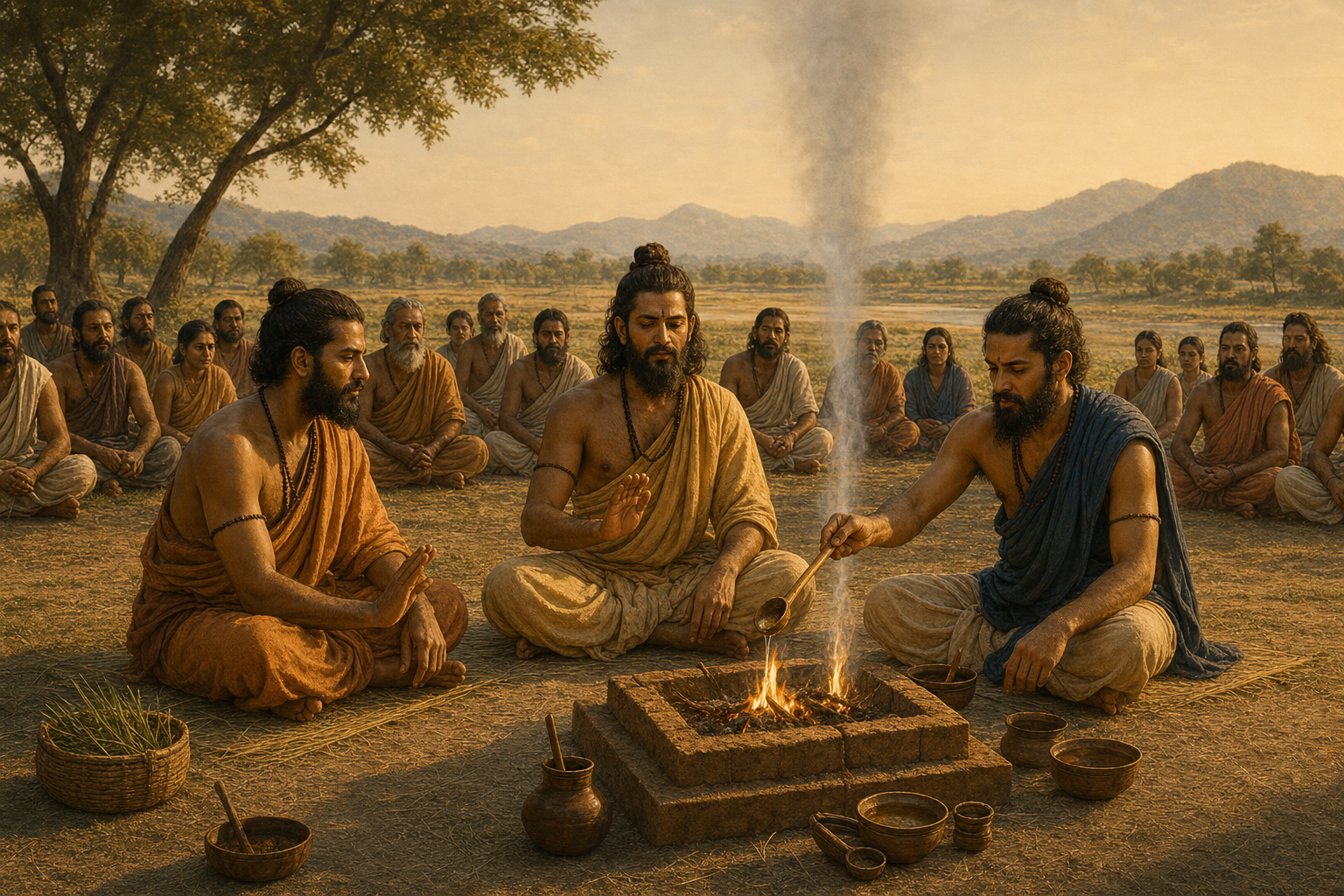
Narashamsa stands in particularly close relation to Agni. Agni is the priestly fire and carrier of oblations, the power through whom the offering moves toward the devas. Narashamsa represents the charged human address that gives articulate form to the approach. A useful ritual analogy is that Agni carries, while Narashamsa gives sacred shape to what is being communicated.
The analogy is a reading aid, not a rigid division of divine labor. Vedic ritual does not operate like a mechanical delivery system in which separate parts never overlap. Fire, offering, mantra, priestly action, intention, and divine presence participate in one event. The distinction simply helps you notice why praise matters alongside the physical oblation. Transport alone does not explain what is being conveyed, and human words alone do not explain how they acquire sacrificial efficacy.
Some later interpretations consequently understand Narashamsa as an epithet or aspect of Agni. Their closeness makes that identification intelligible, but it need not erase every functional distinction. When a passage invokes them separately, attend to the separate addresses. When a tradition brings them together, notice which qualities make the identification possible.
This balanced approach prevents two opposite mistakes. The first is to turn Narashamsa into a completely independent personality whose role has no relation to Agni. The second is to replace the name with “Agni” so quickly that the text’s attention to human praise disappears. Keep the distinction as long as it helps you see the rite more clearly.
Recognize what makes praise ritually effective
Ritual praise is formed speech, not flattery
Narashamsa does not sanctify whatever a person happens to say with enough enthusiasm. Vedic praise is effective because several elements cohere: the mantra’s sound, Vedic accent, meter, clarity of articulation, the intention of the participants, the ordered sequence, and the offering itself. Meaning matters, but meaning is not isolated from sound and performance.
This gives you an important distinction. A translation may communicate semantic meaning while leaving the original sonic structure behind. Accurate sound without attention to intention and ritual place is also incomplete. Narashamsa belongs at the point where voice, form, purpose, and offering become mutually supporting parts of one act.
The boons associated with this field of praise include prosperity, progeny, cattle, fame or kīrti, and enduring renown or śravas. These aims belong to the social and religious horizon of Vedic sacrifice. They should not be converted into a modern promise that praise mechanically produces wealth or reputation. Their deeper ritual logic is alignment: human aspirations are voiced within an act directed toward ṛta, the order that makes truthful relationship and right action possible.
Flattery tries to manipulate its recipient. Sacred praise tries to bring speaker, speech, intention, offering, and cosmic order into correspondence. If you remember only one theological distinction, make it this one. Narashamsa concerns rightly directed praise, not verbal ornament or divine persuasion.
This is also why Narashamsa can be read beside the Vedic understanding of Vāc, sacred speech. The later idea of śabda-brahman, ultimate reality apprehended through sound, can illuminate the wider Dharmic importance of sacred utterance. It should not, however, be projected backward as though it were a complete dictionary definition of every Vedic use of Narashamsa. Begin with the ritual setting; introduce later theological lenses only after that setting is clear.
When reading a translation, preserve what the gloss loses
If a translation alternates among “praise of men,” “praised by men,” and the proper name “Narashamsa,” keep Naraśaṁsa in your notes. Then mark the immediate addressee, the neighboring invocations, and the ritual transition. This small habit stops an interpretive choice in English from silently deciding whether you see a deity, a ritual function, or both.
Next, ask whether praise is merely being described or ritually personified. A capital letter alone cannot settle the question, because editors and translators make different choices. Placement and action are better evidence. Finally, separate what belongs to the Rigvedic occurrence from what comes through later interpretation. This produces a clearer reading without pretending that every ambiguity can be eliminated.
When learning recitation, treat form as part of meaning
If you’re learning formal Vedic recitation, accent, meter, sequence, and pronunciation are not decorative refinements added after the “real meaning” has been understood. They participate in the act itself. Follow the recitational discipline of the tradition you’re studying rather than manufacturing an isolated Narashamsa practice from an English gloss.
You can still apply the governing insight outside a śrauta sacrifice without claiming to reproduce one. Before japa, Vedic study, or kīrtan, identify your intention plainly. During recitation, slow down enough to preserve the clarity you have actually learned. Afterward, examine your ordinary speech with four questions: Is it true? Is it non-harming? Is it clear? Do the words match the intention behind them?
That exercise carries the values of satya, restraint from harm in language, appropriate expression, and svādhyāya into daily conduct. It does not turn an informal practice into a Vedic sacrifice. The boundary matters because respect for ritual includes refusing to claim a ritual authority or precision that has not been learned.
Compare Dharmic traditions without flattening them
The wider Dharmic family offers useful parallels. Buddhist paritta and dhāraṇī chanting shape and protect intention. The Jain Navakāra or Namokar Mantra praises perfected virtues rather than petitioning a creator. Sikh devotion gives central place to Śabad and nām-simran. Hindu japa and kīrtan likewise discipline attention through repeated sacred sound.
These practices are not interchangeable versions of an identical rite. Their objects, doctrines, languages, disciplines, and ritual settings differ. The comparison is valuable for a narrower reason: each asks you to take seriously what sacred sound does to intention, memory, ethical formation, and relationship. Use the parallels to sharpen your questions, not to erase distinctions.
Key takeaways
- Narashamsa becomes intelligible when you ask what praise must accomplish in the rite, not when you search only for a later-style divine biography.
- The name can indicate human praise, one praised by human beings, and the sacred agency through which rightly formed praise reaches its ritual purpose.
- Its clearest Rigvedic setting is the Aprī sequence associated with Soma offerings, while Yajurvedic and Atharvavedic uses must be read within their own recensional settings.
- Agni and Narashamsa are closely related but analytically distinguishable: Agni carries the oblation, while Narashamsa marks the sanctified human address accompanying the exchange.
- Vedic praise depends on the coherence of sound, accent, meter, clarity, intention, sequence, and offering. It is neither casual expression nor divine flattery.
- You can carry the principle into daily speech through truth, non-harm, clarity, attentive recitation, and study without claiming that a personal exercise reproduces a formal Vedic rite.
The next time Narashamsa appears in a hymn, don’t pass over the name as a minor deity with too little mythology. Write down its ritual neighbors, note the movement from human utterance toward divine address, and preserve the Sanskrit term if the translation settles the ambiguity too quickly. That small discipline will let you see one of the Veda’s most demanding insights: speech becomes sacred through truthful intention, exact form, and ordered participation.