
You may approach Somnath’s millennium with two legitimate concerns. One is that the violence in its history will be softened into a harmless heritage story. The other is that memory will be turned into hostility against people living now. You don’t have to accept either choice.
Somnath becomes more instructive when you ask a harder question than how often it was attacked: what made return possible after each rupture? The answer lies not in stone alone, but in sacred geography, ritual continuity, patronage, skilled communities, trade, and a civilizational refusal to treat destruction as the final word.
What Somnath’s two anniversaries actually mark
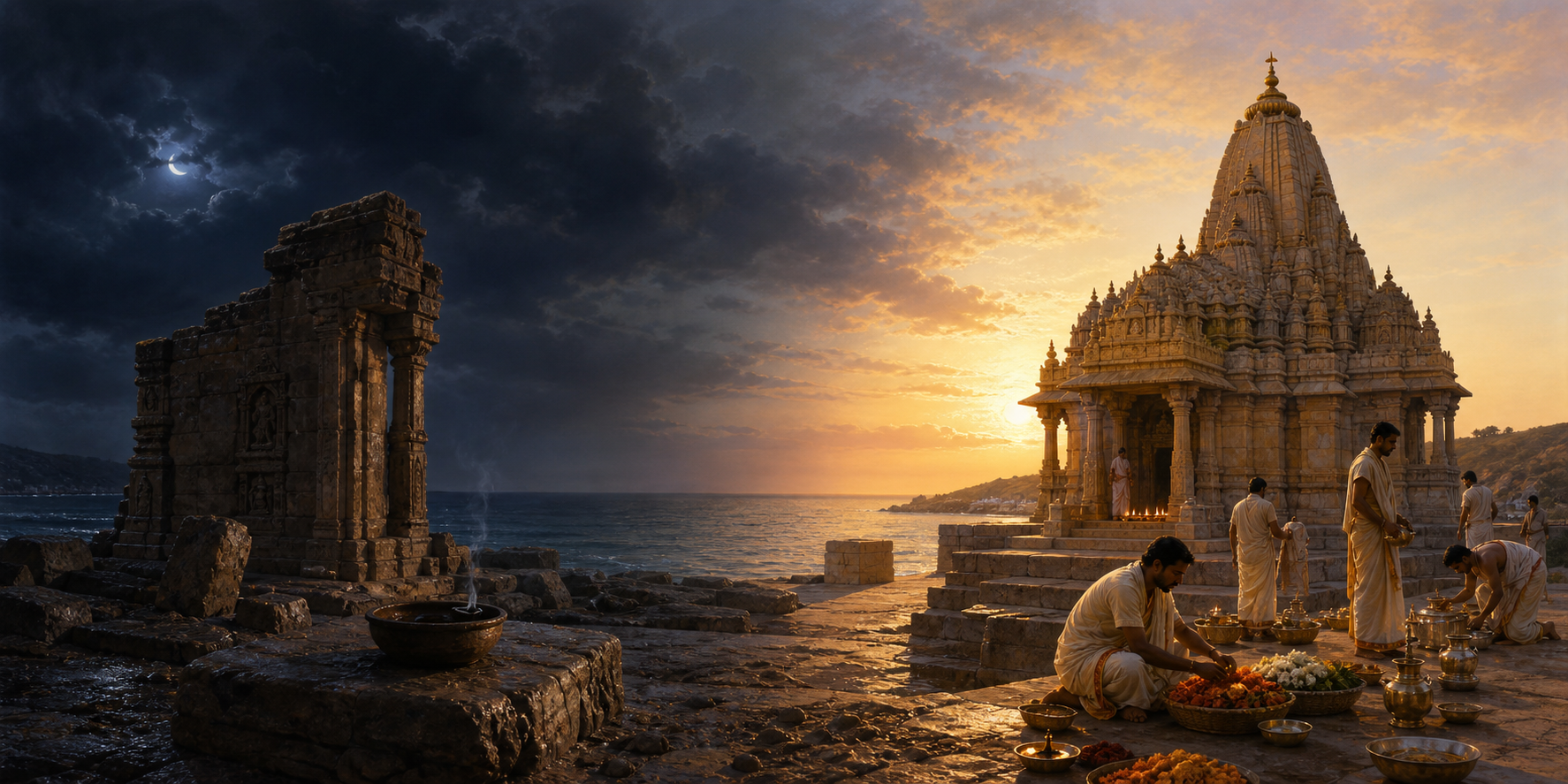
The year 2026 joined two historical clocks. It completed a millennium since the major Ghaznavid assault of 1025–1026 CE. May 11, 2026 also marked seventy-five years since the Pran Pratishtha of the present temple in 1951.
Neither anniversary means that Somnath began in 1026. Prabhas Patan was already an important pilgrimage centre long before the eleventh century. Somnath is revered as one of the twelve jyotirlinga shrines of Shiva, while Prabhasa-kṣetra is remembered in the Mahabharata and celebrated in the Prabhāsa-khaṇḍa of the Skanda Purana. Traditions associated with the closing phase of Krishna’s earthly life deepen the sanctity of the wider landscape.
This is the first distinction to keep clear when you hear Somnath discussed. The millennium measures the interval since a recorded assault, not the age of the tirtha. The seventy-five-year anniversary belongs to the present structure’s consecration, not to the beginning of worship at Prabhas.
The distinction between temple, tirtha, and institution matters. A temple is a constructed sacred building. A tirtha is a place of passage and pilgrimage whose meaning joins story, landscape, water, ritual, and human movement. An institution is the network that maintains worship, trains specialists, receives gifts, serves pilgrims, and renews the physical site. At Somnath, attackers could damage the first and disrupt the third, but eliminating the second was far more difficult.
The geography explains why. Prabhas Patan stands on Saurashtra’s Arabian Sea coast, near the confluence traditionally associated with the Hiran and Kapila streams and the sea. The ocean, the Triveni Sangam, Someshvara, and the sacred memories attached to Prabhasa form one ritual map. Even when masonry was broken, pilgrims still knew where to return.
When you encounter a historical claim about Somnath, therefore, ask four questions. Which period does it concern? Is it about the building, active worship, or the wider pilgrimage institution? What kind of evidence supports it? Is the claim well established, traditionally attributed, or still uncertain? Those questions prevent a dramatic detail from swallowing a thousand-year history.
A timeline that separates the pattern from exaggeration
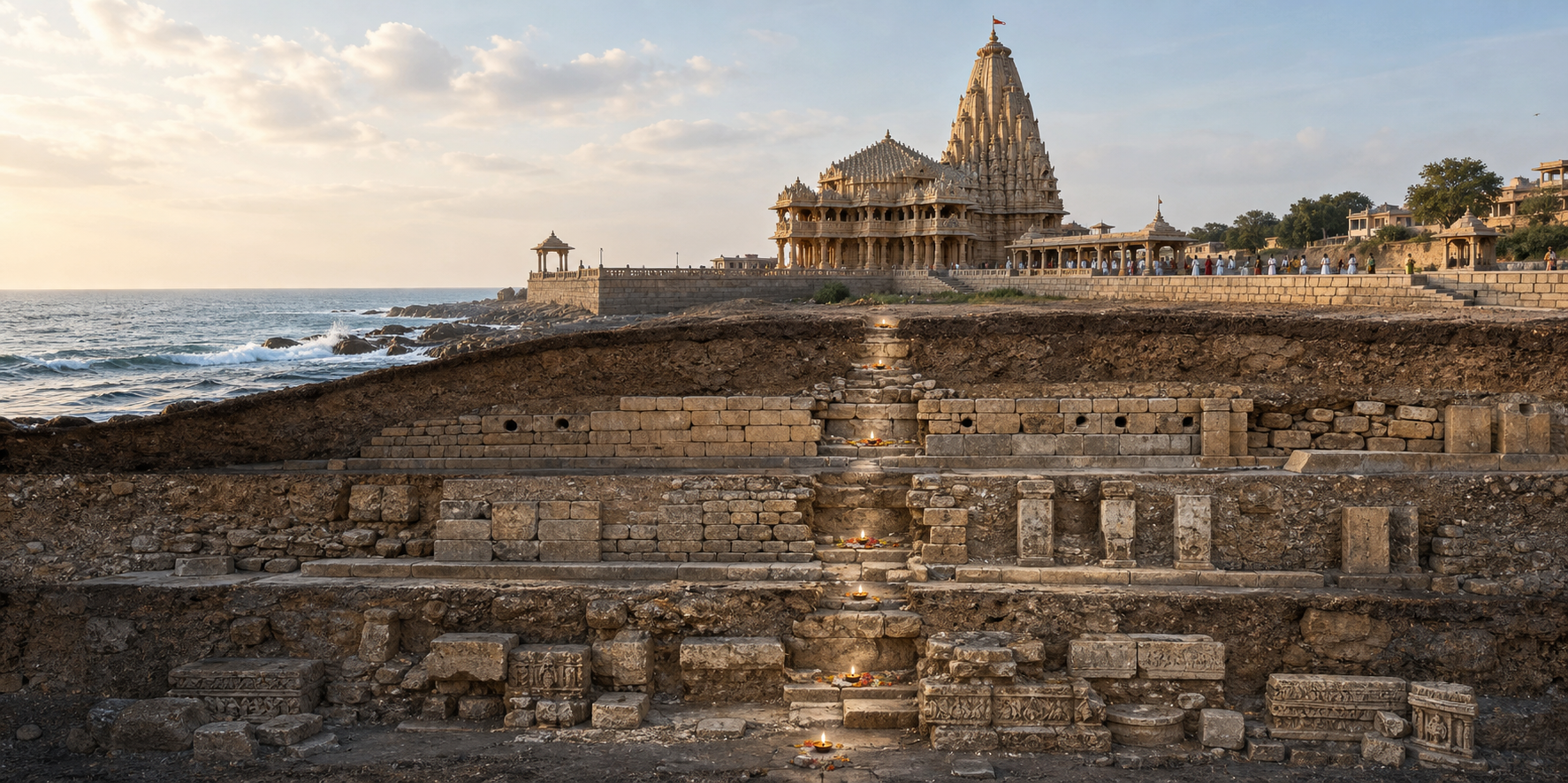
Somnath’s broad historical pattern is clear: sacred prominence, violent disruption, reconstruction, renewed worship, and further disruption. Not every detail carries the same degree of certainty. Exact medieval totals for casualties or seized wealth should not be repeated as settled facts merely because they are vivid. The occurrence of iconoclasm, loss of life, and large-scale plunder in 1025–1026 is much firmer than every number attached to the campaign.
| Period | What happened | What you should notice |
|---|---|---|
| Before the eleventh century | Prabhas Patan functioned as an established sacred and pilgrimage centre associated with Someshvara, Krishna traditions, and the coastal confluence. | The tirtha and its ritual memory predate the millennium being commemorated. |
| 1025–1026 CE | The Ghaznavid campaign brought iconoclasm, deaths, and extensive plunder. | The assault had symbolic, ideological, strategic, and fiscal dimensions. Exact dramatic tallies require caution. |
| Eleventh century | Reconstruction is traditionally credited to the Solanki ruler Bhima I and the Paramara ruler Bhoja. | Renewal began within the same century; the community did not wait for the trauma to fade from memory. |
| Twelfth century | Somnath again became a major religious centre in western India, supported by patronage, donations, craft expertise, and pilgrimage. | Reconstruction restored an institutional ecosystem, not merely a monument. |
| 1299 and later centuries | The shrine was desecrated during the Gujarat campaigns of Alauddin Khalji’s generals. Further pressures are associated with Zafar Khan, later Muzaffar Shah I, Mahmud Begada, and Aurangzeb. | The episodes vary in documentation and context, but repeated disruption did not end the site’s sacred life. |
| 1783 | Ahilyabai Holkar sponsored a major restoration that re-established active temple life. | Her intervention belongs to a wider revival of pilgrimage institutions under her patronage. |
| 1947–1949 | Sardar Vallabhbhai Patel resolved to restore Somnath after visiting Prabhas Patan, and the Shree Somnath Trust was formed in 1949. K.M. Munshi sustained the work. | The new reconstruction joined cultural memory to the responsibilities of an independent society. |
| May 11, 1951 | The present temple was consecrated in the presence of President Rajendra Prasad. Patel had died before the ceremony. | The consecration completed the modern rebuilding while reconnecting it to an older architectural and ritual lineage. |
This sequence is more reliable than a slogan built around a fixed number of destructions. A count can conceal disagreements about what qualifies as an attack, a desecration, a period of suppression, a partial repair, or a complete reconstruction. If you are teaching or discussing Somnath, use named episodes and dates where they are available. Mark uncertainty where it remains. Precision strengthens remembrance; it does not weaken it.
Five things had to survive before the stone could rise again
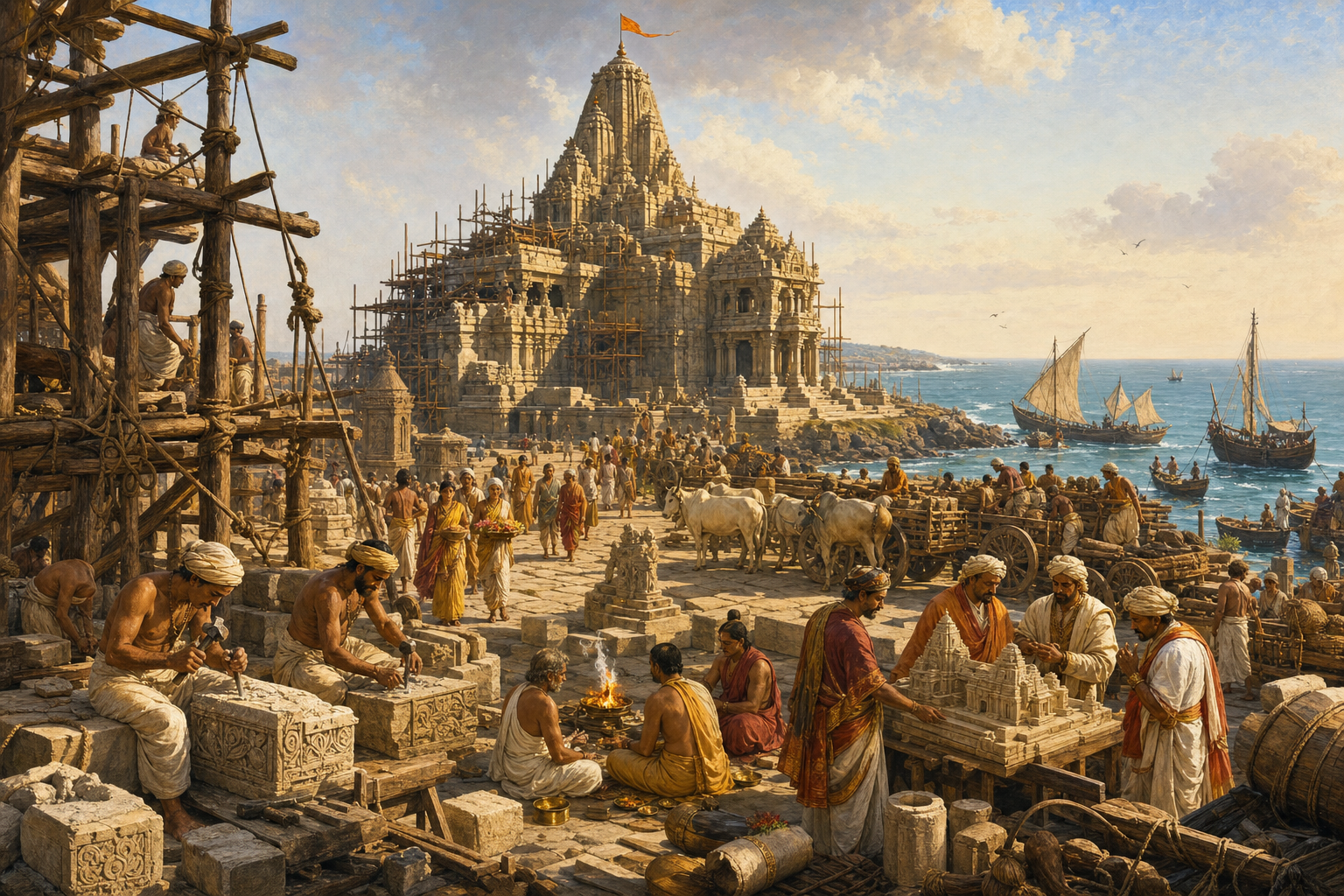
A ruined structure does not rebuild itself. Somnath endured because several forms of continuity reinforced one another. You can use the following five-part test whenever someone calls a sacred place resilient.
- The sacred location remained identifiable. Prabhas was not an interchangeable plot of land. Its sea, confluence, stories, and ritual associations kept pilgrimage directed toward a specific place.
- Ritual memory remained usable. Somnath was remembered as Someshvara, the Lord of the Moon, and as a jyotirlinga. This gave later restoration a living religious purpose rather than merely an archaeological one.
- Communities could reorganize support. Rulers mattered, but so did donors, priests, pilgrims, artisans, volunteers, local households, and the livelihoods surrounding the pilgrimage centre.
- Craft knowledge crossed generations. The Maru-Gurjara tradition supplied a recognizable architectural grammar, while guild and family expertise made ambitious stone construction possible again.
- Economic routes kept people and resources moving. Coastal Gujarat connected pilgrimage with agriculture, ports, commerce, hospitality, and charitable activity. A tirtha sustained by movement could recover even after a period of political shock.
This test corrects a common misreading of reconstruction. Ahilyabai Holkar’s work in 1783 and the consecration of the present temple in 1951 are not competing dates for the same event. The former re-established active temple life in the late eighteenth century. The latter completed the monumental reconstruction associated with independent India. Ritual renewal and architectural rebuilding can occur on different timelines.
Somnath’s maritime setting was also more than scenery. Routes running through coastal Gujarat linked centres such as Veraval and Khambhat with Aden and the wider Indian Ocean. Gujarati commercial activity even appears in medieval Jewish Geniza records connected with Abraham bin Yiju. Trade did not make the shrine sacred, but circulating people and wealth helped support pilgrimage, endowments, food, accommodation, artisans, and local employment.
That mechanism still matters when you assess heritage preservation. Ask whether custodians are preserving only a facade or also the practices and skills that make the place intelligible. At a coastal stone monument, this includes attention to salt-bearing air, structural load paths, drainage, traditional joinery, documentation, and the training of craftspeople. Conservation fails when it treats living knowledge as an optional ornament.
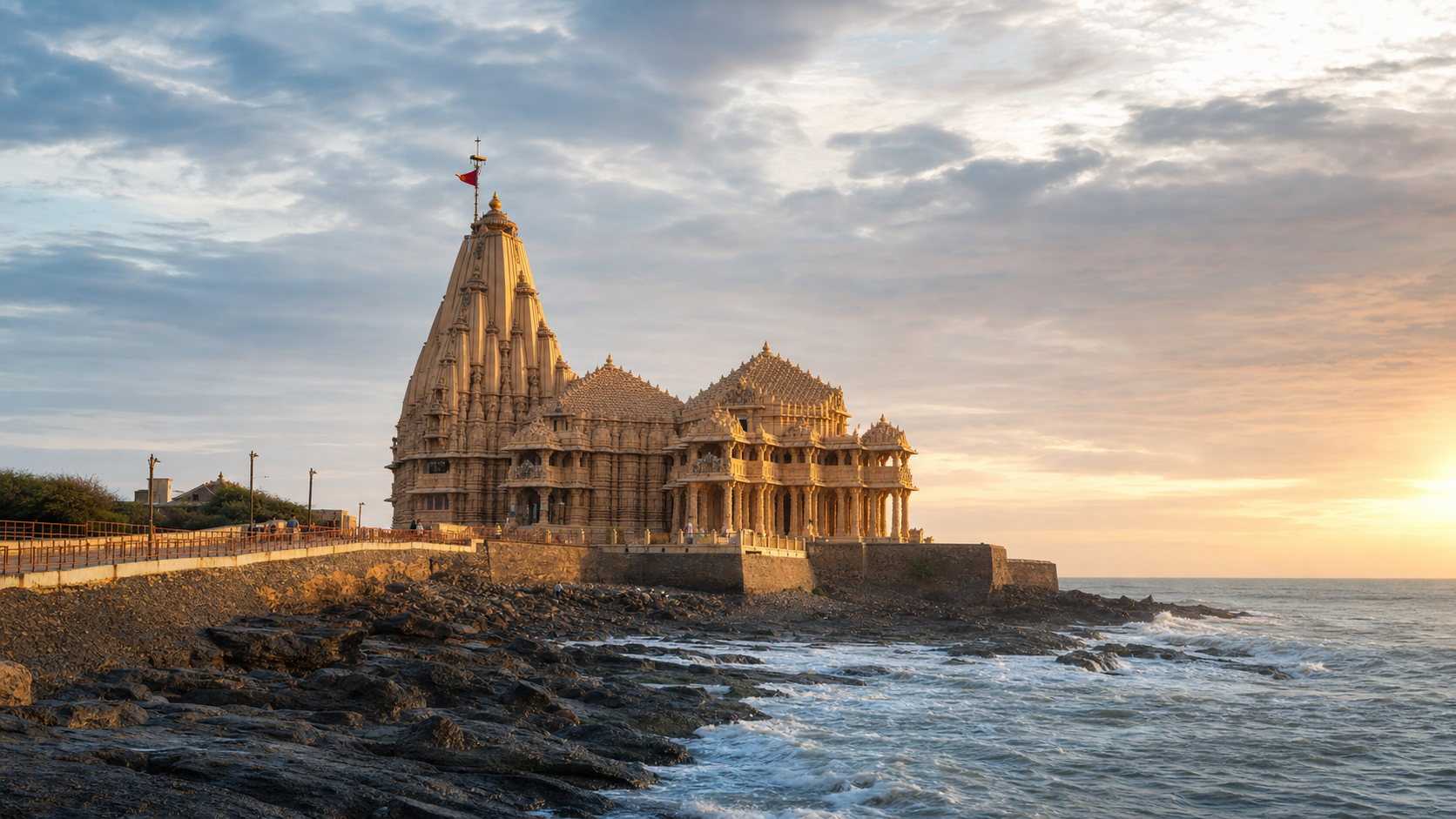
The present building makes that continuity visible. Constructed by Sompura shilpis in the Maru-Gurjara idiom, it follows the sequence of garbhagriha, antarala, and mandapas. Its shikhara rises approximately 50 metres, while carved surfaces, projections, recesses, and the vertical composition recall the mature Chaulukya-Solanki tradition. Near the seafront, the Bāṇasthambha points symbolically across an uninterrupted southern ocean. Read it as an expression of geographic and cosmic imagination, not as a substitute for modern surveying.
Yet architecture alone gives you only half the answer. Daily abhishekam and āratī, together with the observances of Mahashivaratri, Śrāvaṇa, and Kārttika, keep the shrine in ritual time. The building is most fully itself when worshippers, priests, bells, lamps, conches, volunteers, and the sound of the sea converge. That is the difference between a reconstructed monument and a restored tirtha.
Truthful memory need not become inherited hatred
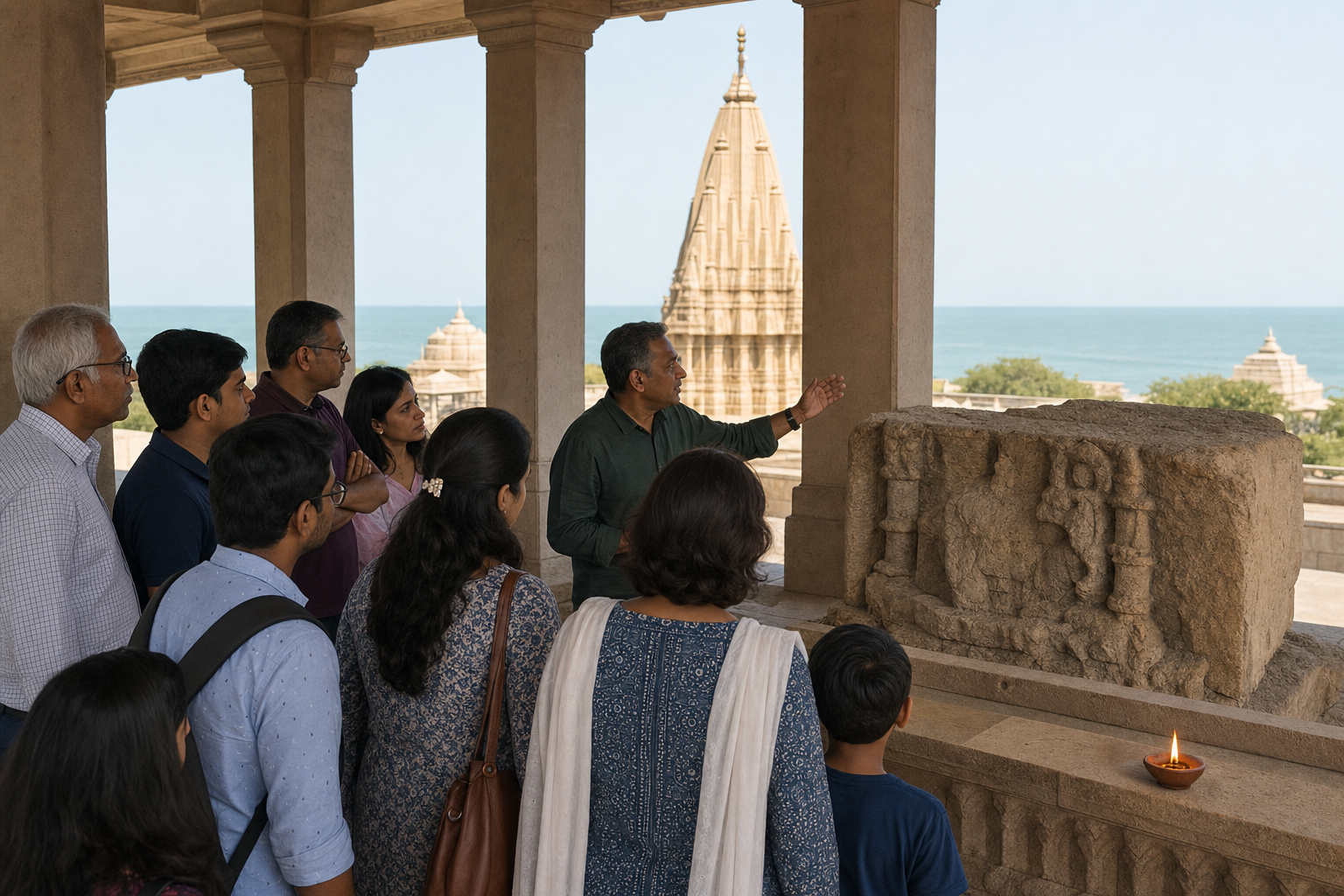
Responsible remembrance begins by refusing euphemism. Somnath suffered deliberate iconoclasm, plunder, deaths, and repeated interference with worship. Economic motives do not cancel ideological ones, and ideological motives do not make fiscal or strategic calculations irrelevant. Several motives can operate in the same campaign.
Responsible remembrance also refuses false precision. Different kinds of historical evidence were created for different purposes. Sacred traditions preserve meaning and continuity. Inscriptions can establish patronage, grants, titles, and phases of construction. Architectural forms reveal craft lineages and rebuilding. Courtly and conquest narratives record campaigns but may magnify numbers, wealth, or victory. Archaeological remains supply material constraints. A credible account emerges when claims are tested across these forms without pretending that all of them answer the same question.
The final discipline is moral: guilt is not hereditary. Naming the perpetrators, policies, and institutions involved in a historical assault is necessary. Assigning their guilt to present-day people merely because they share a religious label is neither historical reasoning nor dharma. It converts remembrance into a new injustice and leaves the original history less accurately understood.
The independent Indian reconstruction offers a useful model. Patel framed restoration as cultural self-respect. Munshi helped carry the project from resolve to institution. Rajendra Prasad’s presence at the 1951 Pran Pratishtha affirmed that an ancient civilizational inheritance could be honoured without turning the republic into an agent of religious revenge. The distinction is important: neutrality among creeds need not require amnesia about what a civilization has endured.
Somnath can also be approached through values shared across India’s dharmic families. Hindu tirtha-yatra centres the transformative journey to sacred geography. Buddhist traditions help us notice the discipline of mindful journeying. Jain Anekantavada asks us to recognize the limits of any single perspective without declaring every assertion equally true. Sikh seva directs attention to the work of feeding, welcoming, and serving people at places of pilgrimage.
These parallels should not be exaggerated into a claim that all four traditions tell the same story or maintained Somnath in the same way. Their doctrines and histories remain distinct. The practical kinship lies in habits of pilgrimage, restraint, service, disciplined memory, and the renewal of community life. That is a stronger basis for Dharmic unity than flattening real differences.
If you are explaining Somnath to a child, a classroom, or a mixed audience, avoid two shortcuts. Do not say that nothing certain can be known merely because some details are disputed. Do not present every reported medieval number as unquestionable merely because the underlying attack was real. State the firm core, label traditional attributions, identify uncertainty, and explain why worship returned. This gives your listener history rather than a grievance script.
Key takeaways for visiting, teaching, or commemorating Somnath
- Keep the two anniversaries separate: 1026 marks a millennium since a major assault; May 11, 1951 marks the consecration of the present temple.
- Do not mistake the anniversary of an attack for the origin of the shrine. Prabhas was a sacred pilgrimage landscape before the eleventh century.
- Distinguish the tirtha, the worshipping institution, and the physical temple. Each can survive, suffer, or recover on a different timetable.
- Use named episodes instead of an unsupported fixed destruction count. Treat exact casualty and treasure totals cautiously while stating the well-attested violence plainly.
- Notice the mechanisms of recovery: sacred geography, ritual memory, patrons, community giving, skilled shilpis, pilgrimage, and coastal economic networks.
- At the present temple, read the garbhagriha, antarala, mandapas, shikhara, carvings, and Bāṇasthambha as parts of a renewed Maru-Gurjara architectural language.
- Make room for living practice. Abhishekam, āratī, festivals, hospitality, volunteering, and local livelihoods explain more about resilience than an inspection of stone alone.
- Remember perpetrators and policies accurately, but do not transfer medieval guilt to people in the present. Historical candour and present-day restraint belong together.
If you visit Somnath, carry one simple discipline with you: place every claim beside a date and a level of confidence. Then look beyond the wound to the human systems that made renewal possible. You will leave with something more durable than outrage or admiration alone—a practical understanding of how a civilization keeps a sacred promise across generations.