
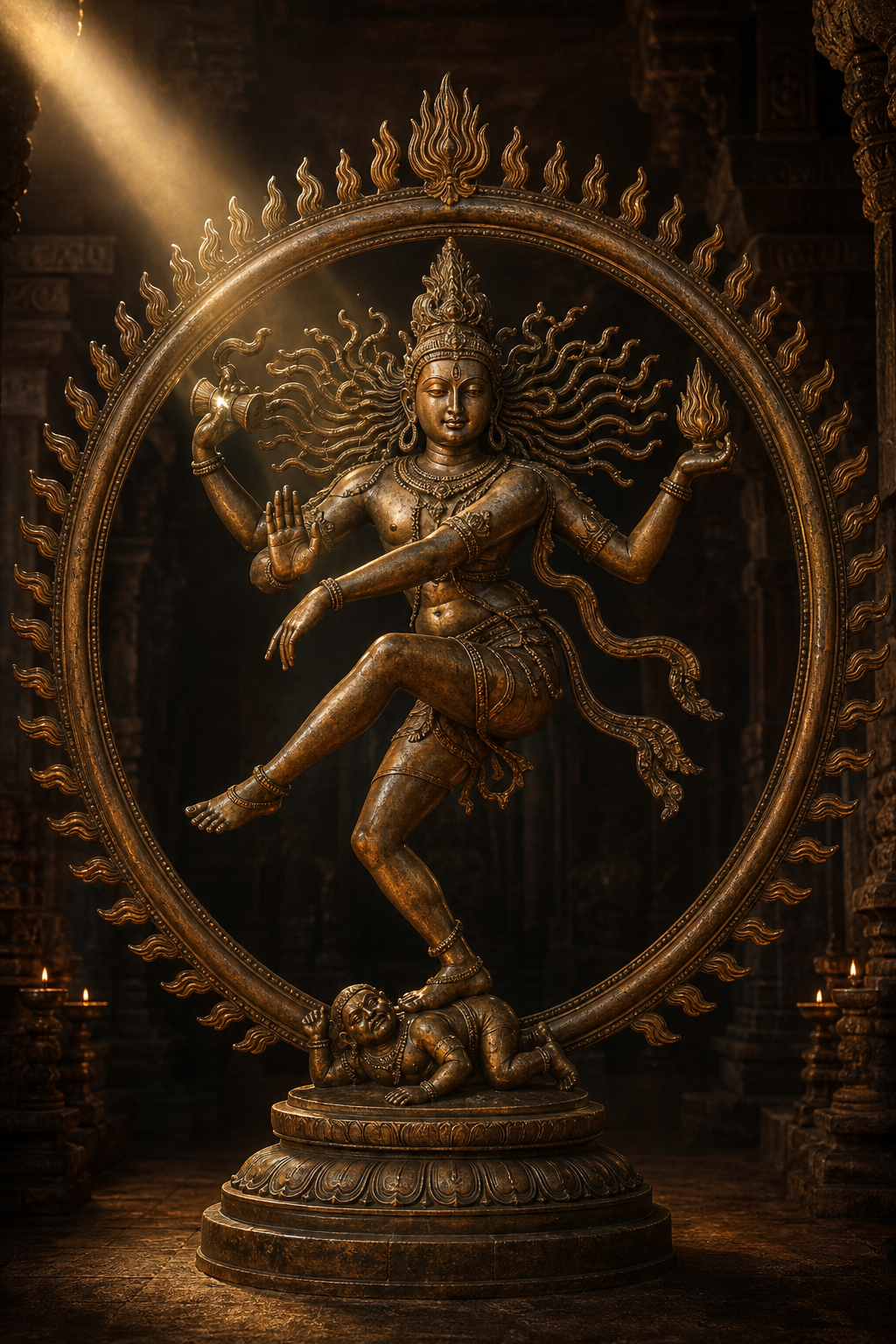
You see the small hourglass drum in Shiva’s raised hand, but the rest of the Nataraja image can make it easy to overlook. Why should this modest instrument stand beside the fire of dissolution, the gesture of fearlessness and the lifted foot of refuge?
The damaru becomes useful when you stop treating it as an isolated emblem and begin following its rhythm: a sound arises, takes form, continues, fades and returns to silence. That cycle gives you a practical way to read Shiva’s iconography, understand sacred sound and examine the phase of life in which you now find yourself.
Key takeaways
- The damaru represents more than a moment of creation. Its beat belongs to a continuing rhythm of emergence, sustenance, transformation, concealment and grace.
- Its two heads can represent complementary poles such as Shiva and Shakti, while the narrow centre points to the unity from which apparent opposites arise.
- Sacred sound includes the silence into which sound subsides. In Omkara, A-U-M is incomplete as a contemplative map if you ignore the quiet that follows it.
- The traditional connection between Shiva’s drumbeats and the fourteen Maheshvara Sutras presents ordered sound as the basis of intelligible language. It should be understood as sacred memory, not casually turned into a modern historical claim.
- You can work with the damaru’s teaching without owning a drum: breathe steadily, listen to an external sound through its full decay, notice the interval after it and then decide what you need to begin, sustain or release.
Read the whole Nataraja image, not just the drum
A physical damaru has two membranes joined by a narrow waist. Cords bind the body, and bead-like strikers hit the membranes when the instrument is moved. These details matter because Hindu iconography often communicates through relationships between form, function and philosophical meaning.
The two heads, crossing cords, central waist and moving strikers offer several compatible ways of reading the instrument. The paired heads can evoke Purusha and Prakriti, the manifest and unmanifest, or Shiva and Shakti. The narrow waist suggests bindu, the point at which polarity converges. The cords show that apparent opposites remain connected, while the strikers turn motion into an audible pattern.
You do not have to choose one of these correspondences and reject all the others. A sacred symbol is not a rebus with only one correct answer. Its discipline lies in the structure shared by the interpretations: two distinguishable poles, an underlying unity and a movement through which relationship becomes perceptible.
That structure becomes clearer in the Nataraja image. The damaru announces manifestation, while the flame answers with transformation and re-absorption. The abhaya mudra offers fearlessness amid this change. The foot over Apasmara depicts the overcoming of forgetfulness or ignorance, and the lifted foot offers refuge. Creation is therefore not shown as unlimited production. It belongs to an ordered cosmos in which forms must be sustained, transformed and understood.
When you next look at Nataraja, follow a deliberate route through the image. Begin with the damaru and ask what is trying to come into being. Move to the fire and ask what has completed its form. Notice the abhaya hand and identify the fear making you resist a necessary transition. Look at Apasmara and ask what you are forgetting. End at the lifted foot and consider where genuine refuge lies. This is not a substitute for theological study, but it turns viewing into attention rather than ornament appreciation.
Sacred sound begins with vibration and matures into silence

Discussion of the damaru often goes wrong in one of two directions. Sacred sound is either reduced to ordinary acoustics, or its metaphysical language is presented as though it were a laboratory conclusion. The Dharmic understanding is more demanding. It asks you to recognise several levels of meaning without confusing them.
At the physical level, stretched membranes, a resonant body and repeated impacts produce the damaru’s penetrating timbre. The individual strikes may appear irregular, but the instrument’s form and tension give the sequence a recognisable sonic character. Rhythm can gather attention because it gives the mind a recurring point of return.
At the contemplative level, Nāda refers to sound as a principle of manifestation, while Spanda points to vibration or pulsation. Shabda is not treated merely as disposable noise. It has roles in knowledge, language and cosmology. In classical accounts associated with Sankhya and Vedanta, subtle sound is connected with akasha, or space, the condition in which differentiated sensory experience can unfold.
Omkara makes this movement available to practice. A can be contemplated as the opening surge of manifestation, U as continuity, and M as subsidence. Yet the most commonly missed part arrives after the voiced syllable: amatra, the measureless quiet. The Mandukya Upanishad associates this with turiya, the ever-present ground that is not exhausted by the arising and disappearance of particular experiences.
This changes how you listen. Do not stop attending when a beat, bell or recitation becomes inaudible. Follow its decay to the point where you can no longer separate sound from silence. The silence is not an interruption in the exercise. It reveals the field in which the next sound can arise.
Shaiva theology expands the cycle into the five cosmic acts, or panchakritya: srishti, manifestation; sthiti, sustenance; samhara, re-absorption or dissolution; tirobhava, concealment; and anugraha, grace. The damaru is especially associated with srishti, but Nataraja prevents you from mistaking the beginning for the whole.
You can use these five acts as a diagnostic lens. Ask what needs to begin, what deserves steady maintenance and what has reached the time for release. Then ask what assumption is obscuring clear perception and what becomes possible when control gives way to grace. The point is not to force every personal decision into a cosmic scheme. It is to notice that beginnings, maintenance and endings require different kinds of attention.
Ordered sound connects grammar, ritual and Dharmic traditions

From Shiva’s drumbeats to linguistic order
Traditional accounts connect the vibrations of Shiva’s damaru with the fourteen Maheshvara Sutras associated with Panini’s Sanskrit grammar. These compact sequences organise sounds so that pratyaharas, economical abbreviations for sound classes, can be used throughout the grammatical system.
The claim carries a precise philosophical insight even when sacred memory and historical reconstruction are kept distinct: intelligibility depends on pattern. Language can communicate because sounds are differentiated, ordered and related by rules. The damaru is therefore not a symbol of noise exploding into existence. It represents articulated manifestation.
This gives you a standard for approaching mantra and sacred recitation. Intensity is not a replacement for attention. Sound, sequence, measure and pronunciation matter because form carries meaning. If you are learning a lineage-specific mantra, receive its pronunciation and method from a competent teacher or established tradition rather than guessing from English transliteration. The damaru’s lesson is disciplined freedom: expression becomes more powerful when its pattern is respected.
Shared motifs do not make every tradition identical
The movement from audible sound toward interior awareness belongs to a wider Dharmic vocabulary, but each tradition places it inside a distinct philosophical and ritual framework. Recognising family resemblance is valuable. Declaring all teachings interchangeable is not.
In Vajrayana Buddhism, the damaru can be paired with the bell, or drilbu, in a ritual conjunction associated with method and wisdom. Its sound serves a path concerned with impermanence, emptiness and compassionate engagement. The object may look familiar to a Shaiva practitioner, but its ritual setting determines how it should be understood.
Jain thought analyses sound as a modification of pudgala, or matter, while preserving a strong civilizational commitment to sacred recitation and beginningless cyclical time. The Namokara mantra occupies a central place, and some Jain lineages use Om as a condensed seed-form of its fivefold salutation. This is a convergence in sonic practice, not proof that Jain and Shaiva metaphysics are the same.
Sikh tradition centres the Shabad Guru, the revelatory Word, and speaks of Anhad Naad, the unstruck sound encountered in contemplative absorption. The resemblance to the movement from ahata, struck sound, toward anahata, unstruck sound, is meaningful. The surrounding theology and discipline must still be allowed to speak in their own terms.
When you compare sacred-sound traditions, ask four questions. Is the sound physically produced, inwardly apprehended or both? What object, word or ritual action accompanies it? What account of reality gives it meaning? What ethical transformation is it supposed to support? Those questions reveal genuine connections without erasing difference.
Use the damaru as a disciplined listening practice

You do not need to own a damaru or imitate a temple ritual to begin learning from its rhythm. A simple Nada-oriented exercise can train the movement from external sound to subtler attention. Keep the breathing natural and the aim modest. You are practising careful listening, not trying to manufacture an extraordinary experience.
A simple sequence from sound to stillness
- Sit in a stable position. Let the jaw, throat and shoulders soften so that listening is not accompanied by unnecessary tension.
- Breathe quietly through the nose. Do not impose a ratio or hold the breath. Let its ordinary movement establish the underlying tempo.
- Open your attention to environmental sounds. Notice near and distant sounds without immediately naming their source or judging them as pleasant or unpleasant.
- Choose either the heart region or the brow as a steady point of attention. Pick one for the session instead of repeatedly moving between them.
- Select one audible sound and follow its entire life: appearance, continuation, fading edge and disappearance. If Om is already part of your practice, you may use its fading resonance in the same way.
- Remain attentive after the sound ends. Notice the interval without demanding that another sensation appear. If a subtle internal hum becomes apparent, receive it without straining or trying to amplify it.
- Return to ordinary hearing and breathing. Before rising, name one concrete matter that needs beginning, steady maintenance or release. Carry that single recognition into action.
The shift from ahata to anahata is not achieved by rejecting the senses. External sound supplies the first object of attention. By following it with care, you become less preoccupied with identifying and possessing the experience. What remains is a quieter mode of listening.
Three mistakes that empty the practice of meaning
- Forcing the breath: strain replaces listening with control. Return to an unforced nasal breath and allow rhythm to emerge from steadiness.
- Chasing an inner sound: anahata is not a trophy or proof of spiritual rank. Attend to what is present instead of inventing what you think should be present.
- Using calm as an escape: the Nataraja image joins sound with fire, fearlessness, the overcoming of ignorance and refuge. If contemplation never changes how you begin, maintain or end an action, you have separated the damaru from the rest of Shiva’s dance.
The practical test is not whether you can produce an impressive explanation of sacred vibration. It is whether you hear beginnings before rushing them, sustain worthy obligations without restlessness and release completed forms without mistaking change for chaos.
The next time you encounter Nataraja, follow one imagined beat from impact through resonance into silence. Then choose the action appropriate to the phase you are actually in. The damaru becomes a living symbol when its rhythm changes your timing.