
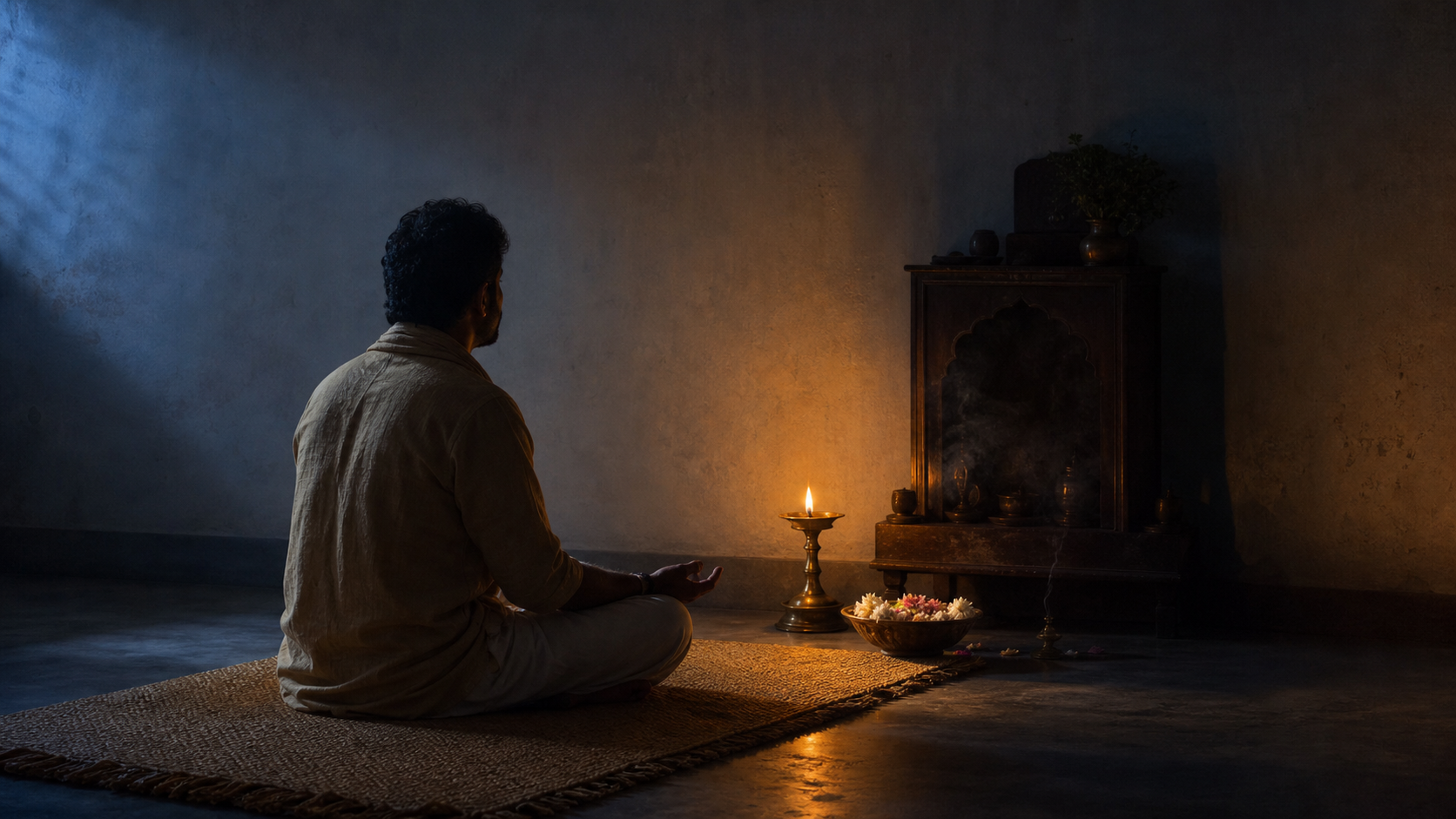
You keep the lamp, repeat the name, and sit for prayer, but the warmth that once came easily is gone. Or perhaps it never came at all. The silence leaves you wondering whether your devotion is shallow, whether the Divine has withdrawn, or whether you have mistaken emotional need for bhakti.
You do not have to pretend that absence feels sweet. You do need to know what to do with it. Dharmic traditions judge longing less by its emotional intensity than by what it becomes: steadier remembrance, freedom from possessiveness, greater truthfulness, and service that continues when no consolation arrives.
Divine absence is not automatically spiritual failure
Bhakti can include delight, intimacy, tears, beauty, and a vivid sense of presence. It does not, however, depend on receiving those experiences continuously. The devotional vocabulary of rasa distinguishes sambhoga, love experienced in union, from vipralambha, love experienced in separation. The second is not merely a deficient version of the first. Properly held, vipralambha can intensify remembrance and loosen the demand to possess what is loved.
Radha-Krishna devotion gives this paradox its most refined form. In the 10th Skandha of the Srimad Bhagavatam, presence and apparent withdrawal shape the Rasa-lila and the later anguish of separation. In Jayadeva’s 12th-century Gita Govinda, estrangement, yearning, reconciliation, and renewed intimacy become an intricate language of sacred love. Gaudiya Vaishnava theology later describes Radha as Krishna’s hladini-shakti, the personified potency of divine bliss and love.
Their apparent distance therefore should not be reduced to an unhappy human romance. Achintya-bheda-abheda, inconceivable oneness and difference, allows Radha and Krishna to be inseparable at one level while meeting each other in loving relation at another. On the narrative plane, separation is real enough to be felt. On the theological plane, it unfolds within a unity that has never been destroyed. Remembrance becomes the bridge between those levels.
A textual nuance matters here. Radha is not consistently named in the Bhagavatam’s Rasa-lila passages, although later Sanskrit, vernacular, liturgical, and theological traditions identify a foremost gopi whose devotion becomes associated with her. You need not deny that historical development in order to enter the practice. It shows how generations of devotees developed an increasingly precise vocabulary for the highest forms of love.
The practical lesson is simple: stop using felt sweetness as the only measure of a successful practice. After japa, kirtana, or silent prayer, ask questions that can still be answered on a dry day:
- Did the Divine name return to your attention after it wandered?
- Did the silence make your prayer more honest, or merely more demanding?
- Did you become a little less harsh in the next conversation?
- Did you fulfill the duty in front of you without making recognition the price of service?
If remembrance and ethical steadiness are growing, absence may be doing real devotional work. If the practice is producing entitlement, contempt, or fixation, intensity alone does not make it sacred.
Learn to distinguish longing from attachment

Not every ache is viraha, and not every powerful feeling is prema. Dharmic vocabulary helps because it does not place every form of attraction under the single word love. Kama seeks gratification. Sneha is affection. Maitri is friendliness. Karuna is compassion. Prema is love becoming expansive, non-possessive, and increasingly concerned with the good of the one who is loved. The movement from desire to prema is a change in motive and conduct, not simply an increase in feeling.
This distinction protects both spiritual practice and human relationships. Devotional imagery cannot be used to sanctify jealousy, coercion, surveillance, or refusal to accept another person’s boundary. Radha-Krishna’s sacred separation is not permission to pursue someone who has declined a relationship. Love without possession means exactly that: the other is not an object through which you complete your preferred story.
Watch what your longing asks you to do. Its direction tells you more than its intensity:
- Longing that is ripening into devotion returns you to remembrance, prayer, study, restraint, and compassionate action.
- Longing distorted by rajas becomes restless, dramatic, comparative, and hungry for repeated signs or emotional peaks.
- Longing clouded by tamas turns into resignation, neglect, resentment, or the belief that nothing matters because consolation is absent.
- Longing clarified by sattva becomes quieter, more lucid, less controlling, and more capable of serving without display.
Raga and dvesha, grasping and aversion, often work as a pair. You grasp at an experience of nearness, then resent the silence when it does not appear. The immediate remedy is not to manufacture a better mood. Practice santosha by receiving the present session as it is, and practice samatva by refusing to treat sweetness as success and dryness as defeat.
Householder duty offers a reliable test. If longing repeatedly becomes an excuse to ignore children, elders, work, promises, health, or basic honesty, it is not yet functioning as mature bhakti. Grihastha life is not an interruption of devotion. It is where devotion is tested under fatigue, disagreement, limited time, and obligations you did not choose for their emotional appeal.
Spiritual language should not conceal serious distress. If yearning is accompanied by an inability to function, dangerous behavior, or thoughts of harming yourself or someone else, devotional practices and spiritual counsel are not substitutes for qualified mental-health or emergency support. Seek that help directly while retaining any safe spiritual practices that support you.
Give longing a disciplined form instead of chasing a mood
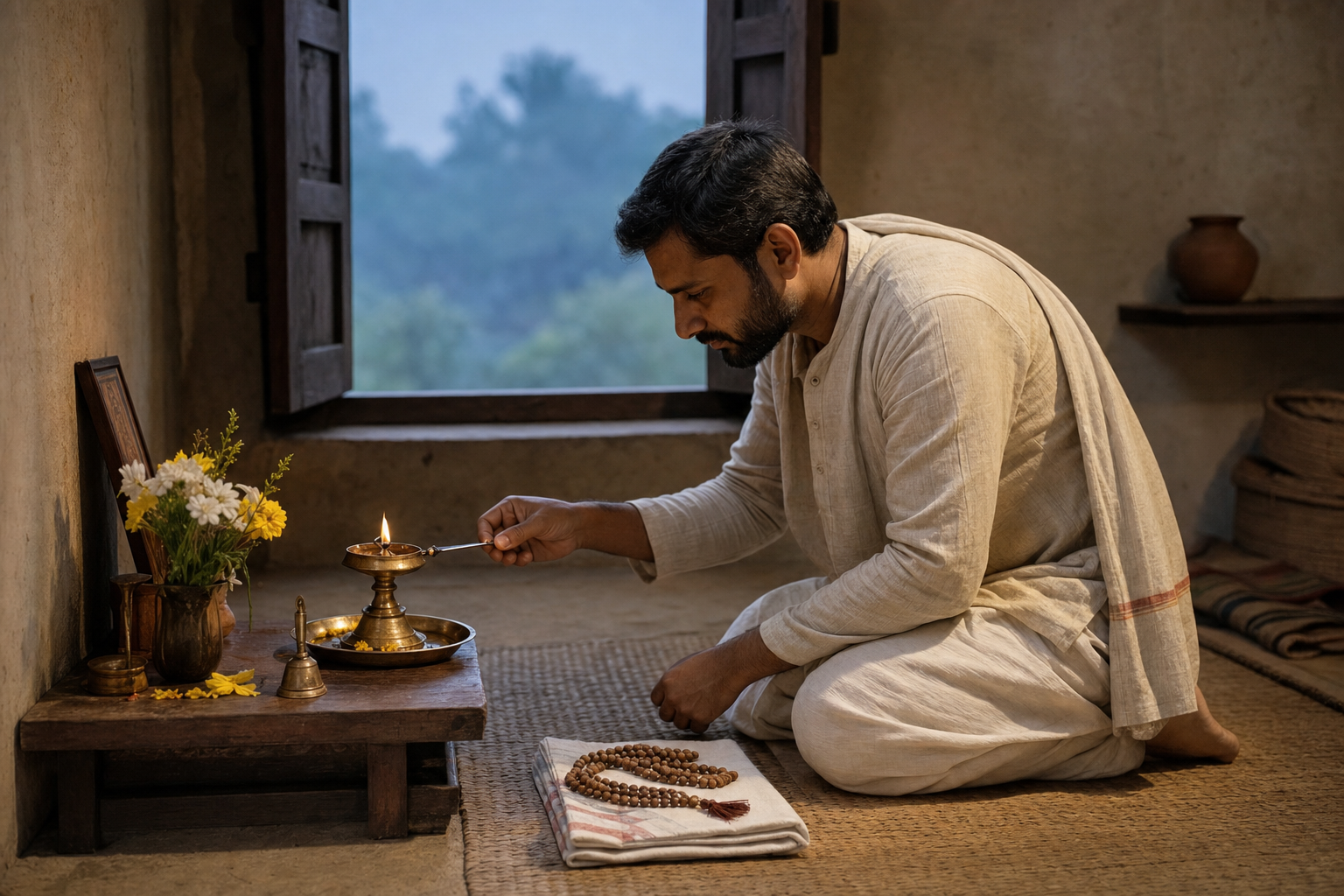
The Bhagavata tradition organizes bhakti into nine modes: shravana, listening; kirtana, singing or recitation; smarana, remembrance; pada-sevana, service at the Divine feet; archana, worship; vandana, reverent prayer; dasya, service as a devoted servant; sakhya, friendship; and atma-nivedana, self-offering. These are ways of training love through attention, relationship, ritual, and action. They also prevent you from confusing bhakti with a single emotional state.
You do not need to perform every mode every day. Choose one inward practice and one outward practice, then keep them stable long enough to notice their effect on conduct. Constantly changing mantras, teachers, music, or visualizations whenever a practice feels dry can train the mind to seek novelty rather than deepen remembrance.
- Establish your ishta. Relate to the Divine through a form, name, or ideal that is genuinely rooted in your temperament and tradition. Ishta honors plurality without turning practice into random spiritual consumption. If you already have a mantra or lineage commitment, let that commitment guide the choice.
- Anchor remembrance in one repeated name. Use nama-japa at a dependable point in your day. On a dry day, your task is not to produce emotion. Hear the name, notice when attention leaves, and return without staging an inner drama about the wandering.
- Feed memory with shravana or kirtana. Place listening, recitation, or singing next to your japa practice. Sacred narrative and melody give attention somewhere definite to rest when abstract contemplation becomes thin.
- Practice lila-smarana carefully. Bring one sacred scene to mind and stay with its devotional meaning. If you contemplate separation, notice the faithfulness of remembrance rather than indulging a fantasy of personal tragedy. The purpose is orientation toward the Divine, not amplification of your own emotional identity.
- Pair remembrance with seva. Select a recurring household, temple, community, or work duty and offer it without waiting to be praised. This gives longing an outward channel and reveals whether devotion is becoming generous.
- End with an ethical audit. Before sleep, ask where grasping entered your speech, where aversion hardened your response, and where you remembered to act as an offering. Choose one correction for the next day. Keep the audit factual; self-condemnation is another way the ego keeps itself at the center.
Breath awareness can support this structure. A gentle pause before speech gives reactivity time to settle, while pranayama may help steady attention for japa or meditation. Some yogic maps associate love’s harmonization with anahata, the heart center. Do not make a bodily sensation the new object of craving. The deeper measure remains ethical, cognitive, and contemplative transformation, not tingling, warmth, or an unusual emotional event.
When the same thoughts keep circling without producing clarity, bring them to satsang, svadhyaya, or a trusted guide. A sound guide should help you distinguish surrender from passivity and love from compulsion. Guidance that flatters obsession, encourages coercion, or places the teacher beyond ethical accountability has failed that test.
Let devotion enter speech, boundaries, and ordinary duty

The most revealing moment in devotional longing may come after worship, when someone interrupts you, disappoints you, or asks for work you do not enjoy. A practice that remains beautiful only inside the shrine has not yet crossed into dharma. The transition happens through small transfers of attention:
- Transfer remembrance into speech. Pause before replying when you feel slighted. Choose satya without using truth as a weapon, and choose kshama without pretending that harm did not occur.
- Transfer non-possession into boundaries. Love does not require control, but neither does it require unlimited access. State a boundary plainly, honor the other person’s boundary, and refuse the idea that emotional intensity creates entitlement.
- Transfer surrender into responsibility. Offer the fruit of an action to Ishvara, but still perform the action carefully. Karma Yoga does not erase standards; it releases the ego’s claim over recognition and outcome.
- Transfer intimacy into inclusion. Let care move beyond the people who confirm your identity. Seva to someone outside your preferred circle tests whether affection is widening into compassion.
This is how devotional longing contributes to loka-sangraha, the holding together of social life. The heart’s private ache becomes patience in a household, fairness in exchange, care for the vulnerable, and steadiness in communal duty. Such love does not abandon the world in order to reach the Divine. It treats responsible participation in the world as an offering.
When beauty carries devotion
Music, poetry, dance, and sacred image can carry meanings that discursive thought cannot hold for long. Viraha has shaped Braj poetry, miniature painting, temple arts, and the abhinaya of Kathak and Odissi. These forms preserve subtle movements between nearness, separation, remembrance, and surrender.
Use beauty as a doorway, not as a substitute for practice. After hearing a kirtana, reading devotional poetry, or watching sacred abhinaya, name the quality it awakened: patience, tenderness, courage, humility, or faithfulness. Then give that quality one concrete expression before the day ends. Without that transfer, devotional art can remain an exquisite form of consumption. With it, rasa begins to educate character.
Honor different theologies without flattening their paths

Devotional longing does not carry exactly the same metaphysical meaning in every Hindu school. The differences are substantial, and you do not need to erase them to recognize their shared ethical fruits.
- In Advaita Vedanta, the apparent otherness between self and reality is traced to avidya. As ignorance recedes, love broadens through recognition of the Self in all beings.
- In Vishishtadvaita, intimacy is grounded in belonging to the Lord, with prapatti, grace, and service shaping the devotee’s response.
- In Dvaita, the distinction between the individual soul and the Lord remains real. Love deepens through gratitude, devotion, and willing obedience rather than ontological identity.
- In achintya-bheda-abheda, unity and difference remain simultaneously true. This gives Radha-Krishna longing its distinctive power: relationship is preserved without severing inseparability.
These schools offer different accounts of who loves, who is loved, and how union should be understood. Choose practices consistent with the theology you actually follow. Mixing vocabulary carelessly can create confusion, especially when surrender in one school, identity in another, and relational difference in a third are treated as interchangeable claims.
Related disciplines appear across the wider dharmic family without making the traditions identical. Sikh devotion gives yearning practical form through Naam-simran, kirtan, seva, and the soul-bride imagery of Gurbani. Buddhist cultivation of metta and karuna trains loving-kindness and compassion without appropriation. Jain commitments to ahimsa, aparigraha, vairagya, and anekantavada restrain possession and widen reverence for life. The common ethical movement is from clinging toward remembrance, non-harm, and service, even though the metaphysical accounts remain distinct.
Use that kinship as an ethical cross-check rather than a reason to collapse all paths into one. If a claimed experience of divine love makes you more violent, more possessive, less truthful, or less capable of seeing from another standpoint, it is moving against the disciplines these traditions cultivate.
Key takeaways
- Felt absence is not proof that devotion has failed; vipralambha can turn absence into sustained remembrance.
- Longing becomes prema only as possessiveness, coercion, and entitlement diminish.
- Measure practice by its effect on attention, speech, duty, boundaries, and service, not by emotional intensity alone.
- Keep one inward discipline and one outward offering stable enough for character to change.
- Respect the theological integrity of your path while using non-harm, truthfulness, compassion, and responsibility as practical tests.
Begin with what is already in reach. Repeat one Divine name without demanding a particular feeling. Offer one recurring duty as seva. At night, identify one place where grasping entered and one correction you will make. Do that faithfully when presence feels vivid and when it does not. Longing becomes devotional when it no longer waits for consolation before choosing love.
References
- DharmaRenaissance Blog – Hindu Views on Love: A Scholarly Guide to Bhakti, Dharma, and the Heart’s Awakening
- DharmaRenaissance Blog – Eternal Longing, Infinite Union: Decoding Radha-Krishna’s Divine Love and Sacred Separation