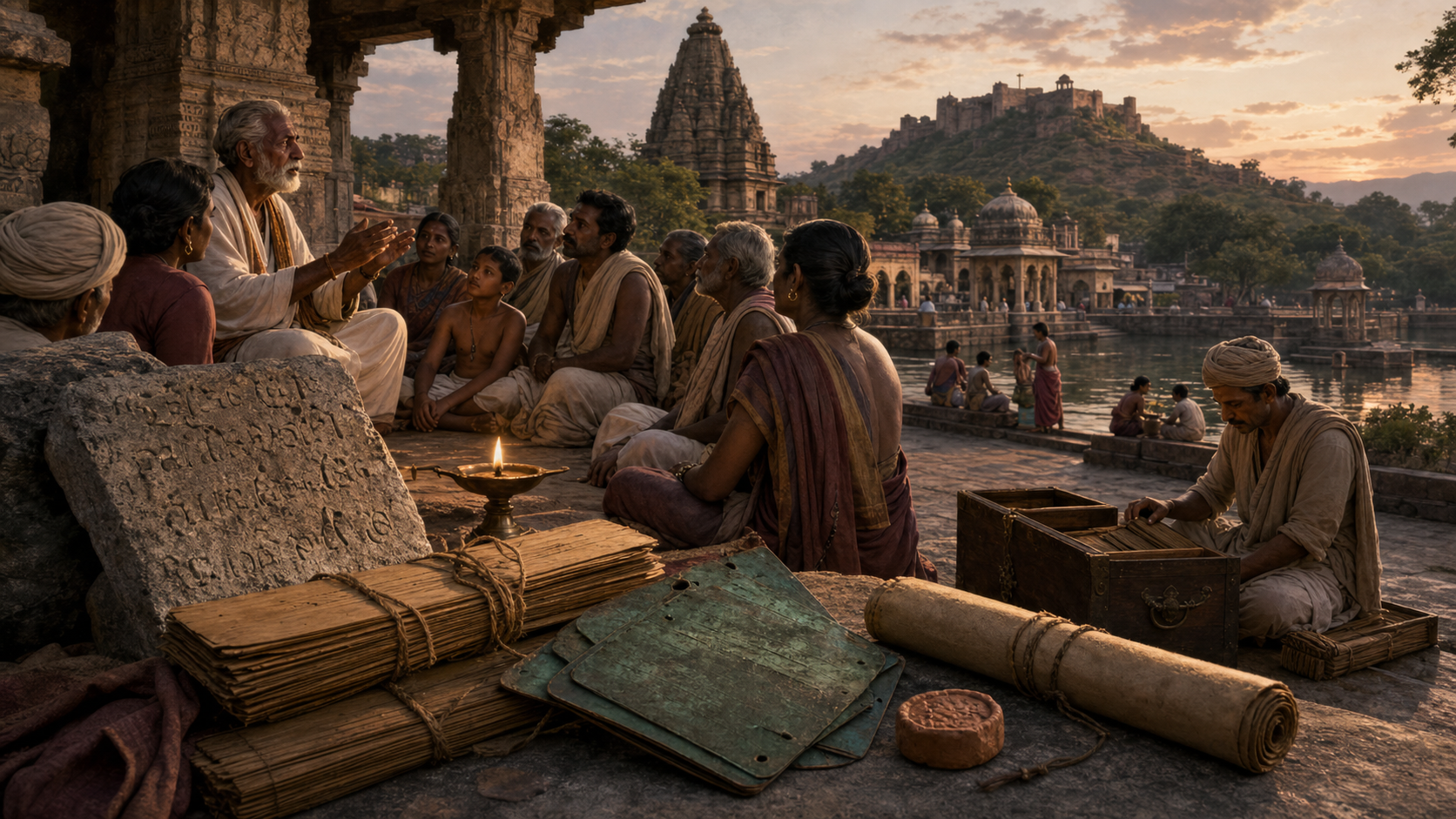
If someone tells you that Hindus had myths but no history, you do not have to choose between accepting the claim and treating every inherited narrative as a literal chronicle. Both responses begin with the same mistake: they force India’s ways of remembering into a single modern category.
A better response is to ask where a community preserved names, lineages, grants, places, conflicts, institutions and moral judgments about the past. Once you know where to look, you find not an empty shelf but a distributed archive. This matters because recovering India’s historical memory requires more than pride. It requires a method you can use to distinguish evidence, interpretation and sacred meaning without discarding any of them.
Start by changing the test
The accusation of historical absence usually rests on a narrow definition. It treats the continuous, court-centered and chronological narrative as the normal form of history. A civilization is then judged historically mature only when its records resemble that form.
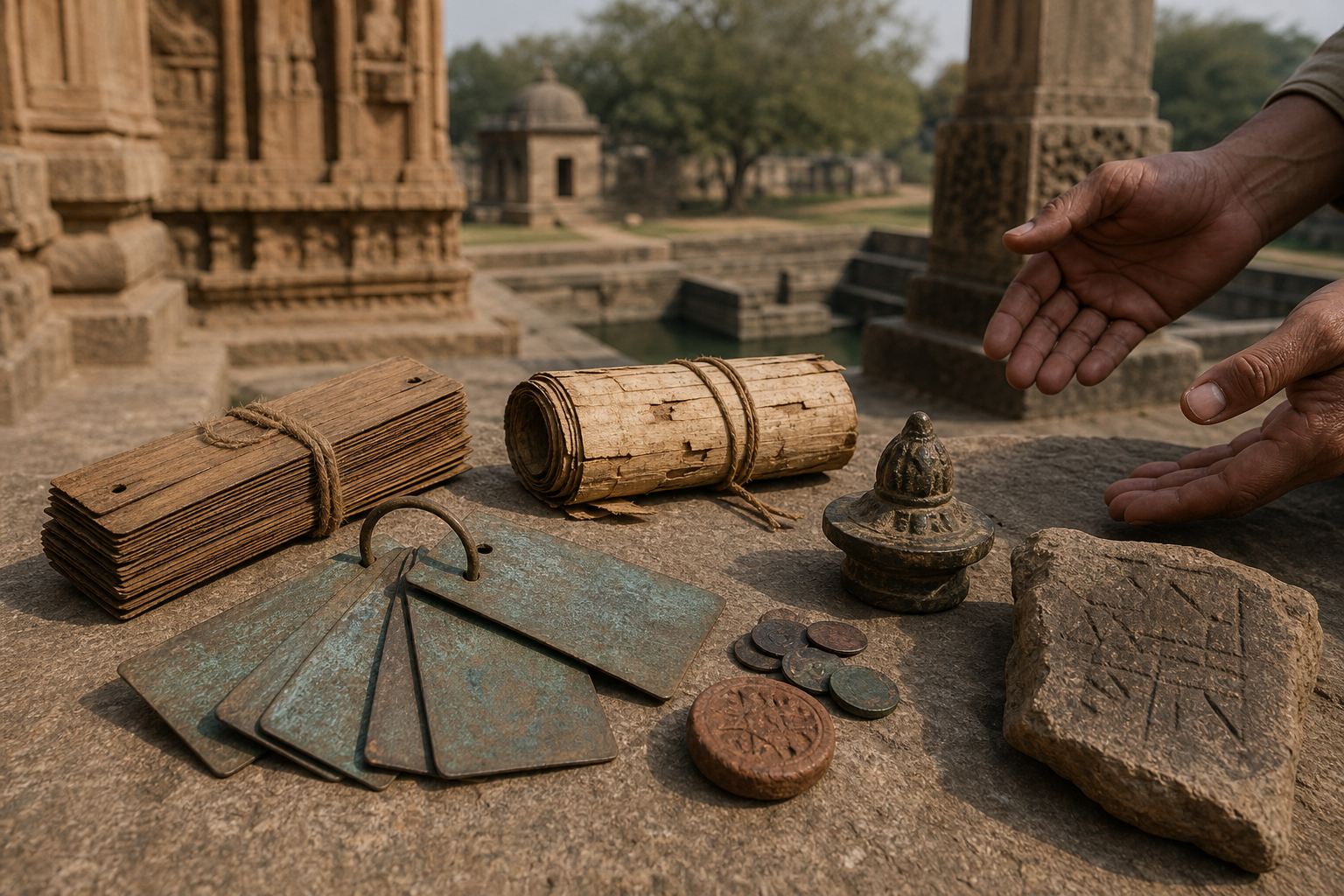
India certainly produced political narratives, dynastic accounts and dated inscriptions. But it also placed memory in Itihasa, Puranas, caritras, genealogies, royal eulogies, copper-plate grants, temple walls, institutional registers and accounts of sacred places. These forms did different jobs. Some remembered rulers and succession. Some established rights and endowments. Some connected a place to a lineage. Some judged conduct through dharma. Together they formed a differentiated ecosystem of historical remembrance.
This distinction is crucial: a sense of history is not identical to the modern academic discipline of history. The former is a civilization’s capacity to preserve, organize and interpret its past. The latter is one institutionalized way of testing and presenting claims about that past. Confusing them makes every premodern civilization look deficient by definition.
The correction should not become an overcorrection. A sacred narrative does not become a dated event merely because it carries civilizational truth. A royal inscription does not become impartial merely because it is carved in stone. Indigenous records deserve to be read seriously, which means reading each according to its form, purpose and conditions of preservation.
Key takeaways
- Do not equate the absence of one preferred chronicle form with the absence of historical consciousness.
- Identify what kind of record you are reading before deciding what it can prove.
- Test a claim across unlike witnesses, such as an inscription, a genealogy, a place-tradition and a court narrative.
- Treat an archival gap as a question to investigate, not as automatic proof that nothing was recorded or remembered.
- Preserve moral and sacred meaning, but do not use it as a substitute for evidence about dates, people or events.
Learn to see the archive Bharat actually made
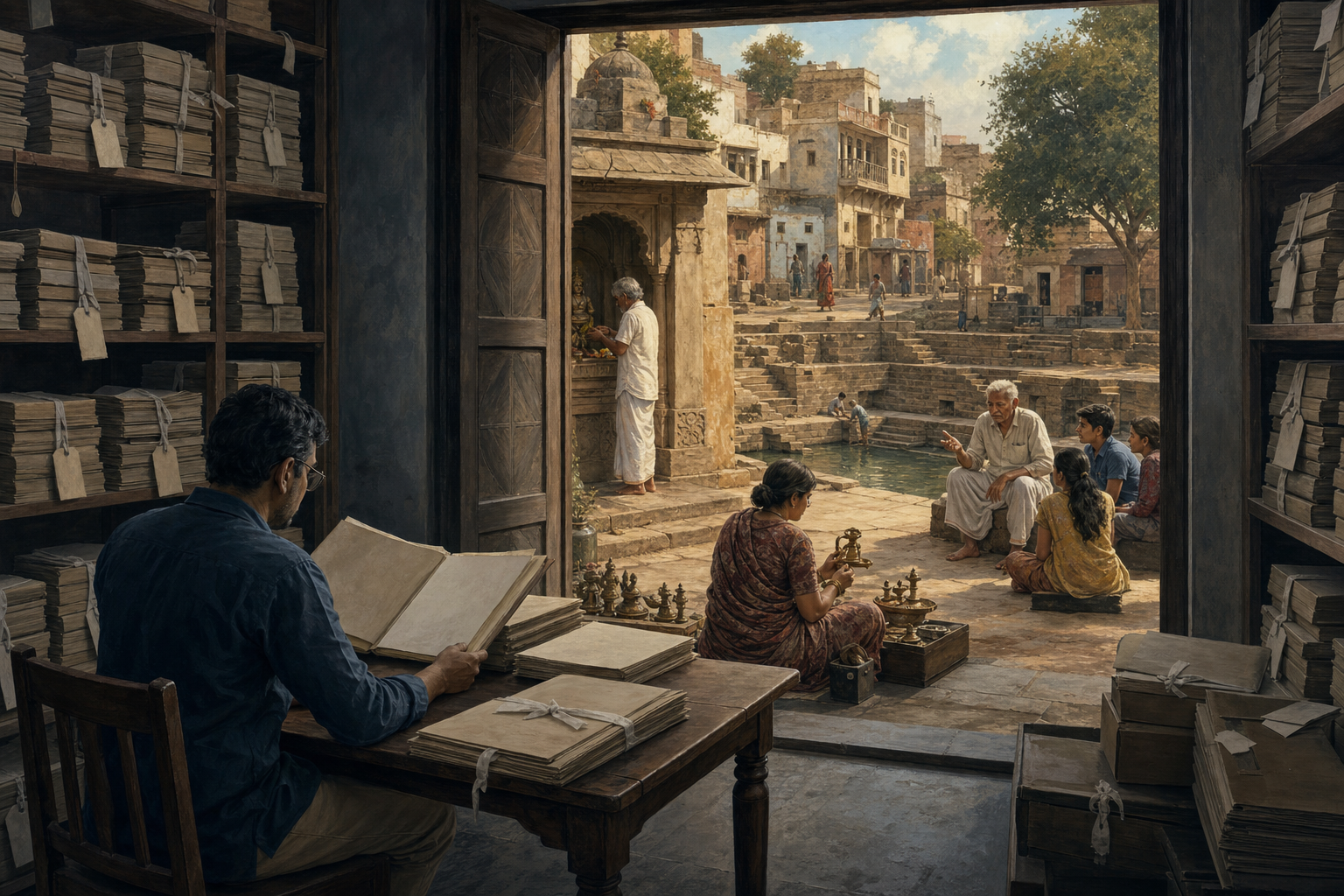
India’s historical memory was distributed because social and political memory had many custodians. A king, temple, matha, village, pilgrimage community, poet and genealogical lineage did not preserve the same facts for the same reason. Their records overlap, but they are not interchangeable.
| Form of memory | What it can help you investigate | Your first caution |
|---|---|---|
| Itihasa and Puranas | Civilizational self-understanding, dynastic and place memories, moral models and ideas of time | They are layered sacred and literary traditions, not modern event ledgers |
| Caritras and vamsavalis | Rulers, lineages, succession, court life, political relationships and remembered character | Literary purpose and patronage influence what receives praise, blame or silence |
| Prashastis, inscriptions and copper plates | Titles, grants, endowments, administrative arrangements, political claims and public commemoration | An official or celebratory record advances a claim; durable material does not guarantee neutrality |
| Temple, matha and village registers | Local administration, custodianship, donations, land, ritual obligations and institutional continuity | Survival may be fragmentary, and a local record should not automatically be generalized to an entire region |
| Sthalapuranas and tirtha-mahatmyas | Place-memory, lineages, renovations, endowments, disasters, community roles and moral expectations | Devotional and oral layers require comparison with material and documentary evidence |
| Foreign and imperial court records | Administration, revenue, warfare, official ideology and the priorities of ruling establishments | A court’s vocabulary reveals its governing frame, not an unmediated picture of every community it ruled |
The epigraphic record alone defeats any simple claim that India did not record political or institutional life. The Allahabad Pillar Prashasti, the Aihole inscription composed by Ravikirti for Pulakeshin II in 634 CE, Chola copper plates and the Uttiramerur inscriptions on local self-governance are prominent examples. Kadamba, Hoysala, Kakatiya and Vijayanagara epigraphy extends the field across regions and centuries. Temple endowment records survive in Sanskrit, Prakrit, Tamil, Kannada, Telugu and other languages. What looks like an absence from a distance often turns out to be a problem of language, genre and access.
Literary narrative also carried political memory. Bana’s Harshacharita, Bilhana’s Vikramankadevacharita, Vakpati’s Gaudavaho, Kalhana’s Rajatarangini and the works of Hemachandra combine artistry with lineages, political events, social observation and judgments about conduct. Their literary character is not a reason to discard them. It is a reason to ask how form shapes selection and emphasis.
Kalhana is especially useful because his 12th-century history of Kashmir drew upon earlier lists, inscriptions and texts and subjected inherited accounts to critical judgment. It is tempting to call this a surprisingly modern method. That compliment can obscure more than it reveals. Kalhana did not have to become culturally modern before he could compare records. His work belonged to an indigenous intellectual lineage in which earlier testimony could be collected, weighed and integrated into a political narrative.
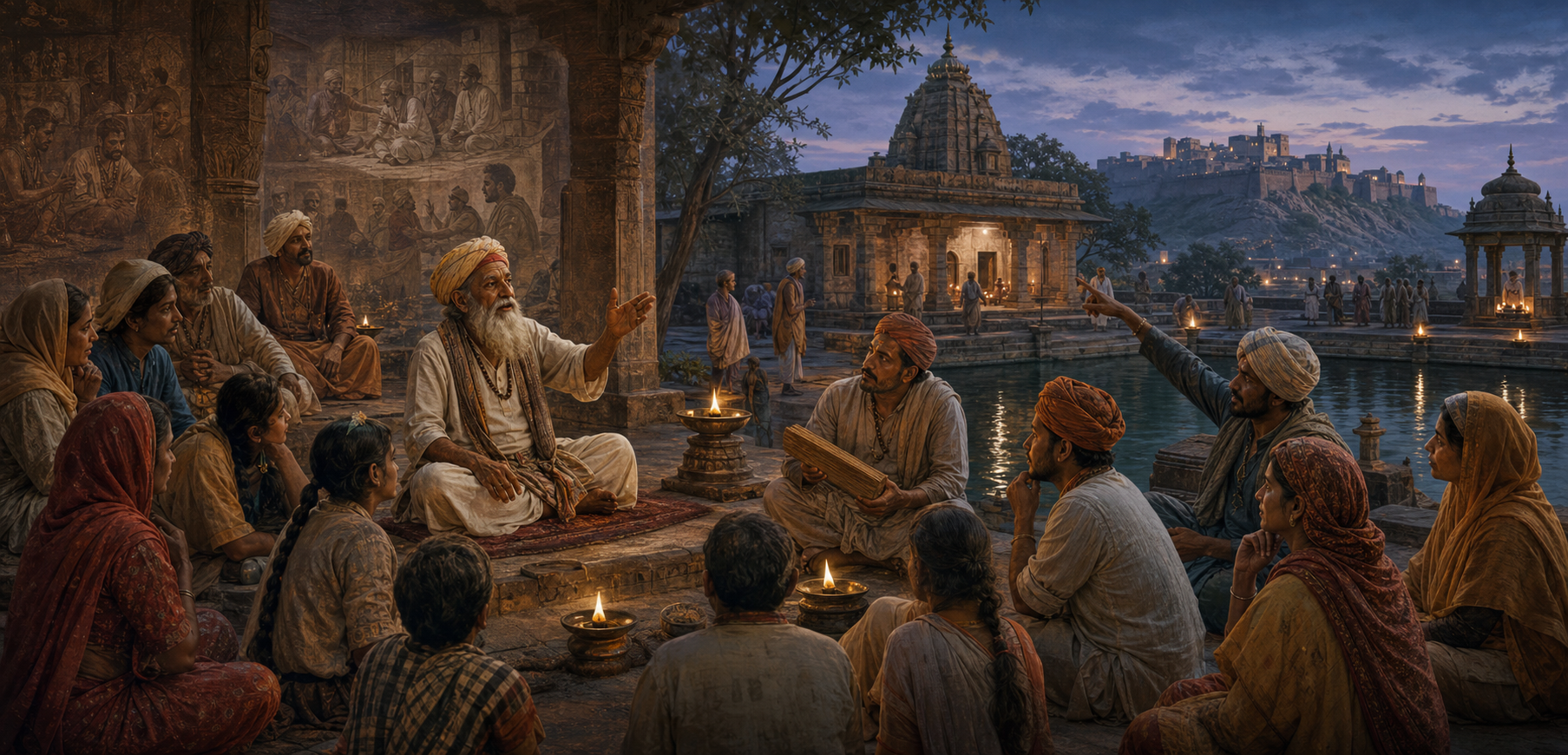
Place-traditions require the same seriousness. A sthalapurana or tirtha-mahatmya may carry memories of a lineage, endowment, craft community, renovation, flood or famine alongside theological meaning. Calling all of it folklore closes the inquiry too early. Calling all of it verified history closes it just as early. Your task is to isolate the recoverable claim and test it against inscriptions, material remains and records of economic or institutional life.
Read layered memory with disciplined sympathy
A useful method neither begins with suspicion toward indigenous testimony nor grants it automatic immunity from scrutiny. It begins by asking the same demanding questions of every record, whether the language is Sanskrit, Tamil, Kannada, Telugu, Persian, Arabic or English.
Establish the record’s job before extracting facts
Start with function. Was the record composed to praise a ruler, confirm a grant, preserve a genealogy, explain a sacred place, regulate an institution or narrate a reign? Then identify its likely audience and patron. A prashasti can preserve names, titles, relationships and political aspirations while using praise as its governing mode. A grant can establish a transaction while presenting the donor according to an ideal of kingship. Purpose does not make a record useless; it tells you how to read it.
Apply this rule evenly. Medieval Persian and Arabic chronicles are indispensable for reconstructing court politics, administration and war. Works associated with Barani, Minhaj-i Siraj and the Mughal court also employ normative languages of sovereignty, victory, law, revenue and subjecthood. Terms such as zimmi and levies such as jizya belong to particular ideological and administrative settings in certain periods. They should be studied directly, but a courtly classification must not be mistaken for the complete social identity of the people being classified.
Separate anchors, inferences and meanings
As you take notes, keep three layers apart. An anchor is what the record directly presents: a personal name, title, location, lineage, grant, renovation or date. An inference is the conclusion you draw by connecting that information to other evidence. A meaning is the moral, sacred or political significance the tradition gives the remembered event.
These layers can support one another, but they cannot silently replace one another. A remembered flood may lead you to inspect construction phases, endowment changes or other local records. The sacred interpretation of that flood tells you how the community understood its endurance. It does not by itself establish a calendar date. Conversely, uncertainty about the date does not erase the tradition’s role in shaping collective memory.
Triangulate unlike witnesses
Do not merely collect several retellings that may descend from the same account. Compare different kinds of evidence. Put the local narrative beside an inscription. Compare a royal claim with a land grant or institutional register. Read an imperial chronicle alongside vernacular literature and Dharmic institutional records. Where appropriate, bring in archaeology and economic history.
Agreement between unlike witnesses raises confidence because each preserved the past through a different mechanism. Disagreement is also evidence. A ruler’s victory claim and a local memory of displacement may be answering different questions. Record the difference before trying to harmonize it. Forced harmony produces a comforting story; documented tension produces better history.
Keep truth and feeling in the same field of vision
Dharmic traditions did not normally treat the past as morally inert. Dharma, artha, kama and moksha informed judgments about rulers, householders, institutions and communities. That value-laden quality should be made visible rather than stripped away in pursuit of an imaginary neutrality.
Both truthful and warm-hearted, both factual and moving.
D.V. Gundappa
The balance is exacting. Warmth without conscience becomes romanticism. Fact collection without attention to inherited meaning cannot explain why a memory survived or what work it performed. A responsible historian tells you both what can be established and why a community considered it worth carrying forward.
Read archival silences as problems, not verdicts
When fewer indigenous records survive for a particular region or century, three possibilities must remain open. A record may never have been made. It may have been made and lost. It may survive but remain uncatalogued, dispersed, untranslated or unrecognized as historical evidence. Claiming certainty before distinguishing these possibilities turns absence into rhetoric.
The physical archive was vulnerable. Palm-leaf manuscripts depended on recurring acts of copying and custodial care. Copper plates and institutional registers could be separated from their communities through conflict or migration. When patronage moved away from temples, mathas and other knowledge institutions, the people and practices required to maintain a record could disperse even if the surrounding culture continued.
War and political upheaval intensified that vulnerability. Nalanda, Odantapuri and Vikramashila were devastated around the turn of the 13th century. Elsewhere, temples and manuscript collections underwent cycles of plunder, abandonment or neglect. Later extraction and dispersal under colonial rule further separated manuscripts from the contexts in which they had been interpreted and maintained.
None of these mechanisms proves that every missing record was destroyed by conquest. That claim would outrun the evidence. They do show why survival cannot be treated as a neutral sample of everything once known. Archives reflect durability, patronage, political power, custodial continuity and later decisions about what deserved collection.
This survival problem helps explain why Persian and Arabic court materials form a large, relatively contiguous body of evidence for parts of medieval India. Their continuity reflects the record-making needs and support of states as well as later archival priorities. These materials must be used, not rejected. But they should be compared with epigraphy, vernacular writing and local institutional memory rather than allowed to stand in for the whole civilization.
British rule changed the archive again. Surveys, gazetteers and professional repositories expanded certain forms of documentation, while Eurocentric classifications often demoted Itihasa, Puranas and local knowledge to categories outside history. Parts of the educated elite inherited that hierarchy. The result was not simply the addition of new evidence; it was a new gatekeeping rule about which forms of memory counted.
You can avoid repeating that error by making every assertion about silence precise. Name the region, century, institution and kind of record. State whether the problem is non-production, known destruction, material decay, loss of patronage, dispersion or lack of cataloguing. If you cannot tell, say that the cause is unresolved. A bounded gap is a research question. A vague claim that India kept no history is a civilizational judgment disguised as one.
Build one piece of civilizational memory correctly
Reclaiming historical memory becomes real when you move from defending an abstraction to preserving a traceable record. You do not need to begin with the history of all Bharat. Begin with one place, institution, lineage or episode that can be investigated within clear boundaries.
Choose a question small enough to answer
Ask who endowed a shrine, when a structure was renovated, which lineage held a custodial role, how a festival survived a disruption or what an inscription says about local administration. A bounded question tells you which records matter. It also prevents a cherished conclusion from deciding in advance what you will count as evidence.
Capture provenance before interpretation
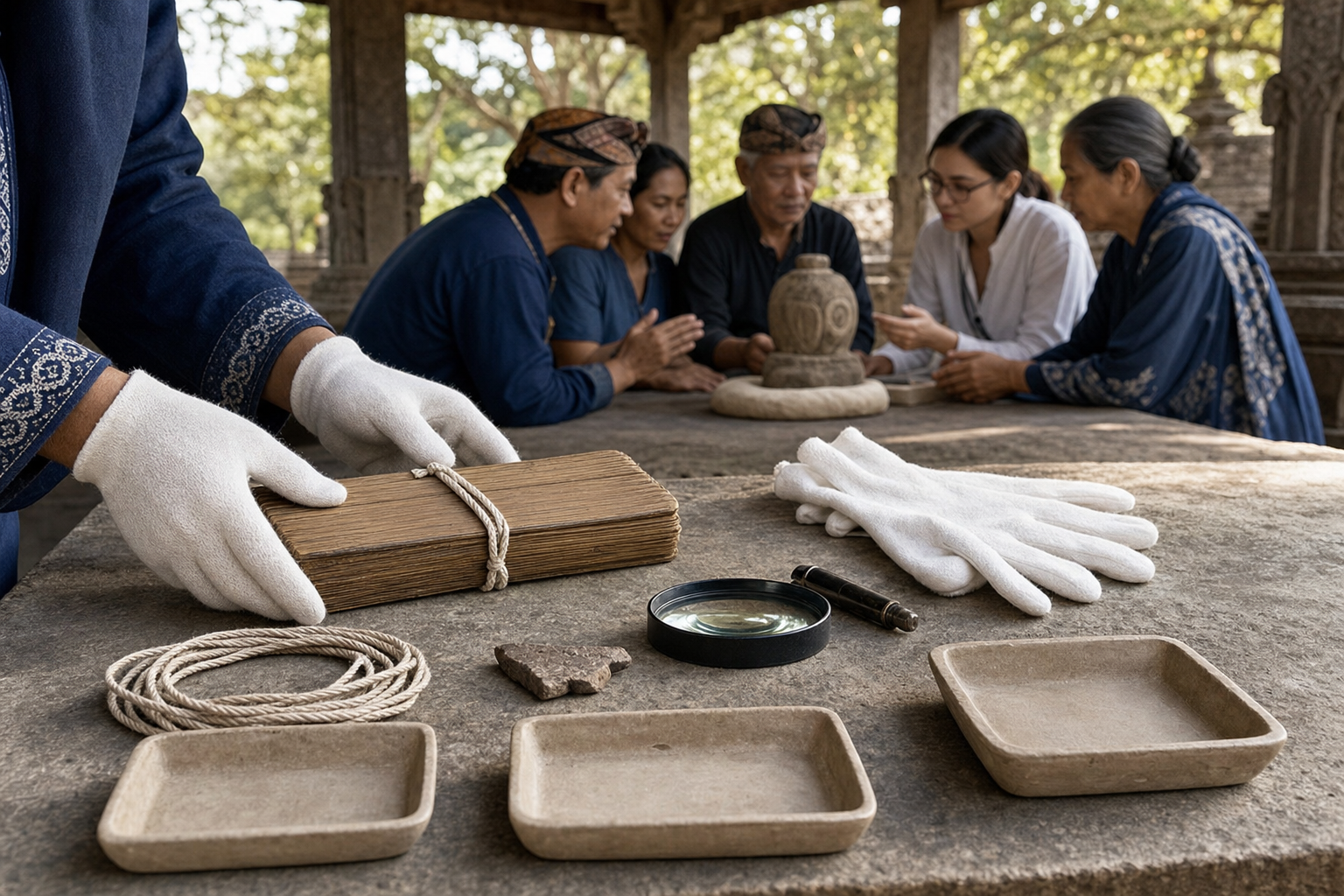
For each item, record where it is held, what material it uses, its language or script if known, the date you examined it and the custodian who provided access. Keep the original image, transcription, translation and interpretation as separate files or clearly separated fields. If the evidence is an oral account, record who narrated it, when it was recorded and how the narrator learned it.
Do not move, clean or handle an inscription or manuscript without the custodian’s permission and suitable conservation knowledge. A clearer photograph is not worth damaging the object. Do not publish restricted ritual knowledge or personal information merely because you were allowed to hear it. Preservation includes respecting the community that kept the memory alive.
Make every conclusion auditable
Attach each conclusion to the item that supports it. Mark uncertain readings as uncertain. Note when two witnesses depend on a common earlier account, because apparent agreement is weaker when the testimony is not independent. Preserve competing readings rather than deleting the one you dislike. A later researcher should be able to retrace your path and see exactly where the evidence ends and your inference begins.
Then compare the dossier across forms: narrative memory, inscription, genealogy, grant, register and material setting. You may confirm only one modest detail. That is still valuable. Civilizational recovery is built from verifiable connections, not from the size of the claim.
The next time you hear that India lacked history, resist the urge to answer with another slogan. Ask what form of memory is being excluded, what evidence survives and what method can test it. Then choose one local record and preserve its provenance. That is how historical reclamation becomes custodianship rather than rhetoric.