
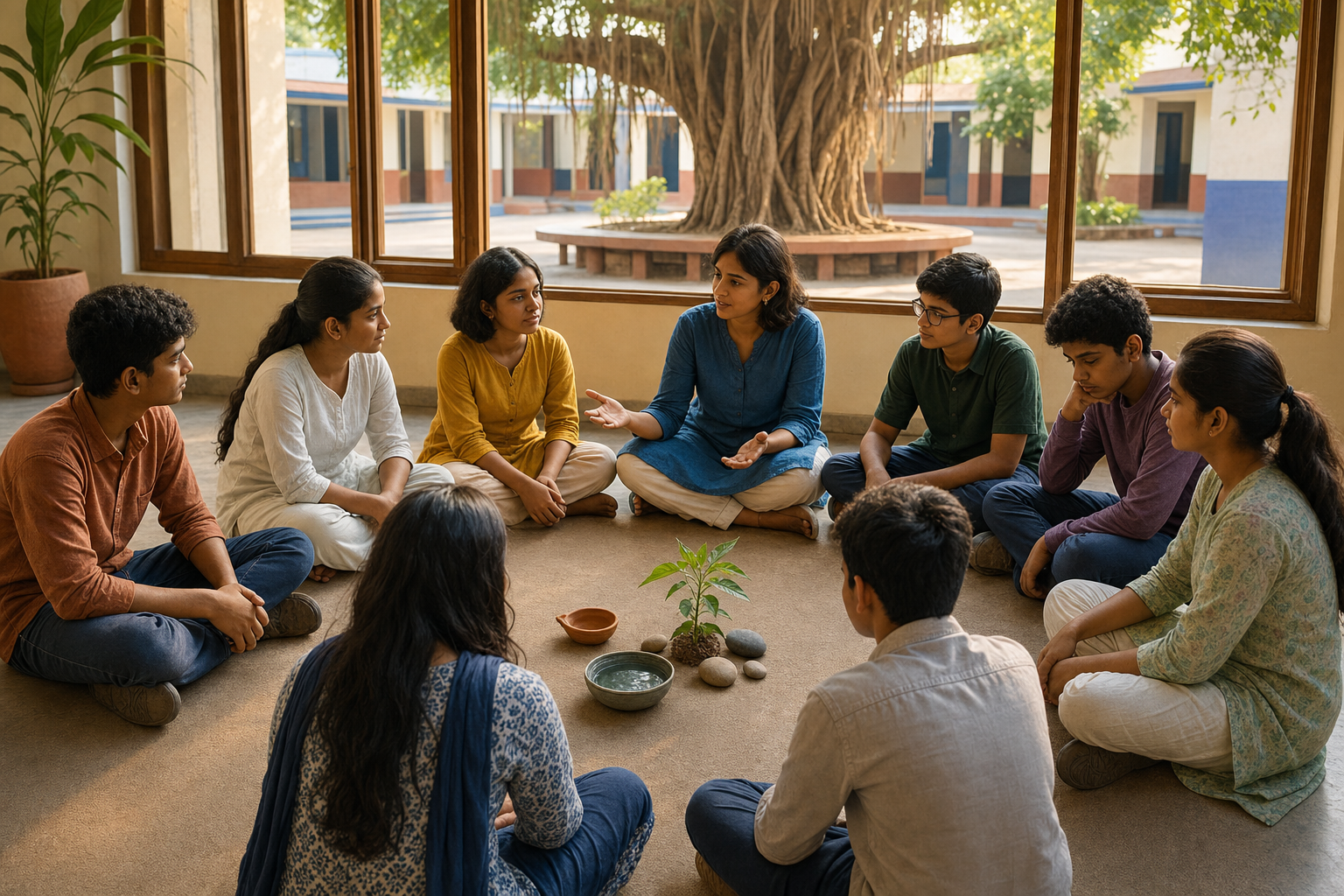
You may be deciding whether to support a values programme at your child’s school, or you may be the teacher expected to design one. The difficult question is not whether education should convey values. Every timetable, reward, punishment and group task already does. The difficult question is how to teach a Dharmic inheritance confidently while protecting every student’s conscience.
A sound programme should leave a student able to do more than repeat noble words. The student should be able to restrain a harmful impulse, hear an opposing view fairly, serve without seeking status, care for shared property, explain the history of a national symbol, and disagree without degrading another person. That is where Dharmic formation and civic education meet.
Define the values before you design the activity
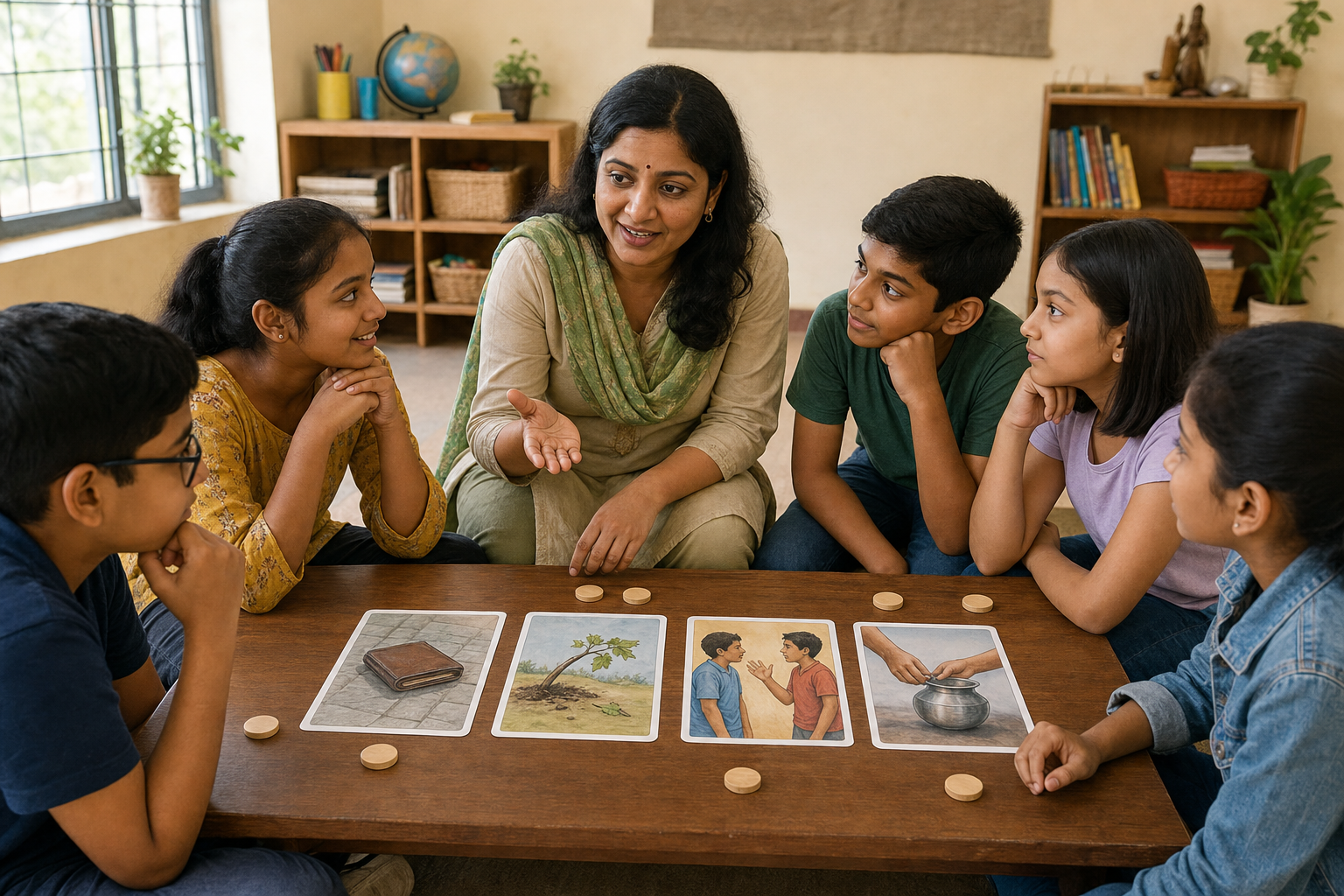
Dharma should not be reduced to a religious slogan, and civic education should not be reduced to memorising constitutional vocabulary. A credible curriculum makes two commitments at once: civilizational literacy and equal civic standing.
Begin by identifying the ethical idea being taught, the tradition from which it comes, and the public capacity it can cultivate. Several Dharmic traditions offer especially useful starting points:
- Ahimsa: notice preventable harm and choose a proportionate response. In school, this applies to physical conduct, humiliation, gossip, online speech and the treatment of animals and the environment.
- Seva: meet a real need without making recognition the purpose. Students should learn to ask what a community needs before deciding what they want to give.
- Anekantavada: recognise that a single viewpoint may not exhaust a complex reality. A practical exercise is to require a student to state an opposing position accurately before criticising it.
- Metta: cultivate goodwill without pretending that disagreement has disappeared. This can shape how students correct, debate and compete.
- Disciplined pursuit of dharma: connect freedom with duty, self-command and responsibility for consequences. This turns character into a daily practice rather than an occasional moral lecture.
These ideas are not synonyms. Jain ahimsa and anekantavada, Buddhist metta, Sikh seva, and Hindu understandings of dharma arise within distinct philosophical and spiritual settings. Teach those settings accurately. Shared civic action does not require the false claim that every tradition teaches the same doctrine.
Then convert each value from a noun into an observable action. ‘Respect’ is too vague for a lesson objective. ‘Wait until a classmate has finished, restate the classmate’s position fairly, and then give a reasoned disagreement’ can be taught, practised and assessed. ‘Service’ is vague. ‘Ask a community partner to identify the need, complete the agreed task, and invite the partner to judge whether it was useful’ is concrete.
This distinction also protects freedom of belief. A school can assess whether a student understands ahimsa, considers consequences and engages respectfully. It should not grade whether the student privately professes a spiritual conviction. If an assessment requires a child to affirm belief rather than demonstrate learning, the assessment is testing conformity, not education.
Build a learning cycle, not a calendar of ceremonies
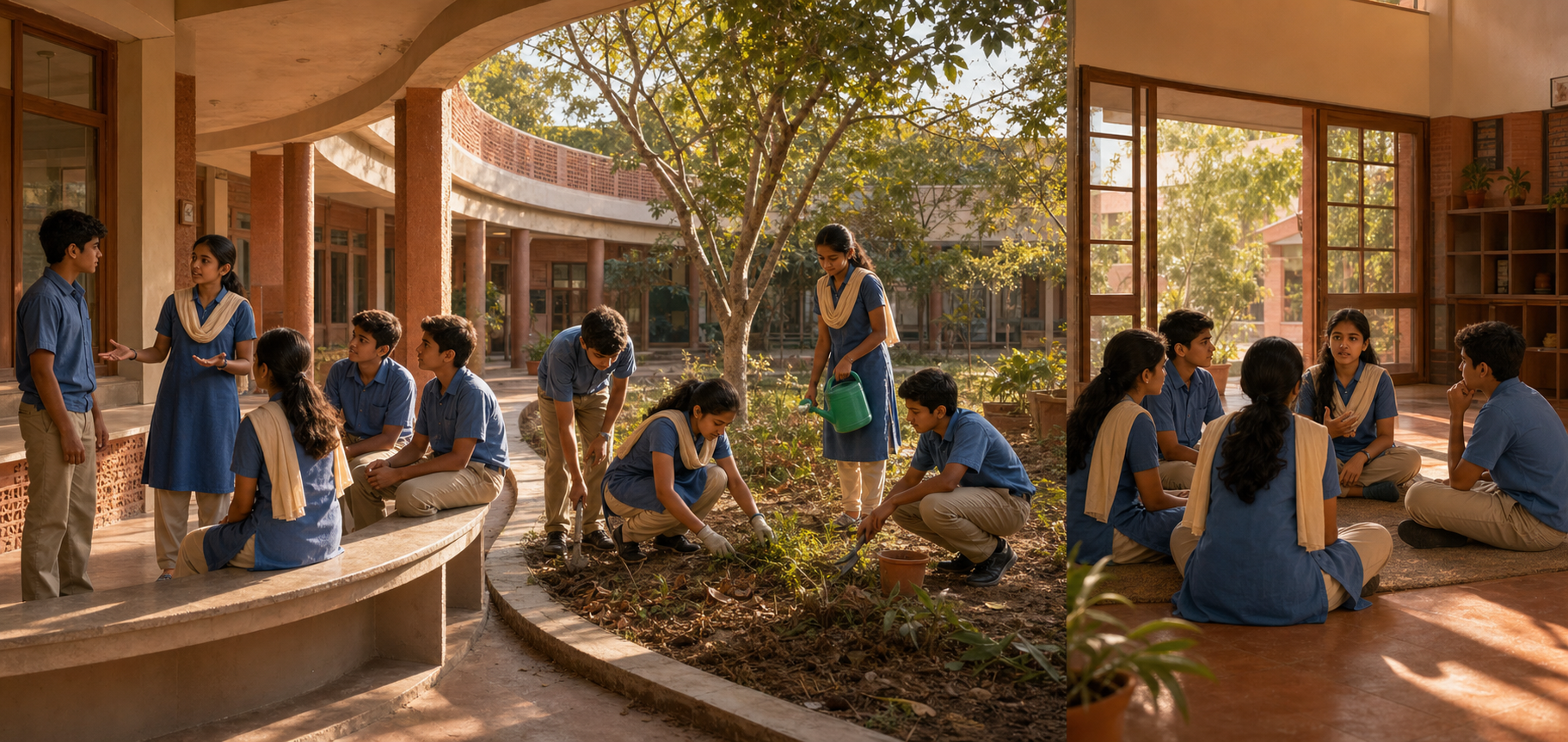
Assemblies, festivals and commemorative days can create attention, but values do not become habits through exposure alone. Use a repeatable cycle that moves from knowledge to judgment and then to conduct:
- Encounter: present a story, teaching, historical episode, local practice or civic dilemma in enough context for students to understand it.
- Interpret: ask which duty or virtue is at stake, who may be affected, and what competing obligations exist.
- Practise: give students a real decision, classroom responsibility, discussion protocol or community task through which the value must be applied.
- Reflect: require evidence. What did the student do? What consequence followed? Whose perspective was missing?
- Revise: let the student identify what should change the next time a similar situation arises.
The same cycle can be adapted to the learner’s stage without diluting the idea. Younger children need concrete duties and visible consequences. Secondary students can handle conflicts between values. University students should connect ethics to disciplinary knowledge, fieldwork and public responsibility.
| Learning context | Useful task | Shortcut to avoid |
|---|---|---|
| Primary classroom | Share materials, care for a common space, listen before responding, and describe who was helped | Reciting a value word without connecting it to conduct |
| Secondary classroom | Analyse a difficult case, identify competing duties, represent more than one viewpoint, and defend a course of action | Rewarding the answer that most closely matches the teacher’s opinion |
| Higher education | Use disciplinary knowledge in a community project, follow ethical safeguards, and evaluate the result | Treating attendance at a volunteer event as proof of learning or social impact |
Good dilemmas prevent values education from becoming decorative. Ask whether ahimsa requires silence when a truthful correction may cause embarrassment. Ask who controls photographs when a service activity helps materially but exposes the recipient’s hardship. Ask how a majority can participate in a national ritual while a conscientious non-participant remains an equal member of the school. Students should have to weigh duties, not merely identify a virtuous keyword.
Assessment should follow the same logic. Look for accurate understanding of the tradition, identification of affected people, reasons for the chosen action, evidence of what occurred, and willingness to revise. Do not award marks for devotional intensity, political agreement or public displays of enthusiasm.
Teach national symbols without turning them into loyalty tests
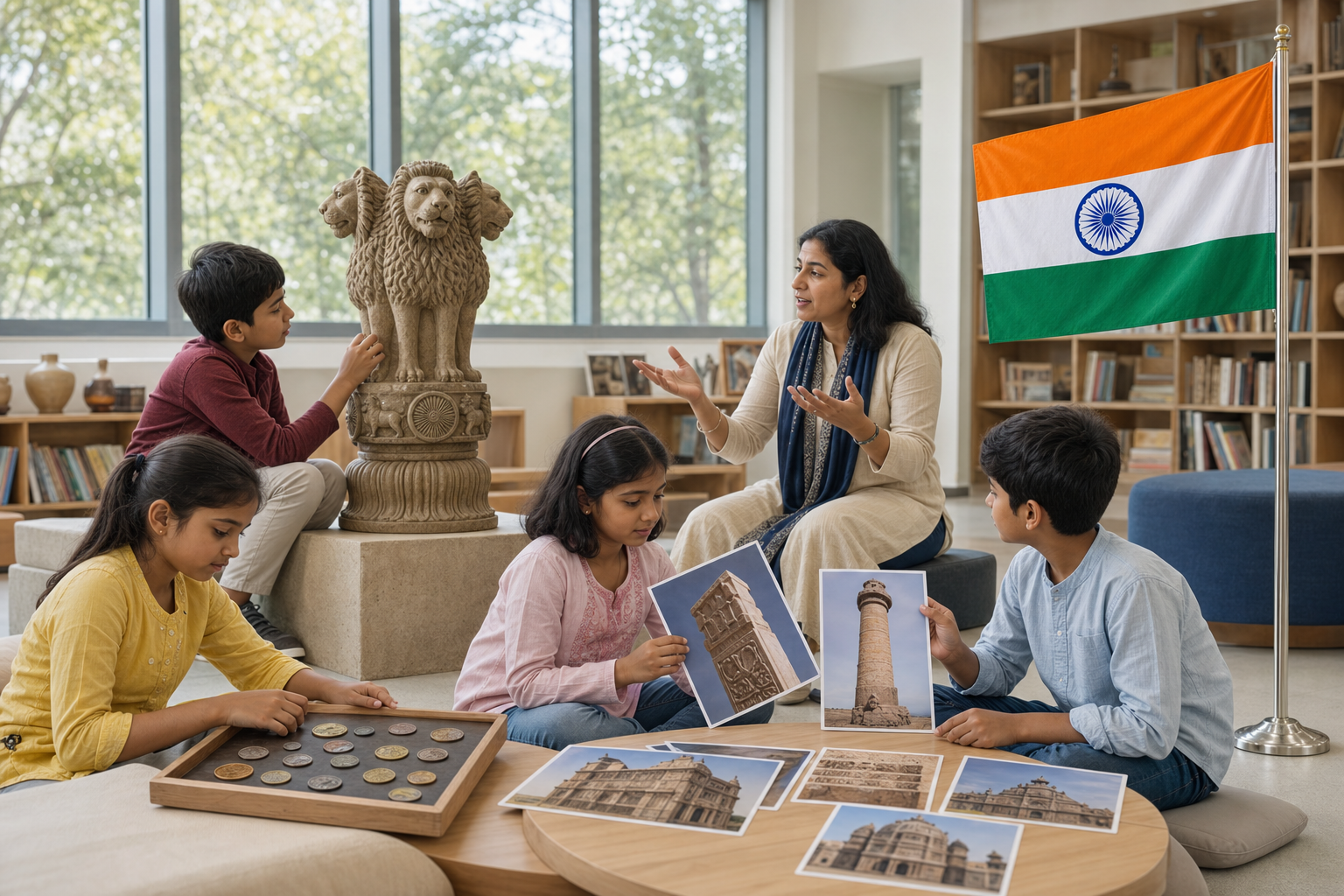
National symbols reveal whether a values programme can hold confidence and restraint together. On 14 May 2026, West Bengal announced that ‘Vande Mataram’ would be mandatory in morning assemblies at recognised schools. The educational promise and the constitutional risk sit in the same word: mandatory.
A school should first teach what students are being invited to sing. Bankim Chandra Chattopadhyay published ‘Vande Mataram’ in the 1882 novel Anandamath. The hymn became prominent in the nationalist movement, including the Swadeshi movement following the 1905 partition of Bengal, and Rabindranath Tagore sang it at the 1896 session of the Indian National Congress. On 24 January 1950, the Constituent Assembly accorded it a place of honour as India’s National Song while recognising ‘Jana Gana Mana’ as the National Anthem.
That sequence turns a daily performance into historical education. Display the first two stanzas customarily used in public settings, provide an accurate translation, teach pronunciation without ridicule, and explain the image of the land as mother. Students can then explore gratitude to the country’s land, people and ecological inheritance without being told that a civic metaphor demands a particular act of worship.
The constitutional distinction is equally important. Article 51A(a) places respect for the Constitution, its ideals and institutions, the National Flag and the National Anthem among the fundamental duties. Articles 19(1)(a) and 25 protect expression and freedom of conscience. In Bijoe Emmanuel v. State of Kerala in 1986, the Supreme Court protected students who declined to sing the National Anthem because of sincerely held religious beliefs while remaining respectfully present.
Bijoe Emmanuel concerned the National Anthem, not ‘Vande Mataram’, so it should not be presented as a direct judicial ruling on the National Song. It nevertheless makes the design problem impossible to ignore: a school can require respectful conduct without humiliating a child or trying to compel an inner conviction.
A rights-conscious assembly protocol should therefore be explicit:
- Teach the words, translation, historical setting and civic meaning before expecting participation.
- State in writing that respectful non-singing will not attract punishment, public questioning, loss of opportunity or a negative behavioural record.
- Provide an accessible alternative for a student who cannot participate in the usual physical or vocal manner.
- Train staff to distinguish disruption from quiet non-participation. The first concerns the rights of others; the second may concern conscience.
- Give families and students a clear grievance path through the school head, management structure or appropriate education authority.
- Assess historical and constitutional understanding through reflection, discussion, music, art or a short project, not through surveillance of enthusiasm.
This is not a retreat from cultural confidence. A symbol taught with historical depth is stronger than a symbol enforced without explanation. A student who understands why generations sang ‘Vande Mataram’ has learned something durable; a student who merely fears being noticed for silence has learned something else entirely.
Make service-learning answerable to the community
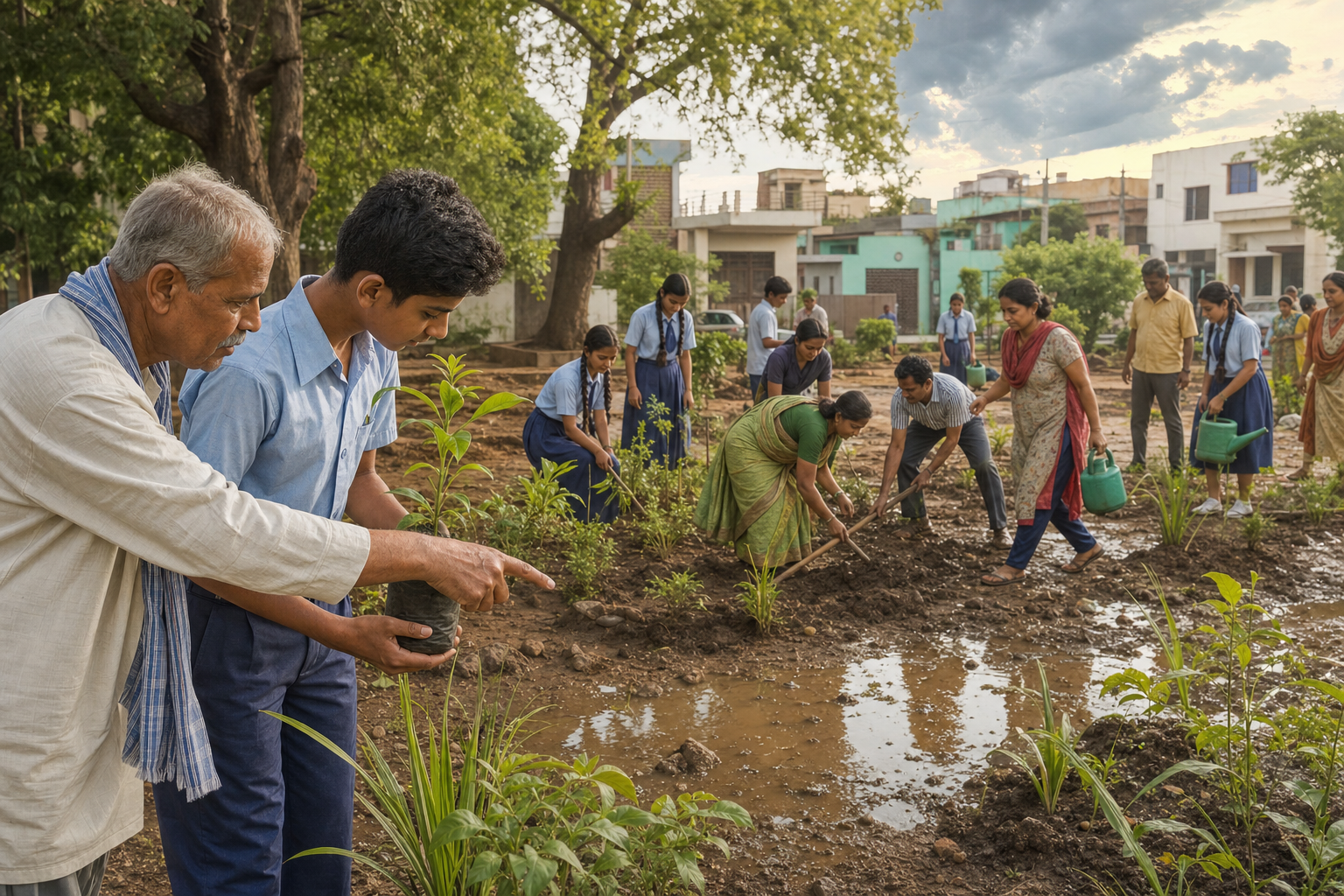
Dharmic and civic education becomes credible when students encounter people whose needs, knowledge and consent matter. The institutional opening already exists: a Kochi dialogue involving Hindu Janajagruti Samiti representatives and academic leader Dr U. Krishnakumar at Amrita Vishwa Vidyapeetham explored common ground around values-based learning, cultural literacy and community engagement. The practical task is to turn such trust-building into academically serious work.
Write a project brief before sending students into the field
A service project needs more than a worthy theme. Its brief should identify the community-defined need, the Dharmic and civic question, the academic contribution, the respective roles of students and partners, the consent procedure, the intended evidence, and what will be returned to the community.
Suitable projects depend on local conditions and institutional competence. Students in a health-oriented setting might support an approved awareness initiative around a hospital community. Arts and humanities students might document living heritage with the permission of practitioners. Science, commerce and technology students might work with local bodies or residents on waste management and environmental stewardship in coastal or backwater communities. The value does not come from placing the label seva on the activity. It comes from disciplined attention to a need that another person has helped define.
Heritage work requires particular care. A ritual, oral history or traditional practice is not raw material that belongs to the student who records it. Agree beforehand what may be observed, photographed, stored, interpreted and published. Explain the intended use in language the participant understands. If a person withdraws consent, the inconvenience to the project does not override that decision.
Give governance to people who can stop a bad idea
A partnership should have a steering group that includes faculty or teachers, students and community stakeholders. In higher education, connect the programme to the Internal Quality Assurance Cell where appropriate. Human-participant work should pass through the institution’s research-ethics process, and personal information should be handled under clear data-protection rules.
The steering group must do more than endorse the programme. It should define scope, approve field protocols, separate educational activity from partisan campaigning, receive complaints, and halt work that becomes unsafe, coercive or extractive. Student enthusiasm is valuable, but it is not a substitute for adult accountability or community authority.
Plurality also belongs in governance. If a project invokes values shared across Hindu, Buddhist, Jain and Sikh traditions, knowledgeable participants should be able to correct inaccurate representation. Inclusion does not mean placing every tradition in every activity. It means avoiding the claim that one organisation, teacher or textbook can speak exhaustively for all Dharmic paths.
Separate activity, learning and impact
Many programmes overclaim because they confuse what happened with what changed. Attendance, volunteer participation, completed surveys and distributed materials are outputs. They show that an activity occurred. They do not by themselves show improved judgment, stronger community trust or a solved public problem.
Use a simple logic chain: inputs lead to activities, activities produce outputs, outputs may contribute to outcomes, and sustained outcomes may produce longer-term impact. Measure each level with evidence suited to it:
- Student learning: compare responses to an ethical scenario before and after instruction, examine reflective writing, and assess whether students can apply a value in a new context.
- Quality of participation: record whether responsibilities were completed, consent procedures followed, disagreements handled respectfully and disciplinary knowledge used correctly.
- Community value: ask partners whether the chosen need was accurate, the work was usable, communication was respectful and further collaboration is wanted.
- Institutional learning: document complaints, ethical problems, failed assumptions and the changes made before the programme is repeated.
- Longer-term impact: claim it only when evidence shows that a benefit persisted. Do not relabel a successful event as social transformation.
Pre- and post-learning checks can be combined with student reflections and community feedback. Sustainable Development Goals and national quality benchmarks may help an institution report relevant work, but those frameworks should be applied after the need and outcome are honestly defined. They should not be used to decorate an activity that lacks community value.
Key takeaways
- Teach each Dharmic concept in its own philosophical setting before drawing a shared civic application.
- Define values through conduct that students can practise and explain, not through slogans or declarations of belief.
- Move every lesson through encounter, interpretation, practice, reflection and revision.
- Teach national symbols through history and meaning while protecting respectful non-participation from punishment or stigma.
- Let communities help define service projects, control consent and judge whether the work was useful.
- Measure learning and impact separately. Neither attendance nor visible enthusiasm proves ethical formation.
Your next step can be small. Take one existing assembly, moral-education lesson or volunteer activity and add these fields to its plan: the named value and tradition, the civic capacity, the action students will perform, the conscience or consent safeguard, and the evidence that will show whether anyone learned or benefited. If one of those fields remains blank, redesign the activity before expanding it.
Dharmic education does not need coercion to be confident, and civic education does not need cultural amnesia to be inclusive. When knowledge, practice, freedom and accountability are designed together, students can inherit a civilization while learning how to share a republic.
References
- Hindu Janajagruti Samiti – Inspiring Dialogue in Kochi: HJS and Amrita Vishwa Vidyapeetham Explore Value-Centered Synergy
- Hindu Existence – Vande Mataram Made Mandatory in Morning Assemblies Across Bengal Schools