
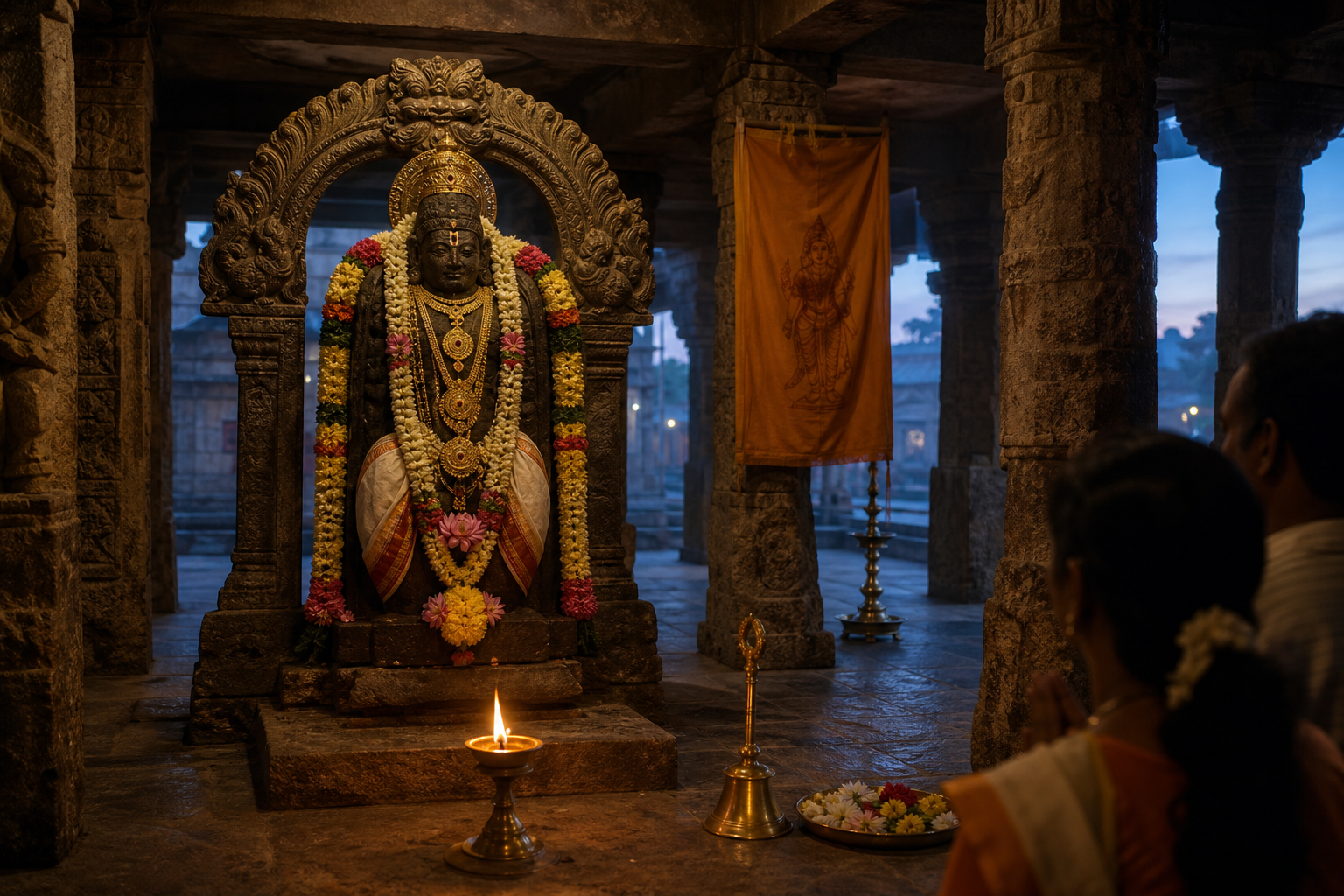
You are standing before a carved deity, a temple banner or an ornament on a murti. Should you see a divine presence, a symbol, a work of art or a piece of inherited culture? If you choose only one of those answers too quickly, you will probably miss what the form is doing.
A better approach is to ask how matter, form, ritual and memory work together. That question lets you appreciate Hindu sacred objects without reducing them either to ordinary things or to puzzles whose only purpose is to conceal an abstract meaning.
A sacred form is more than matter or visual code
Hindu traditions can affirm that the divine exceeds every name and form while also approaching the divine through particular names and forms. These positions are not automatically contradictory. A form can make a relationship possible without exhausting the reality to which it gives access.
This is why murti should not be treated as a polite synonym for statue. A statue can be viewed from a distance as an object. A murti in active worship receives darshana, offerings, bathing, clothing, adornment and service. Devotees arrange their conduct around the presence encountered through it. What practitioners do with the form is therefore as important as what the form looks like.
You should also distinguish several categories that are often collapsed in English:
- An ordinary image depicts a deity or sacred narrative but may have no ritual status.
- An iconographic image follows a recognisable vocabulary of bodily features, attributes, gestures, ornaments and companions.
- A consecrated murti has been ritually installed for worship. The rites and theology differ among traditions, so consecration should not be assumed merely from appearance.
- An emblem identifies a deity, lineage, ruler, ethical commitment or sacred power without necessarily depicting a complete bodily form.
- An ornament can beautify a deity while also communicating identity, rank, quality or theological association.
These categories can overlap. A sculpted form may be an iconographic masterpiece, a consecrated presence and a focus of community memory at the same time. Conversely, a museum sculpture may retain profound religious and historical meaning without functioning there as an installed temple murti.
The familiar accusation that Hindus worship stone or wood starts from the wrong level of analysis. It assumes that a worshipper notices only the substance while ignoring consecration, divine name, inherited form, ritual action and devotional intention. Yet the opposite simplification is also unhelpful: not every Hindu school explains divine presence in exactly the same way. Some descriptions emphasise manifestation, some presence, some a support for contemplation, and many lived traditions hold these dimensions together.
When you encounter a sacred form, begin with one practical question: What relationship does this form establish for the people who honour it? That will take you further than asking whether it is literally a god or merely a symbol.
Material is part of the sacred logic
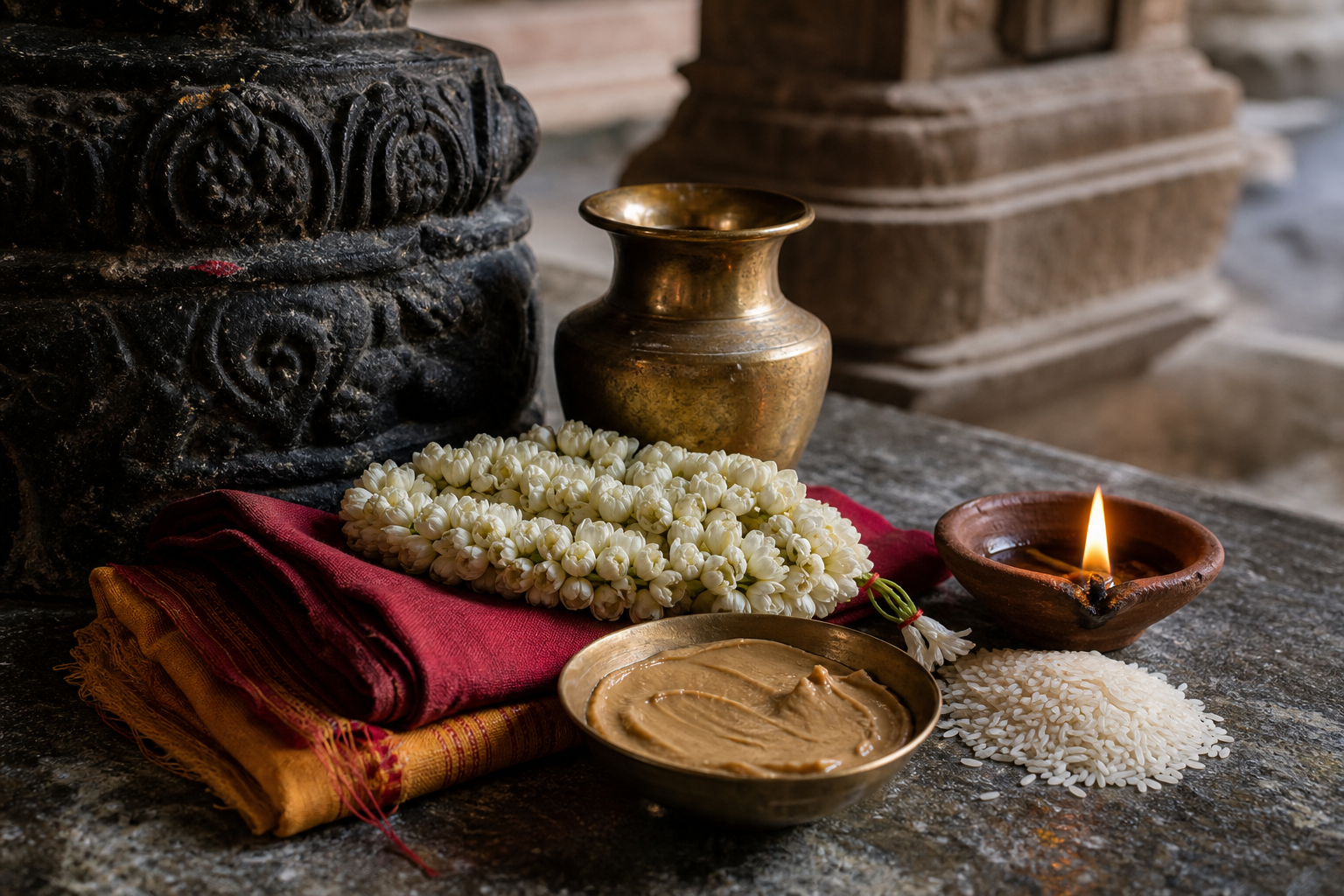
Modern habits often place meaning in the mind and treat physical material as disposable packaging. Hindu ritual culture frequently refuses that separation. Stone, wood, metal, clay, pigment, cloth, flowers and sound can matter because sacred life is enacted through bodies, places, substances and repeated acts.
The material does not become important merely because it is expensive or durable. Within Jagannath devotion, the wooden divine form is approached through the striking expression Daru-brahman, or Brahman in wood. The expression joins an ordinary natural substance with the language of ultimate reality. It prevents you from dismissing the form as only timber while also keeping its material character fully visible.
This does not establish a single Hindu rule that every piece of wood is divine. Sacred status arises within a particular tradition of recognition, formation, consecration and worship. A wooden deity, an unused block of wood and a souvenir carving may share material but not ritual identity.
Four questions will help you read material correctly:
- What is the substance? Identify wood, stone, metal, clay, cloth or another material before jumping to an interpretation.
- How was it given form? Look for a traditional iconographic pattern rather than treating craftsmanship as incidental.
- Has it been ritually established? A form made for worship may pass through consecratory rites; a visually similar object made for display may not.
- How is it cared for? Bathing, dressing, feeding, ornamenting, carrying in procession or placing on an altar reveals the relationship maintained through the object.
The fourth question is especially revealing. Care turns matter into a site of reciprocity. Food is offered and later received as prasada. A lamp is shown before the deity and its light is then received by devotees. Ornamentation is not simply added decoration; it is service performed within a sacred relationship.
Material change need not imply spiritual failure. Wood can weather, flowers fade and clay can return to the earth. The physical properties of a substance are acknowledged rather than denied. What gives the form continuity is not a modern demand for permanent material preservation alone, but its place within a disciplined ritual and theological world.
Flags, ornaments and sounds belong to one visual grammar
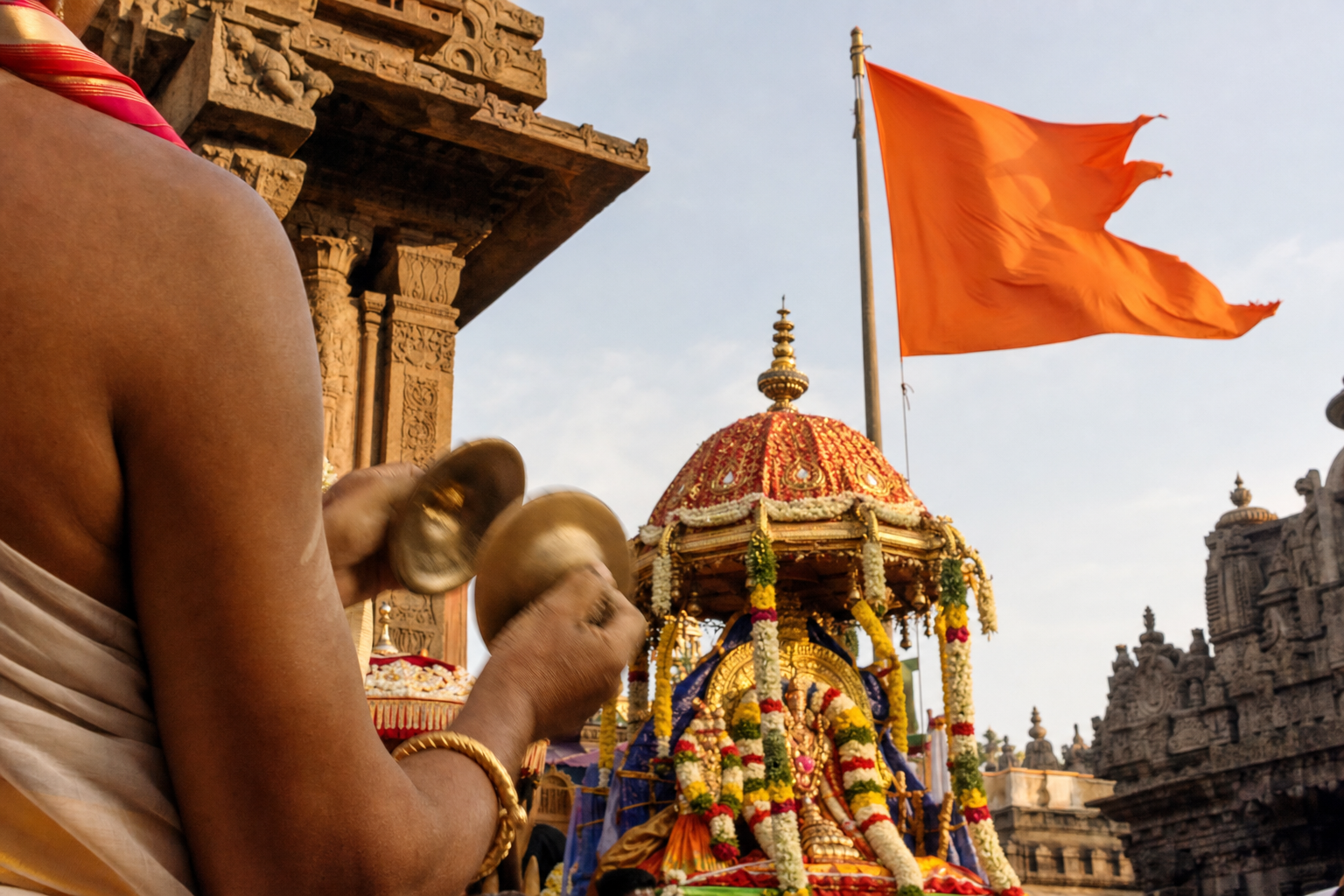
A deity’s body is rarely the only meaningful element in a Hindu image. Gesture, posture, vehicle, weapon, flower, crown, jewellery, colour, banner and attendant can all contribute to identification. You therefore need to read the whole composition before interpreting a single detail.
Consider the self-playing drums on Yudhishthira’s flag at Kurukshetra. A chariot banner was not empty decoration. It publicly identified the warrior and condensed a claim about his character and place in the conflict. The drums, or dundubhi, belong to a world in which sound announces presence, authority and resolve. On Yudhishthira’s banner, that sonic image must be read in relation to his association with dharma.
The important lesson is not that every drum always has one fixed meaning. It is that bearer, setting and narrative alter the force of an emblem. Drums on a royal banner do different work from drums played during temple worship. On the battlefield, the banner communicates before direct combat begins. It makes an ethical and political identity visible at a distance.
Ornaments require the same contextual attention. The hamsa kundala is an ear ornament formed as the sacred hamsa, belonging to the wider category of karna abharana. It is simultaneously jewellery, sculptural detail and symbolic form. If you classify it as decoration alone, you lose the sacred association. If you treat it only as a coded message, you lose the importance of beauty and adornment as modes of honour.
The hamsa is commonly associated with purity and discernment in Hindu thought. On an ear ornament, those associations become qualities attached to the divine or exalted wearer. You may also notice that the ornament stands beside the organ of hearing, but you should label any further connection between the hamsa and sacred listening as an interpretation unless a specific textual or regional tradition confirms it. Good iconographic reading distinguishes what you can identify securely from what you infer poetically.
Use this order when examining an image:
- Central form: Who or what occupies the centre?
- Bodily signs: How many arms, faces or distinctive features are present?
- Gesture and posture: Is the figure standing, seated, dancing, blessing, teaching or protecting?
- Attributes: What is held, worn or displayed?
- Relationships: Which vehicle, consort, attendant, devotee or adversary appears nearby?
- Setting: Is this a sanctum, procession, narrative panel, manuscript, battlefield emblem, household shrine or museum display?
Only after completing that inventory should you ask what a detail means. This sequence protects you from a common mistake: finding an isolated definition in a symbol dictionary and forcing it onto every appearance of the same shape.
A five-pass method for interpreting a sacred object

You do not need specialist training to look carefully, but you do need a method. Use these five passes at a temple, exhibition, historic site or home shrine.
- Locate the object in lived practice. Determine whether it is being worshipped, carried, worn, displayed, stored or studied. Function changes meaning.
- Describe before interpreting. Record visible facts: material, shape, position, gesture, ornament and surrounding figures. Avoid beginning with a grand metaphysical claim.
- Identify the traditional vocabulary. Learn the proper name of the form or feature when possible: murti, dhvaja, kundala, mudra, vahana or another relevant category. A precise name opens the correct field of inquiry.
- Read the cluster. Interpret material, bearer, location and associated features together. A hamsa worn as a kundala is not functioning exactly like a hamsa depicted alone.
- Rank your confidence. Separate secure identification, established traditional association and personal reflection. All three may be valuable, but they are not the same kind of claim.
This method produces a disciplined reading of the three examples above. The hamsa shape of the kundala is an observable feature; its place within sacred iconography is a traditional association; a detailed theory about hearing is a further inference. Yudhishthira’s banner and its drums belong securely to his Mahabharata battlefield identity; a meditation on dharma resounding without human effort is an interpretive development. Daru-brahman securely joins wood and divine presence within a particular devotional world; it does not authorise the claim that every wooden representation has the same status.
Your conduct should follow the object’s setting. In an active shrine, observe local rules, ask before taking photographs and never touch a murti or ritual object merely because it is within reach. In a home, follow the host’s practice. In a museum, you may study the form as art and history while still recognising that its religious identity is not erased by the display case. Respect does not require pretending that every object is ritually active; it requires refusing to treat living sacred traditions as dead ornament.
When information is missing, uncertainty is better than invention. Ask a priest, practitioner, traditional artisan or curator a narrow question: What is this feature called? Is this form consecrated? Does this ornament identify a particular deity or regional style? Specific questions are more likely to produce useful answers than asking what everything symbolises.
Key takeaways
- A Hindu sacred form can be material, aesthetic, symbolic and ritually present at the same time.
- Do not assume that a depiction, an iconographic image and a consecrated murti have identical status.
- Material matters within a tradition of formation, consecration and care; substance alone neither creates nor cancels sacred presence.
- Read every symbol through its bearer, placement and narrative setting. A banner, ornament and divine body perform different functions.
- Separate observation from inherited association and personal interpretation. This makes your reading more accurate without making it less devotional.
- In an active sacred setting, let local practice determine your conduct.
The next time you encounter a Hindu sacred form, give it one uninterrupted minute before searching for a meaning. Notice its material, name its visible features, observe how people relate to it and then ask what those elements do together. That small discipline changes the encounter from decoding an exotic object to meeting a living language of dharma.
References
- Hindu Blog – Symbolism of the Self-Playing Drums on Yudhishthira’s Flag In Mahabharata War
- Dandavats – Understanding Daru-brahman, the Woody-brahman
- Hindu Blog – The Hamsa Kundala: Swan-Form Ear Ornament in Hindu Sculptural Tradition