
You have found a promising date for a puja, wedding, journey, house entry, or new undertaking. Then someone tells you the tithi changes in the afternoon, the nakshatra ends before the ceremony, or the time was calculated for another city. The date that looked settled suddenly is not settled at all.
The practical answer is to stop treating an auspicious date as a full-day label. Define the act, use a Panchanga for the place where it will begin, check the five limbs at the intended start, and choose a workable interval rather than a fragile minute. That is the heart of sound muhurta planning.
A Panchanga date is a moving window, not a fixed label
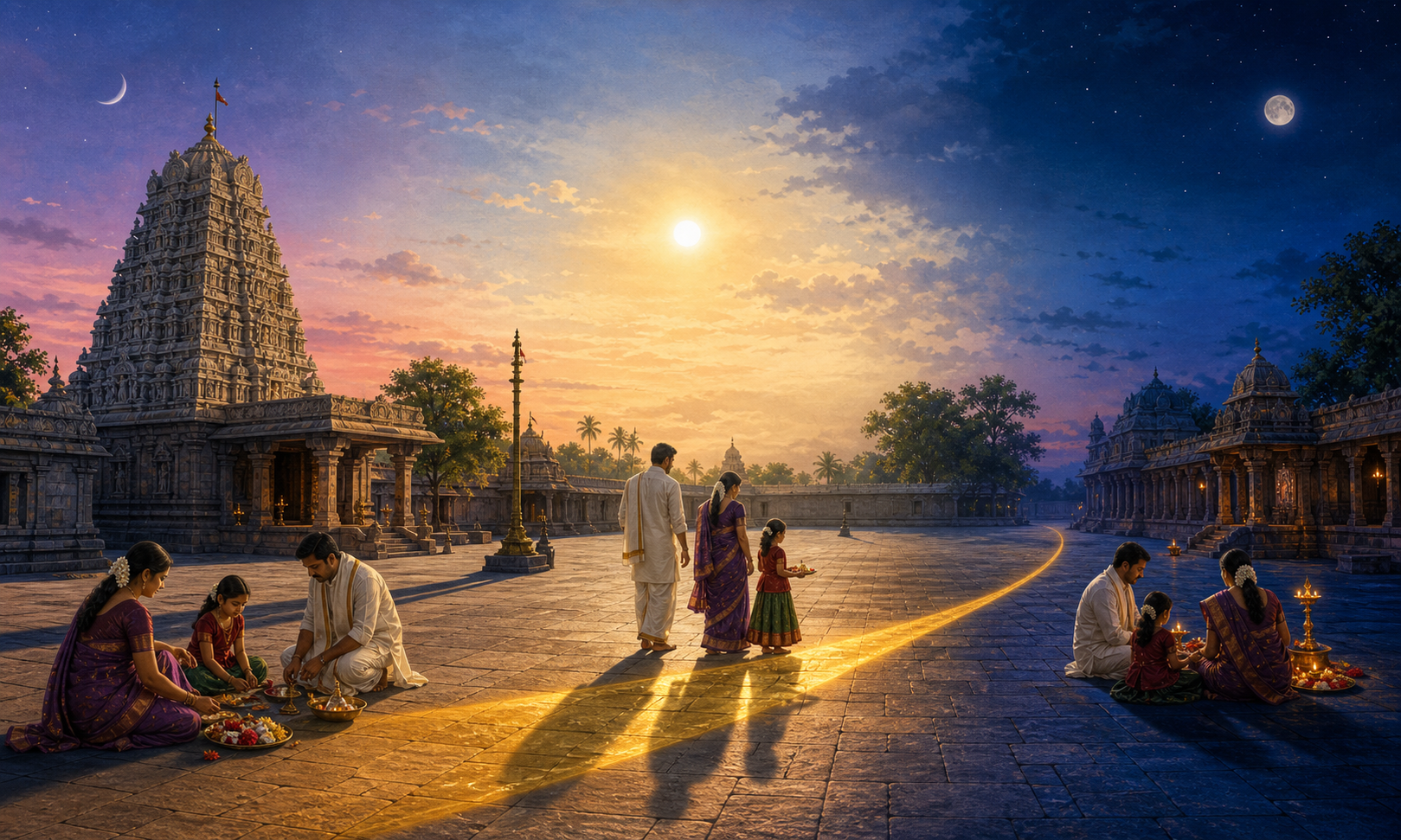
A civil date begins at midnight and lasts until the next midnight. Panchanga elements do not obey that boundary. A tithi, nakshatra, yoga, or karana may end in the morning, afternoon, or night. One civil date can therefore contain parts of two tithis or two nakshatras.
On Tuesday, July 28, 2026, for example, Shukla Paksha Chaturdashi continues only until 5:51 PM, after which Purnima begins. Calling the whole date either Chaturdashi or Purnima hides the very boundary that may matter for your ceremony.
This changes the question you should ask. Do not ask only, “Is Tuesday auspicious?” Ask, “Which tithi, nakshatra, yoga, and karana are operating when the defining act begins on Tuesday in my location?” For a puja, that defining act might be the sankalpa. For another undertaking, it may be the formal opening, first transaction, departure, or entry. Decide that point before looking for a time.
Location matters as well. Panchanga timings are calculated for a place, and many observances are organized around local sunrise. A time printed for one city should not be copied mechanically into another city’s schedule. The 5:51 PM transition above is useful as an illustration of how a day changes; it is not a universal instruction for every location.
The five limbs answer five different questions

Panchanga literally points to five limbs of calendrical time. Panchanga Shuddhi assesses these five principal elements together when choosing a beginning. Here, shuddhi is not a claim that a calendar requires moral purification. It is the disciplined checking of whether the operating conditions of time suit the intended act.
| Limb | What it identifies | What you should notice |
|---|---|---|
| Vara | The weekday | It supplies one layer of the day’s character, but it should not be used alone. |
| Tithi | The lunar day within the waxing or waning fortnight | Check which tithi is active at the start and the exact time at which it changes. |
| Nakshatra | The lunar mansion occupied by the Moon | Check whether it suits the kind of undertaking and whether it lasts long enough. |
| Yoga | A condition derived from the combined positions of the Sun and Moon | Use it as another part of the overall quality of the interval. |
| Karana | Half of a tithi | Use it for finer discrimination within a tithi rather than assuming the entire tithi is uniform. |
No limb is a substitute for the others. A favorable nakshatra does not make the tithi irrelevant. A suitable weekday does not tell you what happens after a mid-afternoon transition. Likewise, one less-preferred factor does not automatically settle every decision without regard to the act, family tradition, or applicable ritual rules.
This is why a generic box marked “good time” can mislead you. Auspicious for what? The interval appropriate for worship is not automatically the interval selected for marriage, travel, education, business, or entering a home. Panchanga Shuddhi is a test of fit, not a hunt for a universally lucky hour.
A practical sequence for choosing your muhurta
You do not need to become a professional astrologer to prepare the decision properly. You do need to provide precise inputs and resist the temptation to begin with a date you are already determined to defend.
- Name one act. Write down exactly what is beginning: the wedding rite, griha pravesha, sankalpa, departure, first lesson, registration, opening, or another defined action. “Something important” is too vague for task-specific timing.
- Identify the decisive moment. A long ceremony may cross a tithi or nakshatra boundary. Determine whether your tradition requires the sankalpa, central rite, entry, or another action to occur within the chosen interval.
- Fix the location. Use the city where the decisive act will physically occur. If the event is online or spans several places, ask the officiant which location governs the observance rather than quietly selecting the most convenient listing.
- Record every transition. Note the start and end times of the tithi, nakshatra, yoga, and karana. Do not copy only their names. A suitable condition that ends before your ceremony begins is not available to you.
- Assess all five limbs. This is the Panchanga Shuddhi step. Evaluate the interval as a whole and in relation to the undertaking, following the ritual tradition that will govern the event.
- Choose a window with a margin. If a relevant limb ends at a stated time, do not schedule the decisive act at that exact minute. Arrival delays, introductions, setup, and ritual preliminaries can consume the margin. Place the defining act comfortably inside the valid interval.
- Confirm consequential samskaras. For marriage, major temple rites, or ceremonies governed by family and sectarian practice, let the officiating priest or qualified practitioner make the final selection. Provide the exact city, proposed schedule, and participant details requested instead of asking only for a “good day.”
A useful request can fit in a short note: “The griha pravesha will occur in this city; the family can arrive between these hours; which interval should contain the entry and sankalpa?” That question is answerable. “Is this date lucky?” leaves out the information needed for a responsible answer.
If you are reading a Panchanga yourself, make a small working sheet with the place, civil date, local sunrise, proposed start, tithi and end time, nakshatra and end time, yoga, karana, and the exact act to be completed. The sheet exposes conflicts immediately. It also prevents you from confusing a festival label with an all-day muhurta.
Avoid the mistakes that make precision meaningless
- Treating a tithi as a civil date: Read the transition time. If the tithi changes before the decisive act, the new tithi governs that moment even though the calendar date has not changed.
- Copying a time without its city: Match the calculation to the event location. A screenshot stripped of its location and time-zone context is incomplete.
- Checking only one limb: A celebrated tithi or appealing nakshatra is not, by itself, Panchanga Shuddhi. Examine vara, tithi, nakshatra, yoga, and karana together.
- Mixing conventions silently: Regional and family practices can differ. Use the Panchanga and interpretive tradition recognized by the people conducting the rite, and resolve disagreements before invitations or bookings make the schedule difficult to change.
- Confusing an end time with a starting suggestion: “Until 5:51 PM” describes a boundary. It does not mean 5:50 PM is automatically the best moment to begin a lengthy ceremony.
- Demanding a perfect instant: A technically selected minute that nobody can meet is not a workable plan. Find a valid interval, build in setup time, and place the decisive act safely within it.
Auspicious timing also does not replace dharma. Consent, honesty, competence, preparation, and responsibility remain essential. A muhurta cannot repair a coercive marriage, an unsafe journey, an unlawful arrangement, or a poorly prepared undertaking. Nor should medical care, a safety response, an unavoidable duty, or a legal deadline be delayed while waiting for a preferred interval.
For ordinary daily worship, you may not need the same level of selection used for a major samskara. The scale of the inquiry should match the scale and ritual character of the act. Panchanga discipline is meant to order action, not paralyze it.
Key takeaways
- An auspicious date is not necessarily an auspicious twenty-four-hour period.
- Always check the active vara, tithi, nakshatra, yoga, and karana at the defining moment of the act.
- Use timings calculated for the place where the event will occur.
- Select the muhurta for a named undertaking; there is no context-free “good time” for everything.
- Treat transition times as boundaries and leave enough margin to complete the decisive action within the intended window.
- Use qualified ritual guidance for consequential ceremonies, especially when family or sectarian conventions govern the choice.
Before you commit to your next important date, write down the act, city, decisive moment, and available hours. Then check the five limbs and their transition times. That small change turns Panchanga reading from date-shopping into a disciplined Dharmic choice.
References
- Hindu Blog — July 28 2026 Tithi – Panchang – Hindu Calendar – Good Time – Nakshatra – Rashi
- Hindu Blog — Panchanga Shuddhi In Hinduism