
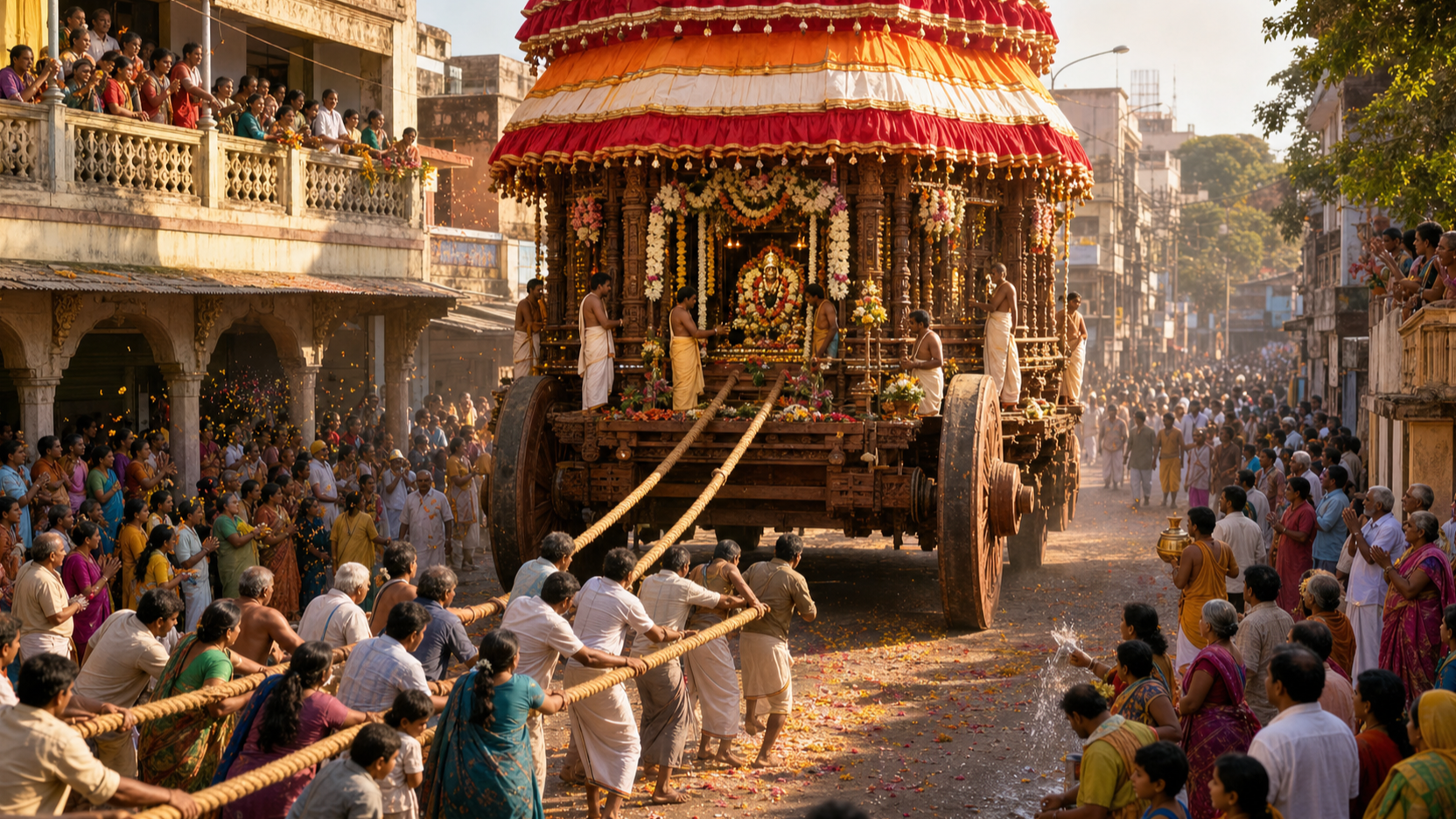
If you have encountered Jagannath Rath Yatra in Puri and then heard a Tamil temple announce Aadi Ther, you may wonder whether they are versions of one festival or entirely different observances. Neither answer is quite right. Hindu chariot festivals share a sacred grammar, but each community speaks it in its own ritual language.
To understand one, look first at who travels, where the procession goes, and how devotees serve. Then notice what the region contributes: its calendar, language, sacred relationships, public space, and political circumstances. This approach lets you recognise Dharmic continuity without treating regional traditions as interchangeable.
The shared ritual begins when the deity comes among the people
A temple procession changes the devotee’s relationship to sacred space. The murti is not presented as a decorative statue on a parade float. For worshippers, the consecrated deity is travelling beyond the usual place of worship, making darshan available along a public route and receiving collective seva.
This is why pulling a chariot is not merely transport. The rope gives devotees a direct bodily role in the procession. Decorating the route, accompanying the deity, offering prayers, distributing food, and maintaining order are other forms of participation. The festival turns a road into a temporary extension of temple space.
The vocabulary changes with language. Rath or ratha refers to a chariot; yatra and jatra refer to a journey or procession; ther is the familiar Tamil term for a temple chariot. These differences do not automatically signal different theology. When you attend or describe a festival, retain the community’s own name instead of replacing every local term with the better-known expression Rath Yatra.
The common pattern also has limits. A regional festival may differ in its deities, ritual sequence, duration, route, chariot design, and relationship with other sacred figures. The right question is therefore not, “How closely does this copy Puri?” Ask, “How does this community bring the divine into shared space?”
Three communities show how the sacred grammar changes
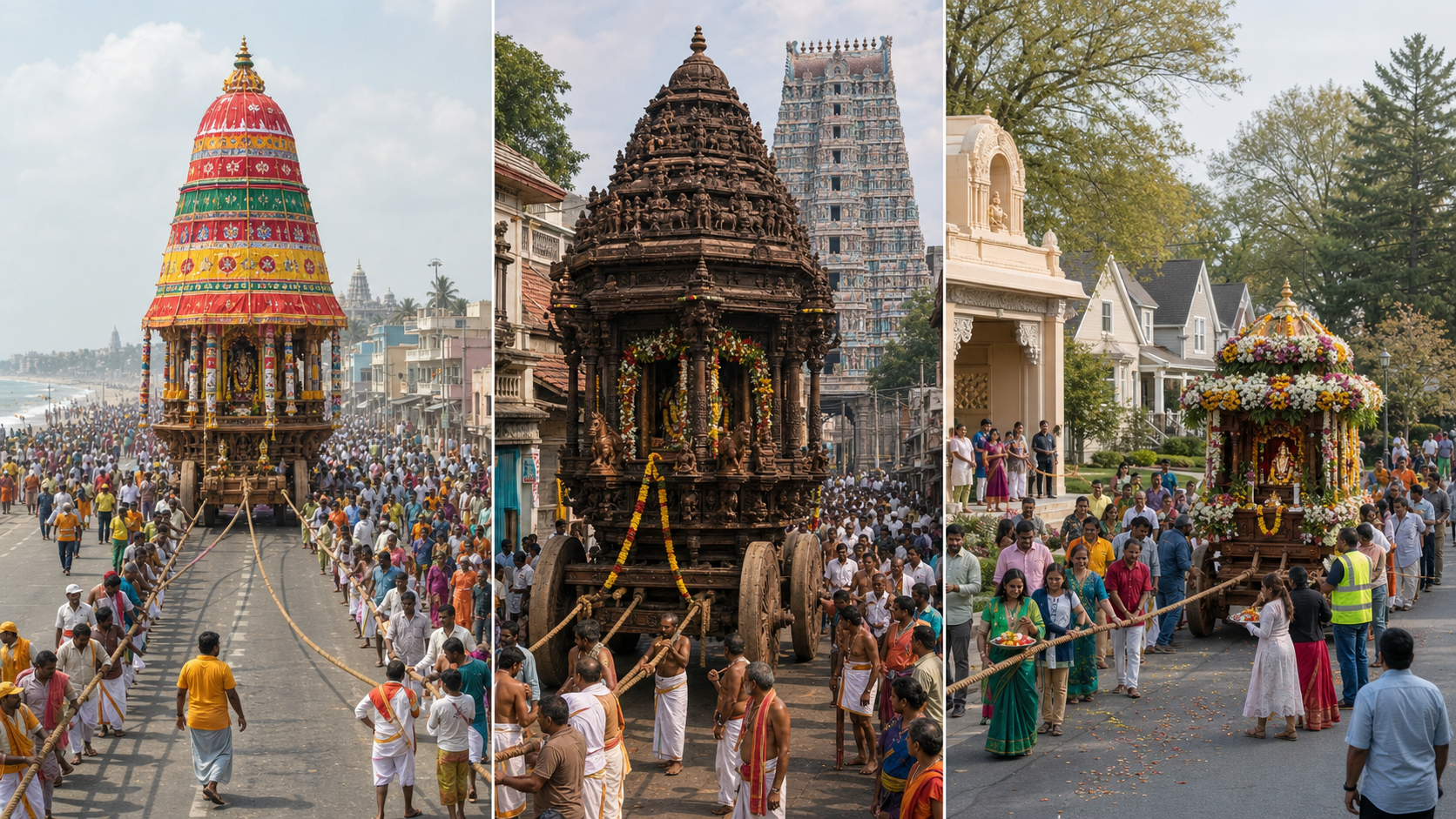
Puri: a journey structured by divine kinship
Puri provides the most widely recognised form of the chariot festival. Its Rath Yatra is widely regarded as the oldest and largest Hindu chariot celebration, but its fame should make it a point of reference rather than a universal template.
The procession takes place during the bright half of the lunar month of Ashar. Jagannath, understood as a form of Vishnu or Krishna, travels with his elder brother Balabhadra and younger sister Subhadra. The three deities are carried on massive, colourful wooden chariots from the Jagannath Temple to Gundicha, roughly three kilometres away. They remain there for about a week before returning.
Read that sequence as more than a route plan. The destination is understood as the home of the deities’ maternal aunt, so departure, travel, residence, and return express a sacred family relationship. The festival’s meaning lies not only in the chariots but also in who travels together and why.
Puri’s scale is exceptional: the celebration is associated with millions witnessing the procession and thousands pulling the chariots. Do not use that scale as a test of authenticity elsewhere. A smaller ther serving one temple community can embody the same principles of darshan and seva without reproducing Puri’s numbers, route, or divine kinship.
Alagarkoil: the chariot within a Tamil sacred landscape
At Alagarkoil near Madurai, Aadi Ther belongs to the festival life of Sundararaja Perumal Temple. The name immediately gives you two pieces of local information: ther identifies the Tamil chariot tradition, while Aadi places the observance within the Tamil ritual calendar.
The surrounding sacred landscape matters as much as the label. Pathinettam Padi Karuppanasamy is also present in the observance at Alagarkoil. At the closed Karuppanasamy doorway, lamps are lit on all 18 steps. That is not a detachable flourish. It is a locally meaningful ritual action connected with a particular sacred presence and place.
This is where an outsider can easily misread a regional festival. If you focus only on the moving chariot, you may overlook the temple relationships that give the day its full shape. Perumal worship, Karuppanasamy’s place at Alagarkoil, the Aadi calendar, and the eighteen illuminated steps form a ritual environment that cannot be explained by importing Puri’s family narrative.
When you encounter a Tamil ther, therefore, learn the local sacred map before looking for a pan-Indian equivalent. Identify the principal deity, the other divine presences honoured during the observance, and the rites performed at thresholds, steps, streets, and stopping points. Those details tell you how the community understands the festival.
Maungdaw: a procession that also protects community memory
A Jagannath Rath Jatra held outside Bharat can preserve the ritual form while taking on another layer of significance. In Maungdaw in western Myanmar, Hindu families from across Buddhist-majority Rakhine or Arakan State gathered for a nine-day Rath Jatra beginning on 16 July 2026. Attendance was reported in the tens of thousands.
The 2026 observance was identified as the community’s 24th Rath Jatra. Its programme combined the chariot procession and religious prayers with cultural performances and free food for participants. These elements show a minority community practising Dharma publicly rather than preserving it only as private memory.
The political setting cannot be separated from that visibility. The festival took place in an Arakan Army-controlled locality under an administration that permitted the observance after earlier Burmese administrations had prohibited it. Locals connected the renewed celebration with preserving heritage and building mutual respect among communities.
That claim should be read with care. Permission for one festival does not by itself resolve a region’s political tensions or guarantee lasting religious freedom. It does show why a public chariot procession can matter beyond spectacle: the community can assemble, transmit ritual knowledge, feed participants, and make its presence visible.
If you are describing Maungdaw’s celebration, do not reduce it to an overseas imitation of Puri. It is a Bharatiya-rooted Hindu tradition sustained by a particular minority community under its own local conditions. Continuity and adaptation are both part of the truth.
Use six questions to understand any regional chariot festival
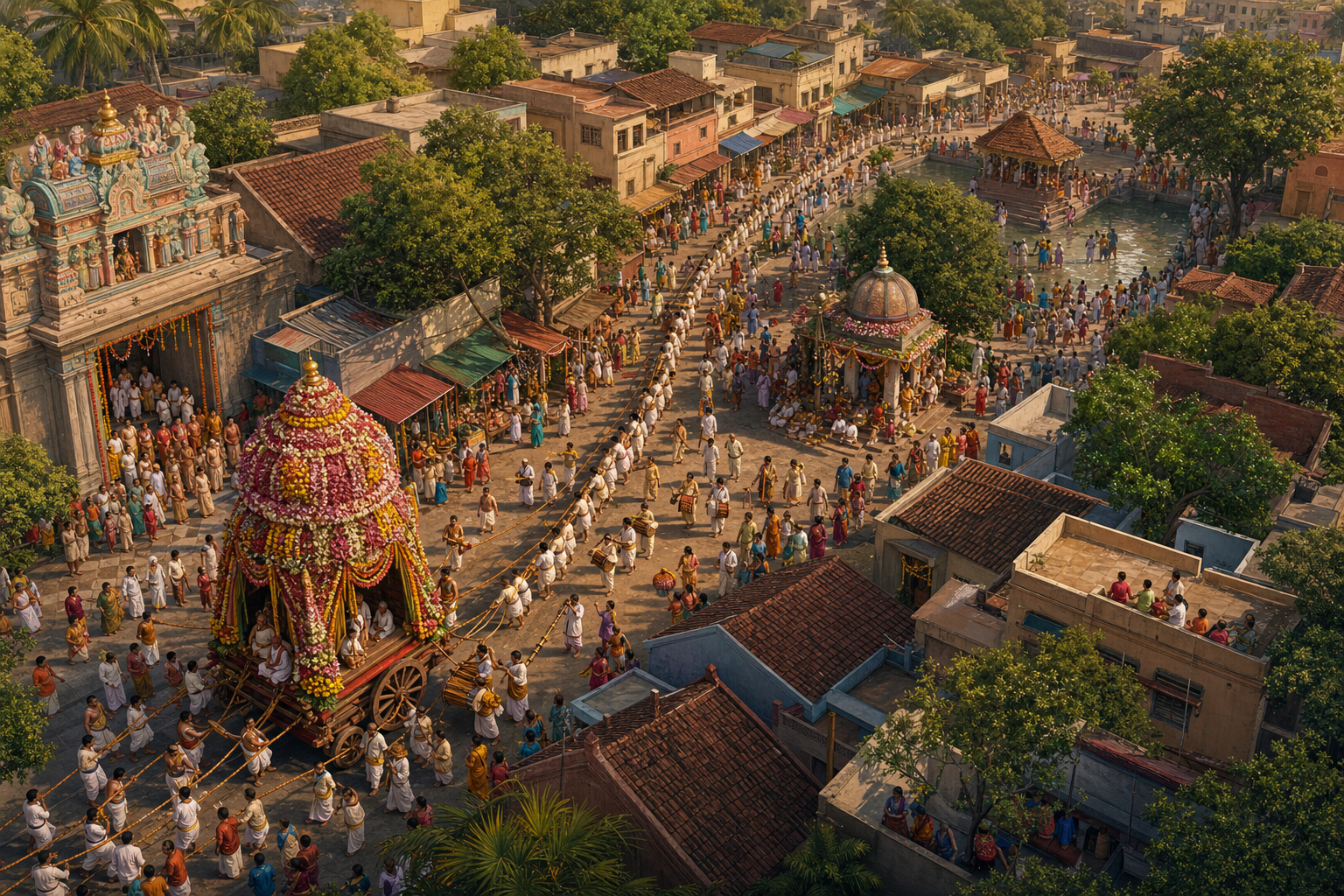
You do not need specialist knowledge to begin reading a procession well. Work through these questions in order:
- What does the community call it? Preserve distinctions such as Rath Yatra, Rath Jatra, and Aadi Ther. Translate the term once if necessary, but do not erase it.
- Who travels? Name the deity or deities and their relationships. Jagannath’s journey with Balabhadra and Subhadra cannot be understood as an anonymous “temple parade.”
- Where do they go, and why? A route between temples, a visit to a relative’s home, and movement through neighbourhood streets can carry different meanings.
- When does it occur in the local calendar? Puri’s bright half of Ashar and Alagarkoil’s Aadi setting belong to different regional systems. Confirm the local calendar rather than assuming a shared civil date.
- Which rites surround the chariot? Look for worship at doors, lamps on steps, food distribution, prayers, music, performances, and service along the route. These actions reveal who sustains the festival.
- What does public assembly mean for this community? In a major temple town, the dominant concern may be pilgrimage at immense scale. For a religious minority, simply holding the procession may also affirm continuity and the right to appear in public.
These questions prevent two opposite errors. One is to flatten every chariot festival into a copy of Puri. The other is to treat regional differences as proof that the communities have nothing in common. The evidence is visible in the ritual itself: a shared practice of bringing the deity among devotees, shaped by local memory and responsibility.
Attend and document the festival on local terms
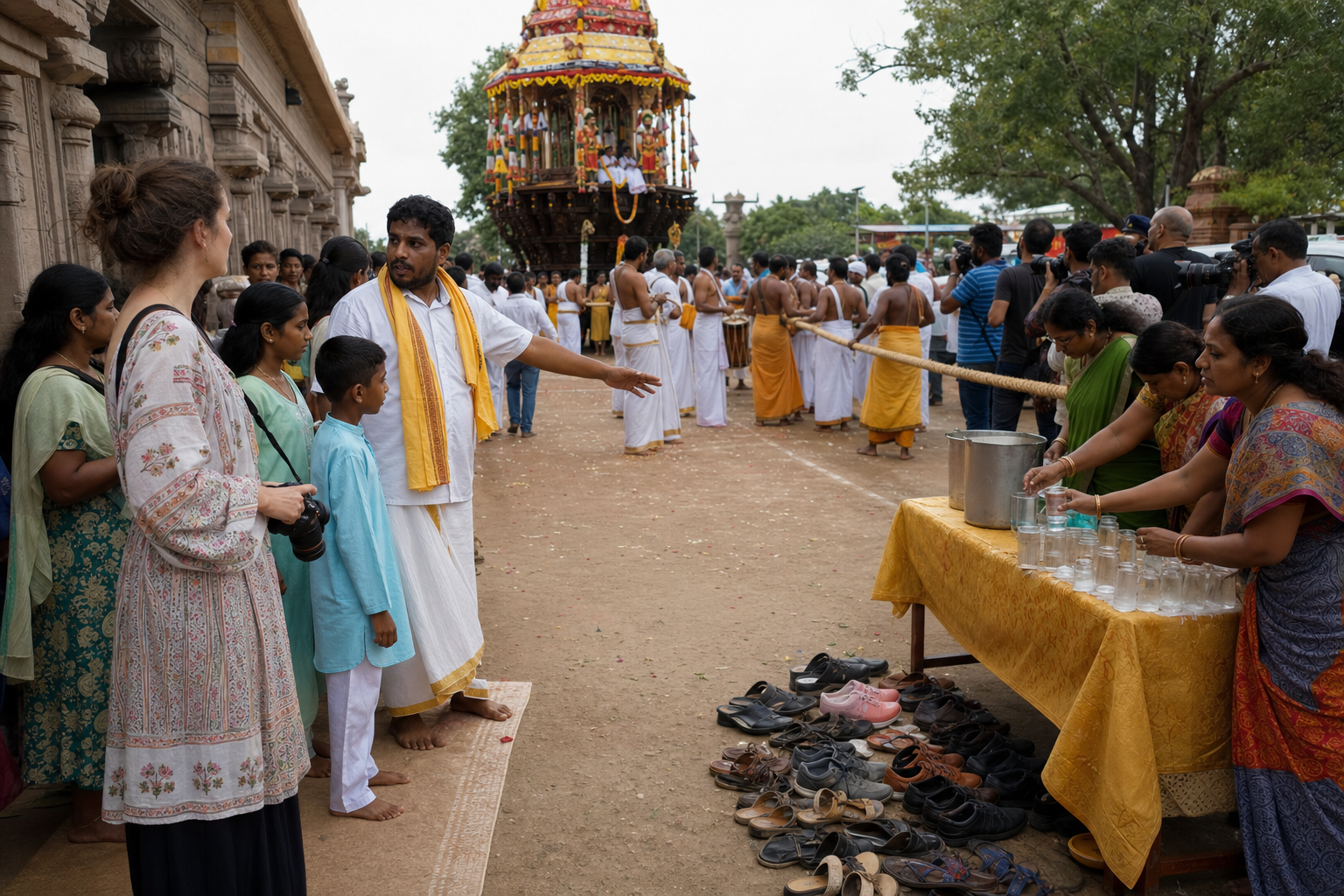
If you are joining the procession
- Confirm the route and timing with the organising temple or local Hindu community. A festival name alone may not tell you when the chariot moves, where it stops, or when the deities return.
- Ask before taking hold of a chariot rope. Pulling may be open to everyone at one observance and managed by designated groups at another.
- Keep clear of the chariot’s wheels and obey crowd-control directions. Do not step into the route for a photograph or attempt to move against the procession.
- Check local rules for footwear, photography, and entry to temple areas. Permission in the street does not imply permission at a shrine or closed doorway.
- Receive prasada or freely distributed food without waste. Food service is part of the community’s seva, not a side attraction.
- Listen to the names devotees use for the deities and rituals. Local vocabulary will teach you more than forcing each unfamiliar practice into a term you already know.
If you are writing, teaching, or posting about it
- Name the place and community early. “Aadi Ther at Alagarkoil” is more informative than “a South Indian Rath Yatra.”
- Use murti, deity, or the deity’s proper name when discussing worship. “Float” describes a parade object and misses the theological purpose of the chariot.
- Separate observed ritual facts from attendance or political claims. If a crowd figure is reported rather than independently established, keep the word “reported.”
- Explain one local detail that changes the reader’s understanding: Puri’s divine kinship, Alagarkoil’s eighteen illuminated steps, or Maungdaw’s history of prohibition and renewed permission.
- Avoid ranking communities by size. Scale affects logistics and visibility, but it does not determine devotional worth.
This discipline matters especially when a festival crosses borders. Calling Maungdaw’s observance merely “Indian culture abroad” can obscure the Hindu families who have maintained it locally. Calling it wholly separate from Bharat can erase the civilisational tradition they are preserving. Describe both inheritance and local agency.
Key takeaways
- Hindu chariot festivals share a ritual grammar: the deity travels, devotees receive darshan, and the community performs collective seva.
- Puri offers the best-known model, with Jagannath, Balabhadra, and Subhadra travelling on three chariots to Gundicha and returning after about a week.
- Alagarkoil’s Aadi Ther must be read within Tamil temple culture, including the local significance of Pathinettam Padi Karuppanasamy and lamps on all eighteen steps.
- Maungdaw’s Rath Jatra shows how a procession can preserve Hindu identity and public memory under changing political conditions.
- Respectful participation begins with local names, local instructions, and attention to the sacred relationships surrounding the chariot.
The next time you encounter a ther, yatra, or jatra, do not begin by ranking its size or searching for the nearest famous equivalent. Ask who travels, why the deity leaves the usual place of worship, which relationships shape the route, and how the community serves. Once you can answer those questions, you are no longer watching a generic spectacle. You are meeting a living regional expression of Dharma on its own terms.
References
- Hindu Pad — Aadi Ther in Pathinettam Padi Karuppasamy Temple, Alagarkoil
- Hindu Post — Jagannath Rath Jatra celebrated in western Myanmar