
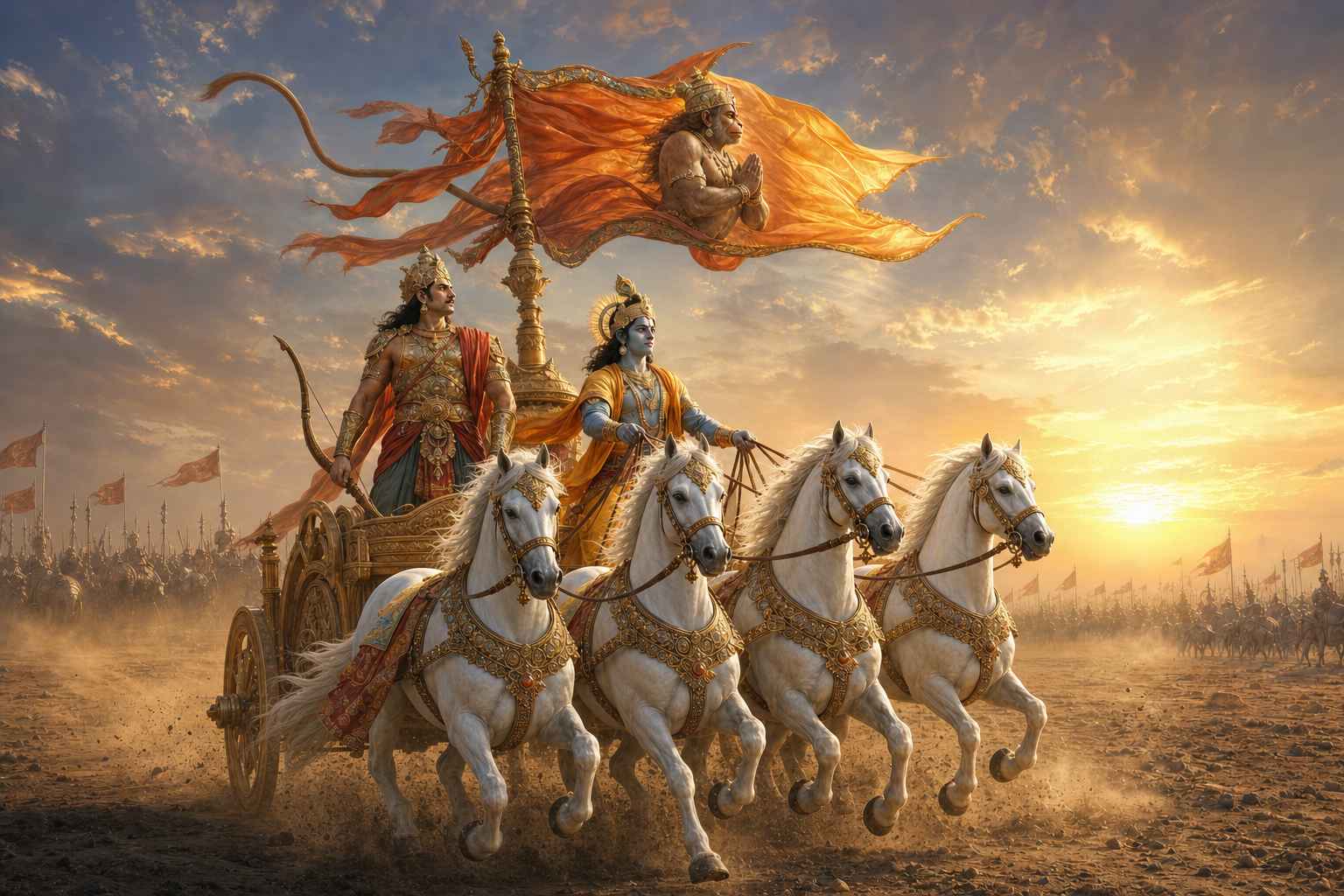
If you have wondered why a hero devoted to Rama appears above Arjuna while Krishna holds the reins, do not settle for the answer that Hanuman was simply there for protection. Protection is one layer. The Kapi Dhvaja is a map of how to enter conflict without letting pride, panic, or faction take command.
Look carefully at the arrangement. Arjuna must act. Krishna directs the chariot. Hanuman crowns its standard. Human ability, divine guidance, and selfless devotion occupy different places, but they move toward one Dharmic purpose. That arrangement gives you a practical way to examine your own difficult duties.
Begin with what the Bhagavad Gita actually establishes
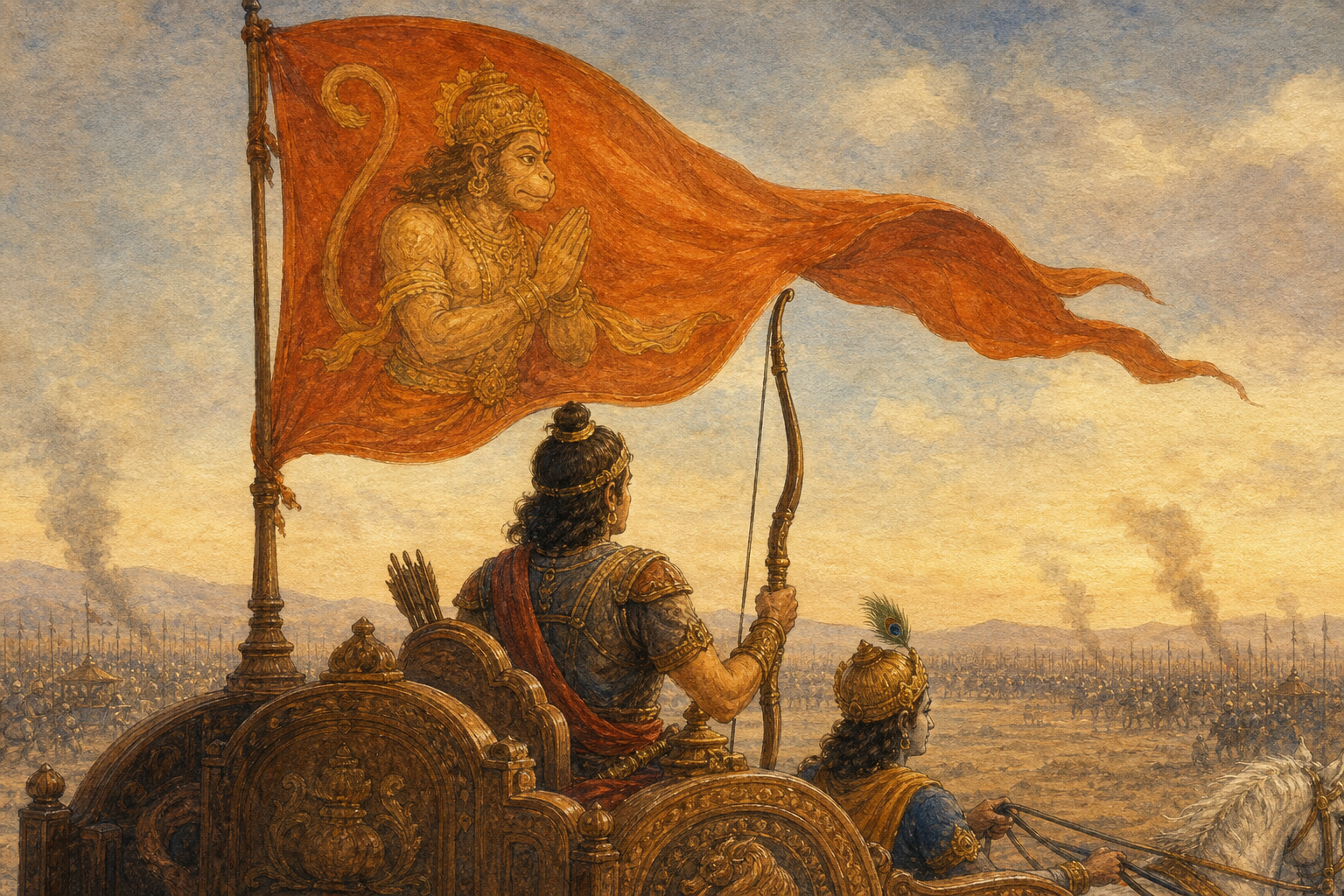
Before Krishna begins his teaching, Bhagavad Gita 1.20 identifies Arjuna as kapidhvajaḥ. The compound joins kapi, meaning monkey or ape, with dhvaja, meaning banner or standard. Arjuna is therefore the warrior marked by the ape-banner.
That wording gives us a firm scriptural anchor, but it also calls for precision. The verse identifies the emblem; it does not pause to narrate the banner’s entire origin. The traditional identification of its figure as Hanuman belongs to the wider Mahabharata and devotional world surrounding the scene. Explanatory legends should not be presented as though they were all contained in this single Gita verse.
A dhvaja was not an ornamental flourish. On a battlefield obscured by distance, noise, movement, and dust, a distinctive standard identified a warrior or formation, gave allies a visible rallying point, and announced identity to the opposing ranks. Hanuman’s image therefore had an immediate military function as well as a spiritual one.
The choice of Hanuman made that signal unusually dense. He represents courage governed by self-mastery, immense power offered in service, and loyalty that does not depend on personal reward. Above Arjuna’s formidable weapons, his image declares that prowess alone is not the highest authority. Ability must answer to a righteous purpose.
That is also why the Kapi Dhvaja should not be reduced to a promise of victory. A sacred emblem does not make every cause sacred. It places the bearer under a standard of conduct. The real question is not merely whether Hanuman protects Arjuna, but whether Arjuna’s action remains worthy of the banner he carries.
Key takeaways
- The Gita explicitly calls Arjuna kapidhvajaḥ, the ape-bannered warrior.
- The standard served as a battlefield identifier and rallying sign, not just a decoration.
- Hanuman joins Rama’s age to Krishna’s age through an unbroken ideal of devotion to Dharma.
- His position above Arjuna’s weapons subjects martial power to humility, discipline, and service.
- The emblem offers protection, but it also demands worthy motives and righteous conduct from its bearer.
Read the whole chariot as a moral arrangement
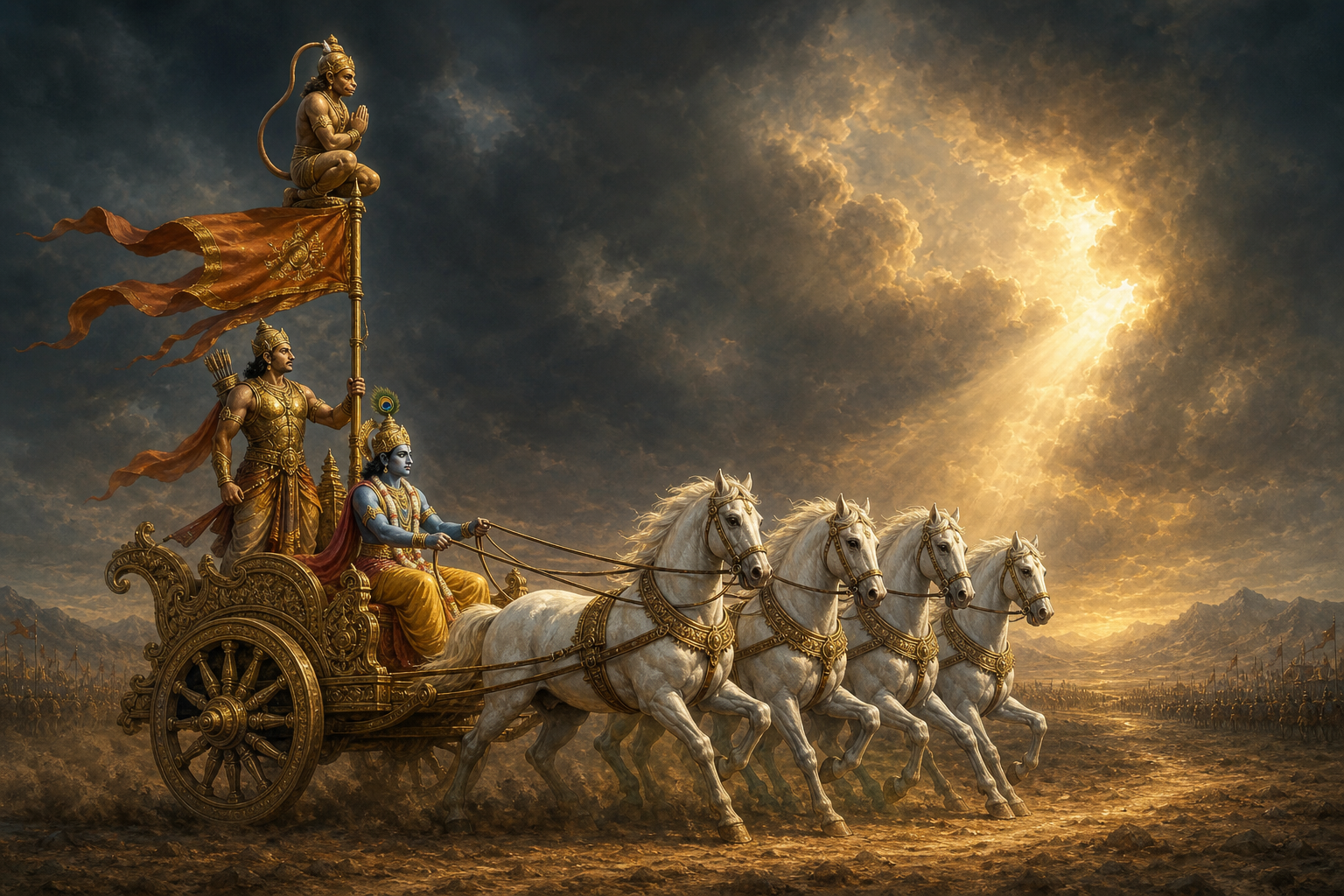
The meaning becomes clearer when you stop isolating the flag and read the entire chariot. Arjuna carries the bow and bears responsibility for action. Krishna holds the reins and determines direction. Hanuman flies above them as the sign of devotion, vital force, and a purpose higher than personal ambition.
Arjuna cannot hand his duty to Krishna and remain passive. Krishna does not erase Arjuna’s agency; he corrects Arjuna’s understanding so that agency can be used rightly. Hanuman does not replace either of them. His presence indicates the devotional orientation within which power and judgment should operate.
The Kaṭha Upanishad offers a related chariot analogy: the body is the chariot, the senses are its horses, the mind functions as the reins, and buddhi, discriminating intelligence, is the charioteer. That Upanishadic analogy does not directly explain Arjuna’s banner, and Krishna cannot be reduced to an abstract mental faculty. Yet it gives us a disciplined way to read the Kurukshetra image. Action goes astray when the senses bolt, the mind loses tension, or discrimination ceases to direct the journey.
Hanuman adds something crucial to that map. As Vāyu-putra, the son of the wind principle, he evokes prāṇa, the vital force carried with the breath. As Rama’s servant, he represents one-pointed devotion. Energy and attention are therefore not left without an aim. They are gathered into seva, service to what is highest.
This reading corrects three common errors. Power without guidance becomes recklessness. Reflection without action becomes paralysis. Devotion misunderstood as passivity becomes an excuse to avoid responsibility. The chariot holds all three in balance: discern clearly, orient yourself through devotion, and then perform the duty that is actually yours.
Hanuman’s presence also binds two epic ages without collapsing their differences. Rama and Krishna are avatāras of Vishnu associated with different yugas. Hanuman, whose life is defined by service to Rama, appears in the world of Krishna and the Pandavas without changing his fundamental vow. The emblem tells you that Dharma is not reinvented whenever history changes. Its application may take a new form, but fidelity, courage, restraint, and service remain recognizable.
The Mahabharata reinforces this continuity through Bhima. Hanuman and Bhima are both associated with Vāyu, and their encounter in the Vana Parva culminates in blessing and support. That does not turn Arjuna into a Vāyu figure. It shows instead that Hanuman’s strength, protection, and disciplined vitality surround the Pandava cause at more than one point.
Keep the scriptural anchor and the later legends distinct
The best-known explanation for Hanuman’s place on the banner begins with Arjuna’s confidence in his own skill. In the widely told story, Arjuna claims that a bridge made from his arrows could bear great weight. Hanuman tests it, and the bridge fails beneath him. It holds only when Krishna secretly sustains it. Arjuna’s pride is corrected, and Hanuman grants his presence on Arjuna’s standard during the great war.
This story is spiritually illuminating, but its textual status must be stated honestly. Its specific details are especially prominent in later retellings and regional devotional lore. It is not safest to say that Bhagavad Gita 1.20 narrates this meeting, because it does not. The Gita supplies the epithet; the later tradition supplies a memorable account of how Arjuna became fit to bear it.
The distinction does not make the legend disposable. It tells us how to use it. Arjuna’s archery is genuine, yet his genuine ability becomes dangerous when it is mistaken for self-sufficiency. Hanuman’s challenge does not demand that Arjuna deny his competence. It requires him to recognize what supports that competence: grace, right judgment, disciplined effort, and forces beyond his command.
That is a sharper lesson than the vague instruction to be humble. Before a demanding undertaking, you should know what you can do, what you cannot control, whose help you need, and what principle must limit your methods. False modesty hides ability. Pride hides dependence. Arjuna needs neither illusion; he needs accurate self-knowledge.
A second customary account concerns the chariot after the war. Krishna directs Arjuna to descend first. Once Arjuna is safely away and Krishna and the banner’s divine presence have departed, the chariot burns. Recensional and commentarial traditions connect the fire with celestial weapons whose effects had been held at bay during the conflict.
Here too, the responsible reading preserves the traditional claim without flattening every version into a single textual report. Its theological point is plain: Arjuna’s courage and skill mattered, but they were not the whole explanation for his survival. Divine protection accompanied human action. Grace did not remove the battle from him; it sustained him as he fulfilled his part.
If you teach or discuss the Kapi Dhvaja, a few verbal distinctions will keep the account both faithful and clear:
- Say, The Gita calls Arjuna ape-bannered, when referring to Bhagavad Gita 1.20.
- Say, The Vana Parva relates Hanuman’s meeting with Bhima, when discussing their connection through Vāyu.
- Say, A later and widely cherished tradition explains the banner through Arjuna’s bridge of arrows, when telling that episode.
- Say, The chariot can be read through the Upanishadic chariot analogy, when offering the philosophical interpretation.
These distinctions do not weaken tradition. They prevent devotional meaning, scriptural wording, and philosophical interpretation from being confused with one another.
Use the Kapi Dhvaja before your next difficult duty

You do not need a battlefield to use the emblem. Its discipline applies whenever you must act under pressure: a hard family conversation, a public responsibility, a moral disagreement, a demanding examination, or work whose outcome affects other people. The point is not to imagine yourself as Arjuna. It is to test whether your action has the same internal order as his chariot.
- Name the duty before naming the result. Write down what you are obliged to protect, tell, complete, or refuse. Do not begin with what would make you look victorious. Dharma concerns the right action and the manner of doing it, not merely the outcome you prefer.
- Inspect the motive flying above your effort. Ask whether you are serving a person, principle, or responsibility, or feeding resentment and vanity. A Hanuman standard over an ego-driven campaign is a contradiction. If praise disappeared, the rightful part of the task should still remain worth doing.
- Decide what is holding the reins. Agitation, group anger, and wounded pride are poor charioteers. Return to sound counsel, scriptural principle, discriminating judgment, and the foreseeable effects of your conduct. Seeking guidance does not transfer your responsibility to someone else; it helps you exercise it intelligently.
- Remember the bridge before displaying your skill. Name the support on which your plan depends. It may include another person’s cooperation, conditions you do not control, knowledge you have not mastered, or divine grace. Then make the plan strong enough to account for those dependencies.
- Steady attention before releasing action. If chanting belongs to your sādhana, reciting the Hanuman Chalisa before a difficult task can recall courage, discipline, and service. Let the breath settle and the motive become clear. Do not treat the recitation as a charm that guarantees your preferred result.
- Perform the next rightful action as seva. Send the necessary message, speak the difficult truth without humiliation, complete the work, or refuse the adharmic demand. Hanuman’s devotion is active. Once the direction is clear, endless rehearsal can become another form of avoidance.
This sequence is especially useful when you feel torn between paralysis and aggression. Arjuna begins the Gita unable to proceed; the answer is not careless violence or permanent withdrawal. His confusion has to be examined, his understanding corrected, and his action aligned with Dharma. The banner above him shows the spirit in which that corrected action should be carried.
Breath and chanting have a modest but important role here. They are not substitutes for ethical reasoning. A calm mind can still choose wrongly, and intense devotion can still be attached to a mistaken cause. Use devotional practice to reduce inner noise, then examine the duty itself. Hanuman steadies the warrior; he does not exempt the warrior from discernment.
Carry the standard without turning Hanuman into a mascot
A sacred symbol becomes a mascot when it is used to intensify group identity but no longer governs the group’s conduct. The Kapi Dhvaja resists that reduction. Hanuman’s strength is inseparable from restraint, his courage from service, and his loyalty from submission to Dharma. Invoking his name while celebrating cruelty, vanity, or indiscipline empties the emblem of its content.
When Hanuman’s image appears on a flag, vehicle, institution, or public campaign, ask practical questions. Does the conduct beneath it protect the vulnerable or merely intimidate an opponent? Does loyalty serve Dharma, or has loyalty to a faction replaced Dharma? Is strength being used to complete a necessary duty, or to humiliate? Are leaders accepting responsibility as readily as they accept praise?
This test matters because a banner communicates outwardly and disciplines inwardly. To allies, it announces the virtues around which they should assemble. To adversaries, it announces resolve. To its own bearer, it establishes a limit: you cannot honor Hanuman through behavior that rejects Hanuman’s defining qualities.
The emblem also discourages needless sectarian narrowing. Krishna’s charioteership and Hanuman’s presence bring devotion to Krishna and Rama into one field. Arjuna’s acquisition of the Pāśupata weapon from Shiva, along with Durga’s pre-battle blessing in certain traditions, places Vaishnava devotion, Shaiva power, and Shakta protection around the same Dharmic struggle. Their forms remain distinct, but they need not be made rivals.
The larger Dharmic family likewise recognizes the moral force of a raised standard. Buddhist traditions preserve the victory banner, Jain temples raise ensigns associated with purity and inner conquest, and Sikh gurdwaras raise the Nishan Sahib as a visible standard of community, courage, and service. These are not interchangeable symbols. Their shared grammar is nevertheless worth noticing: a flag joins a community to a principle and makes that allegiance publicly visible.
Choose one difficult duty you are currently postponing. Before the next conversation or decision, name the Dharma involved, identify what is holding your reins, let the breath settle, and recall whom the action should serve. Then act without using either fear or devotion as an excuse for delay. The most faithful way to raise the Kapi Dhvaja is to make your conduct recognizable beneath it.