
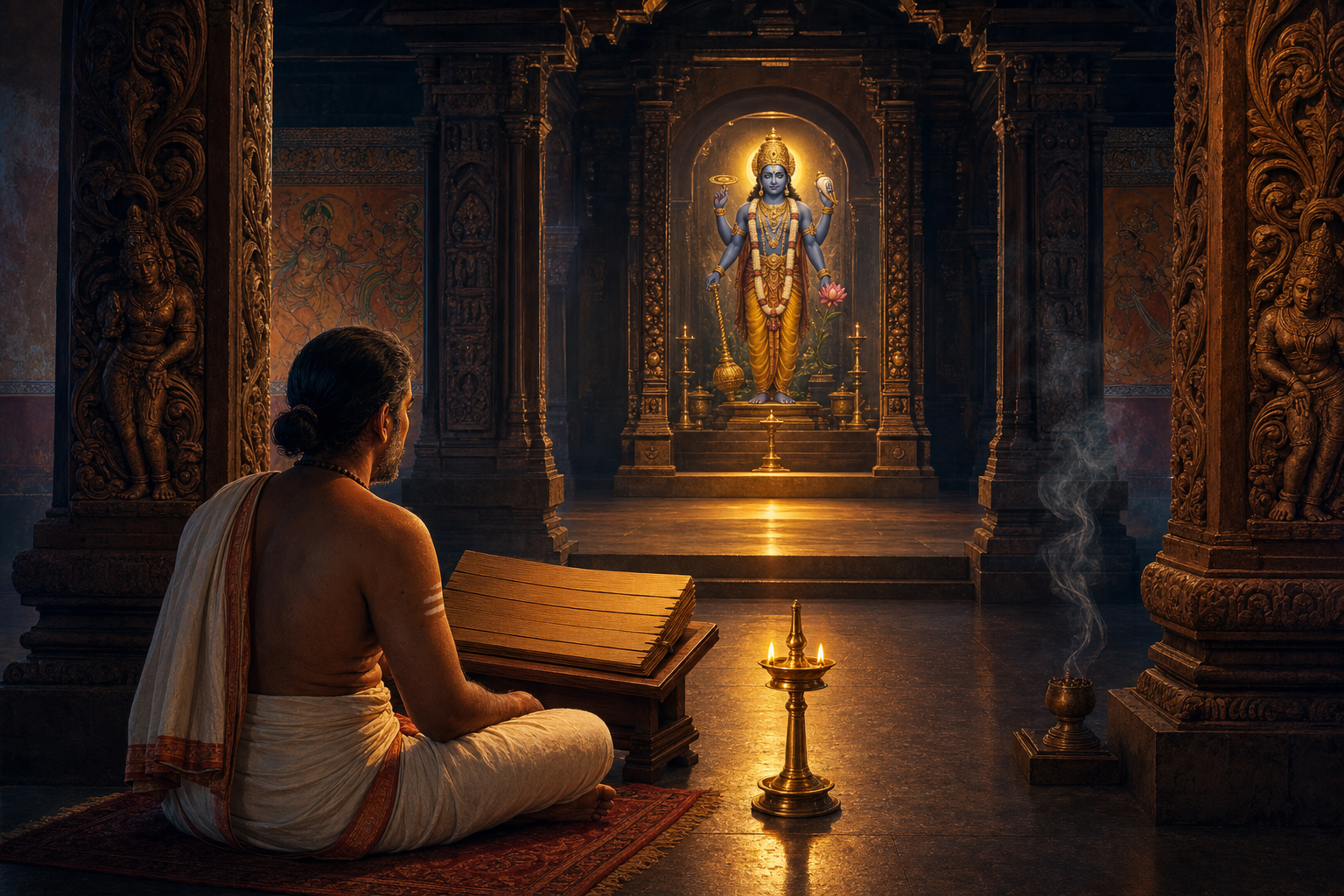
You want to enter the Śrīmad Bhāgavatam, but its twelve skandhas can make daily engagement feel larger than your available time. Nārāyaṇīyam gives you a workable doorway: one hundred daśakas that carry you from creation and the avatāras through Krishna’s līlās, divine counsel, and a final contemplative vision.
The right way to use that doorway is neither to treat Nārāyaṇīyam as a replacement for the Bhāgavata Purāṇa nor to race through it as an abbreviated syllabus. Let it become a map, a prayer, and a discipline of attention. The important question is not how quickly you can finish, but how each daśaka changes the way you remember and relate to Bhagavān.
Decide what you are asking Nārāyaṇīyam to do
Nārāyaṇīyam was composed in sixteenth-century Kerala by Melpathur Nārāyaṇa Bhaṭṭathiri, a scholar of Sanskrit grammar, prosody, and Mīmāṃsā. Its devotional setting is Guruvayur, where Krishna is worshipped as Guruvayurappan. That setting matters: this is learned Sanskrit poetry, but its learning is placed before the deity as an offering rather than displayed as an end in itself.
The work contains 100 daśakas and a little more than a thousand ślokas. Traditional verse counts range from 1,034 to 1,036, so a small difference between editions does not by itself mean that one is incomplete. What matters more for practice is whether your edition has dependable numbering, legible text, and enough explanation to connect each daśaka to the larger Bhāgavata narrative.
Before beginning, choose one primary purpose. Trying to recite, study Sanskrit, master theology, and absorb the complete Purāṇic narrative at the same time often turns a devotional practice into an exhausting project.
- Choose orientation if the twelve-skandha structure of the Bhāgavata is unfamiliar. Read the translation and identify where each daśaka belongs in the larger movement from cosmology to Krishna-bhakti.
- Choose parāyaṇam if you chiefly want a daily act of remembrance. Recite consistently, learn the meaning gradually, and protect the practice from perfectionism.
- Choose close study if Sanskrit, Vedānta, chandas, or poetic expression is your focus. Work slowly enough to notice compounds, sandhi, meter, imagery, and the theological choices made in compression.
If you are unsure, make orientation your first aim. Use an edition with the Sanskrit text or a reliable transliteration, a clear translation, and brief contextual notes. You can add detailed commentary on a later cycle. A first encounter should help you see the whole devotional path, not bury you beneath every possible interpretation.
Calling Nārāyaṇīyam a short form of the Bhāgavata can otherwise mislead you. It is not a prose outline with decorative verses attached. Its changing meters, images, and devotional moods do part of the spiritual work. The condensation preserves the Purāṇa’s movement while making that movement suitable for repeated recitation. Read for narrative understanding, but listen for the change in emotional register as well.
Read the 100 daśakas as one devotional ascent

A common mistake is to treat the daśakas as one hundred separate hymns. Individual cantos can certainly be recited on their own, but their full force appears when you follow the sequence. Nārāyaṇīyam moves from the scale of the cosmos toward the intimacy of loving presence, then gathers that movement into meditation.
- Creation establishes the field. The early daśakas address cosmic emanation, including sarga and visarga, and the ordering of existence. Do not reduce them to ancient cosmological data. Notice how the transcendent Lord is also presented as immanent within the world. Ask what changes when creation is approached as dependent on divine presence rather than spiritually empty matter.
- The avatāras make divine governance concrete. Varāha, Vāmana, Narasiṃha, Rāma, and other manifestations show dharma unfolding through different circumstances. As you read, identify the form of disorder being answered and the quality of the divine response. This keeps the sequence from becoming merely a catalogue of famous stories.
- Krishna’s Vraja-līlā moves devotion into relationship. Krishna’s appearance, childhood sports, Govardhana episode, and rāsa-līlā occupy an extensive central space. Slow down here. Attend to tenderness, trust, delight, dependence, and longing rather than collecting incidents from Krishna’s life.
- The later movement adds counsel and mature remembrance. The Dvārakā narratives and teachings prevent sweetness from becoming sentimentality. Devotion must remain capable of insight, responsibility, and steadiness after the intensity of līlā.
- The hundredth daśaka turns narration into vision. The culminating keśādi-pāda contemplation proceeds from the Lord’s hair to his feet. Do not approach it as a physical inventory. Let each feature hold the wandering mind in one place before attention moves to the next.
This structure gives you a simple way to check whether you are actually following the work. After each daśaka, write three short lines:
- What happened, or what truth was contemplated?
- What devotional disposition did it awaken: awe, service, friendship, tenderness, longing, surrender, or something else?
- What should you remember or do differently before the next recitation?
The third line is essential. Without it, you can know the narrative while remaining untouched by it. Your answer does not need to be dramatic. It may be as concrete as restraining a harsh response, completing a neglected duty, offering food with attention, or remembering Krishna when anxiety scatters the mind.
You also do not need to settle every Vedāntic question before beginning. Nārāyaṇīyam presents Krishna as both personal and cosmic, immanent and transcendent. Readers formed by Advaita, Viśiṣṭādvaita, or Dvaita can therefore recognize important elements without pretending that the schools make identical claims. When a verse seems to stress non-duality, divine qualification, or the distinction between devotee and Lord, mark it. Let repeated reading sharpen the question before you force a conclusion.
Build a recitation rule you can actually keep
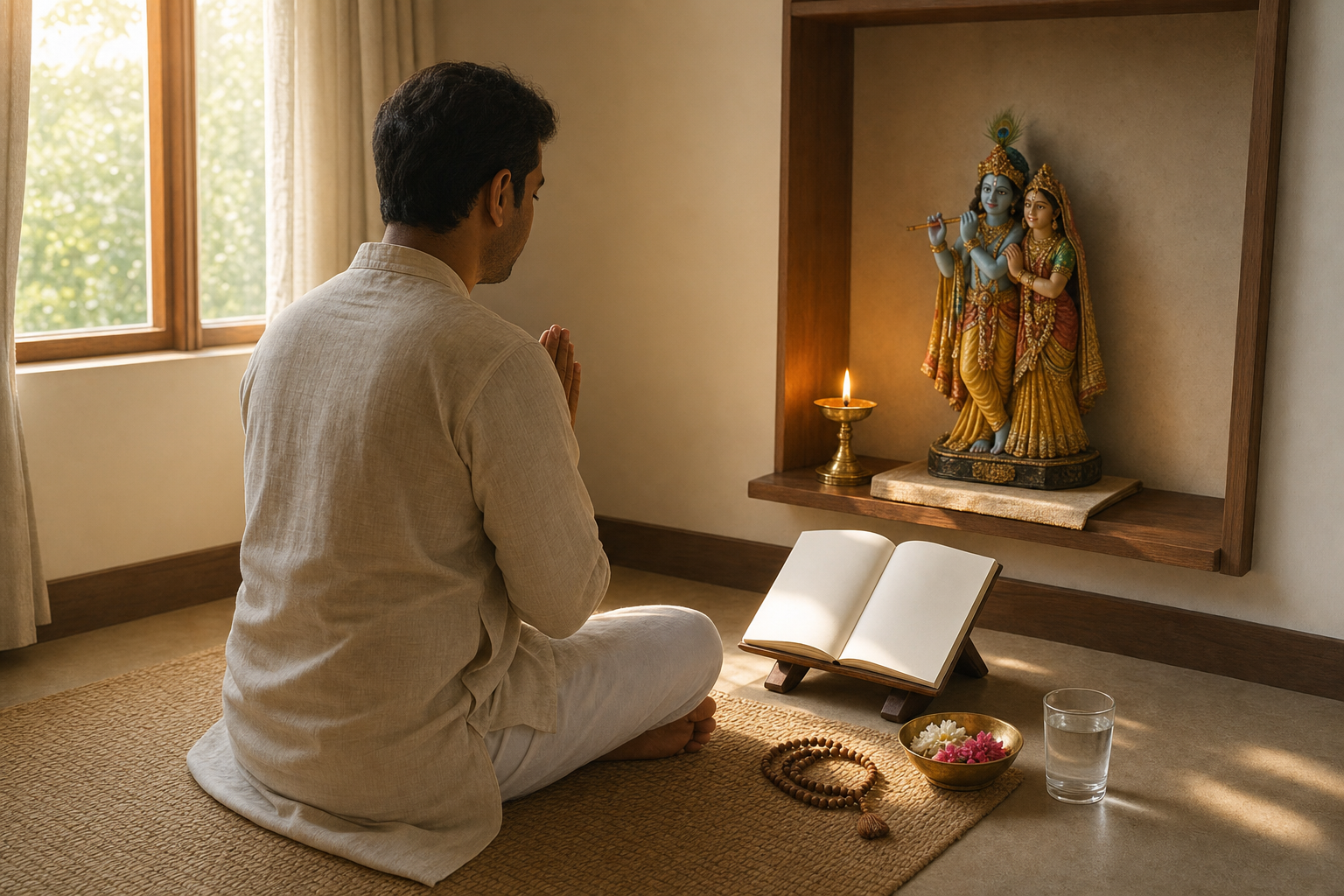
The best rhythm is the one that preserves continuity without making recitation careless. Three established approaches serve different situations:
- One daśaka a day for 100 days gives each canto its own space while preserving the full arc. This is the clearest starting point for an individual practitioner.
- A saptāham, or week-long cycle, compresses the work into an intensive period. It is especially suited to an organized household, temple, or study community, but it demands more preparation and sustained attention each day.
- A thematic selection works when you cannot yet undertake the complete cycle. Choose a coherent cluster: creation, major avatāras, Vraja-līlā, Dvārakā and counsel, or the final contemplation. Do not assemble unrelated favorite verses and then assume you have experienced the work’s architecture.
For a first complete cycle, we would begin with one daśaka a day. Use the same basic sequence every day so that deciding how to practise does not consume the energy needed for practice.
- Keep one stable text. Use the same numbering, transliteration system, and translation throughout the cycle. Consult other commentaries when a genuine question arises rather than switching editions continually.
- Choose a repeatable setting. Morning or evening can both work. Attach the recitation to a part of your day that already has some stability, and keep the text ready rather than stored out of reach.
- Recall the recipient of the offering. Before reading, bring Guruvayurappan or your iṣṭa-devatā to mind. This small act prevents literary appreciation from quietly replacing devotion.
- Recite without racing the meter. Nārāyaṇīyam uses varied Sanskrit meters. Allow the cadence to organize breath and attention. If pronunciation is still developing, aim first for clarity and steadiness, then refine it with an experienced reciter or study group.
- Read for meaning immediately afterward. Identify the central event, image, or teaching while the sound remains present in your mind. Sound and meaning should support each other rather than becoming two unrelated activities.
- Carry one point into the day. Choose a divine quality to remember, a reaction to restrain, or a duty to perform as an offering. Keep it specific enough that you can tell whether you acted on it.
If you miss a day, resume with the next unfinished daśaka. Restarting the entire vow every time life interrupts it can turn discipline into self-punishment. If repeated interruptions occur, change the setting or reduce competing commitments around the recitation; do not dilute the words simply to claim an unbroken count.
A study circle can help when Sanskrit or theology becomes a barrier. Participants can recite together, summarize the narrative setting, clarify one poetic or philosophical point, and end by naming one practical implication. Chant, explanation, and reflection belong together; none needs to consume the entire gathering.
Community practice also connects you with Nārāyaṇīyam’s living Kerala heritage. The traditional completion observance on Vṛścikam 28 in the Malayalam calendar draws congregational recitation at Guruvayur. If your family or temple follows that calendar, you can work backward from the observance when planning a complete cycle. The date should support attention and fellowship, not become a deadline that encourages hurried chanting.
The traditional account of composition gives the 100-day rhythm special emotional force. Bhaṭṭathiri is remembered as composing one daśaka each day while suffering from serious illness and receiving healing grace at the completion. Treat this as a testimony of faith, surrender, and hope, not as a medical protocol. Practitioners may find that regular chanting supports calm, concentration, and resilience, but devotional recitation must complement rather than replace appropriate medical care.
Let Krishna-bhakti move from rasa into conduct
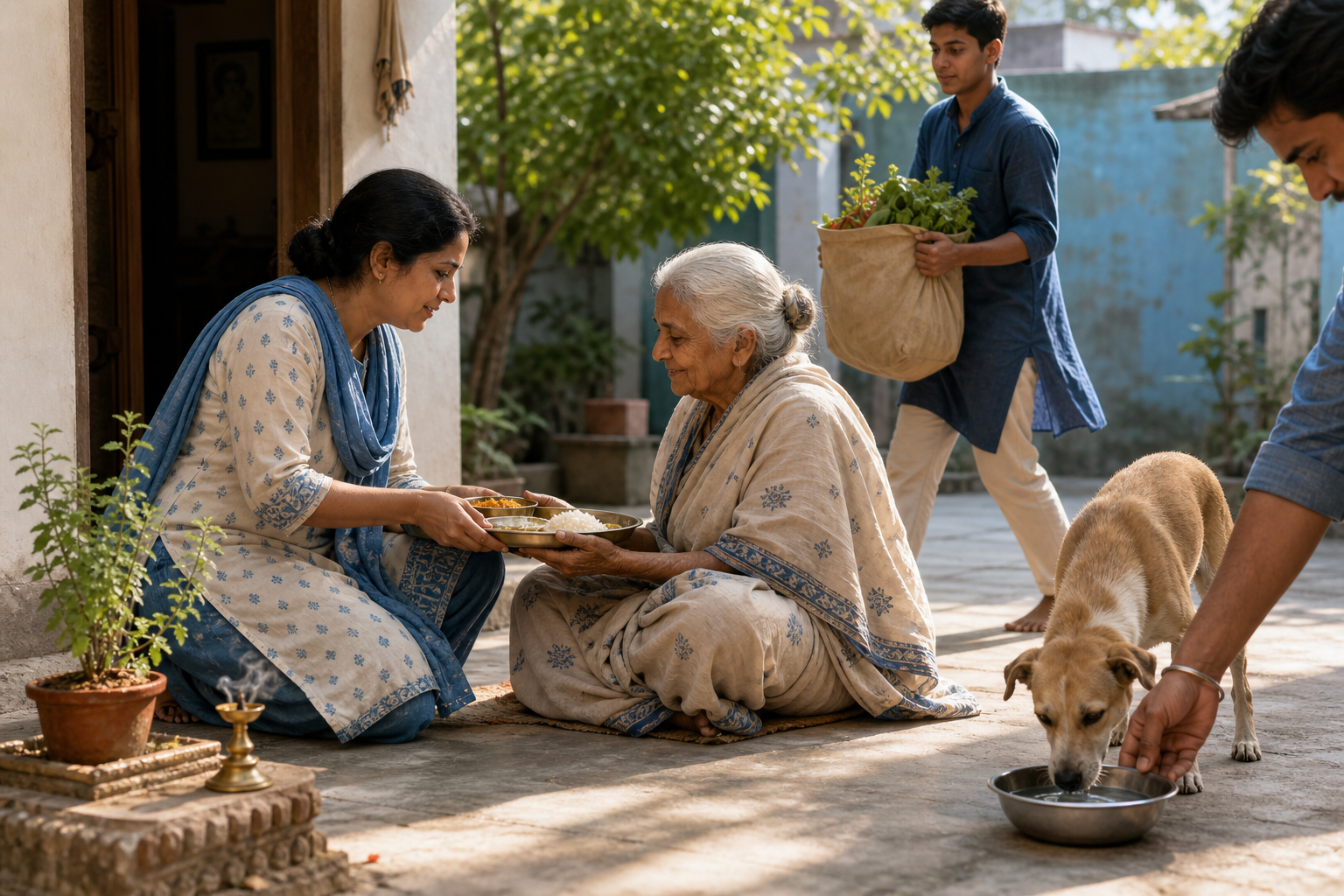
Bhāgavata devotion is not only agreement with a theology. It is a cultivated relationship with the Lord, and Nārāyaṇīyam trains that relationship through rasa, the experienced flavor of devotion. Different passages invite different ways of standing before Krishna.
- Dāsya, reverent service: notice what can be done because it is right, not because it will be noticed. Turn one ordinary duty into a deliberate offering.
- Sakhya, friendship: bring honesty into remembrance. Instead of performing an ideal mood, place confusion, gratitude, or fear before Krishna without disguise.
- Vātsalya, tender parental love: attend to the vulnerability and play of the child Krishna. Let that tenderness make you more patient with someone dependent on your care.
- Mādhurya, sweet and intimate love: read longing as concentrated orientation toward the Divine. If the rāsa-līlā becomes merely romantic entertainment in your mind, return to its devotional center: the soul’s absorption in Krishna’s presence.
Do not force yourself to imitate every mood, and do not rank them after each recitation. Notice which relationship a daśaka opens, then allow it to correct your usual habits. A person who is comfortable with reverence may need the trust of friendship. Someone drawn to sweetness may need the discipline of service. The point is not to manufacture emotion but to make devotion less partial.
Nārāyaṇīyam also refuses a false choice between devotion, knowledge, and action. Jñāna clarifies who is being worshipped and how the Divine relates to the cosmos. Karma gives devotion a field in responsibility and conduct. Bhakti gathers both into loving orientation toward Krishna. If study makes you proud or recitation leaves your conduct untouched, one part of that integration is missing.
You can test the integration after every few daśakas by choosing one of four ethical expressions:
- Compassion: respond to one person’s difficulty without making their need serve your self-image.
- Self-discipline: restrain one recurring impulse that weakens attention or harms another person.
- Surrender: name one outcome you cannot control, perform your duty toward it, and release the demand that events obey your preference.
- Universal goodwill: include someone outside your familiar social or religious circle in prayer and fair-minded action.
These virtues also create points of recognition across the dharmic family. Compassion and contemplative discipline can speak to Buddhist practice; ahiṃsā and self-mastery to Jain practice; remembrance of the Divine and sevā to Sikh practice. Such parallels should encourage respectful encounter, not erase the distinct doctrines and histories of the traditions. Nārāyaṇīyam remains a deeply Vaishnava offering even when its ethical fruits are widely intelligible.
The same caution applies within Hindu thought. Its philosophical inclusiveness does not require you to flatten Advaita, Viśiṣṭādvaita, and Dvaita into interchangeable vocabulary. Let shared devotion create hospitality while disciplined study preserves real distinctions. Unity is stronger when it can bear precision.
Key takeaways for your first cycle
- Nārāyaṇīyam is a 100-daśaka devotional condensation of the twelve-skandha Bhāgavata Purāṇa, not a substitute for reading the larger scripture.
- Choose one leading purpose for your first cycle: narrative orientation, daily parāyaṇam, or close Sanskrit and theological study.
- Follow the complete movement from creation to avatāras, Krishna-līlā, counsel, and the final keśādi-pāda vision. The order is part of the teaching.
- One daśaka a day for 100 days is the most manageable full-cycle starting point. Use a saptāham only when you can protect the concentrated time it requires.
- Pair recitation with meaning. After each daśaka, identify the event or truth, the devotional disposition it awakens, and one implication for conduct.
- Receive the healing tradition as an expression of faith and grace, never as a reason to delay or replace medical care.
For your next quiet morning or evening, choose one dependable edition, mark the first daśaka, and begin before your pronunciation or understanding feels complete. Keep the sequence intact and carry one image or instruction into the day. By the time you reach the hundredth daśaka, the real measure will not be that you covered a shorter Bhāgavata; it will be whether Krishna’s presence has become easier to remember amid ordinary life.