
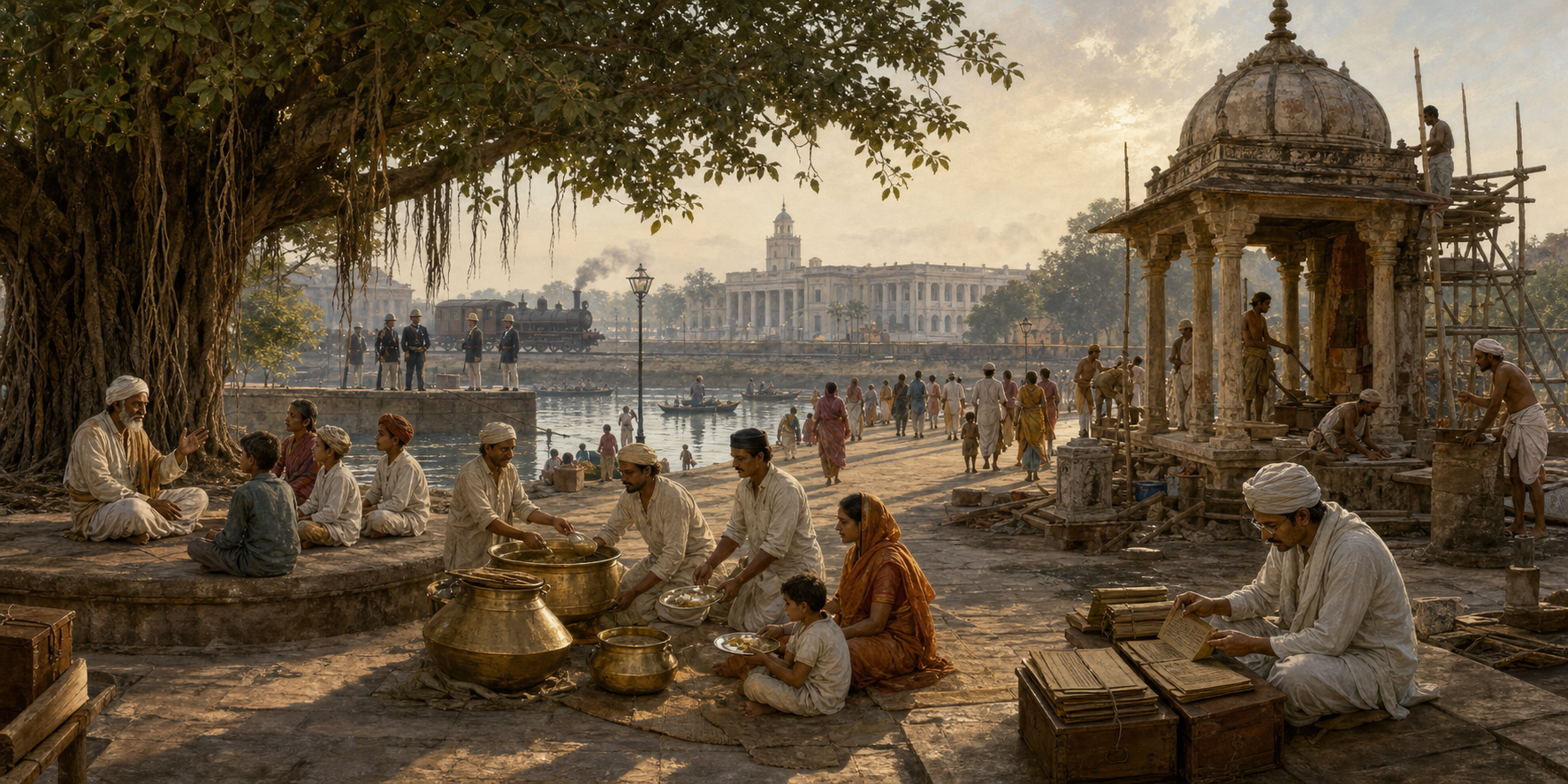
If you are trying to understand how Dharma endured colonial rule, do not ask only who held Delhi, collected revenue, or commanded the army. Ask who still taught a child, fed a stranger, convened a congregation, preserved a manuscript, maintained a pilgrimage, and rebuilt after an institution was disrupted.
That shift in viewpoint prevents two opposite errors. British power was neither superficial nor absolute. It restructured landholding, law, education, trade, and public classification, producing losses that should not be romanticized. Yet it never obtained exclusive control over the relationships through which Hindu, Buddhist, Jain, and Sikh communities transmitted meaning. Once you learn to follow those relationships, Dharmic resilience becomes visible as a practical method rather than a comforting slogan.
Key takeaways
- Measure civilizational survival through the continued capacity to teach, serve, assemble, remember, and repair, not solely through changes of political sovereignty.
- Colonial influence was strongest where revenue policy, legal codification, state-backed education, and administrative classification weakened the material supports of local life.
- Dharmic institutions were difficult to capture completely because authority and memory were distributed among households, teachers, sacred sites, trusts, congregations, pilgrimage routes, and service networks.
- Hindu, Buddhist, Jain, and Sikh traditions cooperated through overlapping ethical commitments without becoming interchangeable or surrendering their doctrinal differences.
- The responsible way to inherit this resilience is to strengthen living transmission: learn a language or practice, document memory with consent, support a teacher or community service, and test historical claims against evidence.
Colonial power changed the supports of Dharmic life
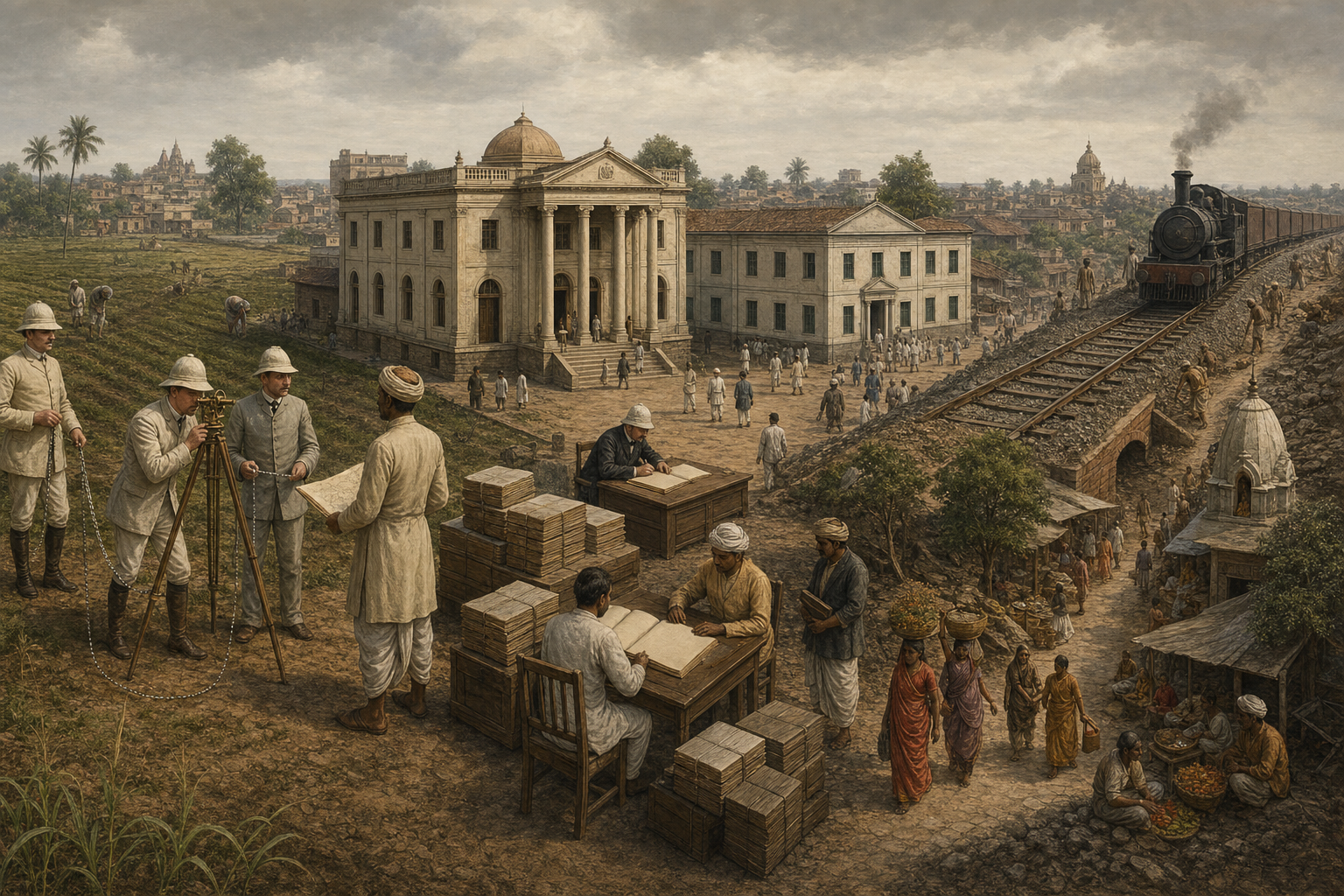
Territorial conquest was only the most visible layer of colonial power. Between the East India Company’s ascendancy around 1757 and the uprising of 1857, the Permanent Settlement in Bengal, Ryotwari arrangements in parts of the south and west, and Mahalwari arrangements in the north changed the relationship among cultivators, intermediaries, communities, and the state. Revenue became more legible and dependable to the government, but customary rights and local systems of reciprocity could become less secure.
This mattered to Dharma because a mandir, matha, vihara, basadi, gurdwara, pathshala, festival, or manuscript collection does not survive on philosophy alone. It needs land, labor, patronage, voluntary giving, skilled custodians, and time. When an extractive fiscal system reduces the local surplus or redirects an endowment, the damage eventually reaches the kitchen, classroom, library, shrine, and pilgrimage shelter. If you want to investigate the colonial history of a local institution, begin with its property, trust, donation, and renovation records rather than stopping at accounts of battles.
Law created a second pressure point. Earlier jurisprudence could combine Dharmashastra, royal edicts, guild rules, local custom, and negotiated authority. Colonial courts initially worked through pandits and maulvis, but codification increasingly compressed this layered practice into categories that officials could apply across large populations. The Indian Penal Code of 1860 crystallized the broader movement toward uniform statute, although its intellectual and administrative foundations preceded 1857.
Uniform law is not automatically unjust, and customary practice is not automatically righteous. The important historical question is narrower: what was lost when context-sensitive authority became an exception to a centralized rule? When reading a dispute over marriage, inheritance, temple management, occupation, or community status, look for the difference between the official category and the practice people actually followed. That gap often reveals where administrative convenience hardened a more fluid social reality.
Education opened a third front. The Charter Act of 1813 facilitated missionary activity; Macaulay’s 1835 Minute, endorsed under Governor-General William Bentinck, privileged English-medium education over Sanskrit and Persian learning; and Wood’s Despatch of 1854 advanced a graded, state-supported school system. Pathshalas, gurukulas, maktabs, and other forms of instruction continued, but they did not possess the same official backing or route into colonial employment.
The effect was not simply that one language replaced another. A school system determines what qualifies as knowledge, which texts receive prestige, who can certify learning, and which education leads to salaried work. English education gave Indians tools later used for organization and resistance, while also moving many inherited disciplines away from the center of elite formation. You should therefore avoid treating English and indigenous education as a simple choice between enlightenment and ignorance. Ask instead which knowledge each system rewarded, which it neglected, and whether a community retained the teachers needed to transmit what the official curriculum omitted.
Administrative classification added another layer. From 1871 onward, census practice placed diverse populations into standardized boxes. Anglo-Hindu law similarly assembled selected textual rules into a package that courts could administer. These processes did not invent every identity or social distinction from nothing, but they could turn negotiated, regional, occupational, and overlapping affiliations into apparently rigid public facts. A census label may therefore tell you how the state saw a community without telling you everything about how that community worshipped, married, worked, or understood itself.
Sacred institutions also faced direct administrative intervention. The Religious Endowments Act of 1863 altered the governance environment of religious trusts, while colonial involvement in places such as Jagannath Puri treated pilgrimage and sacred administration partly as fiscal and bureaucratic matters. Such intervention varied over time and by institution. British officials, missionaries, scholars, courts, and commercial actors did not all share one motive. Some linguistic and textual work preserved valuable material even as the wider classificatory system hardened identities. Precision is more useful than a theory in which every colonial actor follows one hidden plan.
These pressures were serious because they targeted the supply lines of culture. They were incomplete because those supply lines were not located in one treasury, university, priesthood, scripture, or capital.
Dharmic continuity had no single point of failure

The most useful way to recognize Dharmic resilience is to look for four capacities: transmission, provision, congregation, and repair. A community that retains these capacities can suffer political defeat and institutional damage without losing its ability to renew itself.
- Transmission: Can knowledge still pass from teacher to student, elder to child, reciter to congregation, or manuscript to copy? Guru-shishya lineages, household instruction, pathshalas, granthi recitation, katha, kirtan, bhajan, parayana, and vernacular print created parallel routes. If a formal school disappeared, teaching could move to a courtyard, shrine, patron’s home, traveling discourse, or newly formed association.
- Provision: Can the community still feed, shelter, educate, or care for people? Sikh langar, temple annadanam, matha-based support, Jain philanthropy, and monastic charity joined spiritual commitment to material reliability. A kitchen that remains open during scarcity protects more than bodies; it preserves trust, equality, voluntary coordination, and the habit of service.
- Congregation: Can people still gather according to a shared ethical calendar? Festivals, pilgrimages, sangats, sanghas, tirthas, processions, and local observances brought dispersed households into recurring contact. They moved songs, stories, donations, artisans, teachers, and news across regions without requiring a central command.
- Repair: Can the community re-establish what has been damaged? Dharmic communities recopied texts, redirected donations, reconstructed trusts, relocated sacred objects, revived festivals, restored shrines, and created modern organizations around older obligations. Continuity did not require every building or institutional form to remain unchanged. It required the capacity to begin again without forgetting why the work mattered.
This distributed structure functioned like civilizational redundancy. A manuscript might survive in a household after a library was dispersed. A disciple could carry instruction when a teacher was displaced. A pilgrimage circuit could reconnect settlements separated by political boundaries. A community kitchen could preserve solidarity when official welfare failed. If one institution weakened, another could carry part of its work.
You can see this architecture in mandirs, mathas, akharas, viharas, basadis, upashrayas, gurdwaras, village assemblies, mercantile networks, and family lineages. None represented the whole civilization. That was precisely the strength. Knowledge, worship, service, customary authority, and social memory remained spread across overlapping institutions, raising the cost of complete cultural capture.
Philosophy reinforced this institutional pluralism. Hindu acceptance of an Ishta allowed devotion through different chosen forms and paths. Jain Anekantavada disciplined the mind to recognize that a complex truth can be approached from more than one standpoint. Buddhist karuna and upaya joined compassion with methods suited to different needs. Sikh seva, miri-piri, and sarbat da bhala connected spiritual discipline to temporal responsibility and the welfare of all.
These concepts are not synonyms, and treating them as interchangeable would erase the very plurality that produced resilience. Their practical convergence lay elsewhere: none required a single centralized authority to eliminate every alternative path before ethical action could begin. Cooperation could arise through duty, truthfulness, non-harm, compassion, disciplined courage, and service while substantial metaphysical differences remained.
That distinction matters now. Dharmic unity is strongest when it establishes a shared ethical floor, not when it manufactures an artificial doctrinal ceiling. If a call for unity requires Hindus, Buddhists, Jains, or Sikhs to deny their own texts, institutions, histories, or disciplines, it is reproducing the homogenizing impulse it claims to resist.
1857 must be measured beyond its battlefield result
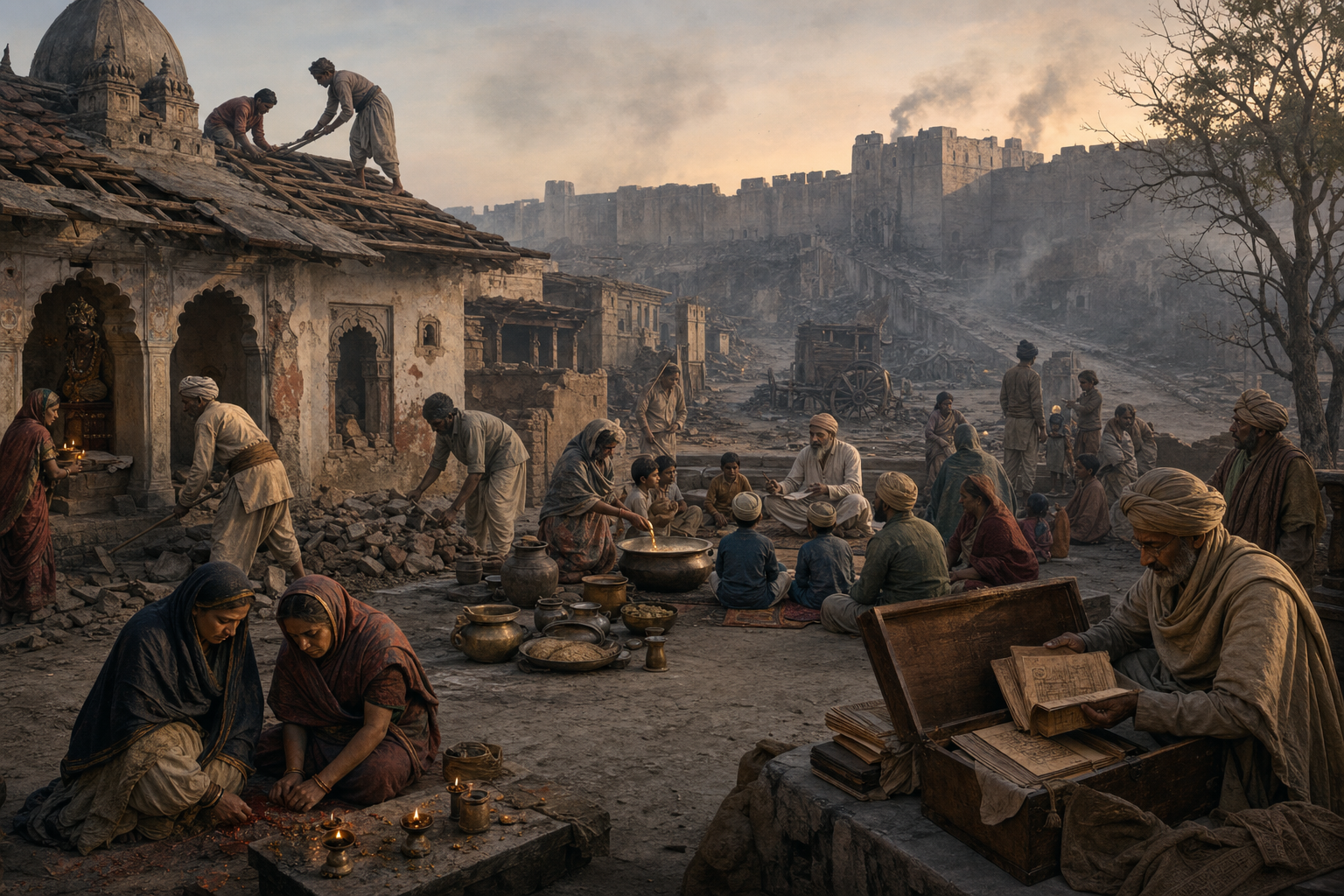
The uprising of 1857 is the clearest test of this wider method. The cartridge controversy was an immediate military grievance, but it intersected with annexations under the Doctrine of Lapse, displaced rulers, disrupted endowments, economic pressure, and fear of accelerated cultural interference. Sepoys, local notables, artisans, religious figures, and householders entered the conflict for different reasons.
The rebellion was also regionally uneven. Some areas committed heavily, some remained quiet, and others divided along local interests. It produced brave resistance, uncertain coordination, and devastating reprisals. Historians have consequently interpreted it as a military mutiny, a political revolution, a war of independence, and a cultural assertion, with the emphasis varying by evidence and definition. You do not need to erase this complexity to recognize its civilizational significance.
British forces suppressed the uprising, and Crown rule replaced Company government. By the normal ledger of campaigns, that was a colonial victory. A broader assessment asks four separate questions:
<!– wp:list {