
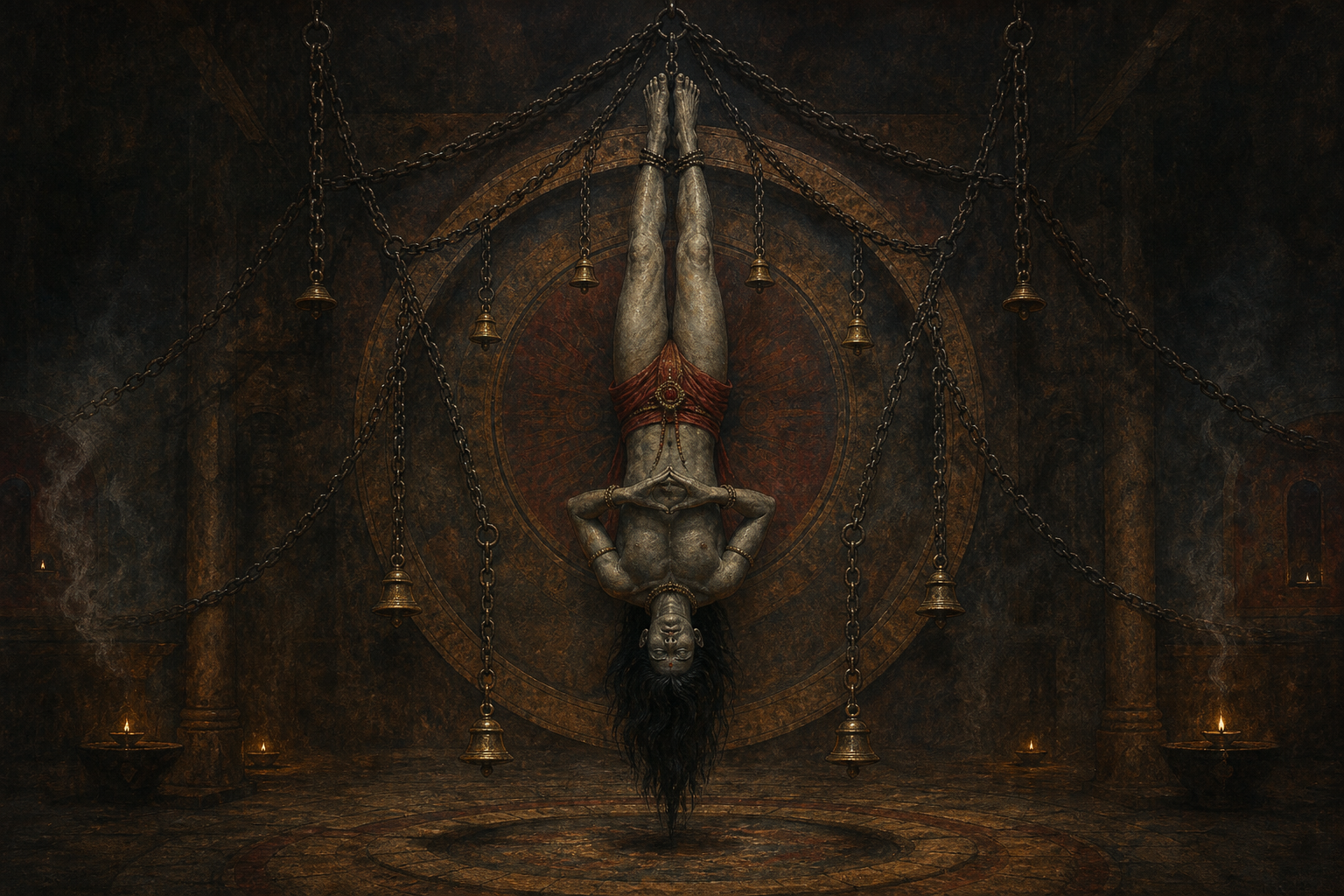
You encounter Vetal hanging head downward, held by chains and accompanied by bells. If you read the image as an ordinary scene, the conclusion seems immediate: someone has captured, punished or humiliated him. That conclusion is understandable, but it is too quick.
Vetal’s image belongs to a sacred visual language in which posture, orientation, restraint and ritual sound work together. Once you read that language as a whole, the inversion stops looking like a simple defeat. It becomes a disciplined challenge to the categories through which you normally separate order from disorder, power from bondage and the divine from the frightening.
Begin with what the image refuses to do
A sacred image is not merely a picture of an event. Its posture can communicate a theological position before any story is told. A seated figure may suggest stability or contemplation. A standing figure occupies the world through an upright axis. Vetal adopts neither posture.
The distinctive representation of Vetal, also called Betal or Vetala, shows him inverted, suspended, bound in chains and adorned with bells. Each detail interrupts an ordinary expectation. His feet do not establish him upon the ground. His head does not occupy the position conventionally called highest. His body is held, yet it remains the centre of sacred attention.
That last point is essential. If the bonds had simply stripped Vetal of significance, there would be little reason for the bound form itself to become an icon. The image preserves the tension instead: Vetal is restrained but not erased, inverted but not ignored, unsettling but still approached within a religious frame.
When you first look at this form, separate observation from judgement. Head downward is an observation. Evil is a judgement. Chains are visible. Punishment is an interpretation. Bells are present. Decoration is only one possible explanation. This small discipline prevents a familiar cultural association from deciding the meaning before the entire image has been considered.
Read inversion, suspension, chains and bells together
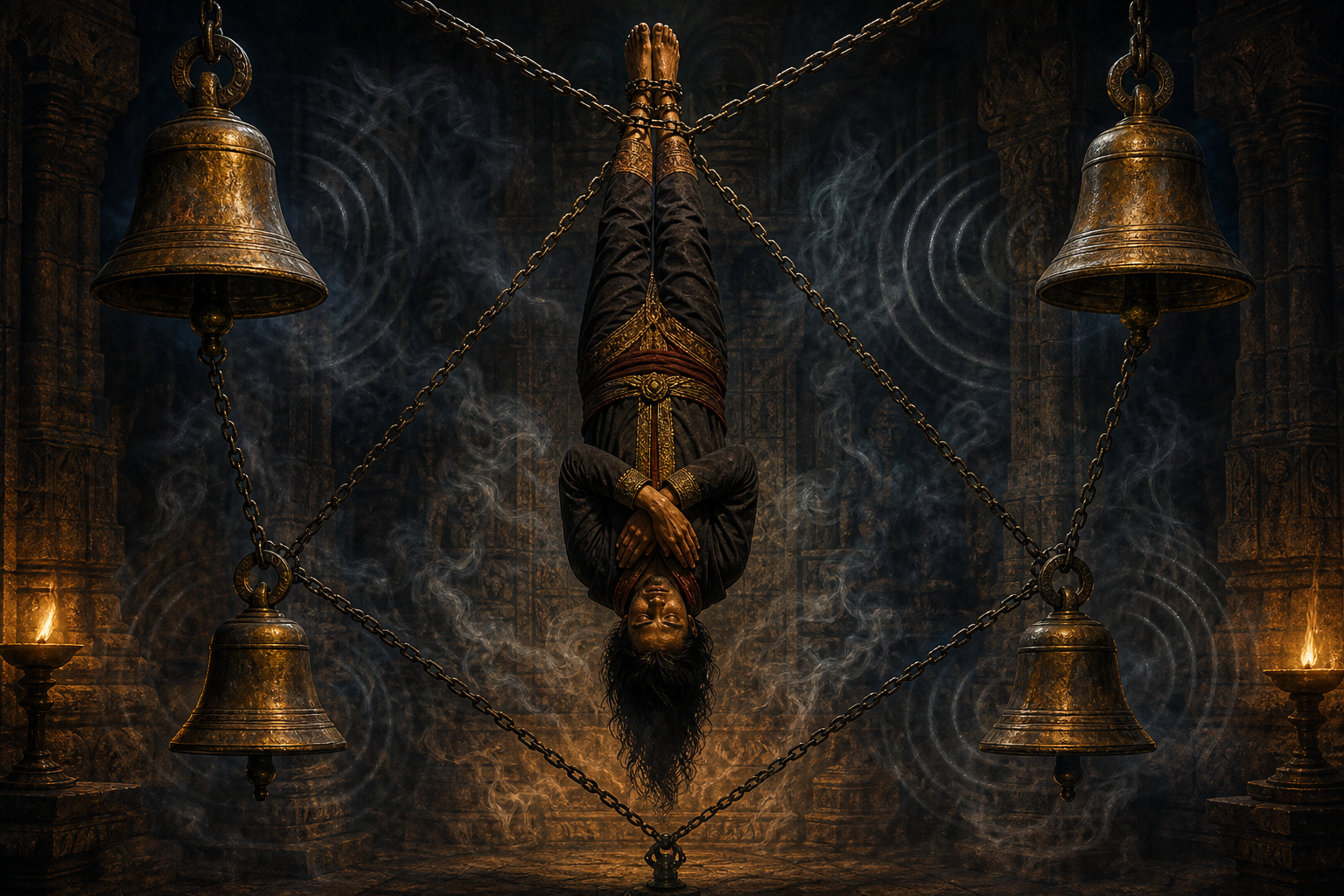
No single feature provides a complete dictionary entry. The image works as a system, and each element changes the meaning of the others.
Inversion dislodges the ordinary hierarchy
Turning a sacred figure upside down does more than make the figure visually strange. It overturns the viewer’s expected relationship to height, stability and control. You cannot approach Vetal with the same effortless orientation that you bring to an upright form. The image makes you perform a mental reversal before you can interpret it.
In a Tantric setting, that reversal can expose the limits of habitual classifications: high and low, pure and impure, auspicious and frightening, controlled and uncontrolled. It does not necessarily abolish those distinctions. It forces you to notice that you were relying on them. An interpretation that says only that upside down means evil has therefore stopped precisely where the image begins.
Suspension removes the comfort of stable ground
Vetal is not merely inverted; he is suspended. The difference matters. An upside-down body resting on a surface would still possess a stable point of contact. A suspended form occupies an interval. It is neither standing nor seated, and its position depends upon the very apparatus that holds it.
This gives the image a liminal quality. Liminal does not have to mean vaguely mysterious or situated between imagined worlds. Here it describes something you can actually see: the figure does not settle into the standard bodily categories offered by the ground. If you want to understand the unease produced by the icon, look first at this denial of ordinary support.
Chains turn raw force into a relationship
A chain always raises relational questions. What is being held? What holds it? Does restraint signal a sentence, a boundary, a vow, subordination or mastery? The visible object cannot answer every question by itself, but it tells you that Vetal’s power is not being presented as casual or unregulated.
Binding and power are not opposites in every sacred context. Restraint can mark potency serious enough to require a form, limit or discipline. The crucial fact is that Vetal remains religiously significant while bound. A defensible reading must therefore explain how restraint participates in his sacred presence; it cannot treat the chains as proof that no presence remains.
Bells make the restraint ritually audible
The bells prevent the chains from being read as purely mechanical equipment. Bells in Hindu ritual commonly direct attention and mark sacred action. Attached to an inverted and bound form, they introduce the possibility of sound whenever the apparatus moves. What looks like confinement also carries a sign associated with ritual presence.
Notice how this alters the whole composition. Without the chains, the inversion could look uncontrolled. Without the bells, the chains could look exclusively punitive. Together, they suggest restrained power made perceptible within a ritual order. That is a stronger reading because it accounts for every major element instead of choosing the most frightening one and ignoring the rest.
Tantric reversal is neither defeat nor a licence for chaos
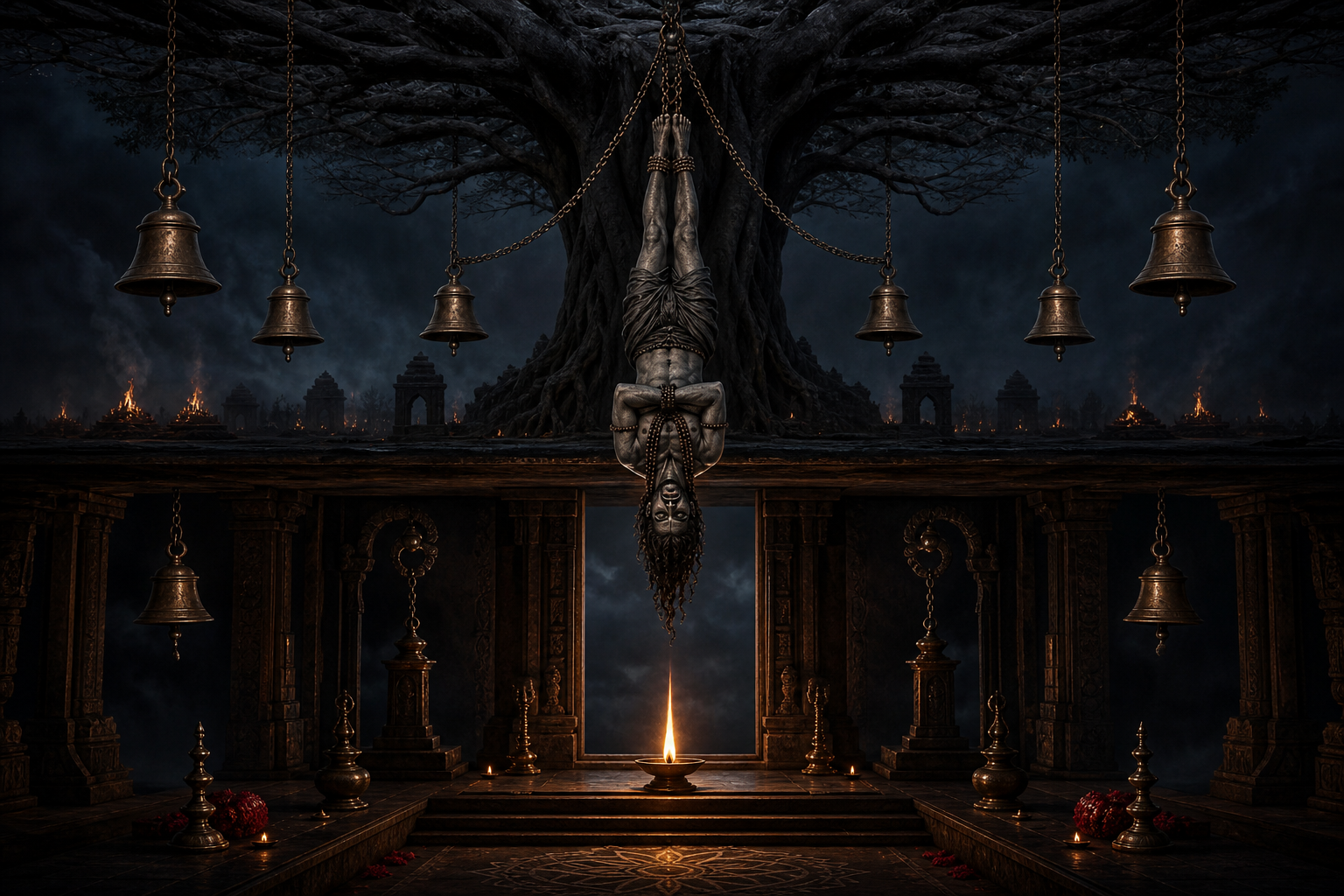
Modern visual habits often make inversion a shortcut for corruption, desecration or horror. Importing that code unchanged into Vetal’s icon produces a moral verdict, not an interpretation. Direction alone is not a universal religious language in which upright always means good and inverted always means evil.
Tantric iconography frequently confronts the practitioner with forms that ordinary devotional taste might avoid. The point is not that everything frightening becomes holy, or that every social boundary should be broken. The sharper principle is that divinity cannot be confined to serenity, symmetry and immediate comfort. A disturbing form may compel attention to powers and conditions that polite representation leaves outside the frame.
Vetal’s inversion should not be romanticised as random rebellion. The chains resist that reading. Reversal occurs under restraint, and restraint bears bells. The composition presents disruption inside a ritual structure. It is closer to controlled confrontation than to a celebration of disorder.
Three common mistakes become easier to avoid once you see this structure. Literalism mistakes an icon for a snapshot of physical abuse. Moral translation assumes that your inherited meaning of upside down must be universal. Romanticisation treats anything transgressive as Tantric and therefore profound. All three isolate one emotional reaction from the complete visual grammar.
There is also no universal Tantric codebook assigning one fixed meaning to every chain, bell or inverted body. Tantra names multiple traditions and ritual worlds, not one interchangeable system. Local worship, lineage and setting may refine the interpretation. Where that context is unavailable, say only what the image supports: it deliberately joins sacred presence to inversion, suspension, binding and ritual sound.
A practical method for examining a Vetal image
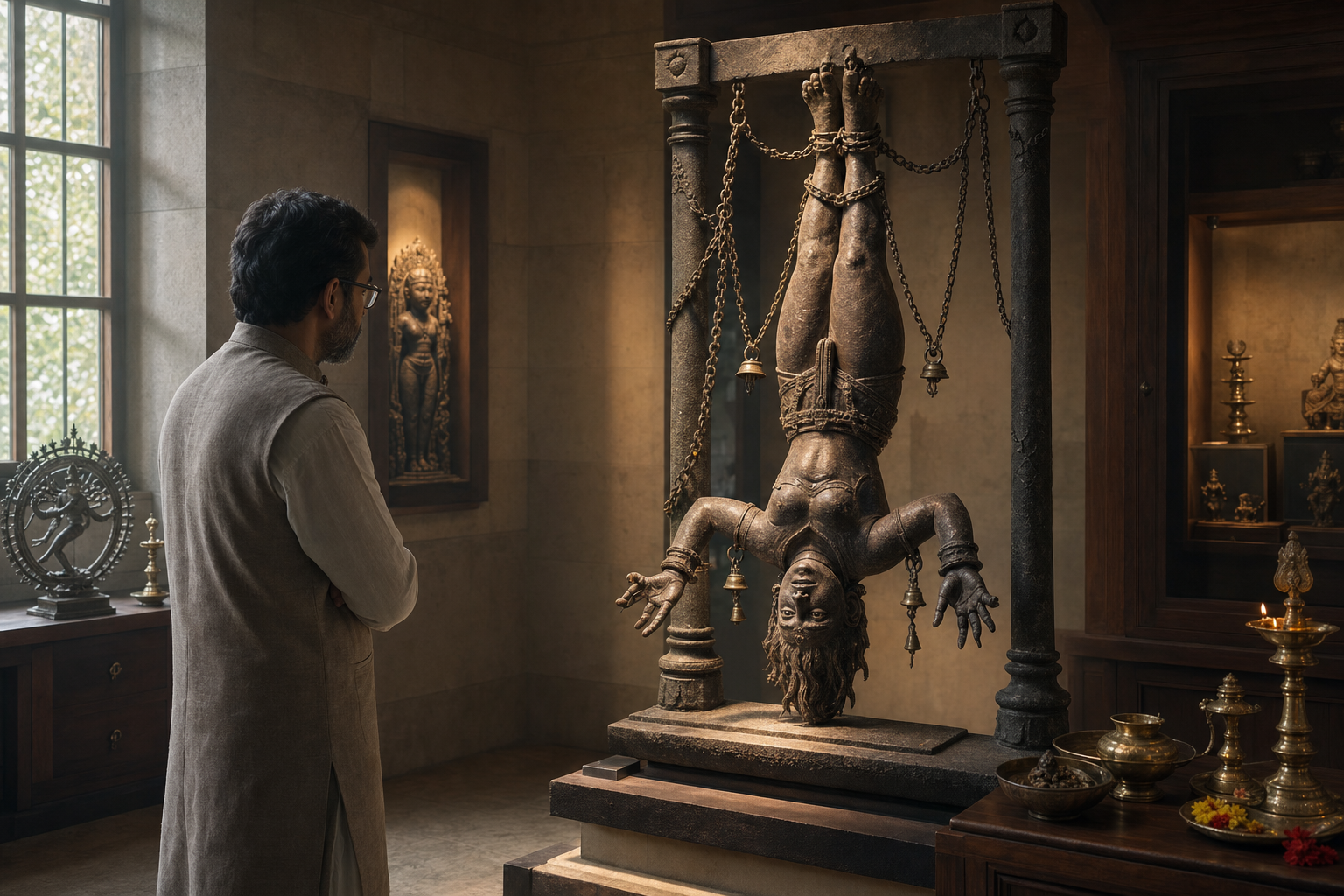
If you encounter Vetal in a temple, a photograph or an illustrated discussion, use the following sequence before accepting a dramatic explanation.
- Verify the orientation. In a photograph, check surrounding architecture, the point of suspension, the direction of chains and any bells. This distinguishes intentional inversion from a rotated or badly reproduced image.
- Make a literal inventory. Record only what you can see: head downward, body suspended, chains holding the form, bells attached or nearby. Keep words such as evil, captive and demonic out of this first pass.
- Identify the refused alternative. Ask what an upright, seated or standing representation would communicate. Vetal’s departure from those postures is part of the message, not a technical inconvenience.
- Follow the relationships. Do not interpret each object in isolation. Ask how suspension depends on binding, how binding relates to the bells, and how all three make inversion visibly deliberate.
- Recover the local context. Note whether the name used is Vetal, Betal or Vetala. If possible, ask the shrine’s custodians how the form is worshipped and whether its position has a local explanation. A living ritual context should outrank a generic caption detached from place.
- Test the explanation for completeness. A useful interpretation should account for the inverted posture, the absence of stable ground, the continuing sacred status, the chains and the bells. If it explains only why the figure looks frightening, it is incomplete.
When only an isolated image is available, stop at the limits of iconographic analysis. You can recognise deliberate reversal and ritually marked restraint without inventing a legend, naming an unknown captor or claiming that every community gives the form an identical meaning. Restraint in interpretation is especially appropriate when the icon itself makes disciplined restraint central.
Key takeaways
- Vetal’s inverted posture is intentional iconography, not a detail to be corrected or dismissed.
- Suspension matters because it removes the stable ground assumed by seated and standing sacred forms.
- Chains need not mean that Vetal is powerless; they can place potency within a visible structure of restraint.
- Bells give the binding a ritual dimension and prevent the apparatus from reading as merely punitive.
- The most coherent interpretation reads all four elements together and leaves room for local Tantric and temple contexts.
The next time Vetal’s image unsettles you, do not hurry to make it familiar. Ask what ordinary posture has been refused, what the restraint organises and what turns that restraint into a sacred sign. If an explanation cannot answer all three questions, keep looking. The inversion has already done its work by making the easy answer unstable.