
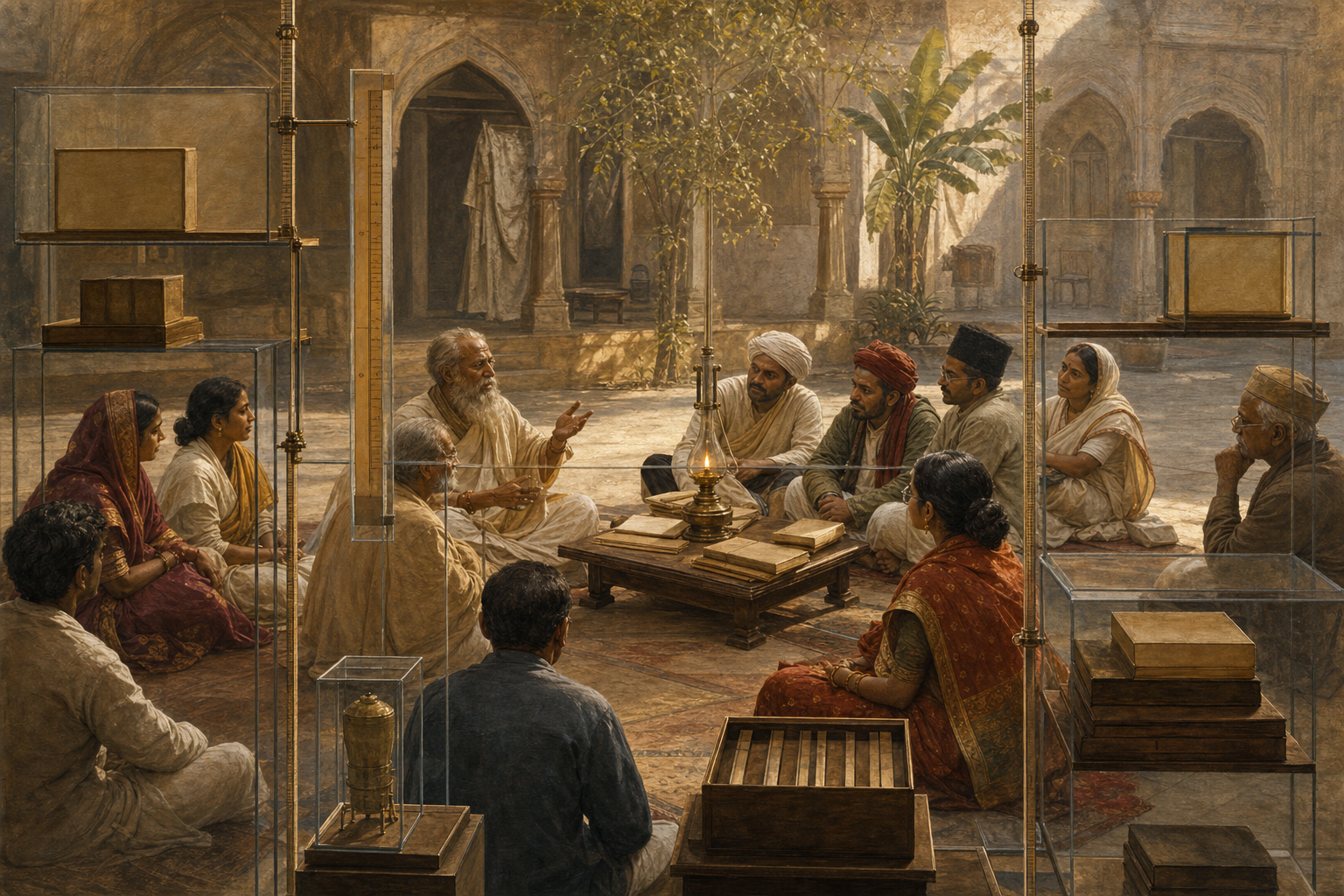
You may agree that Hindu society needed reform and still feel uneasy about the way modern reform was framed. Was a particular injustice being corrected, or was Hindu life being measured against a European model and declared deficient whenever it differed?
You do not have to choose between defending every inherited custom and accepting every modernising demand. A better approach is to separate the harm being addressed, the moral standard used to judge it, and the institution proposed as the remedy. That separation shows where European influence entered Neo-Hindu reform and helps you decide which reforms deserve support.
Start with the hidden yardstick, not the reform slogan

Here, Neo-Hindu refers to a modernising outlook that evaluates Hindu society through categories shaped by European education and political thought. It does not describe every modern Hindu thinker, nor does it prove that every reform proposed under colonial conditions was foreign or misguided.
European influence usually entered at one of three levels:
- The diagnosis: what counted as oppression, backwardness or superstition.
- The norm: what an educated, free or civilised person was expected to become.
- The instrument: whether reform meant moral persuasion, renewed community practice, university education, central legislation or institutional replacement.
These levels need not travel together. A reformer can identify a genuine injury yet misunderstand its cause. A European institution can be useful without its view of human fulfilment becoming the universal standard. Conversely, an appeal to tradition can preserve valuable duties or merely shield an abuse. The origin of an idea does not settle its merit; it tells you which assumptions require inspection.
Consider the debate about women. A European observer accustomed to a different social order could interpret the seclusion, limited freedom and illiteracy of higher-class Hindu women as one undifferentiated condition of degradation. Some Indian modernisers then answered by treating Western-style university education and competition with men as the obvious route to emancipation.
The error lies in turning a bundled description into a bundled remedy. Illiteracy, coercive confinement, household responsibility, economic dependence, spiritual formation and social honour are not the same question. Expanding a woman’s access to learning does not require dismissing household work as bondage. Valuing family duties does not justify denying education or tolerating coercion.
When you encounter a reform claim, therefore, replace the broad label with a concrete sentence. Do not stop at women were oppressed. Ask what a woman was prevented from doing, who prevented it, what injury followed, and which change would remove that injury. A precise diagnosis can support serious reform; a vague civilisational insult cannot.
How European influence travels without announcing itself
Difference is translated into deficiency
A society becomes easy to condemn when its institutions are described only by what they are not. A household organised around reciprocal duties becomes a failed version of individual autonomy. Religious learning becomes a failed version of secular credentialing. A community with inherited roles becomes a failed version of a society built around formally interchangeable individuals.
This translation can expose real injustice, but it can also conceal the purpose of an institution. The practical test is simple: ask what human good the older practice claimed to serve before judging whether it actually served that good. Family continuity, restraint, learning, livelihood, mutual obligation and spiritual discipline are intelligible purposes even when a particular arrangement has become unjust.
The same problem appears in discussions of caste. European condemnation could reduce the entire complex to an engine of pride, conflict and shame, while Indian critics repeated the verdict as if the word caste named one practice with one effect. A useful reformer must be more exact. Is the target humiliation, exclusion from worship, denial of learning, forced occupation, unequal legal treatment, endogamy, hereditary status or local community organisation? These may be connected, but abolishing one injury does not automatically tell you what should happen to every other function.
Precision is not an excuse for delay. It is what keeps a morally necessary reform from becoming an indiscriminate attack on social memory.
External approval becomes a permission slip
European influence did not operate only through criticism. It also determined what educated Indians felt permitted to admire. Vedanta could be neglected as an inheritance and then receive new prestige after Schopenhauer praised the Upanishads and Max Mueller and Deussen endorsed Vedantic thought. The teaching had not changed; the status of the approving voice had.
The same validation pattern appeared in more ordinary domains. Cultured sour milk reportedly gained renewed respect after Metchnikoff commended it. Deep breathing attracted modern attention when Western scientists approved it. The emerging Bengal school of indigenous painting benefited from appreciative European champions. These examples do not establish that every English-educated Hindu waited for foreign permission. They expose a recognisable habit: indigenous knowledge is treated as folklore until an external authority translates it into science, art or philosophy.
You can detect this habit with a counterfactual question: if the evidence and practice remained identical but the European endorsement disappeared, would the advocate still consider them valuable? If the answer changes with the prestige of the speaker, the dispute is partly about authority rather than truth.
The remedy is not to reject external scholarship. Schopenhauer’s admiration does not make the Upanishads false, just as his absence would not make them true. Read the tradition directly, examine its reasoning and observe the practice on its own terms. Outside recognition can begin an inquiry; it should not serve as the final certificate of worth.
Reform becomes institutional replacement
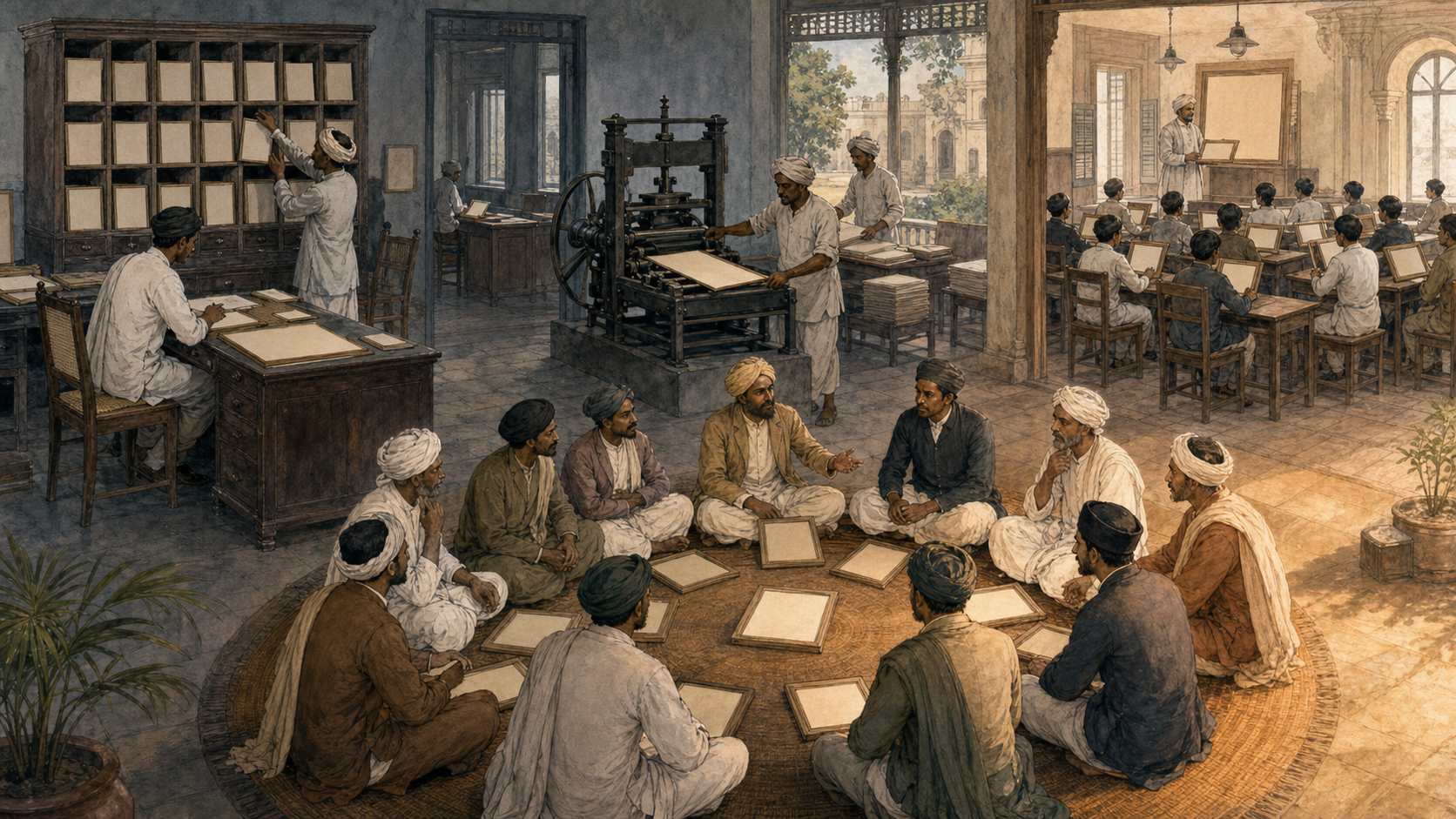
Once the European diagnosis and standard are accepted, the European institution can appear to be the only possible cure. Education then means the university model. Political advancement means seats in a central legislative council. Social organisation means rules administered from above. Local institutions are judged by how closely they approximate the imported structure.
This shift matters because institutions perform several functions at once. An inherited arrangement may transmit skills, distribute duties, provide welfare, settle disputes and preserve religious practice while also containing a serious injustice. If reform removes the institution without identifying those functions, the injury may disappear while dependence, isolation or bureaucratic control grows elsewhere.
The contrast between enthusiasm for additional legislative seats and indifference toward weakening local self-government expresses this concern in political form. The stronger claim that old India enjoyed more real self-government than Western democracies is sweeping and should not be mistaken for a measured comparison covering every time and place. The decision test behind it remains sound: does a reform return agency to the people affected, or transfer another part of life to a distant authority?
Before supporting institutional replacement, make a two-column ledger. In the first column, list every function the existing institution performs, including the informal ones. In the second, identify who will perform each function after reform. A blank cell is not a reason to preserve injustice, but it is a warning that the proposed remedy is incomplete.
Contempt becomes a badge of modernity
Prestige borrowing can become identity performance. Among some early English-educated youths in Bengal, eating beef and drinking liquor served as demonstrations of release from Hindu restraint; a few reportedly threw beef bones into orthodox neighbours’ homes to cause deliberate offence. This was not a representative sample of modern Hindus, and the aggressive spirit later abated. Its significance lies in the mechanism: contempt for inherited boundaries was used to prove intellectual emancipation.
That mechanism still gives you a useful test. Remove every sneer at ancestors, priests, householders and ordinary believers from a reform argument. If a clear account of harm, duty and remedy remains, the proposal may be serious. If ridicule was doing most of the work, you were hearing a claim to social distinction rather than a programme of reform.
A confident civilisation does not confuse criticism with betrayal. It also does not confuse self-disgust with courage.
A seven-question Dharmic audit for any reform proposal

You can use the following audit whether the proposal concerns education, family life, caste practice, temple administration or community government. It neither presumes that the custom is innocent nor that modernisation is beneficial.
- What is the exact injury? Name the affected person, the act or restriction, and the consequence. Backwardness and degradation are conclusions, not descriptions.
- Which layer is being challenged? Distinguish a Dharmic principle, a social institution, a regional custom, a recent habit and an abuse of an otherwise defensible practice. They carry different burdens of argument.
- What is the moral yardstick? State whether the judgement rests on ahimsa, dignity, reciprocal duty, spiritual equality, individual autonomy, economic productivity, state uniformity or another value. If several values conflict, do not hide the conflict inside the word progress.
- What resources for correction exist within the tradition? Look for principles, teachers, community precedents and forms of discipline capable of confronting the injury. Internal reform is not automatically sufficient, but ignoring it guarantees unnecessary cultural destruction.
- Which external elements are genuinely useful? A law, school structure, scholarly method or scientific finding does not become harmful merely because it came from Europe. Adopt it for the problem it solves, not because foreign origin supplies prestige.
- What valuable functions could the remedy displace? Identify who will carry the educational, familial, economic, religious and welfare responsibilities after the change. Preservation of function need not mean preservation of form.
- How will you recognise success? Define the result in terms of the injury removed and the human good restored. If success means only becoming more Western in appearance, the proposal has confused imitation with reform.
Applied to women’s education, this audit replaces the sterile choice between tradition and emancipation. Begin with the precise barrier to learning. Decide what education should enable: literacy, intellectual development, knowledge of dharma, economic capability, civic participation or some combination. Then evaluate the curriculum and institution against those purposes. A programme that merely pushes women onto a male-defined ladder of credential and competition is too narrow. An appeal to family duty that refuses to confront coercion or denied learning is equally inadequate.
Applied to caste, the audit requires you to name the injustice instead of attacking or defending an abstraction. Ending humiliation or exclusion does not require pretending that community, inheritance and mutual obligation have no value. Protecting community life cannot make cruelty Dharmic. Once the target and the functions are separated, reform becomes both firmer and less destructive.
This is the central discipline: judge inherited practices by dharma and their actual consequences, not merely by their age; judge imported remedies by their fitness and consequences, not merely by their prestige.
Key takeaways
- European influence shaped Neo-Hindu reform through categories of judgement, sources of prestige and preferred institutions, not only through explicit foreign commands.
- A genuine injury can be identified through a borrowed framework while the proposed Western remedy remains ill-suited to Hindu social life.
- External approval is evidence of prestige, not proof of truth. Indigenous knowledge should be examined directly.
- Reform should target a named abuse while accounting for the useful functions of the institution being changed.
- A Dharmic alternative to imitation is not static traditionalism. It combines moral scrutiny, internal resources and selective borrowing.
The next time you hear that a Hindu practice must be reformed, make three short columns: injury, authority and replacement. If the injury is vague, the authority is only fashionable approval, or the replacement leaves essential functions unattended, withhold endorsement until the gaps are answered. If the harm is concrete and the remedy survives that scrutiny, support the correction even when one of its tools came from abroad. Civilisational confidence means neither automatic defence nor automatic surrender; it means recovering the right to judge.