
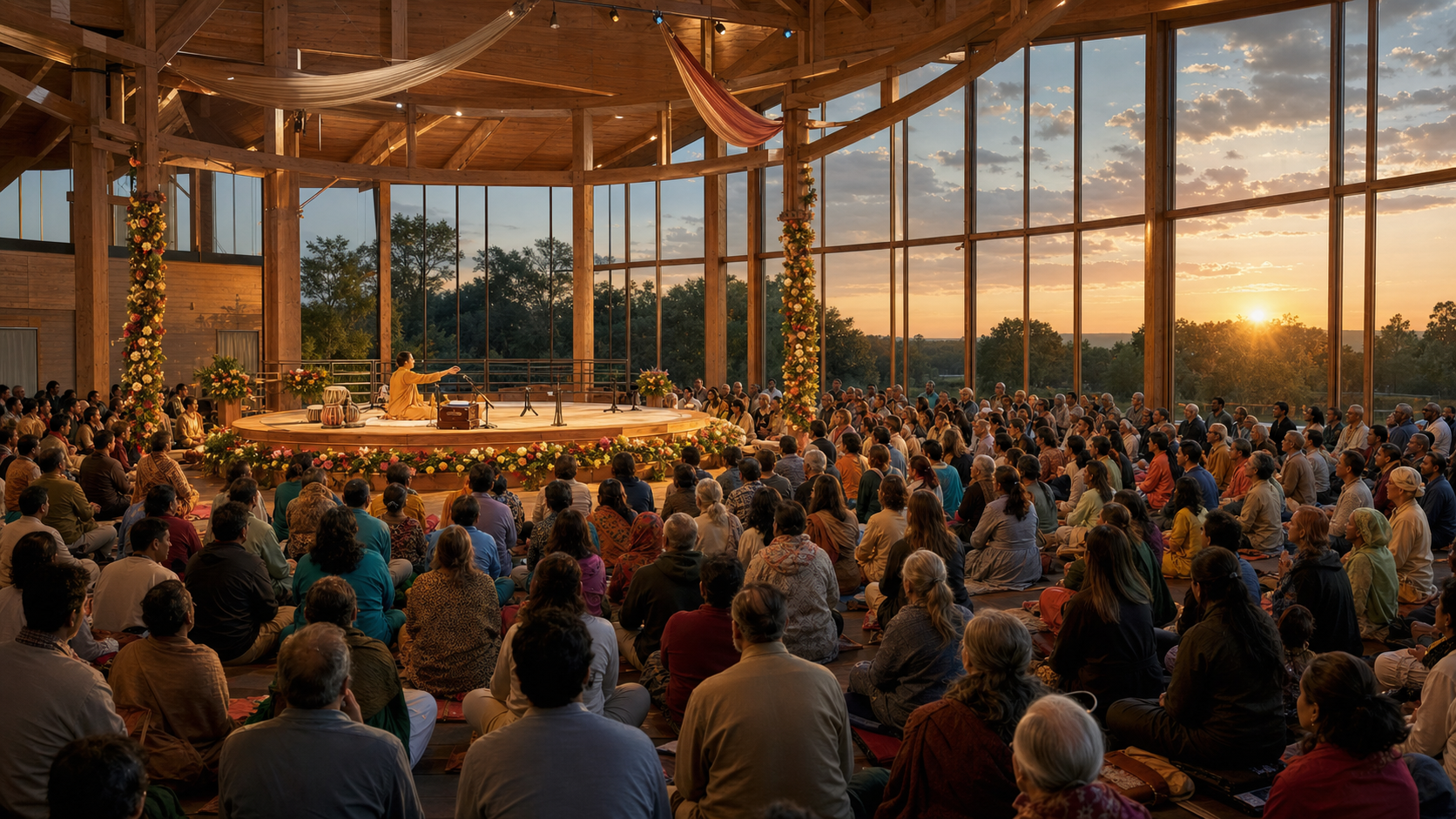
If you saw that a TEDx event had taken place at Bhaktivedanta Manor and wondered whether it was simply an unusual venue booking, look at what the evening asked people to practise. More than 300 guests gathered at Sri Krishna Haveli on Saturday 18 July for talks, storytelling, dinner, conversation, live music and mantra centred on one question: what does love require from us?
For you, the useful part is not the TEDx label by itself. It is the model created when a dharmic institution welcomed contemporary questions without concealing its spiritual character. Ancient narrative sat beside artificial intelligence. Football opened conversations about identity and mental wellbeing. Hospitality and mantra carried ideas out of the abstract and into shared experience.
Why the setting changed the meaning of the theme
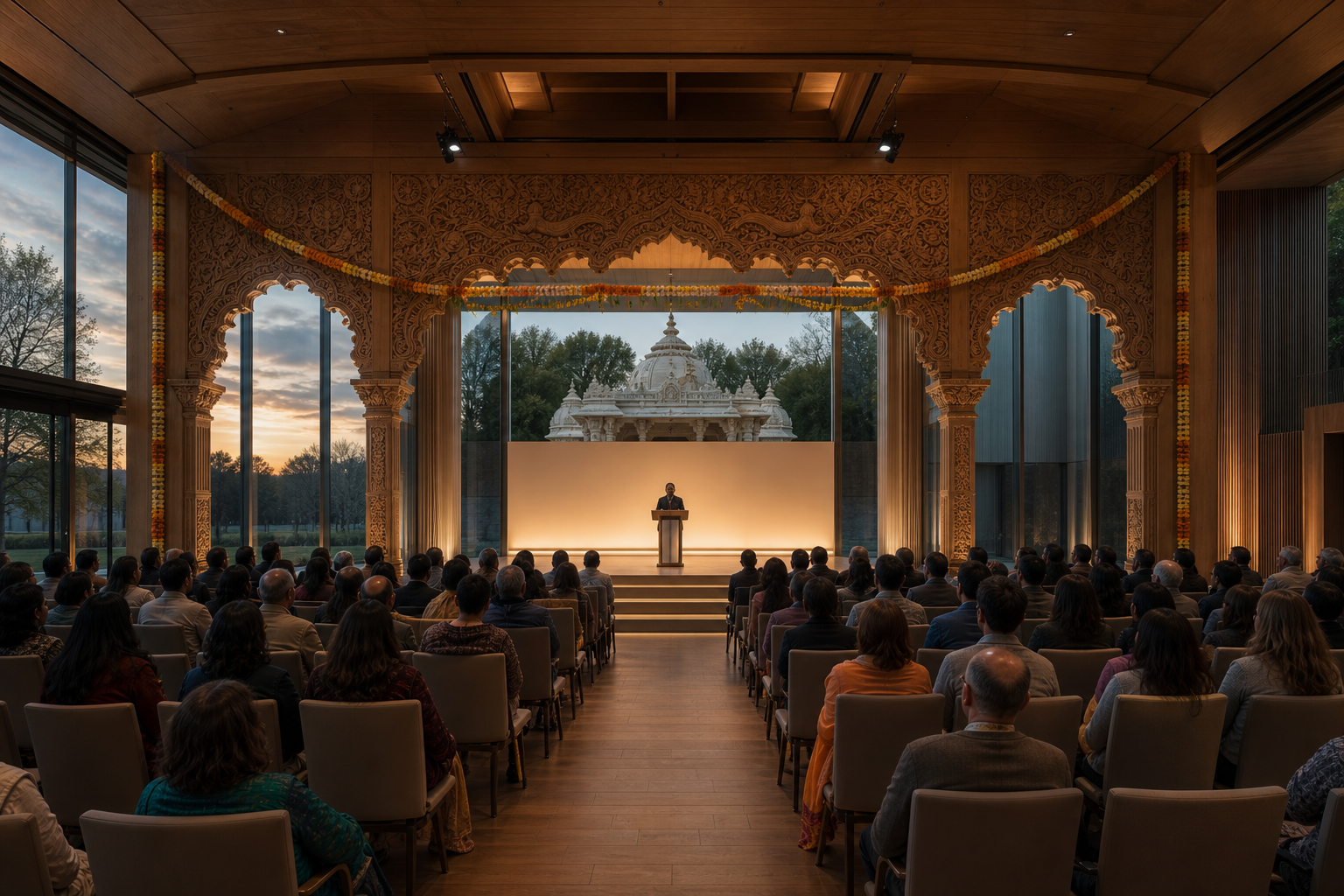
The theme, All You Need Is Love, could have sounded like a familiar slogan in another setting. At Bhaktivedanta Manor, it carried a particular history. The phrase is associated with George Harrison and The Beatles, while Harrison gifted the Manor estate to ISKCON in 1973. A theme drawn from popular culture had therefore returned to a place sustained by spiritual practice, service and community.
That connection mattered because bhakti does not leave love as a pleasant feeling. It asks where you place your attention, how you serve and whether another person is treated as a soul or as an instrument for your purposes. The venue quietly turned a broad cultural phrase into a practical test.
This gives you a useful way to judge any values-led event. Do not ask only whether the theme sounds attractive. Ask why that theme belongs in that place, what history gives it weight and how guests will experience it after the speeches end. If the theme could be moved unchanged to any building, it probably has not yet been connected deeply enough to the host community.
Nine voices turned love into a set of choices

The evening brought together nine speakers, with some contributions also involving family or team members. They did not try to force relationships, technology, health, sport, family life and spiritual practice into one definition of love. Their variety showed where the same ethical question appears in different parts of an ordinary week.
- Choose connection over transaction. Lawrence Rosenberg examined genuine connection and the limitations of transactional networking. The distinction is immediately useful: before approaching someone, notice whether you are interested in the person or only in access, status or advantage. A better conversation begins with something you are prepared to hear fully, not a rehearsed request waiting for its turn.
- Let sacred stories become family conversations. Vrinda Kishori, Lali and Janaki told the ancient story of Dhruva, drawing attention to story, family and presence. If you share such a story with children or friends, resist the urge to deliver the moral before they have responded. Ask what Dhruva wanted, what changed and which choice they found difficult. The story then becomes a meeting place rather than a memory test.
- Decide what technology must not displace. Tom Meyer addressed artificial intelligence through the need to protect human attention and creativity. Before adopting an AI tool, name the human capacity you intend to preserve: careful judgment, original thought, responsibility for the final decision or undivided attention during a conversation. Without that boundary, convenience can quietly determine what you surrender.
- Examine the relationship from which your idea of love begins. Harpreet Kaur considered how love is shaped by the way a person relates to the self. This need not become self-absorption. It can begin with a more demanding question: do your inner habits make you more truthful, patient and available to others, or do they keep you preoccupied with defending an image?
- Use shared activity to loosen social labels. Elliot Bird, Hannah and Jeffery showed how football can help young people develop self-belief beyond imposed labels. Giancarlo Gaglione used football as a setting for honest conversation about mental wellbeing. If a young person withdraws from formal discussion, a shared task or game may offer a less exposed way to build trust before expecting personal disclosure.
- Notice disconnection before it becomes the normal atmosphere. Dr Kapil Chawla used the phrase disease of disconnection while considering its effects on health. That phrase is a relational framing, not a clinical diagnosis. Its practical value lies in the questions it prompts: who would notice if you disappeared from your usual routines, whom would you notice, and which relationship has been reduced to messages sent only when something is needed?
- Move from talking about spiritual life to practising it. Radhika Das closed with reflection, mantra and live music. Ending this way changed the mode of the gathering. Guests were no longer only evaluating propositions; they were invited into attentive participation. A dharmic gathering need not hide its practice in order to make newcomers welcome. It needs to introduce that practice clearly and hospitably.
Hospitality was part of the argument
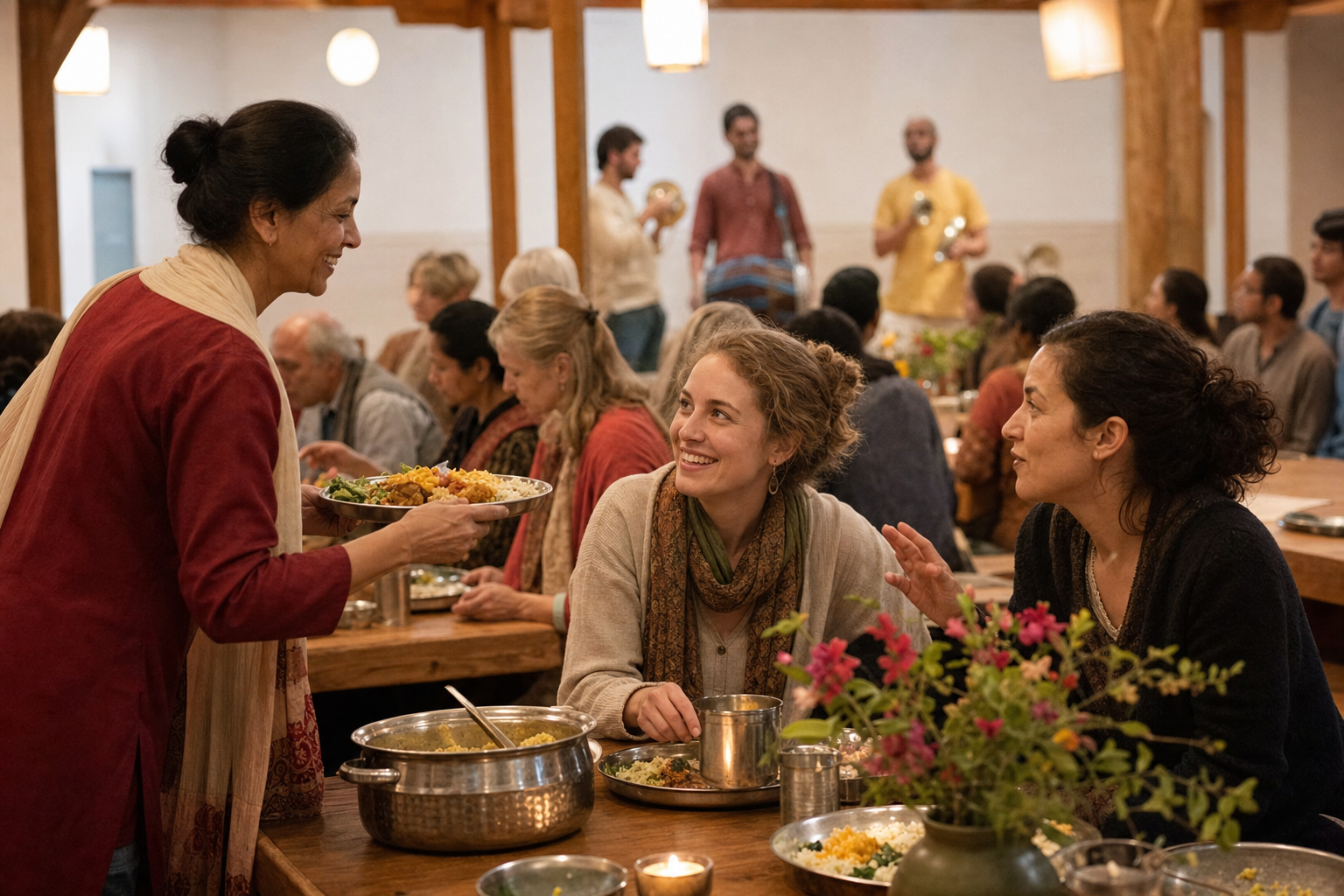
The first TEDxWatford unfolded over five hours of short talks, storytelling, dinner, music and conversation. That sequence gave guests more than one way to participate. A talk could supply an idea, a story could give it emotional shape, a meal could open a personal exchange and music could create a shared experience without demanding agreement on every proposition.
This is especially important for dharmic organisations. Hospitality is not decoration around the serious programme. It is where claims about respect, service and community are tested. Guests learn what a community values partly through the stage, but also through the welcome at the door, the clarity of directions, the care around food, the handling of transitions and whether anyone makes space for an unfamiliar person.
If you are planning a temple, campus or community event, the Manor evening offers a practical design pattern:
- Begin with a human question broad enough to invite newcomers. Love created an accessible doorway, while the setting gave the question spiritual depth.
- Alternate modes instead of stacking speeches. Place story, conversation, food or music between stretches of formal presentation so guests can process what they have heard.
- Protect room for person-to-person contact. Do not schedule every moment so tightly that the value of connection is proclaimed from the stage but made impossible in the hall.
- Let the tradition be encountered directly. A story such as Dhruva’s and a closing mantra communicate differently from an explanation of bhakti. Offer enough context for a newcomer to participate without pretending that the practice is spiritually empty.
- Treat hosting as a shared discipline. Devotees from the School of Bhakti, KCSOCs and Pandava Sena helped host the gathering. For your own event, name reception, guest care, meals, room transitions and follow-up as real responsibilities rather than leaving them to whoever happens to be available.
The point is not to copy the surface of a TEDx programme. It is to align message, setting and conduct. If an event speaks about connection while guests remain isolated, or celebrates service while volunteers are unsupported, its structure contradicts its theme.
Key takeaways you can put into practice

- Give one conversation your full attention. Put away the device, stop preparing your answer and listen for what the other person is actually trying to express.
- Set one boundary for AI before convenience sets it for you. Identify a creative, relational or judgment-based task that will remain under deliberate human responsibility.
- Retell one dharmic story as a conversation. Invite questions and differing observations before explaining what you believe the story teaches.
- Use a shared activity to build trust. With young people in particular, service, sport or another cooperative task may open connection more naturally than demanding an immediate personal conversation.
- End reflection with practice. After discussing love, service or attention, choose one act that embodies it: a sincere check-in, an offered meal, practical help or a period of mantra and remembrance.
Choose the setting you already have – a family meal, a youth gathering, a temple committee or a conversation at work – and change one thing in it. Make more room for attention, story, service or shared spiritual practice. Bhaktivedanta Manor’s first TEDxWatford showed that dharmic culture can meet contemporary concerns most convincingly when its values are not merely explained but made visible in the way people gather.