
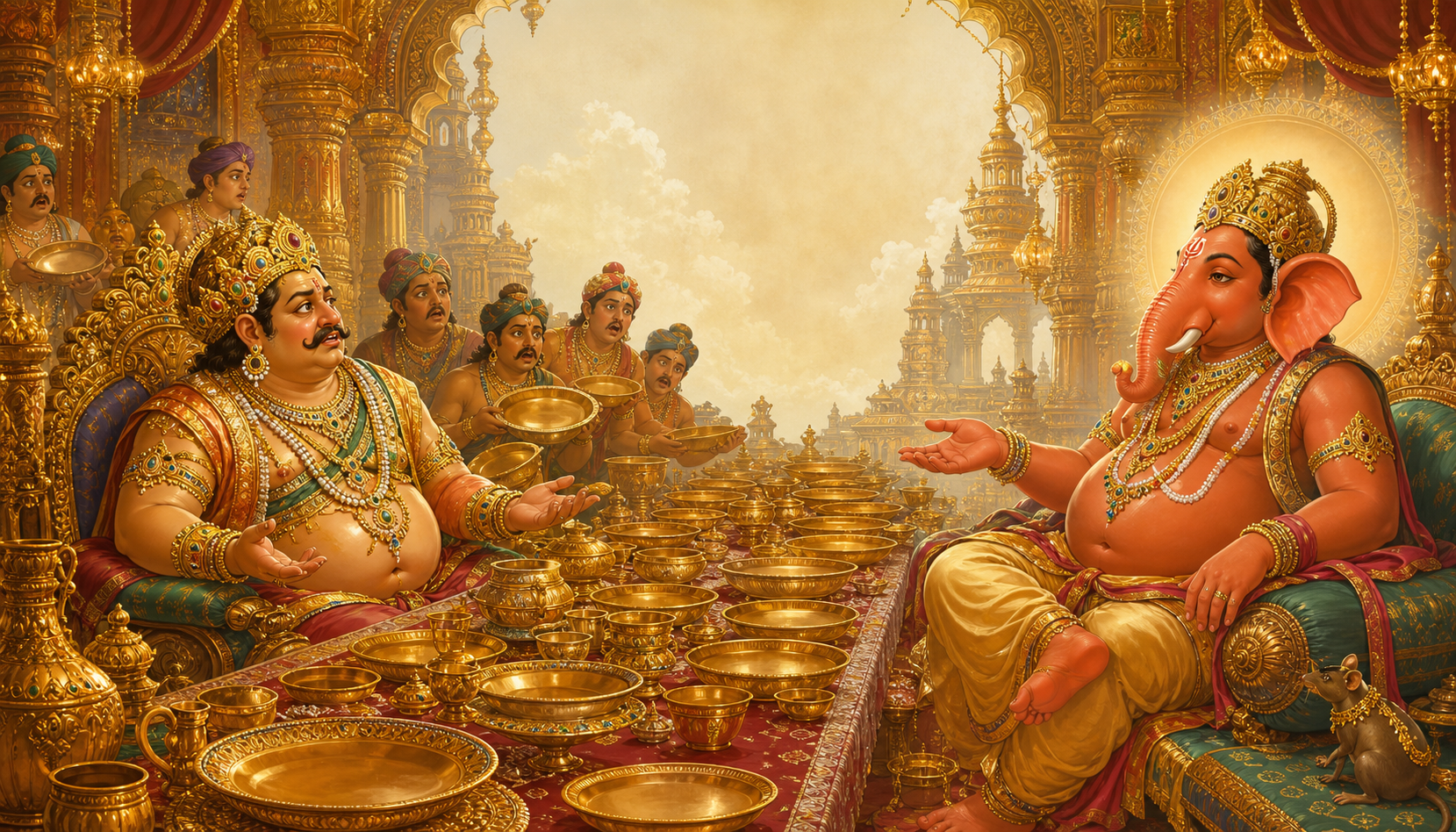
If you are trying to decide whether your generosity is genuine seva or a polished form of self-display, Kubera’s feast gives you an uncomfortable but useful test. The test is not how much you can offer. It is whether the person receiving your gift remains more important than the image you create by giving it.
The story places a confident host before a guest who cannot be reduced to an ornament of the host’s prestige. Kubera, the deity of wealth, lives amid luxury and invites Ganesha to a feast. Ganesha is also Lambodara, the huge-bellied one. Their encounter turns a display of abundance into an examination of pride.
The feast asks you to examine the host, not the menu
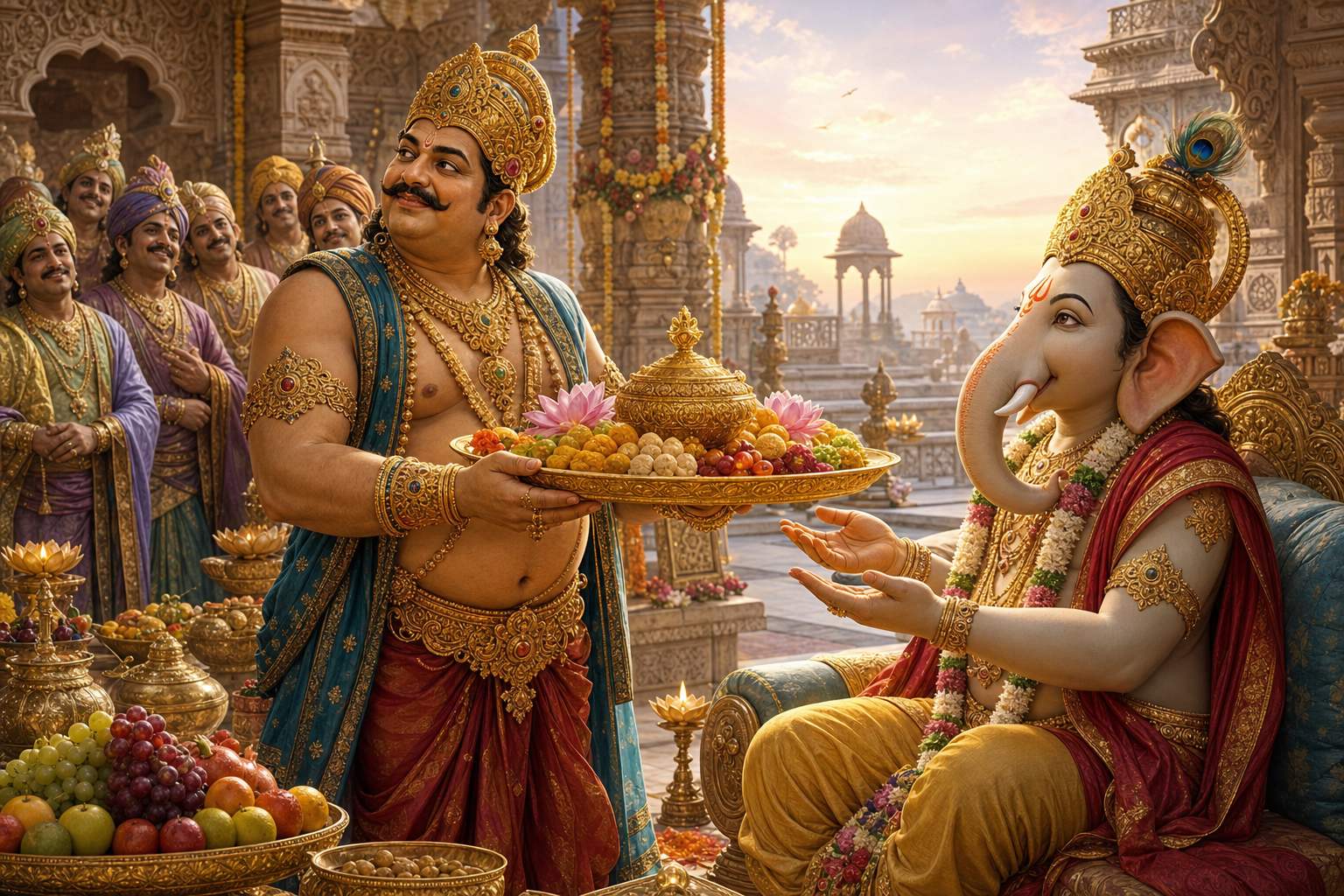
A feast can nourish a guest, honour a relationship, fulfil a sacred intention or strengthen a community. It can also become a stage on which the host tries to prove importance. The food may look identical in both cases. The difference appears in who controls the occasion and whose dignity matters.
Pride changes the guest into an audience. The host no longer asks, “What would serve you?” He silently asks, “Have you seen what I can provide?” That is Kubera’s vulnerability. His resources are real, but pride encourages him to treat those resources as proof that he himself is greater.
You can detect the same movement by noticing what irritates you after you give. Do you resent a guest who does not praise the meal? Does an unacknowledged donation feel wasted? Do you become offended when a recipient uses a gift differently from the way you imagined? Such reactions do not automatically make the original act worthless, but they reveal that recognition may have been part of the expected return.
Before your next act of hospitality, ask three questions privately. Would you still do this if nobody else knew? Can the recipient decline or choose differently without being punished? Will you remain content if the thanks are brief? Your answers will tell you more about the offering than its price will.
Pride, not wealth, is the real object of correction
A shallow reading turns the tale into an argument against wealth. That misses the sharper teaching. Kubera’s abundance creates the conditions of the test, but possessions and pride are not the same thing. Wealth is a capacity. Pride is the mistaken conclusion that possessing more makes the possessor inherently greater.
Kubera’s luxury is placed in contrast with Shiva’s simplicity. That contrast should not be used to romanticise deprivation or excuse careless hosting. A modest meal offered to humiliate someone is not spiritually superior to an abundant meal offered with attention and respect. The decisive question is whether the giver uses resources in service of the occasion or uses the occasion in service of ego.
This distinction matters in ordinary settings. When hosting at home, ask what your guest can comfortably eat instead of choosing everything for maximum display. When supporting a temple or community activity, fund what is actually needed instead of insisting that the most visible item carry your name. When helping a relative, do not turn the gift into a permanent claim on that person’s obedience.
Set the amount you can responsibly give before the social performance begins. Once prestige enters the decision, a useful offering can expand into extravagance, competition or resentment. A private limit protects both the giver and the purpose of the gift.
Lambodara puts Kubera’s false measure under pressure
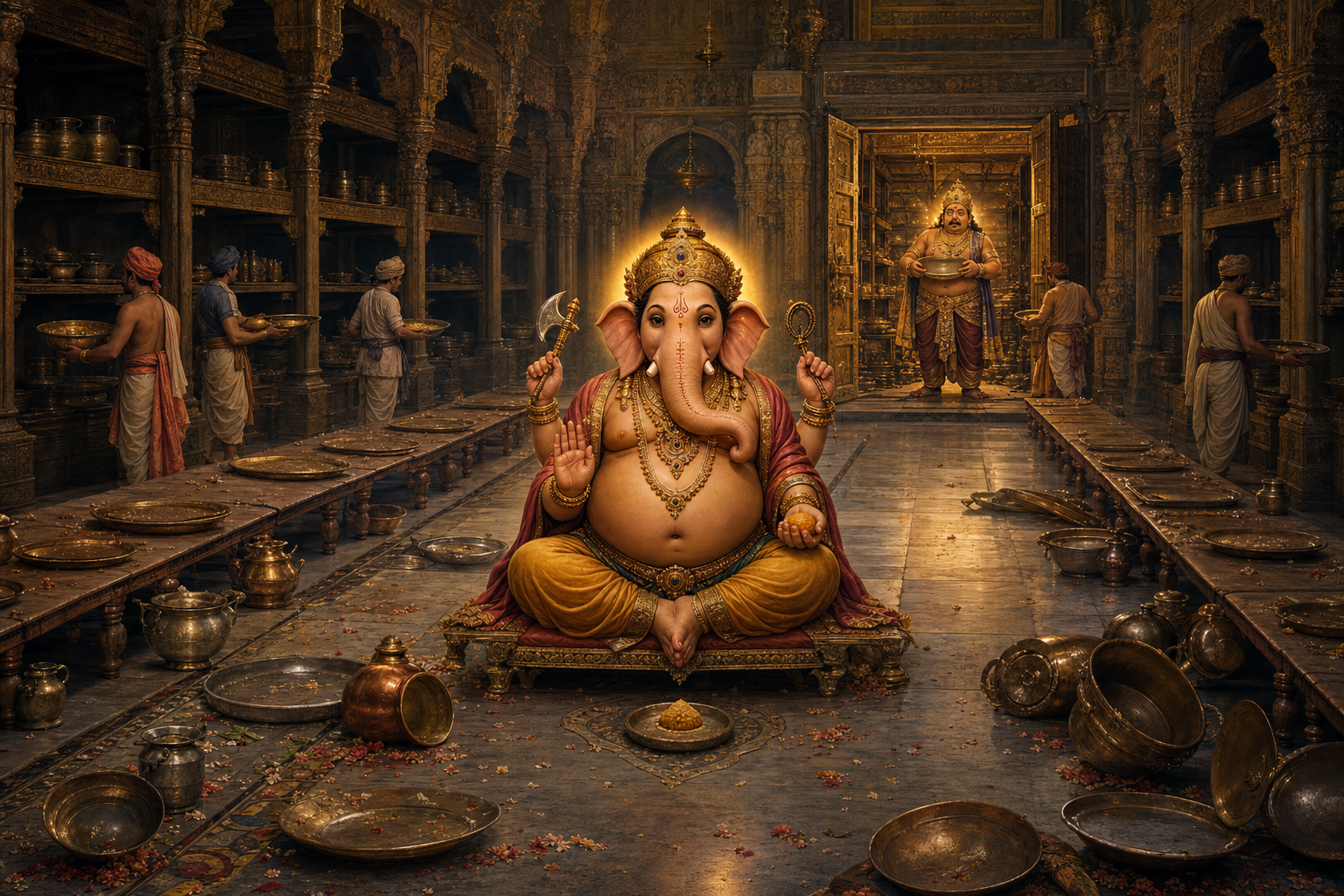
Ganesha’s name Lambodara is not a disposable comic detail. Within the feast, the huge-bellied guest confronts the wealthy host with a reality that cannot be mastered merely by counting possessions. Kubera may possess abundance, but possession does not make him the measure of every need or the controller of every outcome.
The image works because it reverses the apparent hierarchy. Kubera expects his wealth to define the encounter. Ganesha’s presence makes the host’s inner condition the real subject. The person who seems powerful is exposed as dependent on praise, while the guest refuses to remain a manageable prop in someone else’s display.
This is especially important when telling the story to children. If they hear only that Ganesha has a large belly or appetite, the moral shifts toward mocking a body and away from examining arrogance. Redirect their attention with better questions: What was Kubera trying to prove? Why was feeding a guest not enough for him? How would the invitation have felt if it had been made with humility?
Adults can use the same questions. Our preferred symbols of status may be subtler than a royal banquet: an elaborate ceremony, a public donation, a costly family event or a photograph arranged around an act of service. The form changes. The temptation to make another person’s need support our self-image does not.
Key takeaways: turn the feast into a practice
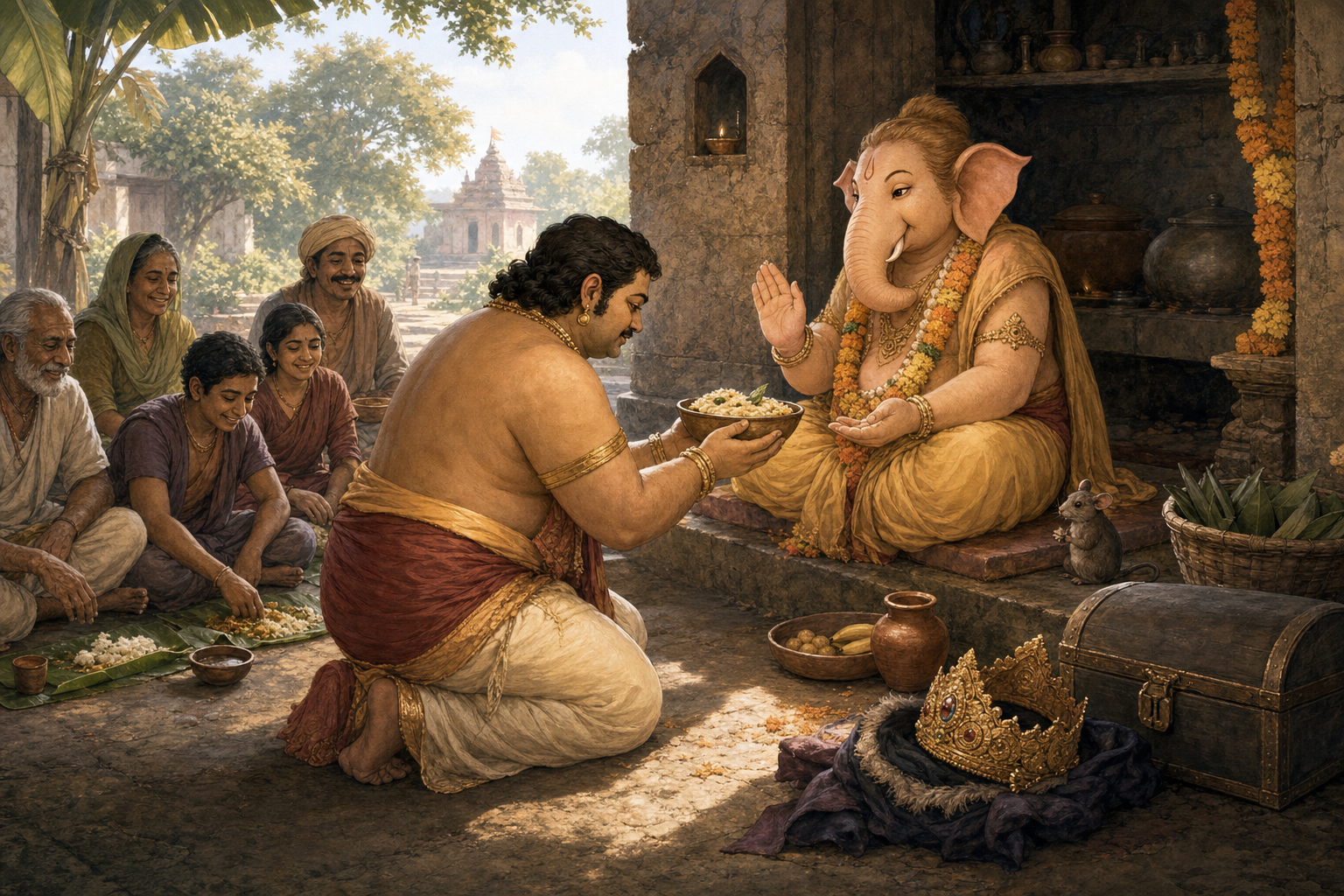
- Name the purpose before spending. Complete the sentence, “This offering is meant to…” If the answer centres on what others should think of you, revise the plan.
- Keep one part of the giving unseen. When it is safe and appropriate, offer some money, food, time or labour without attaching your name. Privacy exposes how much recognition was motivating you.
- Protect the recipient’s agency. Ask what is useful, provide reasonable choices and allow refusal. A gift that cannot be declined easily becomes a demand.
- Remove cost-accounting from the relationship. Decide your budget privately, then stop reciting the price, effort or sacrifice to the person who received the offering.
- Audit your reaction afterward. If limited praise, changed plans or an imperfect outcome makes you angry, do not demand repayment in gratitude. Treat the reaction as information about the attachment still present in your giving.
None of this requires making hospitality drab. A beautiful feast can express devotion, affection and joy. The correction is simpler: let beauty serve the welcome, and let wealth serve the duty. Do not make the guest carry the burden of proving that you are generous.
At your next meal, donation or family celebration, change one concrete thing. Remove one signal designed mainly to make the giver look large, and add one choice that protects the recipient’s dignity. That is where Kubera’s feast stops being merely a remembered tale and becomes a daily spiritual discipline.