
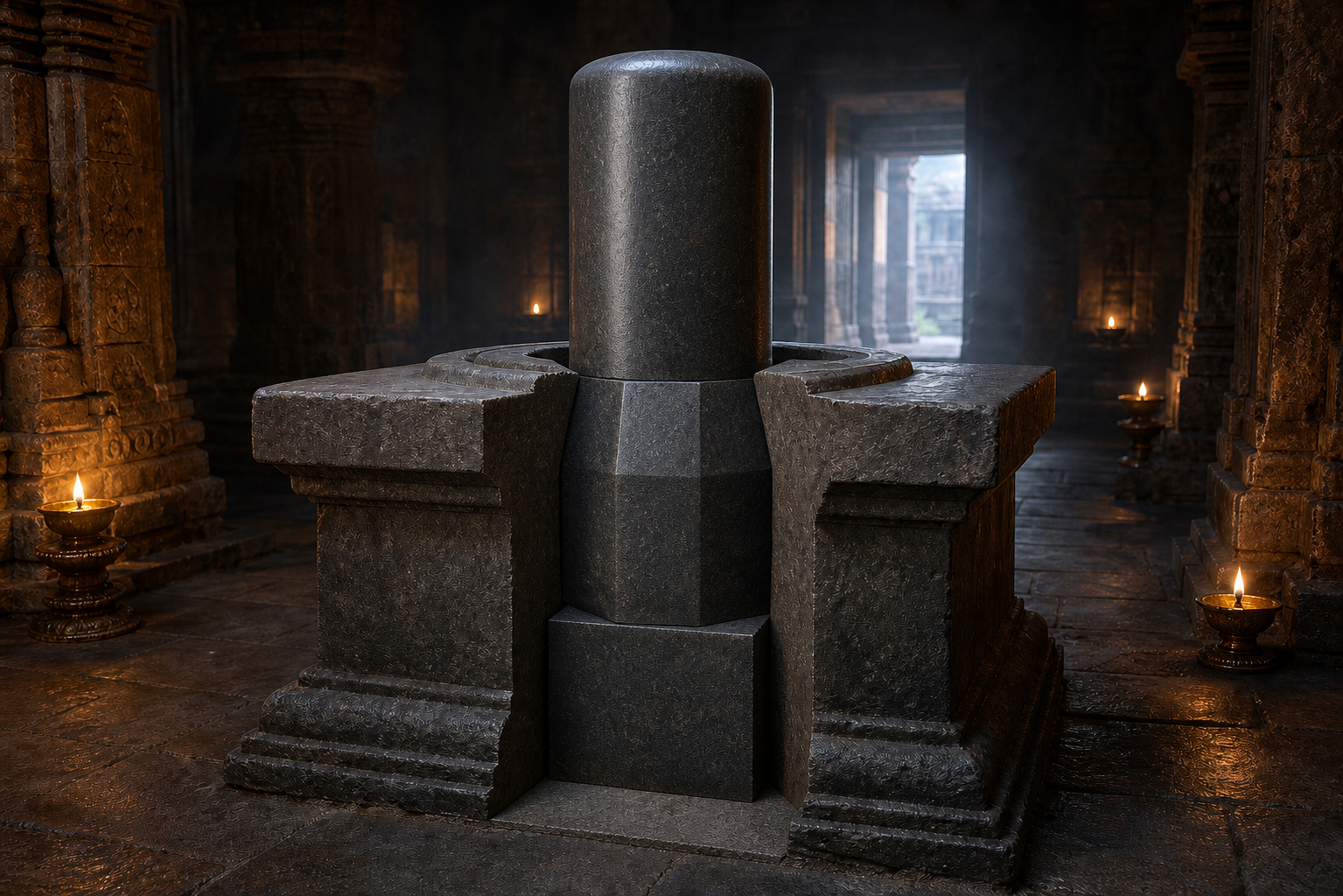
You are looking at a Shivling whose crown appears perfectly simple, yet someone identifies it as Samakanda. What should you actually look for? The answer is not ornament, size, colour, or even the smooth cylinder that receives abhisheka. Samakanda is defined by a measured relationship among three sections, much of which may be concealed after installation.
Once you know how to read that relationship, the form becomes remarkably clear. Square, octagon, and circle express creation, preservation, and dissolution without making any one function dominate. That gives you a practical way to identify the form, understand its theology, and avoid buying or installing something merely labelled “Samakanda” without the geometry that the name requires.
Start with the one-third rule, not the visible silhouette
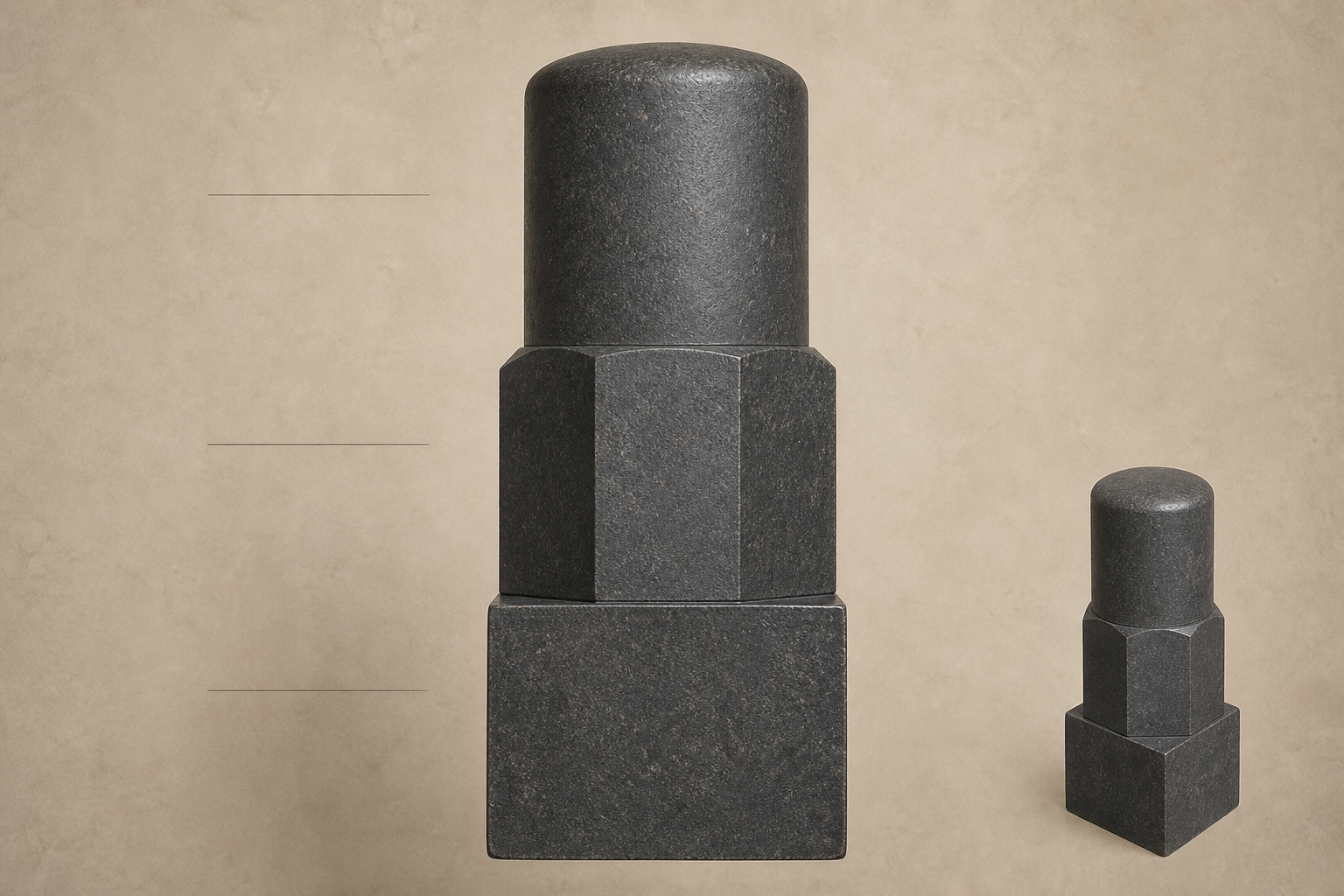
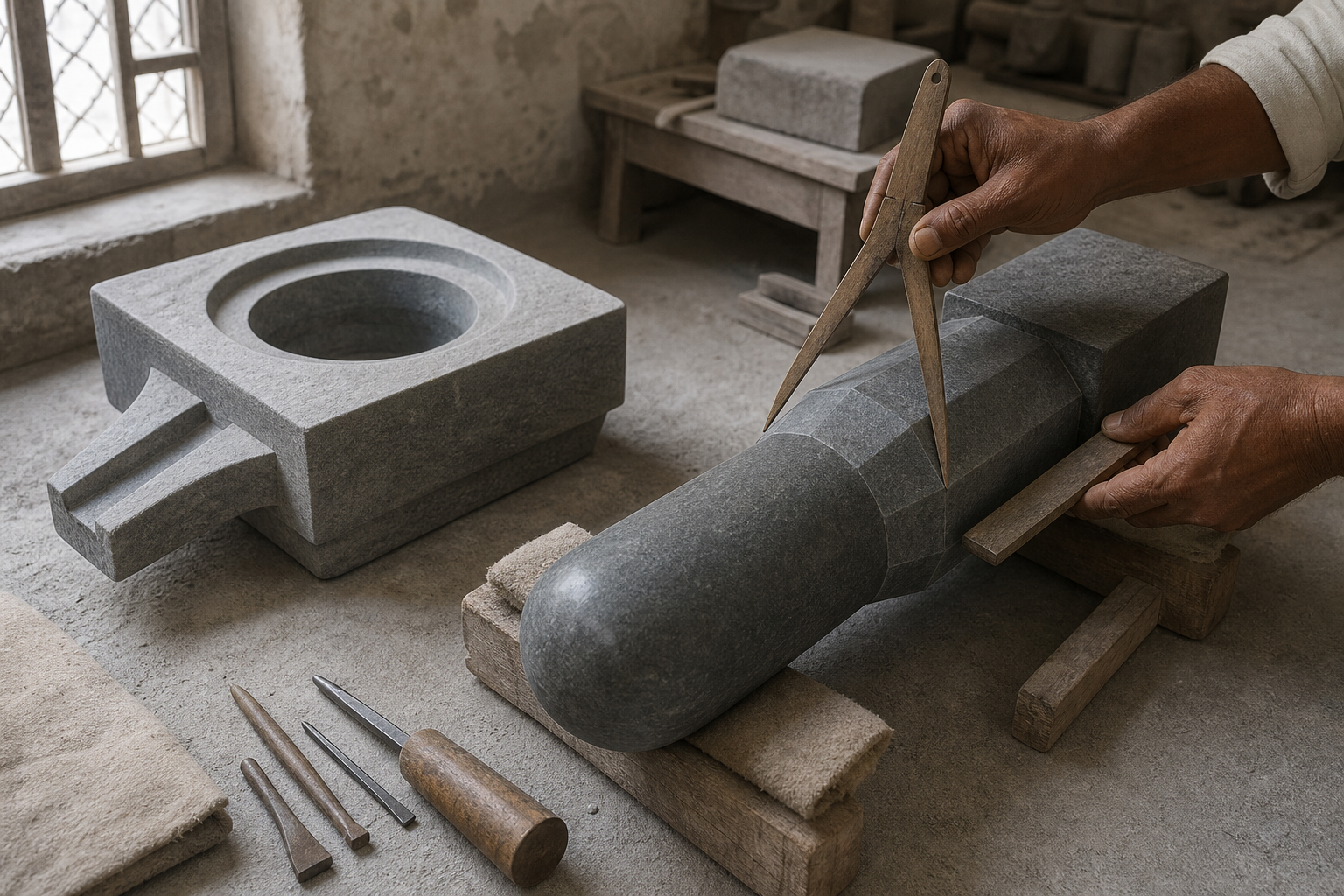
The name can be read as sama-kāṇḍa: an equal division of the vertical body. A Samakanda Shivling is a mānuṣa liṅga, meaning a human-made form shaped according to canonical measurements rather than a naturally occurring or self-manifest form. Its defining feature is that the Brahmā, Viṣṇu, and Rudra portions receive equal shares of the prescribed vertical measure.
This sounds easy to verify: divide the height by three. An installed Shivling is more difficult to read because its conceptual body and its exposed profile are not the same thing. The Brahmā portion is normally held within the pīṭha, the Viṣṇu portion may be only partly visible, and the Rudra portion forms the prominent rounded crown. Measuring only the cylinder above the pīṭha can therefore tell you less than you think.
| Section | Geometric form | Cosmic function | What you may see after installation |
|---|---|---|---|
| Brahmā-bhāga | Square | Sṛṣṭi, creation or manifestation | Usually embedded within the pīṭha |
| Viṣṇu-bhāga | Octagonal | Sthiti, preservation and ordered continuity | Sometimes partly visible as a faceted transition |
| Rudra-bhāga | Circular | Saṁhāra, dissolution and transcendence | The exposed cylindrical crown that receives abhisheka |
The square, octagon, and circle are not optional decorative treatments. They are part of the iconographic grammar. A smooth, attractive Shivling does not become Samakanda simply because its exposed height can be divided into three equal bands. Equality of the three canonical portions and the intended transitions between their geometries must belong to the construction itself.
Traditional measurements may be expressed through units such as aṅgula and tāla. The one-third principle anchors the type, while diameter, curvature, facet transitions, and the precise relationship with the pīṭha can vary across regional canons and workshop lineages. The Kāmikāgama, Suprabhedāgama, Ajitāgama, and related Śaiva and śilpa traditions belong to this larger technical setting. If you are evaluating a newly made form, ask for its dimensional scheme rather than accepting a commercial label as proof.
Read the square, octagon, and circle as one continuous ascent
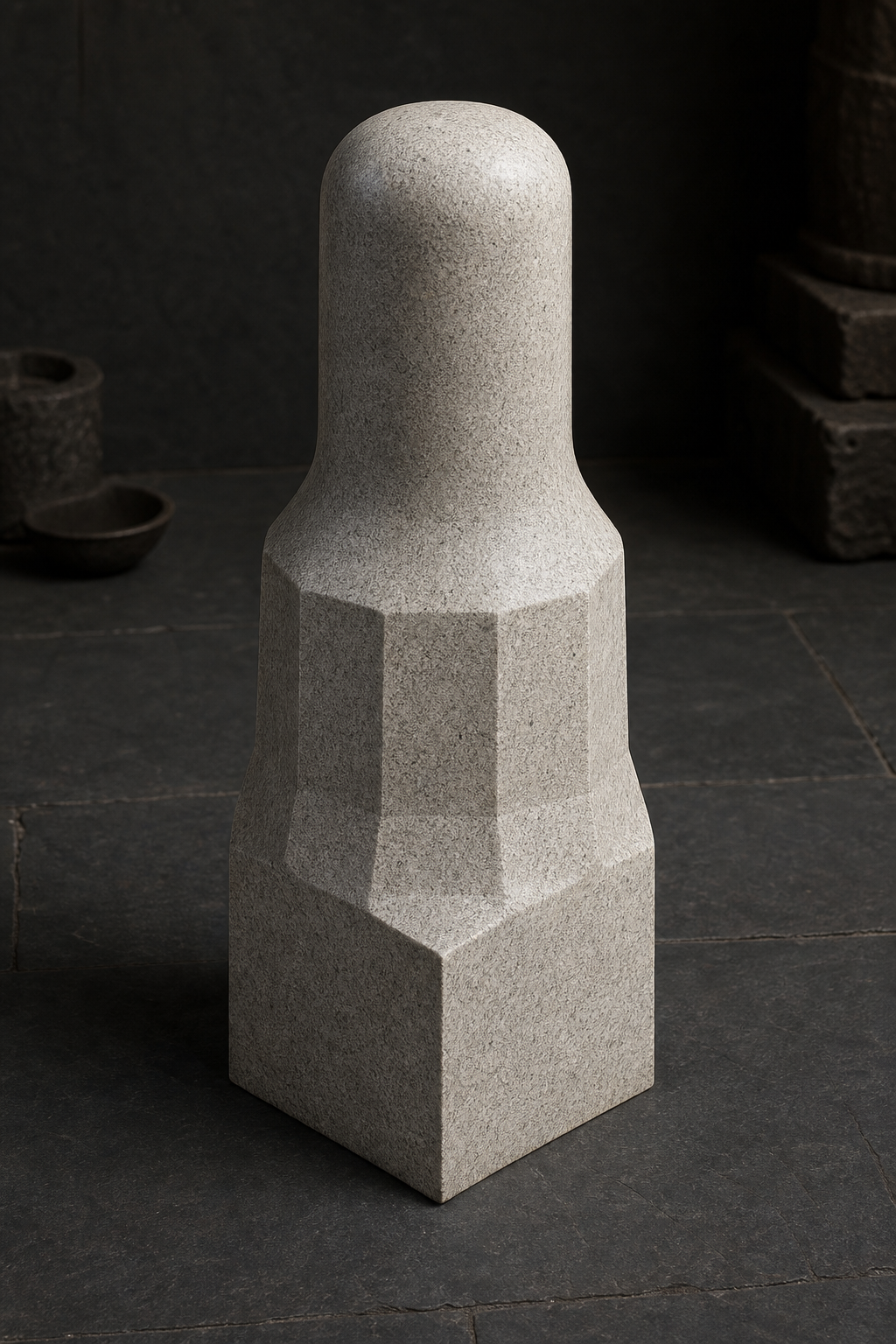
The three geometries tell a story even before their divine associations are named. The square establishes stable directions and a grounded base. The circle has no corners and no privileged direction, making it a natural sign of wholeness and the unbounded. Between them stands the octagon, which mediates visually and geometrically between angular earth and rounded infinitude.
That middle transition matters. Preservation is not represented as a static pause between a creative beginning and a destructive end. It is the ordering activity that allows manifestation to endure, develop, and eventually pass into another condition. The octagonal Viṣṇu-bhāga therefore performs structural work as well as carrying symbolic meaning: it reconciles the square with the circle.
You can read the sequence upward during darshan:
- Begin conceptually at the square Brahmā-bhāga, even when it is hidden, and recognize the stability required for anything to take form.
- Move through the octagonal Viṣṇu-bhāga and notice that continuity depends upon adjustment, mediation, and order.
- Rest your attention on the circular Rudra-bhāga, where bounded form opens toward what cannot be contained by edges.
You can also read it downward. The unbounded becomes ordered and then grounded in manifestation. This second movement becomes especially visible during abhisheka, when liquid descends from the crown toward the pīṭha. Upward and downward readings prevent a common misunderstanding: the three bhāgas are not three unrelated symbols stacked together. They are phases within one continuous axis.
Equal height gives each phase equal formal dignity. Other proportional types can accentuate one portion, producing Brahmādhika, Viṣṇvādhika, or Rudrādhika emphases. Samakanda instead makes equipoise its governing choice. If one function is visibly or canonically privileged, you may be looking at a meaningful liṅga type, but not the equal-section form denoted by Samakanda.
Let abhisheka reveal what the static form conceals
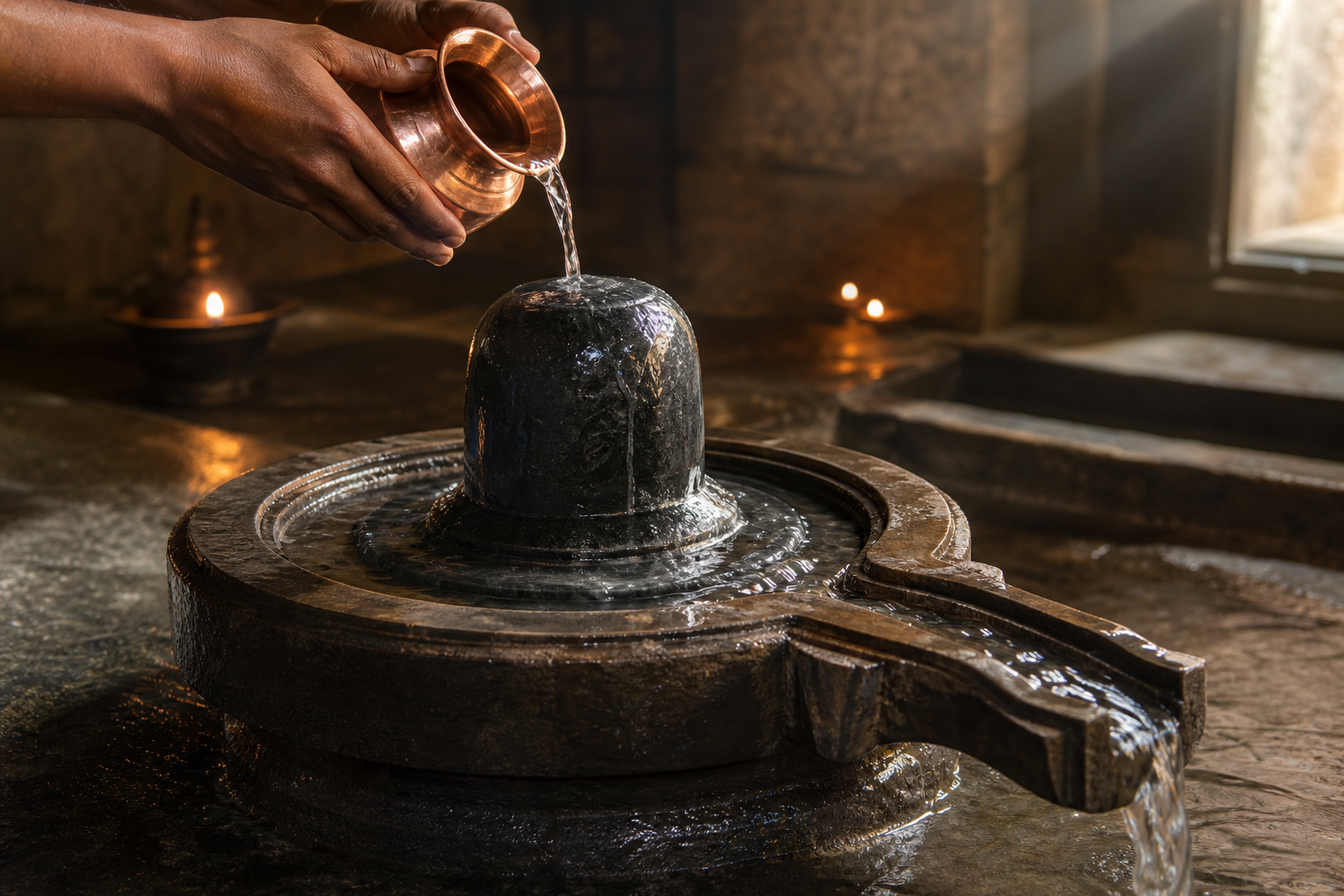
A still photograph encourages you to focus on the crown. Abhisheka restores the complete vertical movement. The offering first meets the Rudra-bhāga, passes over or alongside the Viṣṇu-bhāga, reaches the region grounded by the Brahmā-bhāga, and leaves through the pīṭha’s outlet. In one ritual action, the three equal portions participate in a single flow.
The descent can be contemplated as grace moving from the unbounded, through sustaining order, into embodied existence. This does not require you to invent a new ritual. Simply notice the route that the water already takes. The geometry becomes easier to understand when you watch it functioning instead of treating the Shivling as an isolated sculptural object.
The pīṭha is essential to that functioning. Its slope gathers the liquid, while the prāṇāḷa, also called the soma-sūtra, carries it outward. North- and east-facing outlets occur within Agamic prescriptions, with the applicable arrangement also depending on the character of the installation. Orientation is therefore not a loose aesthetic preference. It belongs with ritual use, drainage, and the theological disposition of the shrine.
This is why a Shivling should not be assessed apart from its pīṭha. When visiting a temple, look at three things together: the crown, any visible faceted transition, and the route of the abhisheka liquid. When commissioning a form, ask for the pīṭha plan and outlet direction alongside the measurements of the liṅga. A drawing that shows only the exposed cylinder leaves out part of the sacred and practical design.
Samakanda’s equality also provides a disciplined devotional emphasis. Rather than becoming preoccupied with beginning, continuity, or ending alone, you can hold all three in view. Creation without preservation does not mature. Preservation without transformation becomes attachment to a fixed condition. Dissolution without the other two is misunderstood as mere negation. The equal flow of abhisheka gives these relationships a visible rhythm.
Equal portions do not divide the Divine into three thirds
The most important theological distinction is easy to miss. Samakanda gives equal geometric measure to three cosmic functions; it does not claim that ultimate reality consists of three separable pieces. The liṅga remains one form, one axis, and one focus of worship. Its divisions teach through differentiation while its uninterrupted body teaches unity.
This allows the form to carry both Purāṇic and non-dual readings. At the level of differentiated function, Brahmā, Viṣṇu, and Rudra make creation, preservation, and dissolution intelligible to the devotee. At the level of unity, these activities arise within an all-pervasive sacred reality rather than competing for control of the cosmos. The Samakanda proportion makes that integration visible by refusing to give one section greater height.
For your own contemplation, equality is better read as sama-bhāva, an evenness of regard, than as a claim that all theological distinctions are interchangeable. You do not need to erase the particular roles of Brahmā, Viṣṇu, and Rudra to recognize their interdependence. Unity here is not sameness. It is coordinated difference within one sacred whole.
Some yogic and Tantric interpretations add an inner map. They correlate the three portions with Brahmā-granthi near mūlādhāra, Viṣṇu-granthi near anāhata, and Rudra-granthi near ājñā. The vertical liṅga can then be contemplated as an axis comparable to Meru, while the temple’s garbhagṛha becomes the ordered space around that axis. Such correspondences vary across Tantric and Haṭha traditions, so they should be used as a contemplative layer rather than as the test by which an object is classified as Samakanda.
The same restraint helps when drawing connections across Dharmic traditions. Balance may resonate with Buddhism’s Middle Way, Jainism’s Ratnatraya of right vision, knowledge, and conduct, or the Sikh integration of remembrance of the One with ethical life. These are illuminating analogies, not declarations that distinct traditions teach an identical doctrine. Samakanda should first be understood within its Śaiva ritual and iconographic setting.
Four practical questions before you identify or install one
Can you identify a Samakanda Shivling from the exposed cylinder alone?
Usually not with confidence. The square Brahmā-bhāga is commonly embedded, and only part of the octagonal Viṣṇu-bhāga may remain visible below the circular Rudra crown. Centuries of repeated abhisheka can also soften facets and transitions. Look for an octagonal change below the rounded summit, but treat that as a clue rather than conclusive proof. Temple records, the installation tradition, or the knowledge of priests and śilpins may be needed when the geometry is concealed or worn.
What should a maker or seller be able to show you?
Ask for a sectioned dimensional drawing. It should identify the Brahmā-, Viṣṇu-, and Rudra-bhāgas; show their equal canonical heights; mark the square-to-octagon and octagon-to-circle transitions; and explain the reference measure used by that workshop. Also request the pīṭha slope and prāṇāḷa orientation. Because lineages can differ in secondary dimensions, a bare claim that “the total height divides by three” is not enough to establish the complete Agamic profile.
Does the material determine whether it is Samakanda?
No. Stone is common for permanent temple installation because of its durability and ritual suitability. Pañcaloha, wood, silver, gold, clay, and gem forms occur in portable or specialized settings. These materials carry different traditional associations, but none replaces the proportional definition. A clay or metal form can follow Samakanda geometry, while a stone Shivling with different bhāga proportions does not become Samakanda merely through its material.
Should you permanently install one at home without guidance?
A permanent, consecrated installation should be planned with qualified ritual and technical guidance. Prāṇa-pratiṣṭhā, the pīṭha’s slope, outlet direction, placement, and continuing worship regimen form one connected undertaking. Decide before buying whether you want a devotional form for a simple household practice or a permanently installed and consecrated liṅga. If it is the latter, consult the priest and śilpin or sthapati who will guide the installation before the object is made, not after it arrives.
On your next darshan, begin at the pīṭha rather than staring only at the crown. Locate the hidden square conceptually, look for the octagonal mediation, follow the circle at the summit, and then watch how abhisheka reconnects all three. If you are commissioning a Samakanda Shivling, make the same reading on the dimensional drawing first. The form’s teaching depends on equality being built into the stone, metal, wood, or clay from the beginning.