

If you are trying to decide whether Sikh sovereignty is simply another name for a separate state, the short answer is no. It can support a territorial argument, but it does not settle one. Sikh political thought developed long before the modern nation-state, and its central concern was not merely who possessed land. It was whether a people could preserve spiritual authority, organize collective action, defend the vulnerable, and govern without placing power above dharma.
That distinction gives you a better way to approach a difficult subject. Instead of treating every reference to sovereignty as a border claim, separate qaum, miri-piri, sacred homeland, and government. Then ask what institution, duty, and standard of justice each term carries. The result is a more historically grounded conversation – and a much harder one to reduce to slogans.
Read Sikh sovereignty through three different layers
The first mistake is to force several related ideas into one word. Sikh nationhood, religious sovereignty, and state power overlap, but they answer different questions.
| Layer | Question it answers | What you should look for |
|---|---|---|
| Qaum | Who are the Sikhs as a historical and ethical people? | Shared memory, discipline, institutions, sacred authority, and obligations that survive changes of regime |
| Miri-piri | How should spiritual authority guide action in public life? | Temporal responsibility held under moral and scriptural accountability |
| Statecraft or raj | How should power actually be organized and exercised? | Decision-making, defense, revenue, welfare, restraint, public order, and protection for people outside the ruling community |
Qaum is a form of peoplehood. It names a community shaped by a common path and public memory, not merely a population sharing ancestry. Sikh history rooted this belonging in the Guru, the Panth, congregational life, discipline, and service. A qaum can retain that consciousness while living under different political systems or across several countries. Nationhood therefore does not automatically specify a constitution, a border, or a diplomatic status.
Miri-piri concerns the relationship between worldly responsibility and spiritual authority. Guru Hargobind gave it institutional form through the two swords of miri and piri and the establishment of the Akal Takht in 1606 opposite Harmandir Sahib. The physical pairing matters. Public authority was neither dismissed as spiritually unclean nor permitted to become self-justifying. Power had to remain answerable to a moral order beyond the officeholder.
Statecraft begins where that principle meets administration. It asks who deliberates, who executes decisions, how revenue is collected, how roads and markets are protected, when force is legitimate, and what happens to minorities when one community gains power. A ruler may be Sikh without meeting the Sikh standard of sovereignty. Conversely, a community may exercise substantial religious and institutional sovereignty without possessing an independent state.
Whenever you encounter a political use of the word sovereignty, ask four clarifying questions:
- Does it mean Sikh peoplehood, authority over religious affairs, ethical influence in public life, territorial government, or some combination of these?
- Where does legitimacy come from – scripture, the collective Panth, an elected public, hereditary power, or control of force?
- Which institution can restrain the people exercising authority?
- What rights and protections would belong to people who are not Sikh?
If those questions remain unanswered, the discussion has not yet reached statecraft. It is still operating at the level of identity or aspiration.
Sikh sovereignty was institutional before it was territorial
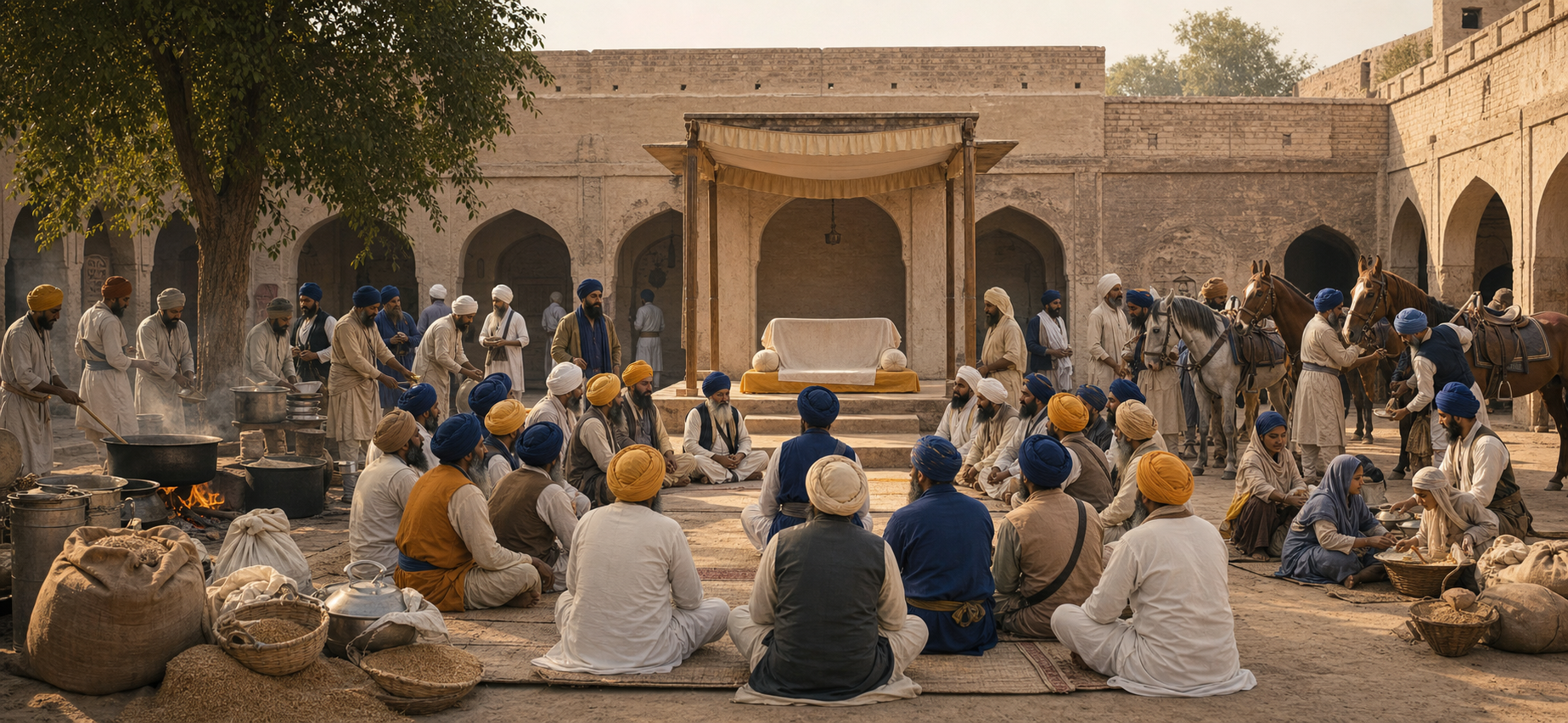
Sikh collective life did not begin with a throne. It began by forming people capable of living differently. Guru Nanak’s emphasis on truthful living, remembrance of the Divine, and solidarity across caste and creed took social form in sangat and pangat. Congregation brought people into a shared moral community; the common langar made equality visible by seating them together for food.
This matters politically. A community that feeds together, deliberates together, and recognizes duties across inherited status already possesses a measure of public agency. It does not need to wait for territorial control before practicing an ethical common life.
The institutional sequence became progressively more durable:
- Sangat and pangat made equality habitual. They placed fellowship and shared provision inside ordinary religious life rather than leaving them as occasional acts of charity.
- Gurmukhi and scripture made authority accessible. Guru Angad’s standardization of Gurmukhi strengthened literacy in the language of common life. Guru Arjan’s compilation of the Adi Granth gave the community a stable scriptural center.
- Harmandir Sahib embodied openness. Its four doors expressed welcome from every direction, making inclusivity part of the community’s sacred architecture.
- The Akal Takht created a public seat of responsibility. Spiritual devotion and temporal judgment stood in relationship rather than in separate compartments.
- The Khalsa converted belonging into discipline. At Vaisakhi in 1699, Guru Gobind Singh established the Khalsa through Khande-ki-Pahul. Kesh, kangha, kara, kirpan, and kachera made discipline visible, while Singh and Kaur challenged inherited rank. The abolition of the masand system also restored direct accountability to the Guru and the collective Panth.
- The Guru Granth Sahib became the enduring center. Guru Gobind Singh’s designation of the scripture as the eternal Guru in 1708 prevented religious sovereignty from becoming the private possession of a dynasty.
This sequence explains why Sikh nationhood cannot be reduced to ethnicity. Its central institutions ask a person to adopt practices, duties, and forms of accountability. The relevant question is not only, “Who were your ancestors?” It is also, “What discipline orders your conduct, and what obligations do you accept toward others?”
You can apply the same test to any contemporary claim made in the Panth’s name. Identify the institution that forms character, the forum that makes decisions, the authority that can correct misconduct, and the service that reaches beyond insiders. A movement that can describe its enemy but not its own restraints has not yet demonstrated sovereign maturity.
This is also where Sikhism’s relationship with the wider dharmic family should be handled carefully. Seva, generosity, self-discipline, compassion, and the defense of the innocent resonate with Hindu, Buddhist, and Jain ethical traditions. That family resemblance supports cooperation; it does not erase Sikh distinctiveness. Dharmic unity is strongest when it allows each path to retain its own vocabulary, institutions, and historical memory.
The eighteenth-century test was turning resistance into order
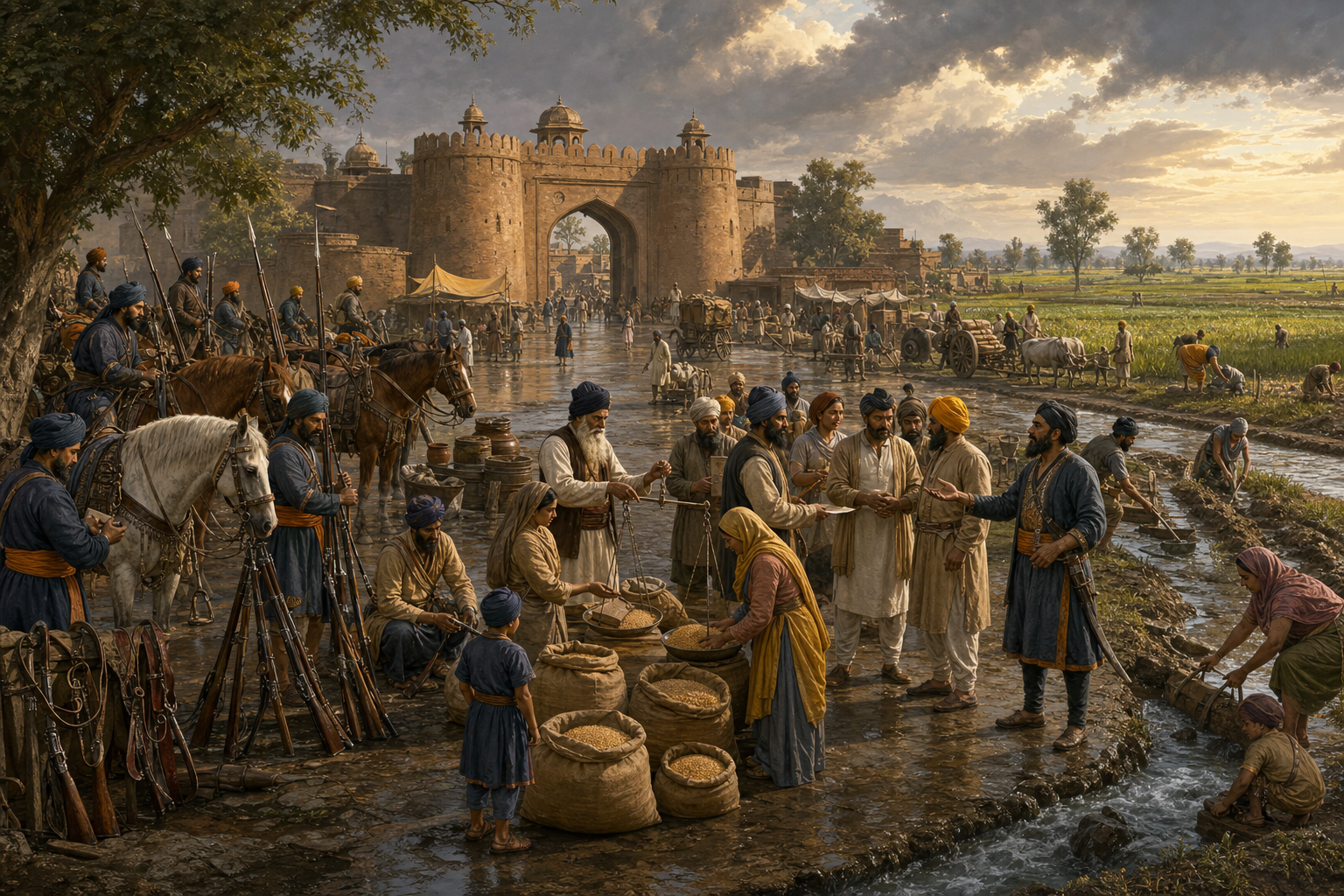
A community under attack can survive through courage. A sovereign people must eventually do more: coordinate power, restrain retaliation, restore livelihoods, and make ordinary life predictable. Eighteenth-century Punjab imposed precisely that test.
The Little Ghallughara of 1746 and the Vadda Ghallughara of 1762 scarred the Sikh community amid Mughal decline and repeated invasions by Ahmad Shah Abdali. The Sikh misls operated as mobile confederacies rather than a single centralized kingdom. Sarbat Khalsa assemblies in Amritsar allowed common strategy to be deliberated collectively while individual formations retained room to act.
Jassa Singh Ahluwalia, who lived from 1718 to 1783, became a central figure in that transition. Under his leadership, the Dal Khalsa coordinated intelligence, defense, relief, and operations across several misls. Its effectiveness did not depend on matching larger invaders soldier for soldier. It relied on village intelligence, cavalry mobility, knowledge of rivers and seasonal flows, operational timing, and the ability to withdraw before a stronger force could impose its preferred battle.
Those methods become statecraft only when tied to a public purpose. The Sikh forces remembered for rescuing abducted women and children from Afghan convoys gained legitimacy by protecting people rather than treating turmoil as permission for predation. Safer trade and pilgrimage routes helped artisans, merchants, cultivators, and religious communities resume ordinary activity. Predictable revenue arrangements reduced arbitrary pressure. Gurdwaras served not only as devotional spaces but also as centers of relief, instruction, and arbitration.
The Deg Tegh test
The most compact statement of this political ethic is Deg Tegh Fateh. Deg, the cauldron, signifies nourishment, hospitality, and material provision. Tegh, the sword, signifies the force required to protect the innocent and resist predatory power. Fateh is not a license for domination; it is victory understood through the union of provision and protection.
Coinage struck at Lahore in the mid-1760s placed this ethic in public circulation and invoked Guru Nanak and Guru Gobind Singh rather than presenting sovereignty as the personal possession of a commander. That choice carried constitutional meaning: authority was exercised by leaders, but its moral source stood above them.
Use Deg Tegh as a four-part audit of any claim to Sikh statecraft:
- Provision: Can the proposed order feed people, restore livelihoods, support learning, and keep essential institutions working?
- Protection: Can it defend worshippers, travelers, traders, women, children, and other vulnerable people without applying a sectarian test?
- Restraint: Does it distinguish defense from revenge and prevent armed power from becoming predation?
- Accountability: Is leadership answerable to a principle and institution beyond personal ambition?
A proposal that speaks only of the sword has lost half the formula. One that offers welfare but cannot protect the weak has lost the other half. Sikh sovereignty requires both capacities at once.
From confederacy to durable government
Jassa Singh Ahluwalia’s consolidation around Kapurthala helped create a more durable political center. The Sikh expedition to Delhi in 1783, undertaken with sardars including Baghel Singh and Jassa Singh Ramgarhia, demonstrated that the Khalsa could challenge an imperial center. Yet a brief presence in the Red Fort was symbolism, not a substitute for settled administration. The harder work remained revenue, security, agrarian recovery, sacred institutions, and civic confidence.
Maharaja Ranjit Singh’s rule from 1799 to 1839 carried that political grammar into a consolidated state. The Lahore Darbar entrusted senior responsibilities to Hindus and Muslims as well as Sikhs, supported temples and gurdwaras, and maintained a disciplined Khalsa Army. Coinage again invoked the Gurus. The governing lesson is exact: a state inspired by Sikh authority did not have to convert civic membership into a sectarian monopoly.
This history should be used as a standard of legitimacy, not as proof that every action by every Sikh ruler met the standard. Ethical language is meaningful only if it can also judge the people who invoke it. Deg Tegh, miri-piri, and sarbat da bhala are constraints on power before they are honors attached to power.
A sacred homeland is more complex than a border claim
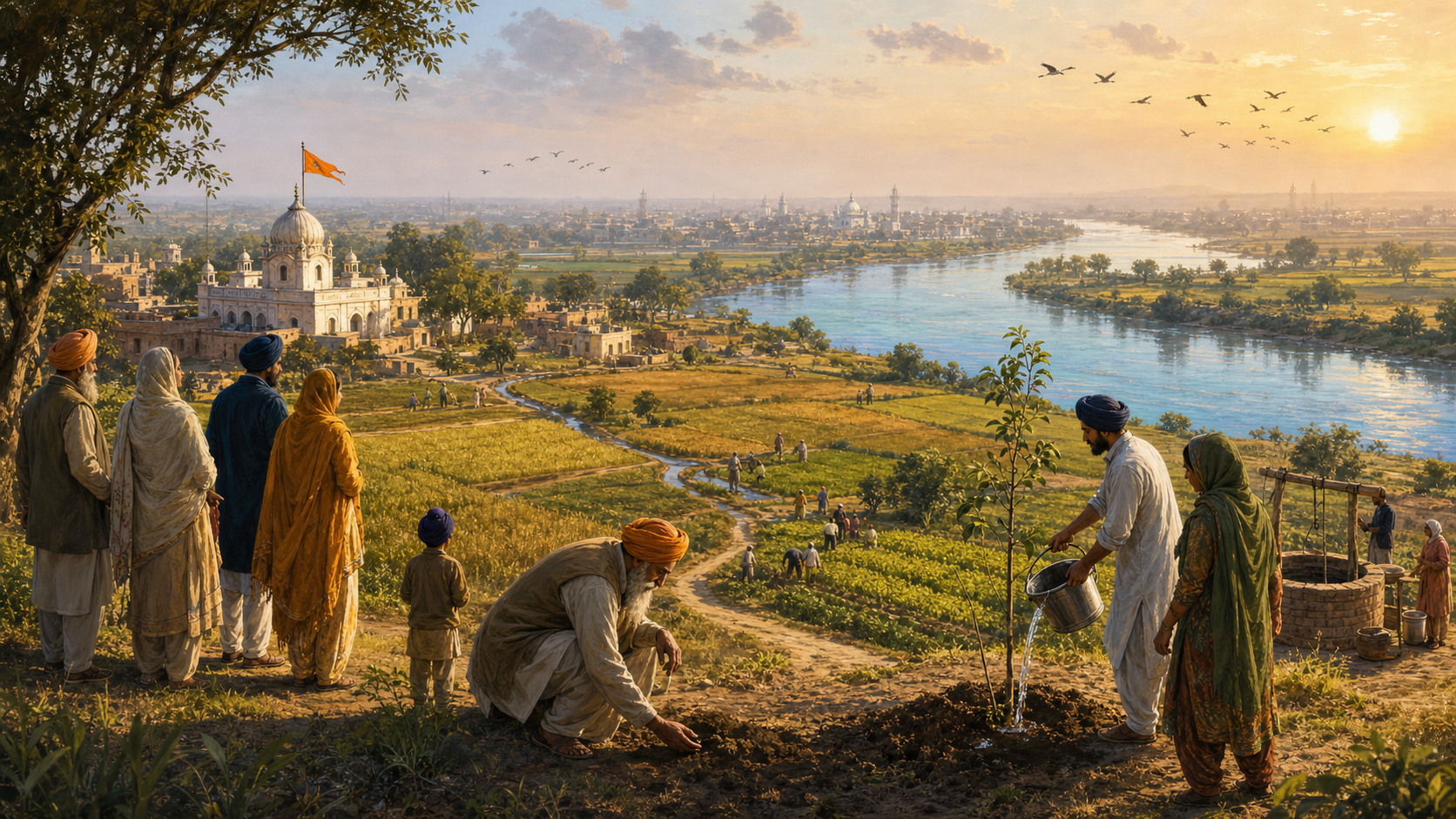
Punjab is indispensable to Sikh history. Majha, Doaba, and Malwa carry distinct memories, dialects, livelihoods, and institutions. Amritsar and Anandpur Sahib are not interchangeable symbols; they are places where Sikh authority and discipline assumed concrete form. Yet the Sikh sacred map has never fitted neatly inside one modern political boundary.
The Panj Takht make that visible. Akal Takht, Takht Sri Keshgarh Sahib, and Takht Sri Damdama Sahib are in Punjab, while Takht Sri Patna Sahib is in Bihar and Takht Sri Hazur Sahib is in Maharashtra. Nankana Sahib and Kartarpur lie in present-day Pakistan. The Kartarpur Corridor opened in 2019 precisely because sacred memory crosses a border that political sovereignty still recognizes.
Partition in 1947 sharpened the difference between homeland and jurisdiction. Sikh families were separated from historic places in West Punjab even as they rebuilt religious, agricultural, and civic life in East Punjab. A sacred homeland can therefore contain loss, pilgrimage, memory, and attachment across states. It does not automatically provide a ready-made border plan.
Postcolonial Sikh institutional life also shows that religious sovereignty can operate inside a larger constitutional order. The Sikh Gurdwaras Act of 1925 recognized community management through the Shiromani Gurdwara Parbandhak Committee. The Sikh Rehat Maryada, finalized in the mid-twentieth century, aligned important liturgical and ethical practices across regional communities. In India, Article 25 protects freedom of conscience and religious practice, while its administrative explanation concerning Hindu religious institutions does not erase distinct Sikh identity. The kirpan receives specific recognition as an article of Sikh faith.
None of this proves that every Sikh grievance has been resolved, nor does it predetermine how Sikhs must judge a contemporary political program. It establishes a narrower and more useful point: historical nationhood, religious self-government, sacred geography, citizenship, and territorial independence are not synonyms. Each requires its own argument.
Before accepting or rejecting a modern proposal made in the language of Sikh sovereignty, work through six questions:
- Name the injury. Is the concern about religious administration, political representation, personal security, cultural memory, economic policy, access to sacred sites, or territorial rule?
- Name the political unit. Does the proposal speak for the Khalsa Panth, all Sikhs, all residents of Punjab, a diaspora constituency, or another defined public? These groups overlap, but they are not identical.
- Connect the remedy to the injury. A demand for control over a gurdwara, a safeguard for an article of faith, and a demand for a state require different legal and political reasoning.
- Specify the decision-maker. Identify who authorizes the claim and how disagreement within the community is represented.
- Account for everyone under the proposed authority. A serious program must say how Hindus, Muslims, Jains, Buddhists, Christians, dissenting Sikhs, and people without religious affiliation would be protected.
- Explain the transborder sacred map. No territorial arrangement can contain every Sikh Takht and historic site. Pilgrimage, cultural stewardship, and diplomatic access therefore remain necessary under any conceivable border.
This method avoids two opposite errors. Treating every expression of Sikh nationhood as separatism erases a long history of religious and institutional sovereignty. Treating a particular territorial outcome as the inevitable command of that history skips the political argument that still has to be made. Respect for the Panth requires enough precision to reject both shortcuts.
For readers committed to a wider dharmic renaissance, the implication is equally direct. Sikhism should not be absorbed into a vague civilizational sameness, and Sikh distinctiveness need not be treated as hostility to every larger Indian or dharmic bond. The historical common ground is practical: feeding without caste distinction, protecting the persecuted, disciplining force, honoring sacred authority, and seeking the welfare of all.
Key takeaways
- Sikh sovereignty is a layered idea. Qaum, miri-piri, religious self-government, sacred homeland, and territorial statehood must be distinguished before they can be debated.
- Sikh nationhood was formed through institutions such as sangat, pangat, langar, scripture, the Akal Takht, and the Khalsa before it was expressed through a consolidated kingdom.
- Miri-piri places temporal power under spiritual accountability; it does not grant political leaders unlimited religious sanction.
- The eighteenth-century misls demonstrated a confederal model in which shared deliberation could coexist with decentralized action.
- Deg Tegh supplies a practical test of legitimacy: provision and protection must operate together, under restraint and accountability.
- Punjab is the Sikh heartland, but the Panj Takht and other sacred sites create a geography extending across several Indian states and into Pakistan.
- Historical nationhood does not, by itself, dictate one modern constitutional arrangement. Every territorial proposal must still explain authority, remedy, minority rights, and public welfare.
The next time you hear a claim about Sikh sovereignty, translate it into four columns: source of authority, governing institution, public duty, and protected population. If the answers stop at pride, grievance, or territory, the statecraft is incomplete. If they reach welfare, defense, restraint, accountability, and plural protection, the conversation has begun to recover the seriousness of miri-piri.
References
- SikhNet – Sultan-ul-Qaum Jassa Singh Ahluwalia: Visionary Sikh Commander Who Forged Unity and Hope
- SikhNet – Sikhs of Punjab: Khalsa Nationhood, Miri-Piri Sovereignty, and the Sacred Homeland