

If you have encountered Smriti Chandrika in a discussion of South Indian inheritance, the confusing part is usually not the individual rule. It is the relationship between a Sanskrit digest, a regional school, inherited authorities, living custom, and the courts that later cited them. Treat those as interchangeable, and almost every conclusion that follows will be distorted.
You need a map before you need a catalogue of rules. Once the categories are clear, you can see why Smriti Chandrika became important to the Dravida school, how its juristic method actually worked, and what a colonial citation to it can and cannot establish.
The first distinction: a digest is not a law code or a school

Smriti Chandrika is generally assigned to the 12th century and associated with southern India. It is attributed to Devannabhatta, whose name also appears in variant forms, and belongs to the Dharmashastra tradition.
The technically important word is nibandha: a digest that gathers, arranges, compares, and reconciles earlier authorities. Smriti Chandrika is therefore not a dharmasutra, an early genre of concise aphoristic instruction. It is also not a statute enacted by a sovereign legislature. Its authority arose from disciplined engagement with recognized texts, interpretive reasoning, acceptance among jurists, and compatibility with established practice.
The Dravida school, meanwhile, was not a building, council, sect, or single book. It was a regional stream of Hindu jurisprudence in which particular authorities and interpretations acquired practical weight. Its approach remained recognizably connected to the wider Mitakshara framework while giving close attention to southern usage. That is why describing Smriti Chandrika as influential within the Dravida school is more accurate than equating the book with the school.
| Term | What it identifies | Misreading to avoid |
|---|---|---|
| Smriti Chandrika | A medieval Dharmashastra digest, or nibandha | A modern statute or an early dharmasutra |
| Mitakshara | A major commentarial and doctrinal framework engaged by later jurists | A rulebook applied identically in every region |
| Dravida school | A regional tradition of interpretation and legal authority | An independent religion or a single promulgated code |
| Sadachara and deshachara | Normative conduct and regional custom considered in determining dharma | A claim that every local habit automatically overruled textual authority |
Keep those four levels separate whenever you read a legal-history claim. Ask whether the claim concerns a passage in Smriti Chandrika, a broader Mitakshara doctrine, a Dravida interpretation, or a local custom. A conclusion valid at one level does not automatically settle the others.
How inherited authority became a usable legal determination
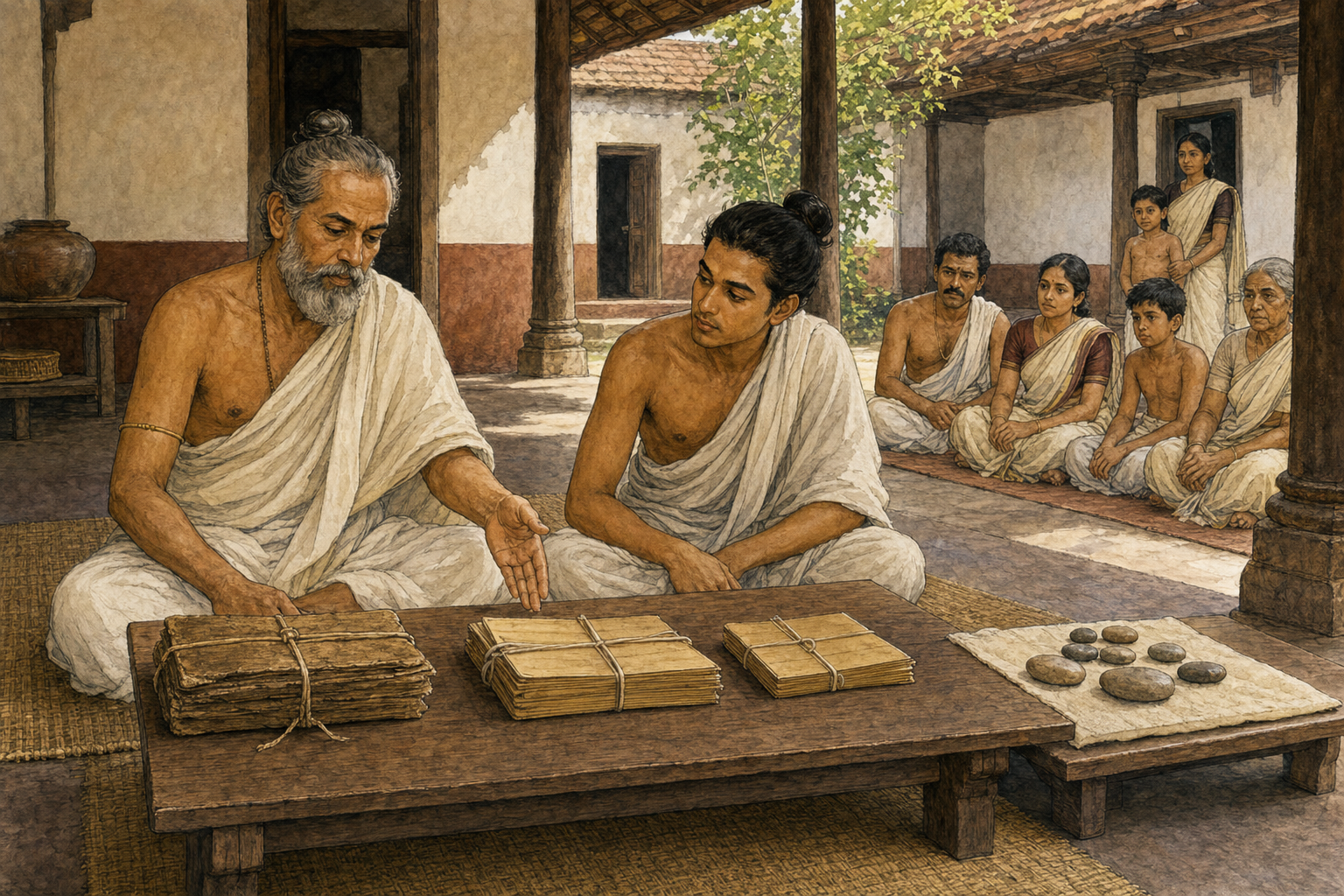
A digest did more than preserve quotations. Its practical task was to make a layered inheritance of sacred teaching, remembered law, commentary, ritual instruction, and custom usable when authorities appeared to point in different directions. Smriti Chandrika gained trust because it carried out that task with extensive citation and relatively little authorial display.
- Identify the field of dharma. A question might belong to conduct, life-cycle rites, ancestral offerings, charity, expiation, judicial procedure, marriage, or succession. Classification came first because different considerations could govern different fields.
- Collect the relevant authorities. The range included such foundational smritis as those associated with Manu, Yajnavalkya, Narada, and Parashara, as well as commentarial traditions, Grhya-sutras, and accepted custom.
- Locate the apparent conflict. Different prescriptions did not have to be treated as evidence that the tradition had failed. A difference might turn on context, subject, eligibility, circumstance, or the level of authority involved.
- Reconcile rather than erase. Interpretive tools associated with Mimamsa and Nyaya helped jurists read provisions in context, establish priority, distinguish general from particular rules, and preserve as much coherence as possible.
- Test the result against legitimate practice. Sadachara and deshachara carried normative force when they did not conflict with higher authority. This allowed continuity without pretending that every place observed every rule in precisely the same way.
This method matters more than any isolated quotation. A modern reader may see several inherited opinions on one page and assume indecision. A Dharmashastra jurist could see a structured problem requiring classification. The disagreement had to be located before it could be reconciled.
Three reading marks will keep you oriented when studying a translated passage or a judicial extract:
- T for textual authority: Which earlier smriti, commentary, or ritual authority supplies the proposition?
- R for reconciliation: What distinction resolves the apparent conflict between authorities?
- C for custom: Is regional or accepted conduct confirming, qualifying, or supplying the practical rule?
If you cannot answer those questions, do not yet reduce the passage to a slogan such as “Hindu law allowed this” or “Hindu law prohibited that.” You may have only one layer of a multi-layered determination.
Why the Dravida school found the digest so useful
The strongest influence of Smriti Chandrika appeared in the Dravida school of Hindu law. The reason was not simply that the work came from southern India. Its arrangement supplied jurists with a dependable way to relate widely respected authorities to regional practice without severing the region from the larger Dharmashastra tradition.
Family, property, and the importance of classification
Its practical value becomes clearest in the treatment of partition, inheritance, stridhana, adoption, guardianship, and obligations among coparceners. These are fields in which a small classificatory difference can change the legal path. The relevant questions include how property was acquired, whether a claim arose by birth or only after an intervening event, which kinship line was involved, and whether a recognized custom affected the result.
This is why a bare list of heirs is an inadequate way to study historical Hindu succession. The distinctions between unobstructed and obstructed heritage, survivorship and succession, lineal and collateral claims, and different orders of priority formed a matrix. A person’s relationship to the deceased was only one coordinate within it.
Use a four-column case sheet when reading an inheritance discussion: write down the legal issue, the category of property, the relevant family relationship, and the textual or customary basis offered for the conclusion. That simple discipline prevents you from carrying a rule from one kind of property into another.
The same caution is essential with stridhana. Women’s property was not treated as one undifferentiated category. The classification of an acquisition affected how it was understood and disposed of. When you encounter the sweeping claim that women either “had property rights” or “had no property rights” under historical Hindu law, ask four questions before accepting it: What kind of acquisition? Which rule of disposition? Which regional tradition? Which historical period? Without those qualifiers, the claim is too broad to teach you much.
Adoption also demonstrates why ritual and property cannot always be separated. Questions of family status, valid performance, kinship obligations, and succession consequences could meet in the same dispute. Reading only the inheritance result while ignoring the underlying status determination reverses the order in which the juristic problem was constructed.
Procedure shows that Hindu jurisprudence was more than inheritance
The prominence of family law in later litigation can hide the breadth of the digest. Vyavahara covered judicial procedure and substantive disputes involving debts, pledges, boundaries, partnerships, agency, property transfers, and injury. Modes of proof included witnesses, documents, and possession, while ordeals belonged to older evidentiary strata. Judicial conduct, truthful testimony, documentary reliability, and proportionate remedies were part of the same concern for an ordered adjudicative process.
Nor should achara, samskara, shraddha, dana, and prayaschitta be dismissed as an irrelevant ritual appendix. Daily and occasional duties, life-cycle rites, obligations to ancestors, charity, purity, and graded expiation reveal the larger conception within which vyavahara operated. Dharma addressed the conduct that should prevent disorder as well as the procedure used after a dispute arose.
Notice the recurring juristic habits across these fields: classify the act, identify the responsible person, consider intention and circumstance, determine the appropriate authority, and seek a proportionate consequence. The details differ, but the intellectual discipline is continuous.
How to read its colonial afterlife without making it current law

During the colonial period, courts in the Madras Presidency commonly treated Smriti Chandrika, together with allied digests and relevant customs, as an authoritative statement of local Hindu personal law. Its influence was especially visible in disputes concerning partition, inheritance, adoption, and marriage.
The words “together with” matter. The historical picture is not one of a court opening a single Sanskrit book and mechanically enforcing whatever appeared on the page. Textual authority, the wider Mitakshara framework, regional interpretation, allied digests, and custom could all bear on the legal conclusion. A citation to Smriti Chandrika therefore proves that the authority was considered relevant; it does not, by itself, tell you what role the cited passage played.
When you meet such a citation, audit it in this order:
- Fix the jurisdiction and period. A Madras Presidency decision belongs to a particular institutional and regional setting.
- Name the precise issue. “Inheritance” is too broad. Determine whether the dispute concerns partition, survivorship, a category of property, the priority of heirs, adoption, or another defined question.
- Identify the citation’s function. Is Smriti Chandrika supplying the main proposition, reinforcing another authority, recording a competing opinion, or helping the court evaluate custom?
- Read the surrounding reasoning. A quoted line can look absolute after the qualifications, contrary authorities, and factual distinctions around it have been removed.
- Separate historical authority from present legal force. A proposition can be indispensable for understanding legal history without governing anyone’s current rights.
Check names, scripts, and editions before treating wording as fixed
The textual record circulated through manuscripts in Devanagari, Grantha, and Telugu-Kannada scripts, while print editions of the 19th and early 20th centuries widened access among jurists, panditas, and scholars. A historical citation to the title alone may therefore be insufficient for close textual work. Record the edition, chapter or section, language, and translation whenever those details are available.
Catalogue searches also require flexible spelling. In addition to Devannabhatta, try Devanna-Bhattopadhyaya, Devanna, Devananda, and Devagana. A failed search under one modern transliteration does not establish that a manuscript, edition, or catalogue entry is absent.
Do not use a medieval digest or a colonial judgment to decide a present inheritance, marriage, guardianship, or adoption matter. Current rights can depend on legislation, later judgments, jurisdiction, and the facts of the individual case. The safe course is to consult the current statutory text and a qualified legal professional. Historical Dharmashastra explains the genealogy of doctrines; it is not a substitute for current legal advice.
Key takeaways
- Smriti Chandrika is a 12th-century Dharmashastra digest, or nibandha, not a dharmasutra and not a modern enacted code.
- The Dravida school is a regional jurisprudential tradition, not another name for the book.
- Its authority rested on organized citation, interpretive reconciliation, and careful treatment of legitimate custom within a wider hierarchy of dharma.
- Partition, inheritance, stridhana, adoption, and coparcenary made it especially valuable to South Indian jurists, but its scope also included procedure, conduct, rites, charity, and expiation.
- A colonial citation establishes historical relevance, not automatic control over present legal rights.
If you want to understand this tradition in action, choose one defined question such as partition, stridhana, or adoption. Follow four layers in order: the earlier authority being cited, the interpretive reconciliation, the regional custom, and the later judicial use. That route will show you more than an isolated rule. It will show you how Hindu jurisprudence preserved continuity while reasoning through difference.