
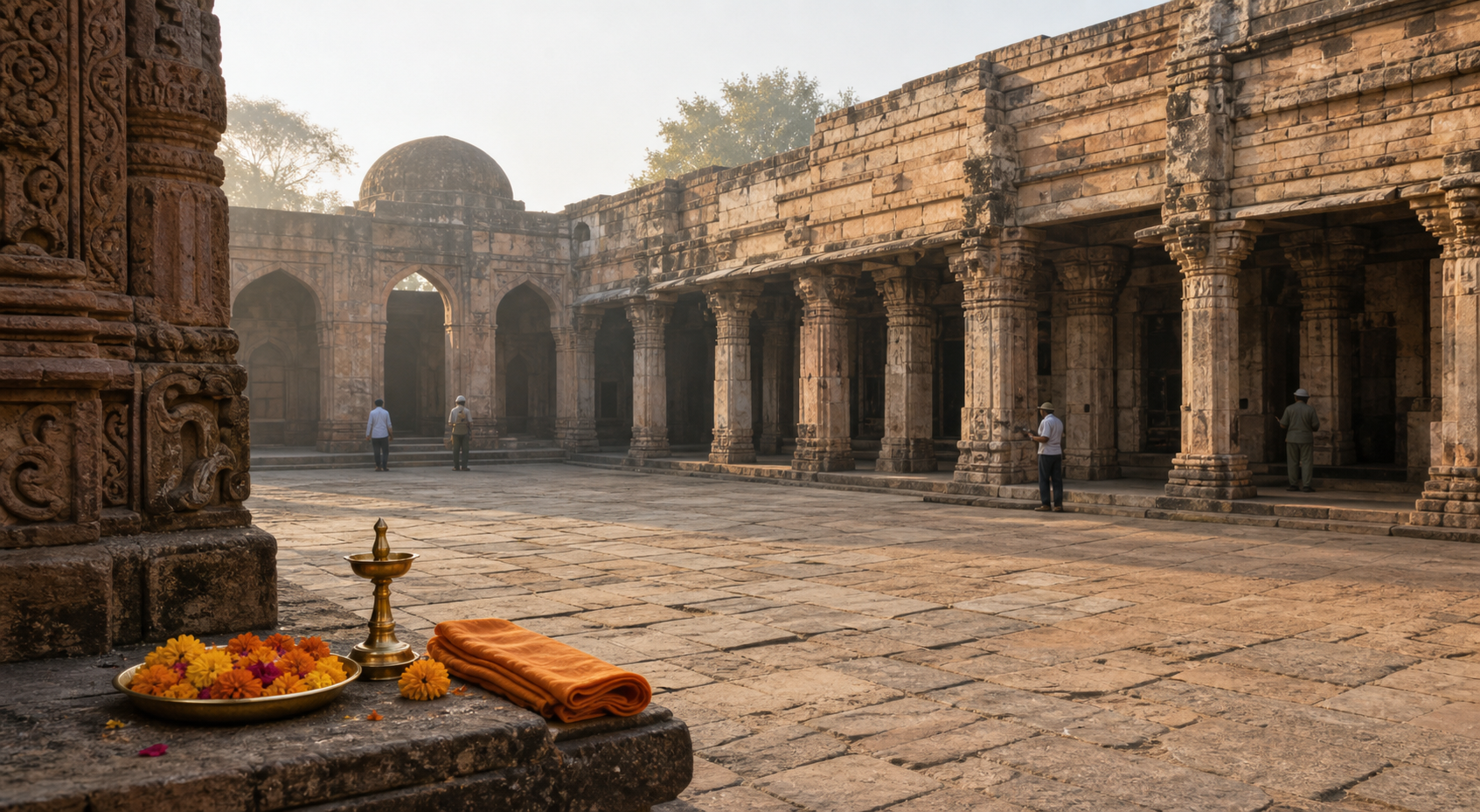
If you are trying to decide what the recent development at Bhojshala proves, start by resisting the easiest mistake: a change in worship access is not automatically a final judgment on ownership, and a compelling historical association is not strengthened by an unverifiable slogan.
You can understand and defend the Hindu position more clearly by separating four questions: what the surviving evidence tells us about Bhojshala’s early identity, how later architectural layers entered the complex, what the court and administration have actually authorized, and how living worship can continue without damaging the monument or public peace.
What the recent worship change actually means
On the first Friday following recent Madhya Pradesh High Court directives, Hindu worship continued throughout the day, congregational Friday namaz did not take place inside the monument, and authorities facilitated an alternative arrangement. This was a consequential operational change at a site where management over much of the previous two decades had generally provided supervised Hindu access on specified days, especially Tuesdays, and Muslim congregational prayer on Fridays under Archaeological Survey of India oversight.
That Friday establishes what occurred under the new arrangement on a particular day. It does not, by itself, prove that every question of title, permanent access, historical chronology, or future religious use has been finally decided. The distinction matters because three statements that sound similar can have very different legal meanings: a court has permitted worship, a district administration has scheduled access, and a court has finally determined legal rights.
Before you repeat a legal claim, look for the operative part of the order rather than a headline or social-media paraphrase. Ask whether the direction is interim or final, which authority must implement it, what dates and conditions it covers, and whether a later order has altered it. If you cannot answer those questions from the order and current official instructions, use narrower language: the directives produced a court-supervised change in worship arrangements, followed by uninterrupted Hindu worship on the first Friday under that change.
This precision does not weaken the Hindu case. It prevents opponents from dismissing a substantial development merely because supporters described it more broadly than the available record could bear.
Three historical questions must be kept separate
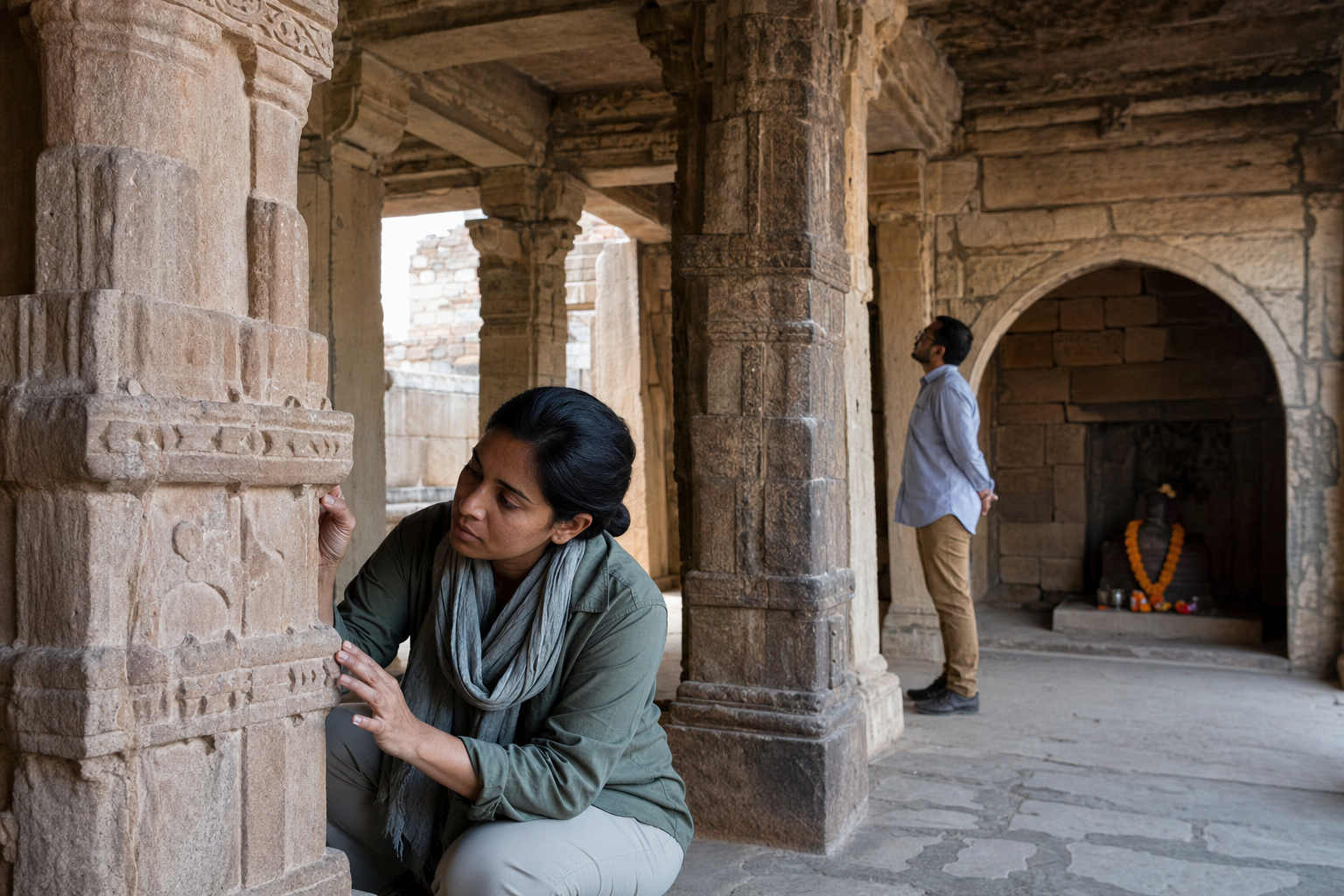
Bhojshala is both a sacred place and a physical archive. Its stones do not all belong to one moment, and its current legal administration cannot be read directly from any single architectural feature. A useful assessment therefore separates early identity, later transformation, and present rights.
The early medieval identity
Bhojshala is widely associated with the Paramara ruler Raja Bhoja, who lived around the 11th century, and with a scholastic and devotional environment centered on Mata Saraswati. Paramara-era stonework, Sanskrit inscriptions, and stylistic features support the understanding of the precinct as an important early medieval center of learning and worship in Malwa.
The careful formulation is important. Widely associated does not mean that every popular detail has been conclusively established, but neither does historical caution make the association imaginary. Epigraphy, architectural style, material context, and the broader pattern of temple-linked education are legitimate forms of historical evidence. They should be documented and evaluated together.
The later architectural and religious layers
The complex also contains later Indo-Islamic construction phases associated in public discussion with the Kamal Maula complex, followed by colonial and postcolonial interventions. These layers help explain why different communities attach different memories and practices to the precinct.
Acknowledging later layers does not erase the Paramara and Saraswati evidence. Likewise, demonstrating an early Hindu identity does not make later fabric archaeologically disposable. A monument can preserve evidence of consecration, disruption, reuse, rebuilding, and changed administration at the same time. The task is to establish the sequence as accurately as possible, not to compress every century into a single label.
The rights that operate now
Present worship rights depend on judicial directions, administrative implementation, constitutional protections, and ASI conservation responsibilities. Archaeological evidence can strongly inform the public and legal understanding of a place, but it does not write a current access schedule by itself. Conversely, an administrative schedule does not settle the monument’s original identity or erase inconvenient evidence.
When you encounter a claim about Bhojshala, identify which of these three questions it is answering. Many arguments become confused because evidence about the 11th century is treated as though it were the operative text of a recent order, or because a modern management practice is presented as proof of what the site was at its origin.
How to defend the Hindu claim without overclaiming
The strongest case for Bhojshala as a Saraswati-centered Hindu seat of learning is cumulative. It does not rest on one viral sentence. You should weigh each assertion according to the kind of evidence behind it.
- Directly observable evidence: inscriptions, carvings, masonry, spatial relationships, construction joints, and other surviving features that can be photographed and mapped.
- Historical attribution: the association with Raja Bhoja, the Paramara milieu, Sanskrit learning, and Mata Saraswati, assessed through epigraphy, architectural style, and historical context.
- Later-use evidence: additions, alterations, religious practices, administrative records, and interventions belonging to subsequent periods.
- Legal evidence: the exact words of judicial orders and the official rules through which the administration and ASI implement them.
- Popular formulation: slogans, commemorative claims, and compressed timelines that may express community memory but still require independent chronological verification.
The widely circulated description of the recent occasion as the first Friday in 700 years without namaz at the site belongs in the last category. It conveys the scale of change perceived by supporters, but a continuous Friday-by-Friday chronology across medieval and early modern centuries has not been established in the material available here. Treat the number as a symbolic approximation unless a transparent historical record verifies it.
You lose nothing by saying exactly what is known: the first Friday after the directives saw continuous Hindu worship at the monument and no congregational Friday namaz there. That is already a significant development. Turning it into an unverified seven-century statistic creates an unnecessary weakness.
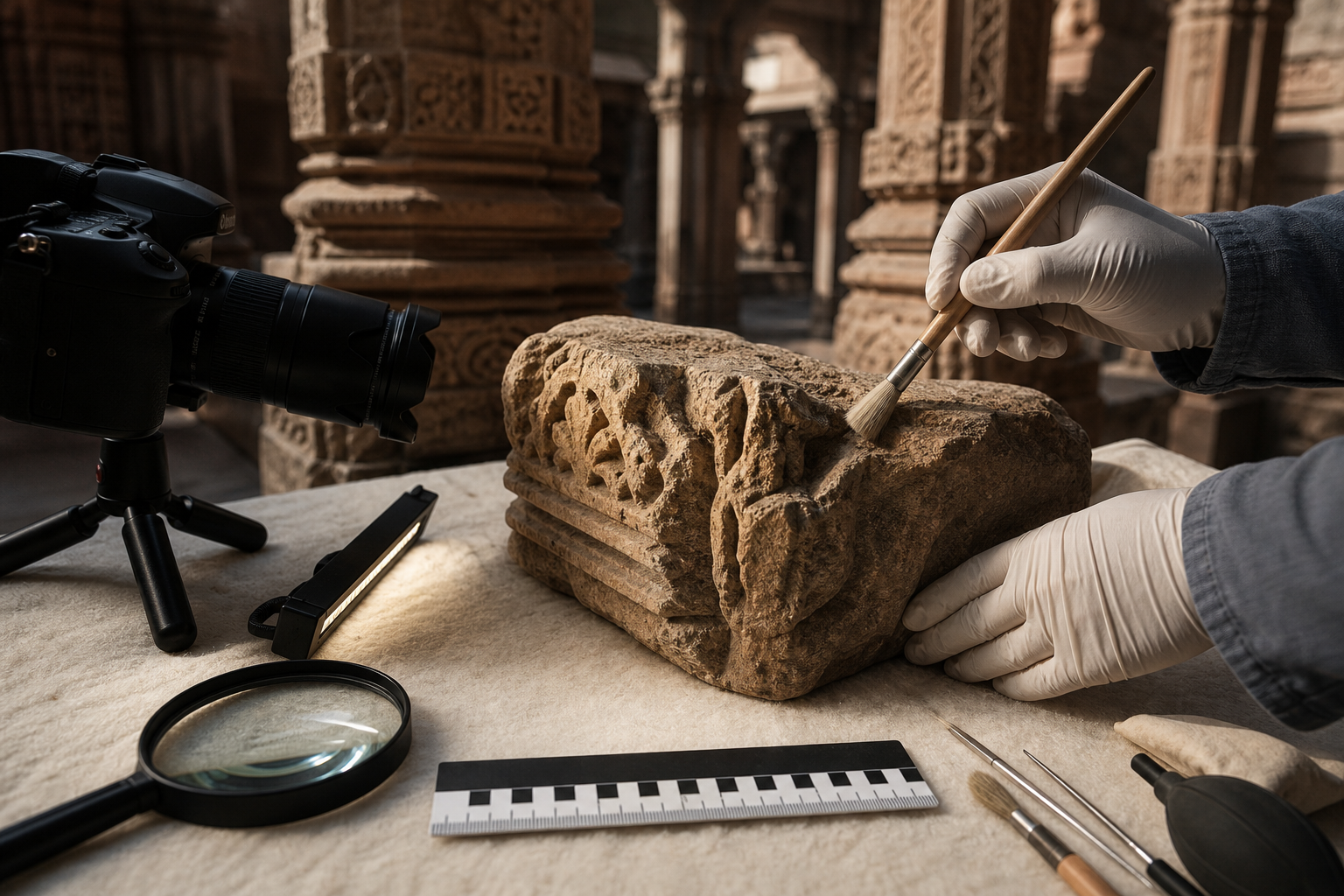
The same discipline should govern archaeological claims. An inscription needs a high-resolution image, a reliable reading, a translation, and a recorded physical context. Stylistic attribution should identify the features being compared. A carved or inscribed stone’s presence, original location, and later architectural placement are related questions, but they are not automatically the same question. If the evidence is strong, documenting these distinctions will make the conclusion more durable.
A responsible site dossier should therefore place photographs, transcriptions, translations, plans, material assessments, survey methods, and confidence levels in one reviewable record. Devotion does not have to wait for every scholarly disagreement to disappear, but public historical claims should reveal how they were reached.
Worship rights and conservation must advance together
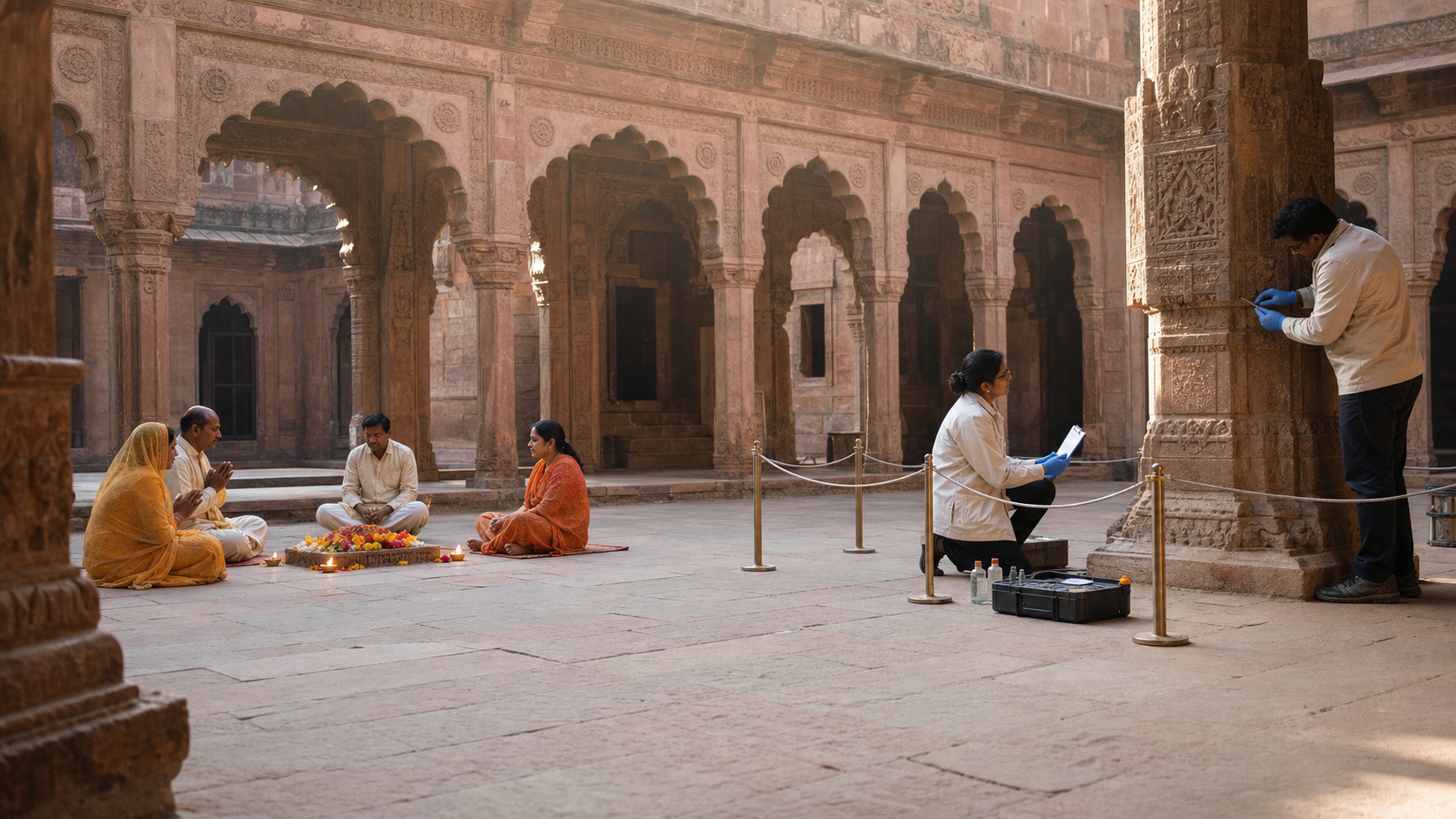
Bhojshala’s value to Hindu society is not confined to the past. A place associated with Saraswati has meaning because learning and worship remain living practices. Yet every increase in access also increases pressure on vulnerable stone, inscriptions, circulation routes, and the administrative system responsible for the complex.
The practical answer is not to choose between worship and preservation. It is to design worship around the monument’s carrying capacity and archaeological vulnerabilities. Calibrated visitor limits, separated circulation routes, protective barriers, multilingual interpretation, and time-segmented access where necessary can preserve dignity while reducing crowding and accidental contact with fragile features.
If you visit, follow the posted ASI and district instructions even when a queue moves slowly or a protected feature is close enough to touch. Do not improvise contact with carvings, inscriptions, or stone surfaces. Keep photography, offerings, and movement within the permissions communicated at the site. Conservation discipline is not a concession against worship; it is how worshippers ensure that the evidence and sanctity they value survive.
Documentation should proceed in parallel. Useful methods include 3D photogrammetry, laser scanning, high-resolution epigraphic photography, petrographic examination, and condition assessment. Ground-penetrating radar may be appropriate where qualified investigators determine that it can answer a defined question without disturbing the fabric. The crucial requirement is not merely the use of advanced technology, but publication of methods, limitations, images, and results in a form that other specialists can review.
Administration also needs predictable coordination. A liaison group bringing together ASI officials, district authorities, local Hindu and Muslim representatives, heritage specialists, and law-enforcement observers could address risks before a major observance or gathering. Its work should produce a public operating procedure: access times, capacity controls, circulation plans, protected zones, grievance channels, and a process for correcting rumors quickly.
Respect for Muslim attachment to the complex’s later history need not require silence about its Hindu and Saraswati-linked origins. The dharmic traditions offer useful disciplines for holding truth and restraint together: jnana and prajna orient us toward knowledge, anekantavada warns against reducing a layered reality to one angle, ahimsa governs conduct, and sarbat da bhala keeps the welfare of all in view. These principles do not decide a legal dispute, but they can shape how citizens pursue justice.
Key takeaways for readers, devotees and advocates
- The first Friday under the recent directives marked a genuine change: Hindu worship continued throughout the day, while congregational Friday namaz did not occur inside the monument and an alternative was arranged.
- Do not convert that event into a claim that every question of ownership, permanent access, or future scheduling has received a final judicial answer. Verify the operative order and current official instructions.
- The Hindu historical case rests on the association with Raja Bhoja, a Saraswati-centered scholastic and devotional milieu, Paramara-era material, Sanskrit inscriptions, and architectural evidence.
- Later Indo-Islamic, colonial, and postcolonial layers should be documented and protected. Recognizing them does not cancel the earlier Hindu evidence.
- Treat the first-Friday-in-700-years formulation as symbolic unless a continuous chronology is produced and independently examined.
- Support worship protocols that include visitor controls, protected routes, clear signage, non-invasive documentation, public survey records, and rapid official correction of rumors.
The next useful step is concrete: before sharing a claim about Bhojshala, label it as archaeological, historical, legal, administrative, or devotional, and check whether the evidence actually answers that kind of question. Then ask authorities for the two things that can move the issue forward: a clear worship protocol and a transparent, reviewable record of the monument’s physical evidence.