
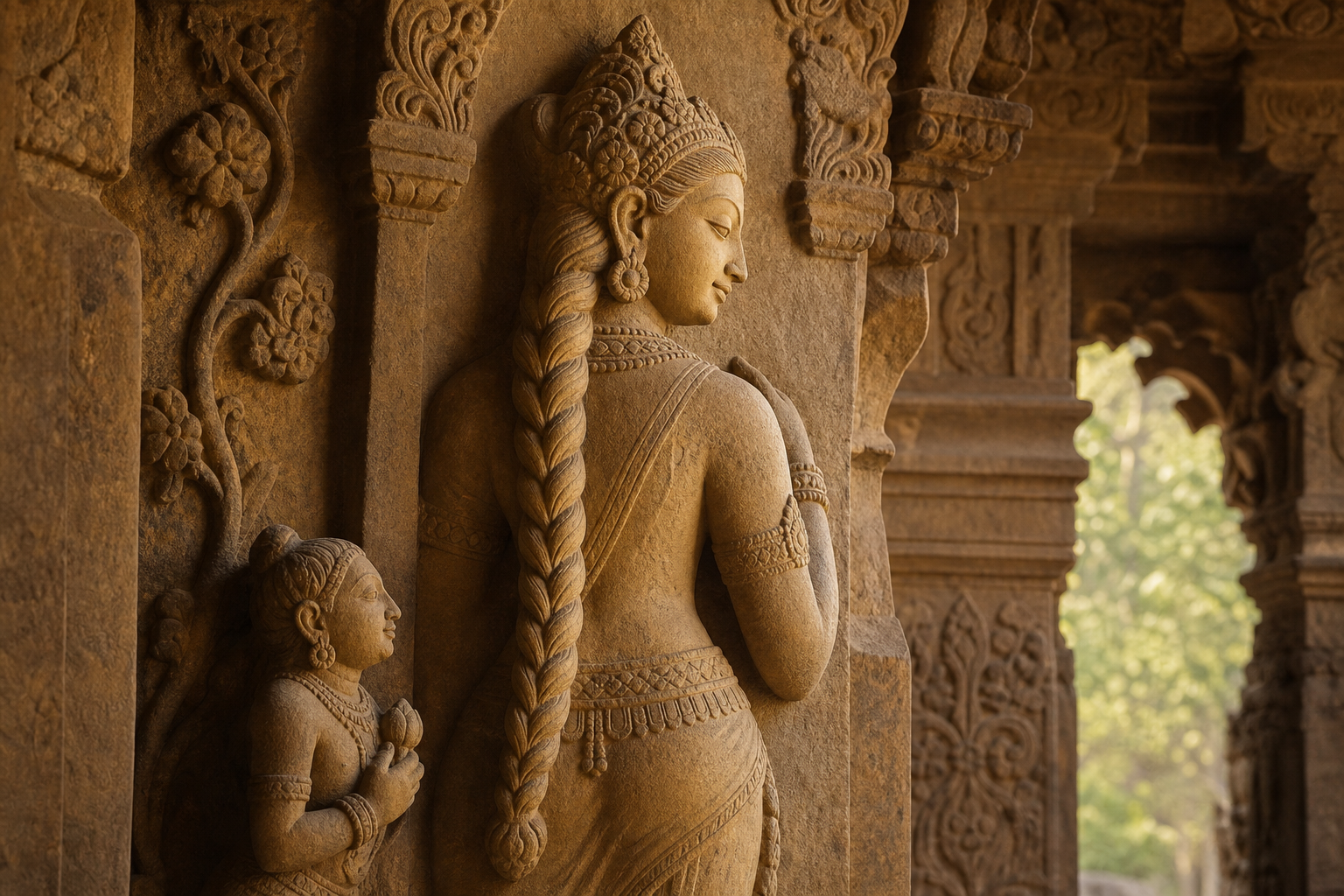
You are looking at a goddess or attendant in a temple carving, and a long plait descends behind her body. Is it merely an attractive hairstyle, or does it tell you something about the figure? With an ekaveni, the answer is usually both: the braid completes the beauty of the image, but it also participates in a deliberate iconographic language.
You can read that language without turning every detail into a rigid code. First establish that the sculptor actually represented a single braid. Then compare the hairstyle with the figure’s posture, ornaments, companions, narrative role, region, and material. That sequence lets you recognize the ekaveni’s associations with grace, auspiciousness, discipline, and concentrated energy while avoiding claims the image cannot support.
Confirm the single braid before interpreting it
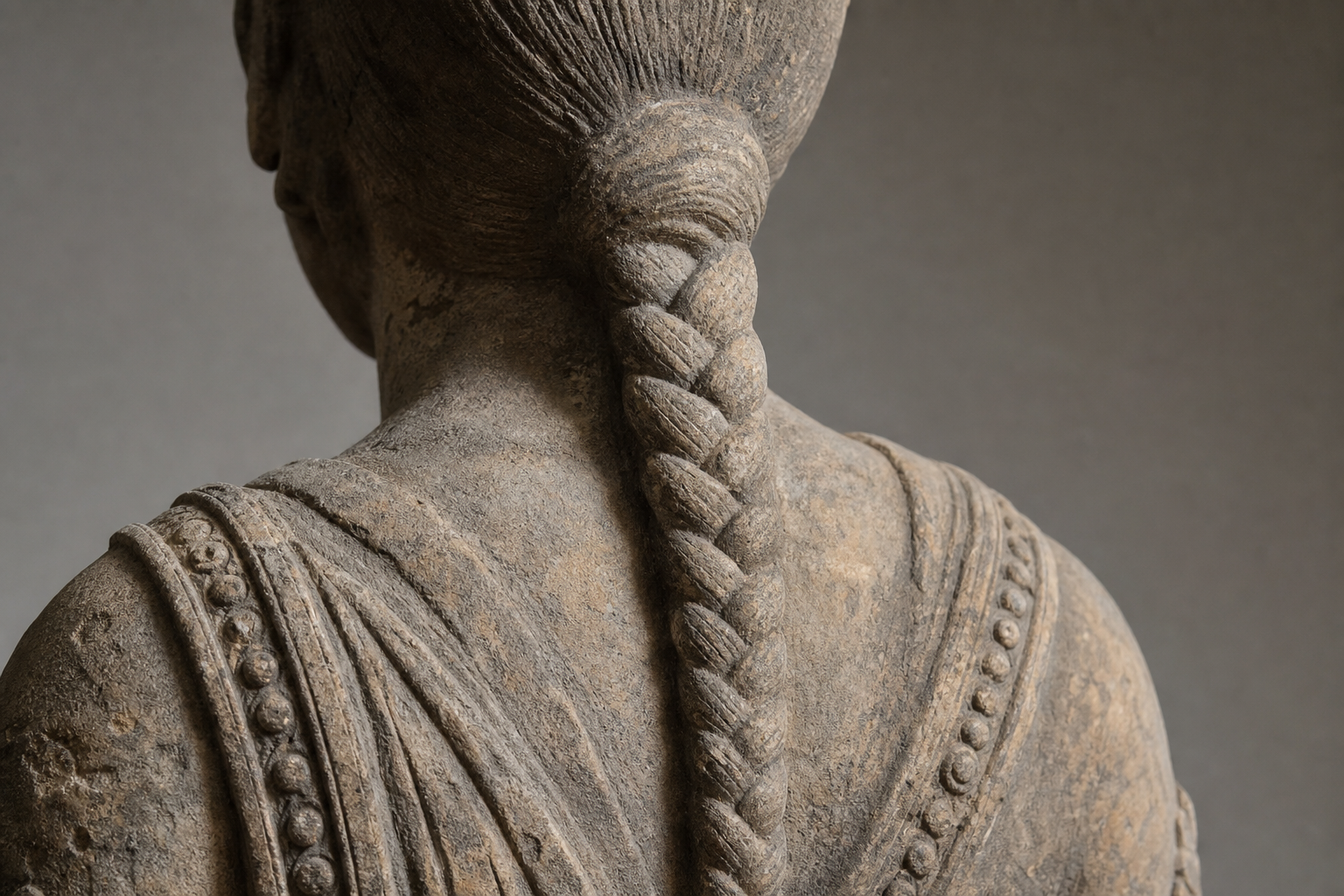
Ekaveni combines eka, meaning one, with veni, meaning a plait or braid. Its defining feature is therefore not simply long hair. It is many tresses organized into one continuous plait, ordinarily descending along the back. Sculptors may make that unity unmistakable through repeated segments, incised strands, ornamental bands, floral bindings, or a pendant at the end.
Use the following sequence when the figure is sufficiently visible:
- Begin at the scalp. Look for a central parting or another orderly arrangement directing the hair toward the back of the head.
- Follow the hair to the nape. A band, tie, or narrowed junction may mark the point where the separate locks become one plait.
- Trace one uninterrupted axis. The diagnostic form is a single braid, not two plaits, a cluster of loose curls, or a mass of hair that merely happens to fall behind the body.
- Inspect the surface. Regular chevrons, bead-like divisions, cross-bands, or rope-like striations can indicate braided construction even when individual strands are not shown.
- Look for a terminal ornament. South Indian images may end the plait in a decorative tassel often called a kunjalam. Its survival can settle the identification when the middle of the braid is worn.
- Check how the line serves the whole composition. In a standing image, the braid may counterbalance the curve of the hip or provide a calm vertical line behind an otherwise mobile pose.
No single cue is compulsory in every sculpture. A front-facing relief may conceal most of the braid. Erosion may remove the terminal ornament. Granite can preserve only the silhouette, while a more workable stone retains minute strand patterns. When preservation is poor, seek at least two independent clues, such as a nape tie plus a segmented vertical form, before labeling the hairstyle.
The terminal tassel is especially useful, but it is not the definition. A plain, uninterrupted plait can still be an ekaveni, and a pendant attached to another coiffure does not turn that coiffure into one. Identify the structure first and its decoration second.
Read the braid as supporting evidence, not a name tag
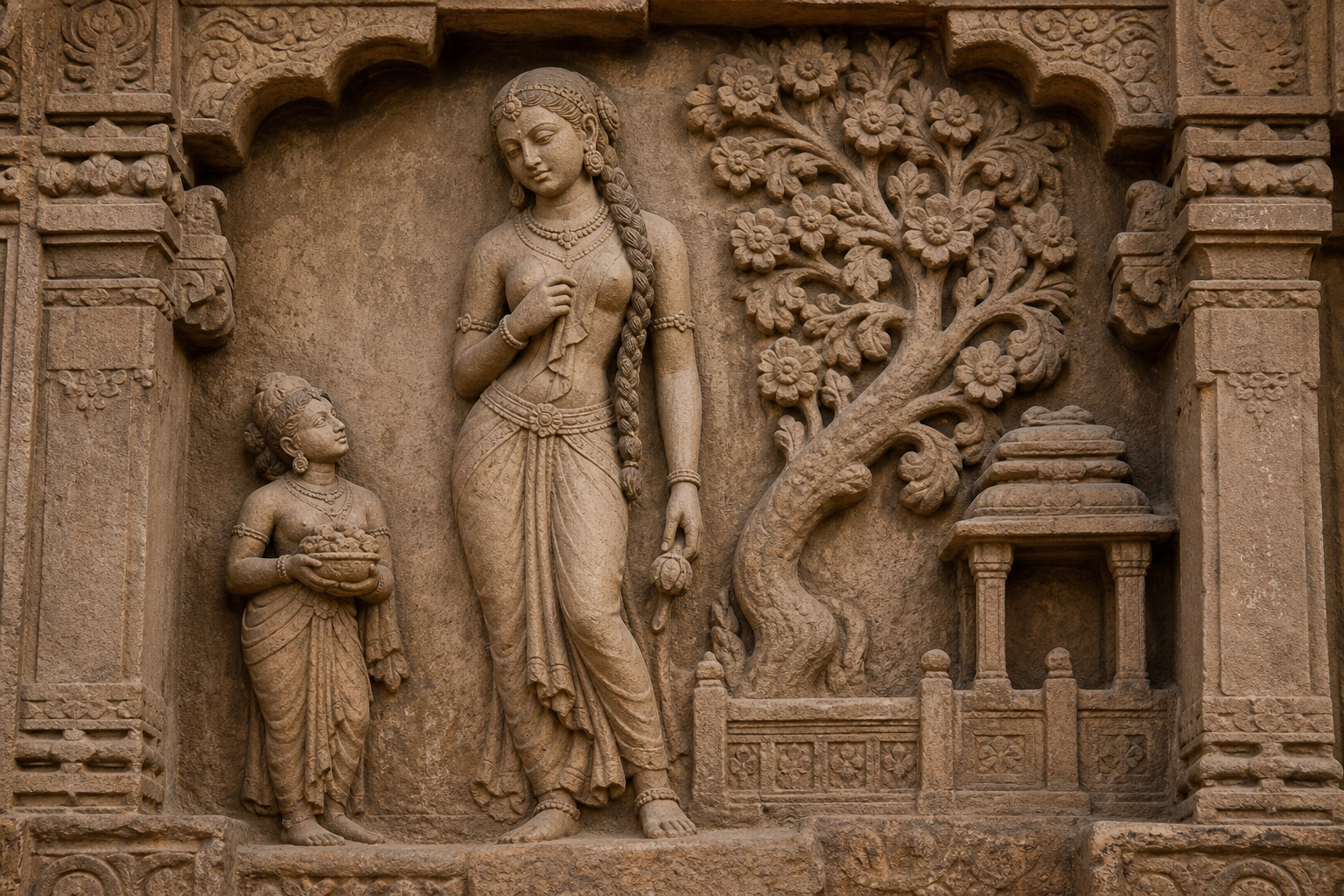
Hair in sacred art can communicate age, disposition, social condition, vow, and mode of divine presence. The ekaveni commonly supports a reading of poised, youthful, and auspicious femininity. Its controlled form can suggest modesty, decorum, serenity, and the disciplined gathering of personal energy. These associations make it well suited to divine consorts and idealized women inhabiting sacred space.
That does not make the braid an exclusive emblem of one deity. It appears with Parvati or Uma in some Somaskanda ensembles, with Bhudevi beside Vishnu, and with yakshi-like attendants on pillars and doorways. Jain representations of Ambika and other yakshi figures can also employ braided coiffures associated with protective grace and abundance. Early Buddhist and other pan-Indic relief traditions likewise include women and yakshi figures with long braided or massed hair.
If you find a braid but lack an inscription, attribute, or narrative setting, stop at what the hair securely establishes. You may describe an auspicious feminine figure wearing an ekaveni. You should not identify her as Parvati, Bhudevi, Ambika, or a particular attendant solely because of the braid. Confirm identity through the ensemble: hand attributes, vehicle, posture, companions, architectural position, and local temple tradition.
The same restraint applies to life stage. In many Indian communities, a long, orderly braid historically carried associations with maidenly decorum, self-command, and familial propriety. Practices involving veni-dana and hair-parting also connected coiffure with marriage and other transitions. Yet customs varied across communities and periods. An ekaveni can contribute to a reading of youth or auspicious womanhood; it cannot prove the marital status of the represented person by itself.
Classical image-making and performance traditions provide the broader grammar. The Vishnudharmottara Purana’s Khilakanda III, the Manasara, the Shilparatna, the Natyashastra, and later abhinaya traditions treat bodily form, ornament, and hair as meaningful components of representation. Their conventions were never applied identically in every workshop. Regional shilpa lineages, patrons, materials, and devotional priorities shaped how the grammar appeared in practice.
A deeper contemplative reading begins with the act of braiding itself. Separate strands are gathered into one ordered line. That visible movement from multiplicity toward unity makes the ekaveni an apt image of ekagrata, or one-pointed attention. Its position along the body’s vertical axis can also invite comparison with contained vitality, ojas, and the centering of prana through the sushumna nadi.
Treat that yogic reading as a meaningful interpretation of the form, not as an automatic label attached to every braided figure. A braid alone does not demonstrate that a sculptor intended to diagram the subtle body. The stronger claim is aesthetic and contemplative: the unified line gives the eye a path to follow, and that visual order can tutor the viewer in composure and concentration.
The form also belongs to a wider Dharmic vocabulary. Braided hair in Buddhist and Jain art can convey fertility, generosity, fullness, or protective presence without becoming specifically Hindu. Sikh reverence for kesh expresses the dignity of uncut hair and the discipline of a vow in a distinct religious setting; it should not be treated as a direct key for identifying an ancient sculpture. The shared principle is that hair can bear ethical and sacred meaning, while the exact meaning depends on its tradition and context.
Distinguish ekaveni from neighboring sacred coiffures
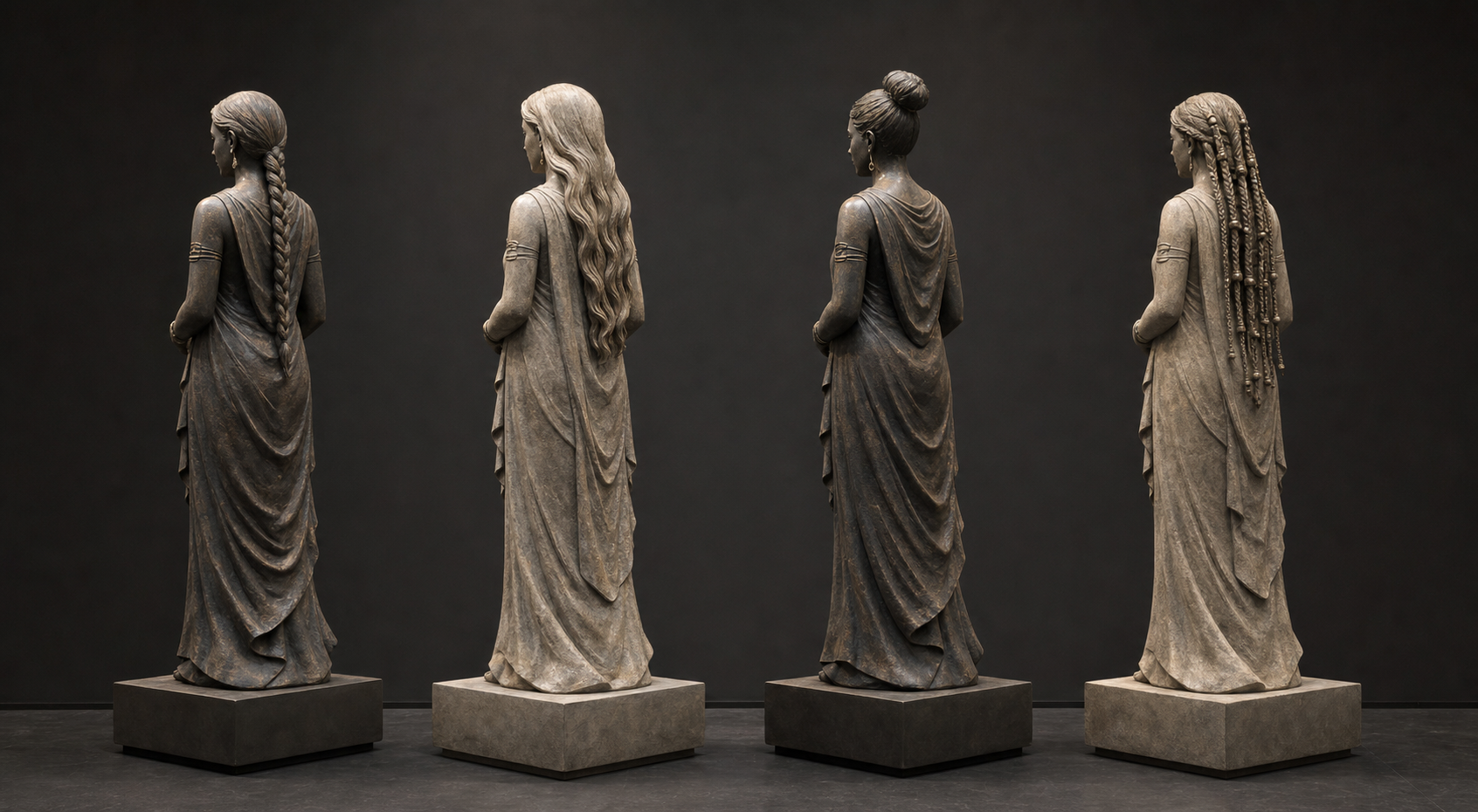
Misidentification usually happens when every elaborate arrangement of hair is treated as a braid. Before interpreting symbolism, compare the structure you see with the main alternatives:
| Hair form | What to look for | Primary iconographic direction | Best identification check |
|---|---|---|---|
| Ekaveni | One descending plait, often segmented, tied, or finished with a tassel | Grace, auspicious femininity, decorum, discipline, or concentrated attention | Trace a continuous braided line from the nape toward its terminal |
| Jata-mukuta | Matted locks gathered into a high, dense arrangement | Tapas, ascetic force, and identities such as Shiva | Look for piled or radiating locks rather than one pendant braid |
| Kirita-mukuta or karanda-mukuta | A jeweled, tiered, or crown-like structure rising above the head | Royal and divine status | Identify the elevated crown silhouette and ornamental tiers |
| Andal Kondai | A distinctive side bun or offset knot | Andal’s identity and bridal mysticism | Locate the lateral bun; do not mistake its trailing ornament for a central plait |
| Loose tresses | Unbound, spreading, or irregular locks without braided segmentation | Wildness, liminality, intensity, or another departure from composed auspiciousness | Check whether the hair remains separate rather than converging into one ordered braid |
The distinction between ekaveni and jata-mukuta is particularly important. Both organize hair rather than leaving it untouched, but they organize it in opposite visual directions. The ekaveni descends as a measured line and commonly supports serene femininity. The jata-mukuta rises as an ascetic mass and signals tapas. Calling both merely long hair erases one of the sculptor’s clearest contrasts.
Andal’s side bun requires similar care. The Andal Kondai is not a regional version of the single braid. Its lateral placement is bound to the poet-saint’s particular iconography and bridal devotion. When identification is uncertain, ask where the main volume sits: an ekaveni draws the eye downward along the back, while the Kondai announces itself at the side of the head.
Let material and region change how you look
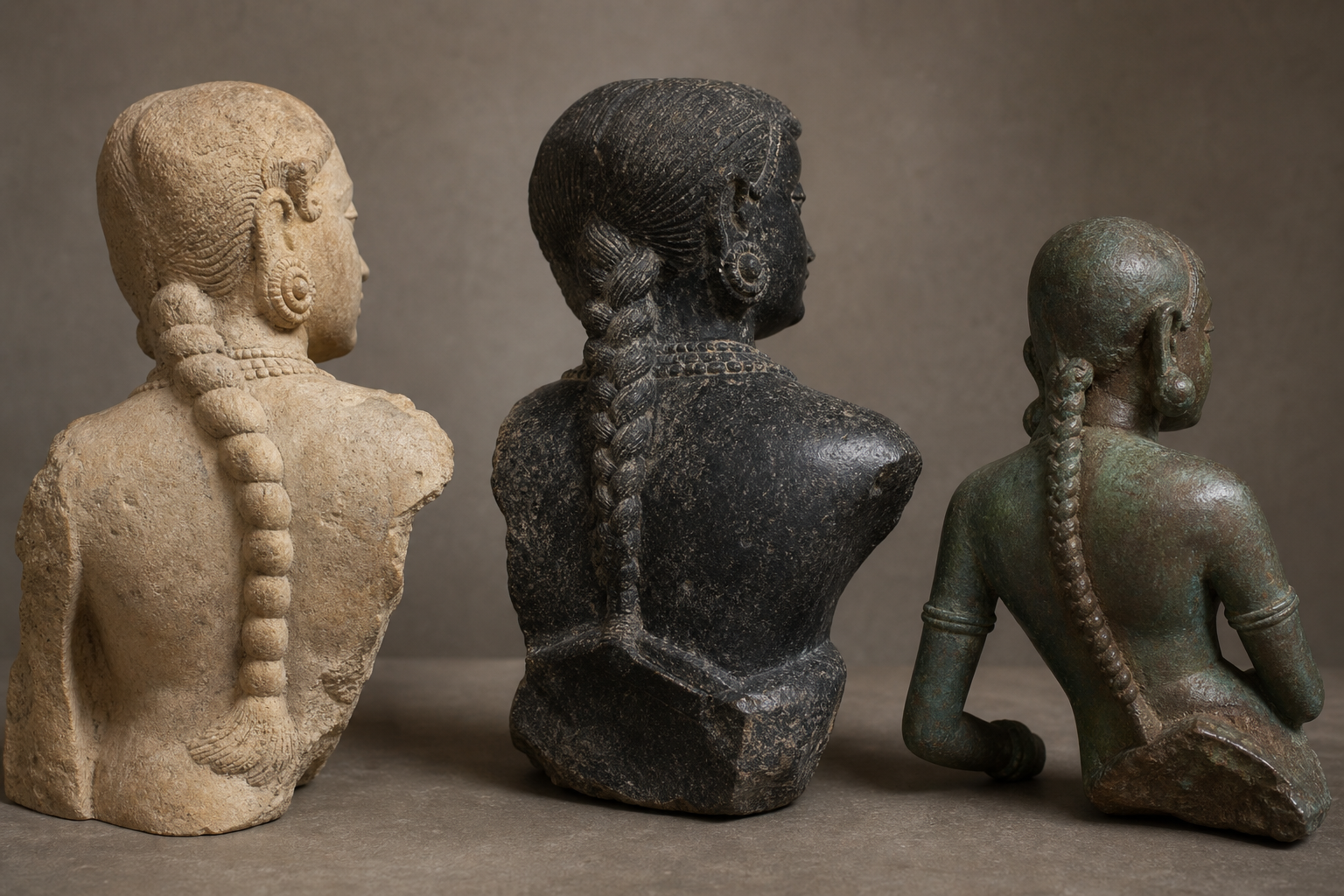
The ekaveni survives across periods and media, but it does not look identical in all of them. You should adjust your expectations to the material rather than treating fine strand work as a universal requirement.
In Tamil lost-wax bronzes, the artisan could model small ridges, ties, and surface incisions directly in wax before casting. Polishing then allowed those raised details to catch moving light. Chola-period images from roughly the tenth through thirteenth centuries often integrate the braid into the body’s stance: the plait curves gently with an Uma or consort figure and may finish in a tassel that answers the rhythms of the girdle, armlets, and anklets.
When viewing a bronze, do not examine the braid as an isolated accessory. Move your eye from the shoulder to the hip, then from the nape to the braid’s end. The relationship between those lines shows how the coiffure stabilizes or answers the figure’s bodily sway. If the display permits a side or rear view, it may reveal more than the frontal view.
Hoysala carving at Belur and Halebidu takes advantage of fine-grained, workable stone to produce deeply cut, jewel-like plaits. Repeated sections, crisp grooves, and elaborate terminals may remain legible even within heavily ornamented compositions. Here the challenge is not finding detail but deciding which detail belongs to the hair. Begin at the scalp and trace continuously downward instead of starting from an attractive pendant near the waist.
Tamil granite ateliers often depend more on outline, mass, and selective drilling. A granite braid may appear schematic beside the intricate work of a Hoysala image. That economy is not evidence that the hair lacked meaning. Under changing temple light, a firm silhouette and a few drilled recesses can make the single descending form remarkably clear.
Earlier reliefs at Bharhut and Sanchi show that long plaits and related hair arrangements already formed part of a broad visual language associated with women and yakshi figures. Gupta and post-Gupta idioms tended toward a more streamlined silhouette, while Pallava, Chalukya, Chola, and Hoysala workshops developed different degrees of strand articulation and ornament. Eastern Indian Pala-Sena images of Ambika and yakshi figures provide another setting in which the braid can contribute to ideas of fecundity and protection.
This range creates two practical limits. First, do not date an image from the braid alone; the basic form persisted too widely and too long. Second, do not assume that the most ornate example is the most symbolically important. Material, available tools, scale, visibility, and workshop preference all affect the amount of detail a sculptor can supply.
Local iconography remains decisive. One temple tradition may favor a braid for a youthful consort, another a crown for the same goddess, and another a different arrangement altogether. Loose tresses may be chosen for a fierce or liminal form, while a bun can identify a poet-saint. Variation does not make the visual language meaningless; it tells you to interpret the hairstyle as one element within a locally composed image.
Key takeaways for your next temple or museum visit
- An ekaveni is one continuous plait, not simply any long or decorated hair.
- The strongest physical clues are convergence at the nape, regular braided segmentation, a continuous descending axis, and sometimes a kunjalam or other terminal ornament.
- The form commonly supports readings of grace, auspicious femininity, decorum, discipline, and serenity, but it does not identify a deity on its own.
- Use attributes, companions, posture, architectural placement, and local tradition to distinguish Parvati, Bhudevi, Ambika, a yakshi, an attendant, or a donor.
- Keep formal identification separate from contemplative interpretation. The movement from many strands to one can evoke ekagrata without proving that the image is a literal diagram of sushumna nadi.
- Expect bronze, soapstone, and granite to express the same basic form differently. Judge the braid by construction and silhouette, not by the quantity of surviving detail.
- Record uncertainty honestly. Single braid is a sound observation; therefore unmarried goddess or therefore Parvati is usually an unsupported leap.
A useful field note needs only five entries: the figure’s setting, visible attributes, hair arrangement at the scalp, path of the braid, and form of its terminal. Photograph the front and, where access rules permit, the side or back. Never touch the image to inspect a worn detail. Add the symbolic reading only after recording what is physically present.
On your next encounter, let your eye follow the sculptor’s sequence: parting, nape, plait, terminal, posture. That short discipline will help you see the ekaveni as it was meant to work – not as an isolated ornament, but as a quiet line joining bodily beauty, social meaning, sacred character, and the devotee’s own movement toward collected attention.