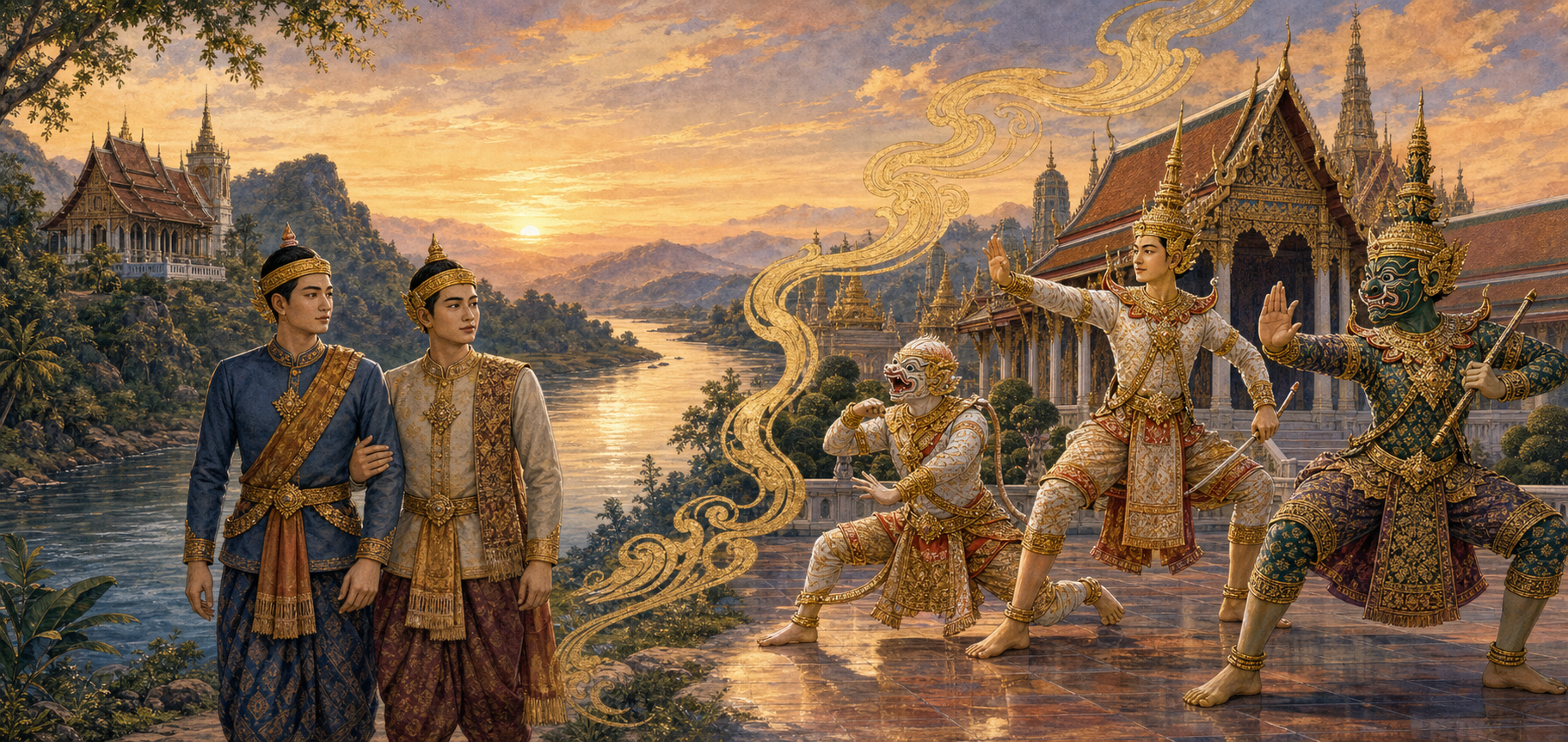
The Lao Phra Lak Phra Lam and the Thai Ramakien share the familiar architecture of the Rama story, but they do not simply relocate an Indian epic. Each tradition makes the narrative answer local questions about moral authority, loyalty, sacred geography, political order, and communal identity.
Reading them together shows how a tradition can retain recognizable characters and ethical problems while acquiring different religious emphases, artistic forms, and historical purposes. Their differences are not signs of a broken lineage; they reveal how the Ramayana became meaningful in two neighboring cultural worlds.
A shared plot becomes two cultural interpretations
According to the supplied DharmaRenaissance Blog account, both traditions preserve the broad narrative pattern associated with the wider Rama Katha: a righteous prince loses his kingdom, the heroine is abducted, loyal companions help find her, war follows, and order is eventually restored. The principal figures remain identifiable even as their names and characterization change. Rama appears as Phra Ram or Phra Lam, Lakshmana as Phra Lak, Ravana as the Thai Thotsakan or Lao Raphanasuan, while Sita and Hanuman retain central places.
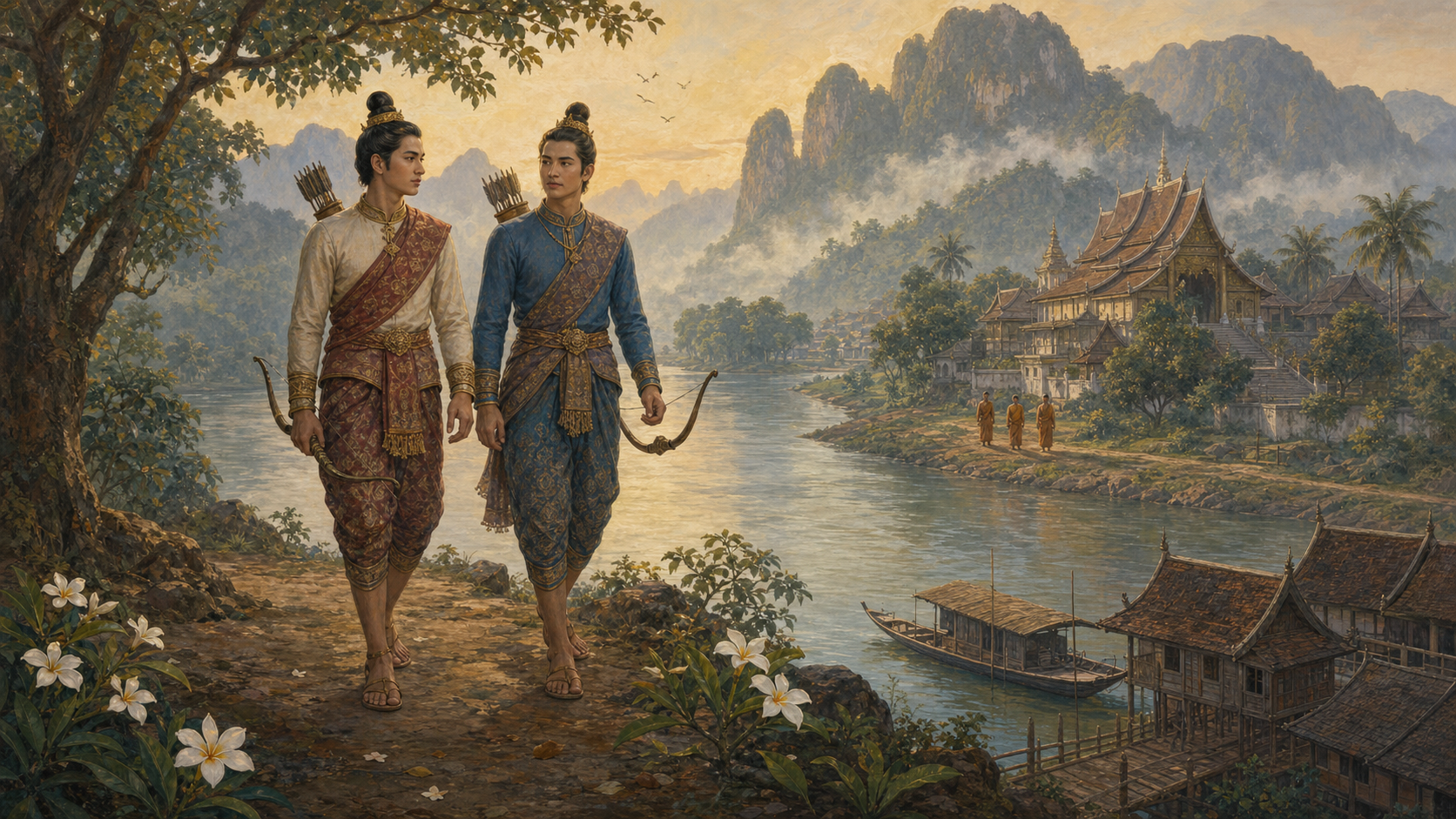
The more revealing comparison begins after these similarities are acknowledged. The Lao title places Phra Lak before Phra Lam, directing attention toward the brother who chooses companionship, service, and shared hardship. The source interprets this ordering as consistent with Lao admiration for fraternal devotion, humility, and relational duty. The Thai title, commonly understood as the glory of Rama, instead corresponds to a tradition closely connected with royal patronage and the public symbolism of righteous kingship.
The same inherited conflict therefore supports different centers of gravity. In Laos, the relationship between brothers becomes especially conspicuous. In Thailand, Rama’s role within a vision of kingship, cosmic balance, and restored order is more institutionally prominent. Neither emphasis excludes the other; each selects particular possibilities already present in the shared story.
Buddhist ethics reshape rather than replace the inheritance
Both versions developed within Theravada Buddhist societies, but the source describes different configurations of Buddhist and Hindu ideas. Phra Lak Phra Lam is often approached as a Jataka-like account associated with a previous birth of the Buddha. Within that frame, the ordeals of the characters can illustrate karma, patience, generosity, restraint, and the sustained cultivation required on the path toward awakening.
The Ramakien, by contrast, reportedly preserves a more visible relationship with Hindu cosmology while operating inside a Theravada Buddhist kingdom. Phra Ram is associated with Phra Narai, the Thai form of Vishnu or Narayana, yet the narrative also expresses Buddhist-inflected ideals of merit, ethical discipline, and righteous government. The source presents this combination as characteristic of a setting in which Brahmanical ritual, Buddhist kingship, and local sacred traditions could function together.
| Comparative dimension | Phra Lak Phra Lam | Ramakien |
|---|---|---|
| Religious framing reported by the source | Strongly Buddhist and often read in a Jataka-like mode | Theravada Buddhist ethics combined with a clearer Hindu cosmological connection |
| Especially visible moral emphasis | Fraternal loyalty, humility, patience, and karmic discipline | Righteous rule, merit, disciplined power, and cosmic order |
| Distinctive character signal | Phra Lak precedes Phra Lam in the title | Phra Ram is associated with Phra Narai |
This comparison cautions against treating religious labels as sealed compartments. In both cases, the Ramayana inheritance becomes part of a Buddhist moral environment without losing every older cosmological association. Adaptation works through selection and reinterpretation, not necessarily through total replacement.
Geography and political memory give the epic a local address
Localization involves more than translating names. The source reports that the Lao narrative incorporates the Mekong, regional place-memory, Naga traditions, local origin accounts, and Lao cosmology. The story consequently operates as a map of belonging: inherited characters move through a world that audiences can connect with their own landscape and collective memory.
Thailand’s version is localized through a different historical relationship. The account notes that earlier Thai texts existed during the Ayutthaya period, but that many literary works were lost when Ayutthaya was destroyed in 1767. The version most widely recognized today was compiled and shaped under King Rama I in the late eighteenth century, with further adaptation for performance under Rama II.
In that context, the Ramakien did more than preserve an admired tale. It reportedly participated in reconstructing cultural continuity and royal order in the Bangkok era. Its political importance emerged not because it offered a literal chronicle, but because the restoration of harmony within the narrative could speak to a kingdom rebuilding institutions and public memory after rupture.
The Lao and Thai cases thus demonstrate two ways an epic can become local. One embeds inherited action in a recognizable sacred landscape; the other also becomes an instrument for articulating continuity, kingship, and recovery. Both approaches turn a transregional story into a framework for remembering where a community belongs and how legitimate order should be imagined.
Performance keeps interpretation open and communal
Neither tradition can be understood adequately as a manuscript alone. The source describes Phra Lak Phra Lam as surviving through monasteries, recitation, sermons, song, dance, temple culture, and court performance. Because manuscripts in mainland Southeast Asia were vulnerable to climate, conflict, and physical loss, these overlapping channels were not merely decorative additions. They helped carry the narrative when any single medium could fail.
In Thailand, the Ramakien became especially visible through royal and temple art. The mural galleries at Wat Phra Kaew in Bangkok’s Grand Palace complex place the story within a public setting associated with sacred and royal authority. The account interprets these murals as more than ornament: they communicate ideals of order, courage, loyalty, beauty, and controlled power through an extensive visual narrative.
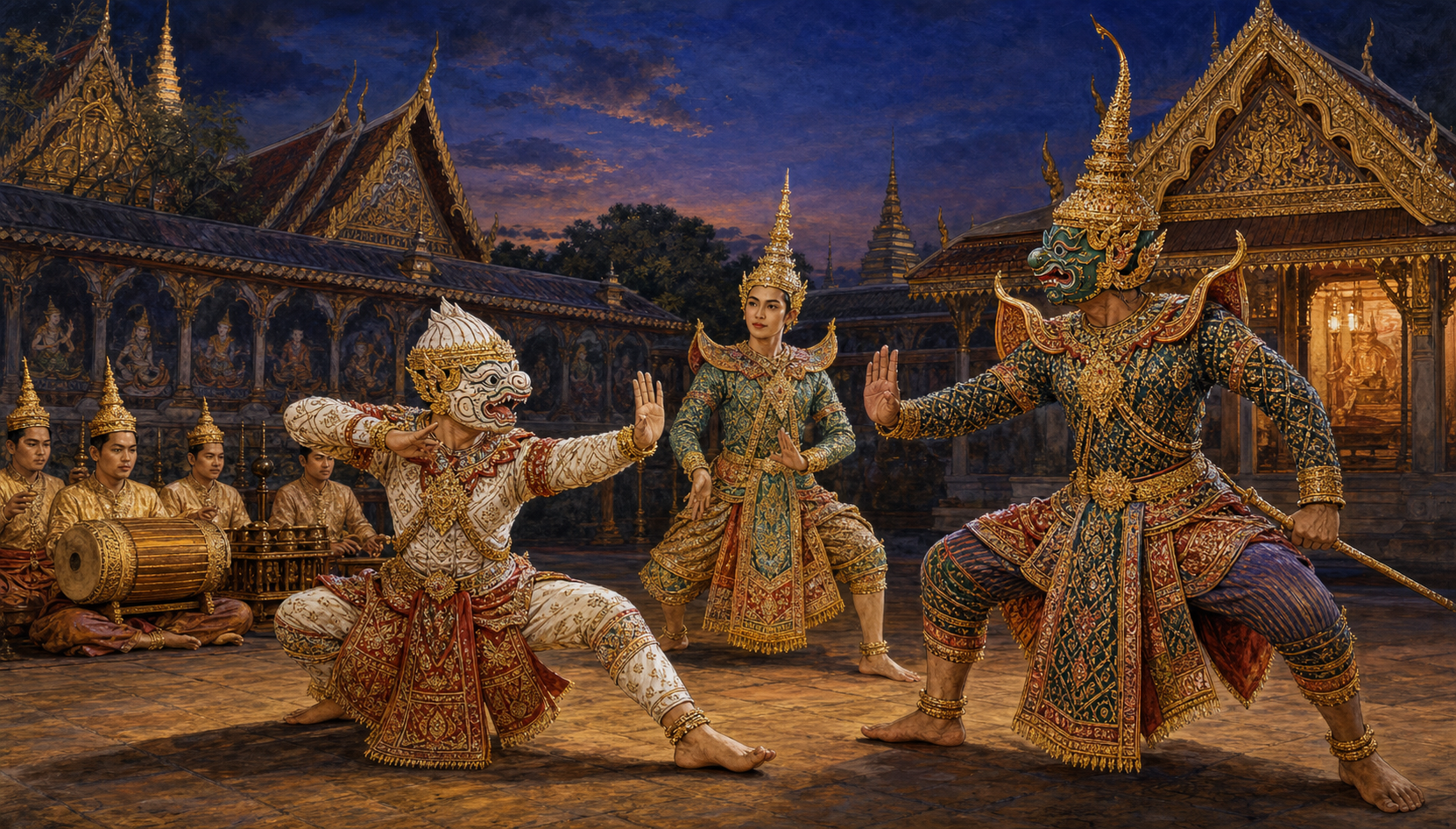
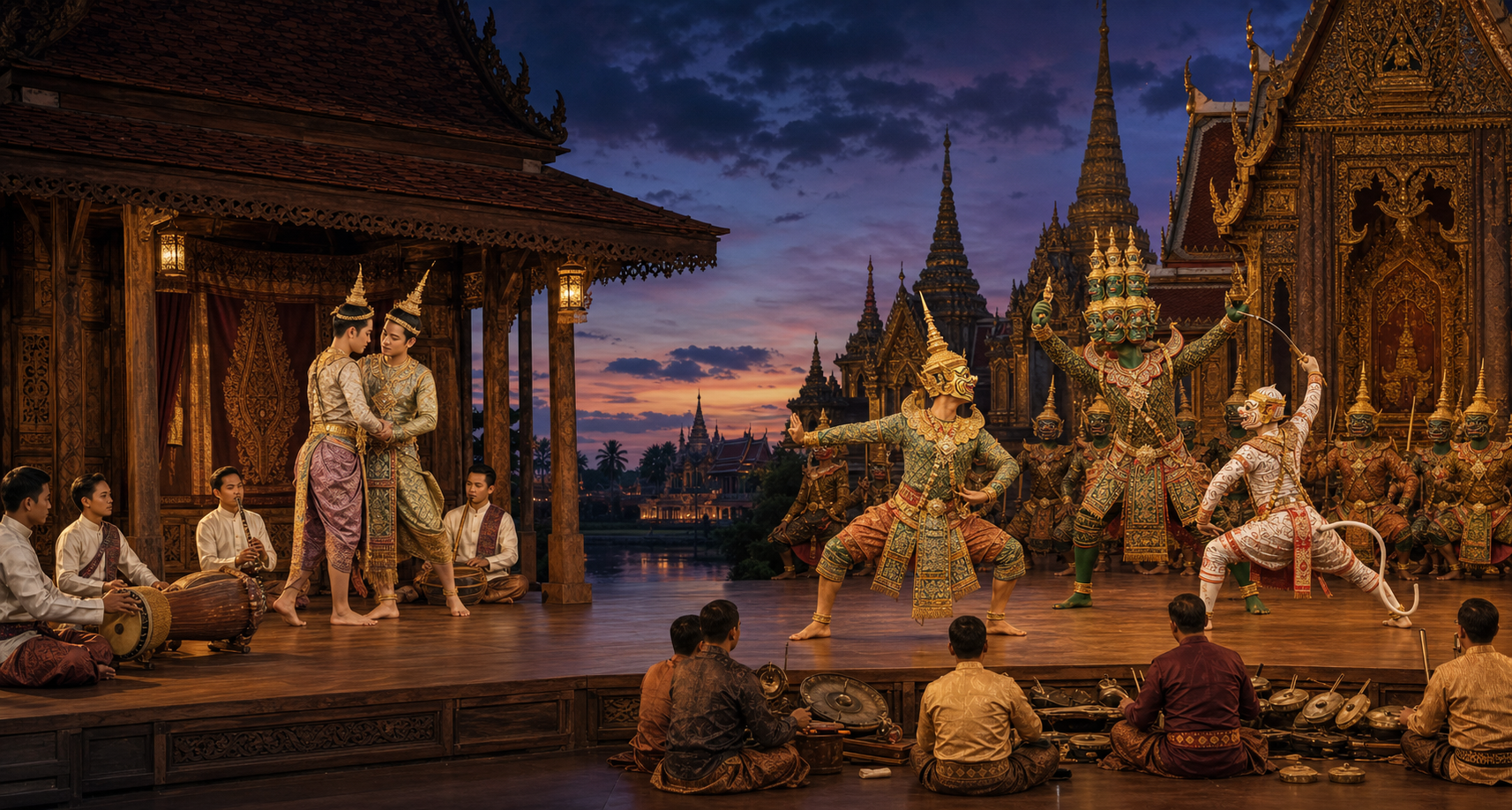
Thai khon masked dance-drama adds another interpretive layer through costume, gesture, music, stylized movement, and narration. The source highlights the enlarged theatrical personality of Hanuman, who appears not only as warrior and devotee but also as witty, charismatic, and at times romantic. Performance can therefore alter the balance of a story without abandoning it, allowing a supporting figure to acquire new emotional and dramatic importance.
These forms also change the audience’s role. A written epic is encountered through reading or recitation; a mural invites movement through a visual sequence; dance turns loyalty, conflict, and restraint into disciplined bodies and shared spectacle. The medium becomes part of the interpretation.
Key takeaways
- The Lao and Thai traditions retain a recognizable Rama narrative while assigning different weight to brotherhood, kingship, karma, cosmology, and performance.
- Phra Lak Phra Lam is presented through a strongly Buddhist, Jataka-like moral frame and is closely connected with Lao geography and place-memory.
- The Ramakien combines Theravada ethical ideas with Hindu cosmological associations and acquired a major role in Thai royal and cultural reconstruction.
- Monasteries, recitation, murals, dance, temple settings, and court patronage are not secondary illustrations; they are among the means by which the traditions were preserved and reinterpreted.
- The comparison shows that continuity in a dharmic narrative can rest on shared ethical questions rather than identical wording, theology, or characterization.
Future study of these traditions can move beyond asking which version is closest to an assumed original and examine how each generation uses narrative, landscape, and performance to reconsider the obligations of kinship and power.